Healthy breakfast pancakes
At Pancakes World, to build a healthier pancake breakfast, improve the whole plate rather than hiding one “healthy” ingredient in the batter. Start with a complete tested whole-grain or partly whole-grain pancake recipe, keep its yield and portion visible, then add fruit, plain yogurt, nuts or seeds as appropriate instead of automatically stacking butter, syrup and sweetened toppings. Compare packaged ingredients by equal serving sizes and check dietary fiber, added sugars, saturated fat and sodium. Add a protein or vegetable side when it helps the meal. Do not make untested flour or liquid substitutions, reuse nutrition numbers after changes, or promise that one pancake formula is healthy for every person.
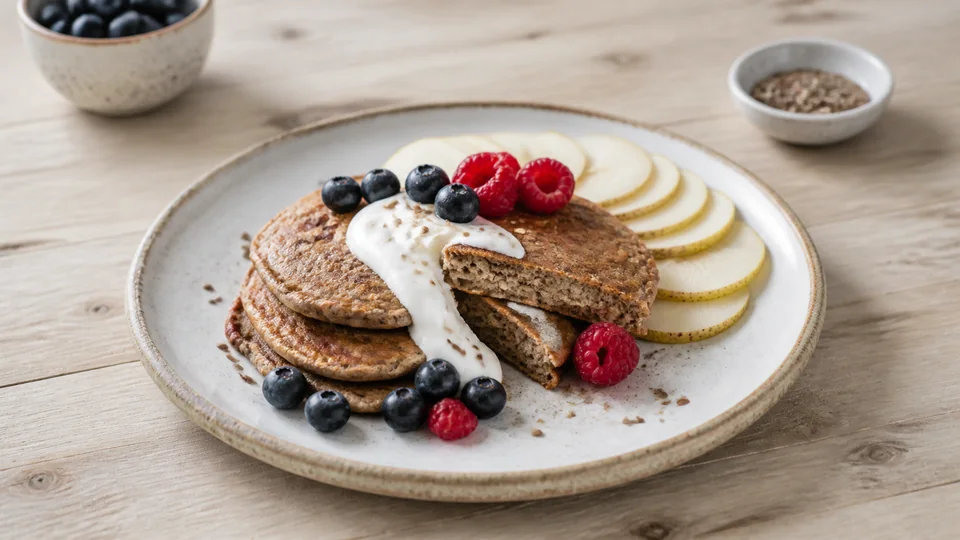
“Healthy” has both an everyday meaning and a regulated use on US food packages. Neither is a shortcut for judging a mixed breakfast. This guide provides decisions and source-backed examples, not a new tested recipe or medical plan. Browse the breakfast hub for other morning formats, or return to Pancake World for the broader collection.
For broader context, continue with Healthy Pancake Guides.
Judge the breakfast in five layers
A pancake meal has more moving parts than the pancake. Evaluate each layer:
- Batter: grain, liquid, egg or binder, fat, sweetener, leavening and salt.
- Portion: pancake diameter, number served and the tested recipe’s yield.
- Topping: fruit, yogurt, nuts, seeds, butter, syrup or another sauce.
- Side: eggs, dairy, fruit, vegetables or a protein food.
- Drink: water, coffee, tea, milk, juice or a sweetened beverage.
A whole-wheat pancake covered with a large amount of sweet syrup is a different meal from the same pancake with fruit and plain yogurt. A refined-flour pancake can still appear in a varied eating pattern. The point is not to sort breakfasts into perfect and forbidden categories; it is to make each tradeoff visible.
Before changing a recipe, write the goal in practical language. Are you trying to include more whole grain, reduce added sugar, lower sodium, add fruit, create a more satisfying plate or meet a clinician-set need? Different goals require different choices. “Make it healthy” is too vague to guide a safe substitution.
What the FDA “healthy” claim means
The FDA updated the criteria for the voluntary “healthy” nutrient-content claim used on regulated food packages. Under the updated framework, a qualifying food must contain a required amount from a recommended food group or subgroup and meet limits for added sugars, saturated fat and sodium. Exact criteria vary for individual foods, mixed products, main dishes and meals.
That rule does not automatically declare a homemade pancake breakfast healthy. A package may use the claim only when it meets the applicable regulatory criteria. A recipe blog using “healthy” in a title is not the same thing as a manufacturer demonstrating compliance for a labeled product.
For the home cook, the useful principle is broader: look for meaningful food-group ingredients and keep nutrients to limit in view. Do not focus on a single number such as calories, protein or fiber while ignoring everything else.
If a boxed pancake mix carries a front claim, turn the package around. The claim applies to the product under its labeling conditions. Preparation with milk, eggs, oil, butter and toppings changes the finished meal. The as-prepared column, when provided, must match the ingredients you actually use.
Start with a complete whole-grain recipe
USDA MyPlate encourages making at least half of grain choices whole grains and suggests whole grains at breakfast. That does not mean any pancake recipe can accept a one-for-one whole-wheat substitution without changes in hydration, texture or spread.
Illinois Extension provides a complete whole-wheat pancake recipe with whole-wheat flour, baking powder, a small amount of salt and brown sugar, egg, low-fat buttermilk and oil. Its method mixes dry and wet ingredients separately, combines them only until moistened, portions batter onto a lightly oiled griddle and defines a yield.
Utah State University Extension provides another complete format using whole-wheat flour, oats, milk, eggs, oil, measured honey and optional pecans. The differences demonstrate why “whole-grain pancakes” is a family of formulas, not one substitution rule.
Choose one intact recipe whose ingredients fit the household. Preserve its flour type, leavener, liquid, egg and batch yield on the first run. If you alter it later, record the change and do not reuse the source nutrition unless you recalculate from exact products and finished yield.
Whole grain is one attribute. It does not cancel added sugar, sodium, saturated fat, allergens or portion size. Read the entire recipe.
Read grain labels precisely
Color is not a reliable whole-grain test. Molasses, caramel color or bran can make a product look brown without establishing that its primary grain is whole. Read the ingredient statement.
For flour, identify whether the label says whole wheat, white whole wheat, whole oat or another whole grain. “Wheat flour” alone may refer to refined flour. For a mix, see which ingredients appear first and whether the package supplies a whole-grain statement supported by its labeling.
Compare mixes on matched serving amounts. One mix may define a serving by grams of dry mix, another by number of prepared pancakes. FDA guidance says all panel values relate to the stated serving, so align the unit before comparing dietary fiber, added sugars or sodium.
Do not assume gluten-free means whole grain or healthy. A gluten-free mix may use refined starches, whole grains or a combination. People with celiac disease or wheat allergy need product-specific safety and cross-contact information, not a texture-based guess.
Control added sugars across batter and toppings
Added sugar can enter through dry mix, flavored yogurt, sweetened milk, syrup, jam, chocolate, granola and sweet drinks. Review the meal as a system.
Use this order:
- check Added Sugars in the mix or recipe ingredients;
- decide whether the batter needs additional sweetener;
- choose one main sweet topping;
- keep other toppings unsweetened where practical;
- compare the actual portion with the labeled serving.
Fruit contributes sweetness and other food components, but it is not chemically “sugar-free.” Honey and maple syrup remain added sugars in FDA nutrition guidance even though they are familiar single-ingredient foods. Replacing white sugar with honey does not eliminate added sugar.
Serve syrup in a small pitcher or spoon it onto the plate so each eater controls the amount. Fruit compote also needs a complete formula; some versions contain substantial added sugar. Fresh or unsweetened frozen fruit keeps composition easier to see.
A savory pancake can remove the expectation of syrup, but cheese, cured meat and packaged sauce may raise sodium or saturated fat. Every direction has tradeoffs.
Watch sodium in mix and leavening
Pancakes can contain sodium from baking powder, baking soda, salt, buttermilk, cheese, cured meat and packaged mix. Illinois Extension specifically notes sodium around pancake leavening and salt. Leavening is structural, so do not remove or reduce it randomly from an untested formula.
Instead, choose a complete recipe designed with its salt and leavener balance, compare mixes by matched serving, and avoid layering several salty sides. If one pancake serving is paired with sausage, cheese and salted butter, the full plate matters more than the mix alone.
FDA’s general guide describes 5 percent Daily Value or less per serving as low and 20 percent or more as high for a nutrient. Use that tool to compare equal servings, not as a guarantee about the total day. Multiply when eating more than one serving.
For a clinician-prescribed sodium target, use the individual plan. This article does not set a medical limit.
Consider saturated fat without eliminating all fat
Fat influences tenderness, browning, release from the griddle and flavor. Removing it without a tested replacement can make pancakes stick or turn rubbery. Choose a recipe whose fat source and amount are already defined.
Saturated fat can accumulate from butter in the batter, butter on the griddle, butter on the finished stack, whole-fat dairy, cream, coconut ingredients, cheese and meat sides. Count the plate rather than treating each addition as negligible.
Nuts, seeds and nut butters can add texture and a protein-food component, but measure them and check allergens. They also change total energy and may carry sodium or added sugar when flavored. A tablespoon of a labeled nut butter is different from an unmeasured layer between every pancake.
Use cooking oil or nonstick spray only as the complete recipe and equipment require. A visual sheen on the pan is not a standardized amount, so it cannot support precise nutrition claims.
Use fruit as an ingredient or topping with purpose
Fruit can appear three ways:
- mixed into the batter;
- cooked into a topping;
- served fresh beside or over the pancakes.
Each changes batter and plate differently. Berries folded into batter release moisture and may affect cooking. Mashed banana or applesauce changes both water and sugar, so it is not a universal one-for-one fat or egg replacement. A complete formula must account for it.
Fresh fruit is the easiest addition because it does not change batter chemistry. Wash it under clean running water, prepare it on a clean board and add it at service. Frozen fruit can be thawed and drained or cooked by a source method.
Avoid claiming that fruit makes a stack healthy regardless of everything else. It contributes a food-group component, but portion, syrup, batter and sides still matter.
For young children, cut round or firm fruit into age-appropriate shapes and follow current pediatric feeding guidance. This article does not provide child-specific choking instructions.
Add protein without turning the batter into an experiment
Egg, milk, yogurt and some whole-grain ingredients already contribute protein. Additional options include plain yogurt, cottage cheese, nuts, seeds, eggs, tofu, fish or lean meat as a side. USDA MyPlate places eggs, seafood, lean meats and poultry, nuts, seeds and soy products in the Protein Foods group.
The simplest route is to keep protein outside the batter. Serve a tested pancake with plain yogurt, an egg cooked by a complete method or a measured nut butter. This preserves batter structure and makes ingredients easy to identify.
Protein powder is not a neutral flour replacement. It can absorb water, change browning and create a dry or gummy crumb. Use only a recipe developed for the exact type and amount. Retain the package for ingredients, allergens, sweeteners and serving data.
Greek-style yogurt and cottage cheese also vary. Sweetened versions add sugar; flavored versions may use starches or gums; sodium differs. Read the exact label.
Protein does not guarantee fullness for every person or make a medical outcome certain. Present it as one component of a varied meal.
Topping decisions that preserve the pancake
Choose one primary topping system:
Fruit and plain yogurt
This combines fruit and dairy when the exact yogurt fits the eater. Keep granola, honey and syrup optional rather than automatic.
Nut or seed butter and fruit
Use a measured spread and fresh fruit. Check for added sugar, sodium and allergens. Provide a separate utensil to prevent cross-contact.
Warm unsweetened fruit
Heat fruit by a complete method and use spices for aroma. Do not label a sauce unsweetened if juice concentrate, syrup or sugar was added.
Small syrup portion with fruit
Syrup can fit when the amount is deliberate. Put it on the side and let fruit provide volume.
Savory vegetables and egg
Use a less-sweet pancake formula designed for savory service. Cook vegetables until excess water is managed, and cook the egg to the required endpoint.
Yogurt, seeds and spice
This adds creaminess and crunch without requiring syrup. Exact carbohydrate, protein and fat depend on the labeled ingredients.
Avoid a toppings bar with five sweet sauces, candy, whipped cream and sweetened fruit unless the event is intentionally dessert-like. Naming it breakfast does not change its composition.
Portion without optical tricks
The tested recipe’s yield is the starting point. If Illinois Extension defines a serving as two pancakes from its specific yield, that information stays with that formula and size. A restaurant-size pancake may equal several small source pancakes.
Use a measuring cup or scoop to keep batter portions consistent. Count pancakes only after diameter and batter volume are controlled. A tall stack of tiny pancakes can be the same total batter as two large ones; appearance does not change the amount.
Plate a first serving and keep additional pancakes warm by a safe method rather than overloading every plate. Let eaters decide whether they want more after the sides and toppings are visible.
When calculating a homemade recipe, add the exact ingredient nutrition, divide by the actual finished yield and include cooking fat and toppings separately. Do not publish estimates as laboratory results.
Build balanced breakfast plates
Here are four planning models, not recipes.
| Plate goal | Pancake choice | Add | Keep controlled |
|---|---|---|---|
| whole-grain breakfast | tested whole-wheat pancake | fruit and plain yogurt | syrup and butter |
| higher-protein plate | intact tested pancake | egg, cottage cheese or nut butter | powder substitutions |
| fruit-forward plate | modest pancake portion | generous fresh fruit | sweetened compote and juice |
| savory breakfast | recipe designed with low sweetness | vegetables and egg or tofu | cheese, cured meat and salty sauce |
Water, unsweetened coffee or tea can keep the drink simple. Milk may add a dairy component when appropriate. Juice is a beverage choice, not a required fruit serving at every breakfast, and its label or food data still matters.
People managing diabetes, kidney disease, food allergy, celiac disease or another condition need individualized choices. A broad plate model does not replace care.
Mix batter for tenderness
Whole-grain pancakes still depend on basic batter control. Follow the source method’s order. Mix dry ingredients evenly so leavener and salt are distributed. Combine wet ingredients separately. Add wet to dry and stop when the recipe indicates; Illinois Extension’s source describes a thick, slightly lumpy batter and warns through its method against unnecessary mixing.
Overmixing develops structure that can make pancakes tough. Undermixing can leave pockets of dry flour or leavener. The goal is the texture specified by the complete recipe, not a universal number of strokes.
Allow any rest only when the recipe provides for it. Oats and whole grains absorb liquid over time, so an improvised long rest can change spread. Do not thin later with an unmeasured splash and still claim the original yield or nutrition.
Preheat the griddle according to the recipe. Portion consistently. Turn when the source’s visual cues are met and the underside is set; avoid repeatedly flipping to chase color. Browning alone does not prove the center is done.
Food safety and make-ahead use
Pancake batter containing egg and dairy is perishable. Keep ingredients refrigerated until mixing and avoid leaving a bowl at room temperature through an extended brunch. Cook in manageable batches.
FDA egg guidance says egg dishes should reach 160°F and cooked egg dishes should reach 165°F when reheated. Pancakes are not classified here as egg dishes for a new numeric endpoint; follow the complete tested pancake method and ensure the center is cooked, not wet or raw.
Refrigerate perishable cooked food within two hours. Cool pancakes in a single layer or with airflow before stacking for storage so trapped steam does not create a wet mass. Label the date. Reheat by a source-supported method until hot, and do not reuse a source freezer promise for a modified formula.
Fresh dairy toppings must remain cold. Put out small bowls and replace them rather than leaving the full container on a warm table. Use separate utensils for nut toppings and other spreads.
Compare packaged mixes fairly
Use a small worksheet:
| Field | Mix A | Mix B |
|---|---|---|
| dry serving grams | ||
| prepared serving definition | ||
| dietary fiber | ||
| added sugars | ||
| saturated fat | ||
| sodium | ||
| first grain ingredient | ||
| required added ingredients | ||
| major allergens |
Normalize the serving before declaring a winner. Check whether the panel is dry mix or prepared product. If Mix A requires oil and whole milk while Mix B requires water, dry numbers alone do not describe the breakfast.
Do not infer that organic, natural, gluten-free, protein or multigrain means the product meets FDA’s updated healthy-claim criteria. Those terms address other attributes.
Plan ingredients before the shopping trip
A short shopping record prevents nutrition goals from disappearing once brands and package sizes change. List the tested recipe, expected number of eaters, required grain, liquid, egg or binder, cooking fat and topping plan. Mark ingredients that must be exact because they control structure. Put optional garnishes on a separate line.
At the store, photograph or record the serving mass, ingredient statement and relevant Nutrition Facts for the chosen mix, flour, yogurt, milk, nut butter and syrup. If the intended product is unavailable, do not silently substitute and preserve the old calculation. Choose whether to recalculate, select another complete recipe or delay the change.
Buy fruit in an amount the household can prepare and use. A very large variety is not necessary for one breakfast. One fresh fruit and one frozen backup often create more reliable use than five fragile choices. For frozen fruit, select unsweetened packages when that is the plan and inspect the ingredient list.
Keep allergy-safe items physically separated in the cart and kitchen when cross-contact matters. A special flour is not useful if it is scooped with the same utensil used in wheat flour or topped from a shared nut-butter jar.
Adapt service for a family without changing one batter repeatedly
Use one tested base recipe and let differences happen on the plate. One person can choose fruit and yogurt, another a measured syrup portion, and another a savory egg side. This is safer and easier to document than dividing the batter and improvising protein powder, mashed fruit, chocolate or extra liquid in several bowls.
Offer toppings in small amounts and refill them. Keep original labels accessible, especially for dairy, nuts, seeds and packaged sauces. Let children participate in washing fruit, setting the table or measuring cooled ingredients while an adult controls the hot griddle.
Do not pressure a child to accept a food because it has been labeled healthy. Present the components plainly and use age-appropriate feeding guidance from the child’s care team when there are growth, allergy, sensory or swallowing concerns.
Compare the two Extension recipe models
The Illinois whole-wheat formula is the simpler grain-first model: one whole-wheat flour, buttermilk, egg, a small measured sweetener and oil. The Utah State model adds oats and optional pecans to whole-wheat flour and uses milk, eggs, oil and honey. Neither is a universal upgrade of the other.
Choose the Illinois model when a straightforward whole-wheat texture and nut-free base are priorities, while still checking every product for cross-contact. Choose the Utah State model when oats and optional nuts fit the eaters and the different texture is wanted. Preserve each source’s quantities, yield and instructions. Do not merge half of one formula with half of the other and keep either nutrition result.
This comparison demonstrates evidence-led choice: two complete recipes can pursue similar goals through different structures. The correct decision depends on ingredients, allergens, texture and service—not on declaring a single winner.
Common mistakes
Swapping all-purpose flour for whole wheat without a tested method
Whole-grain flour changes absorption and structure. Select a complete whole-grain recipe first.
Calling honey or maple syrup “not added sugar”
FDA guidance treats sugars from syrups and honey as added sugars in the diet, with specific label presentation for single-ingredient products.
Adding protein powder and keeping the source nutrition
Both structure and nutrition changed. The original receipt no longer applies.
Ignoring baking powder sodium
Leavening can contribute meaningful sodium. Compare recipes or mixes; do not remove it blindly.
Using fruit as a health halo
Fruit is valuable, but it does not erase the rest of the plate. Keep sweet toppings and portion visible.
Assuming a package claim describes the prepared meal
Milk, eggs, oil, syrup and sides must be included in the final evaluation.
Publishing a universal “healthy pancake” formula
Needs vary. Offer transparent ingredients, portions and labels, and let qualified care guide medical restrictions.
A preparation checklist
Before cooking, confirm:
- the recipe is complete and tested;
- its grain choice matches the goal;
- ingredient substitutions are not improvised;
- the batch yield and scoop size are defined;
- packaged ingredients were compared at matched servings;
- added sugars, saturated fat, sodium and fiber were all reviewed;
- toppings and sides are included in the plan;
- allergen labels remain available;
- batter is mixed only as directed;
- perishable food will be refrigerated promptly;
- nutrition numbers will not be reused after changes.
Frequently asked questions
Can pancakes be part of a healthy breakfast?
Yes, depending on the recipe, portion, toppings, sides and individual needs. A complete whole-grain recipe with fruit and another food-group component is one practical direction, not a guarantee.
Is whole-wheat flour always a one-for-one replacement?
No. It absorbs water and affects structure differently. Use a recipe developed for whole-wheat flour or make controlled, documented tests rather than promising equal behavior.
Are banana pancakes automatically free of added sugar?
Not necessarily. The mix, yogurt, syrup or other ingredients may contain added sugars. Banana contributes naturally occurring sugar and also changes batter moisture.
What is a better topping than a large syrup pour?
Fresh fruit with plain yogurt, a measured nut or seed butter, or a small syrup portion served beside fruit are transparent options. “Better” still depends on allergies and individual goals.
How do I add protein?
Keep the tested batter intact and add an egg, plain yogurt, cottage cheese, tofu or measured nut butter as a side. Use protein powder only in a formula designed for it.
Does a “healthy” label mean the mix is best for me?
No. FDA’s voluntary claim shows that a product meets specific food-group and nutrient criteria. You still need to check serving size, ingredients, allergens and the prepared meal.
Can I meal-prep pancakes?
Use a recipe with make-ahead guidance, cool promptly, label and refrigerate or freeze as directed. Keep perishable toppings cold and do not invent a storage duration.
Should I calculate nutrition after substitutions?
Yes. Use exact brands, measured quantities and actual finished yield. The source recipe’s nutrition does not survive material changes automatically.
Final decision
Healthy breakfast pancakes are best treated as a design problem, not a magic recipe. Begin with a tested whole-grain or partly whole-grain formula, preserve its structure and yield, and build the plate with fruit, dairy, protein foods or vegetables according to the eater’s needs.
Check serving size, dietary fiber, added sugars, saturated fat and sodium across the entire meal. Keep syrup, butter and rich sides deliberate. Most importantly, use “healthy” as a transparent evidence question rather than a promotional promise.
Explore related Pancakes World guidance on American Pancakes, American Breakfast: Pancakes, Diner Plates and Brunch, and Maple Syrup.
Sources and editorial references
- U.S. Food and Drug Administration, “Use of the ‘Healthy’ Claim on Food Labeling”:
https://www.fda.gov/food/nutrition-food-labeling-and-critical-foods/use-term-healthy-food-labeling - U.S. Food and Drug Administration, “How to Understand and Use the Nutrition Facts Label”:
https://www.fda.gov/food/nutrition-facts-label/how-understand-and-use-nutrition-facts-label - USDA MyPlate, “Make Half Your Grains Whole Grains”:
https://www.myplate.gov/sites/default/files/2024-06/TipSheet-4-Make-Half-Your-Grains.pdf - USDA MyPlate, “Protein Foods Group”:
https://www.myplate.gov/web/web/eat-healthy/protein-foods - USDA MyPlate, “Vegetable Group”:
https://www.myplate.gov/web/web/eat-healthy/vegetables - Illinois Extension, “A Hot Breakfast to Start Your Day”:
https://extension.illinois.edu/blogs/simply-nutritious-quick-and-delicious/2016-02-22-hot-breakfast-start-your-day - Utah State University Extension, “Oatmeal Nut Pancakes”:
https://extension.usu.edu/createbetterhealth/kitchen/oatmeal-nut-pancakes - U.S. Food and Drug Administration, “What You Need to Know About Egg Safety”:
https://www.fda.gov/media/82227/download