Healthy Breakfast Options Indian
Direct verdict: Choose an Indian breakfast option by the morning constraint first: vegetable poha suits a quick warm bowl, idli with sambar suits a planned steamed meal, besan chilla suits a savoury pan-cooked option, and vegetable upma suits a one-pan semolina preparation. “Healthy” is not a property of the dish name. Compare the actual base, additions, cooking method, portion context, labels and the eater’s needs; no option is universally best. Pancake World keeps this route focused on choose among indian breakfast formats by time, portability, and preparation constraints.
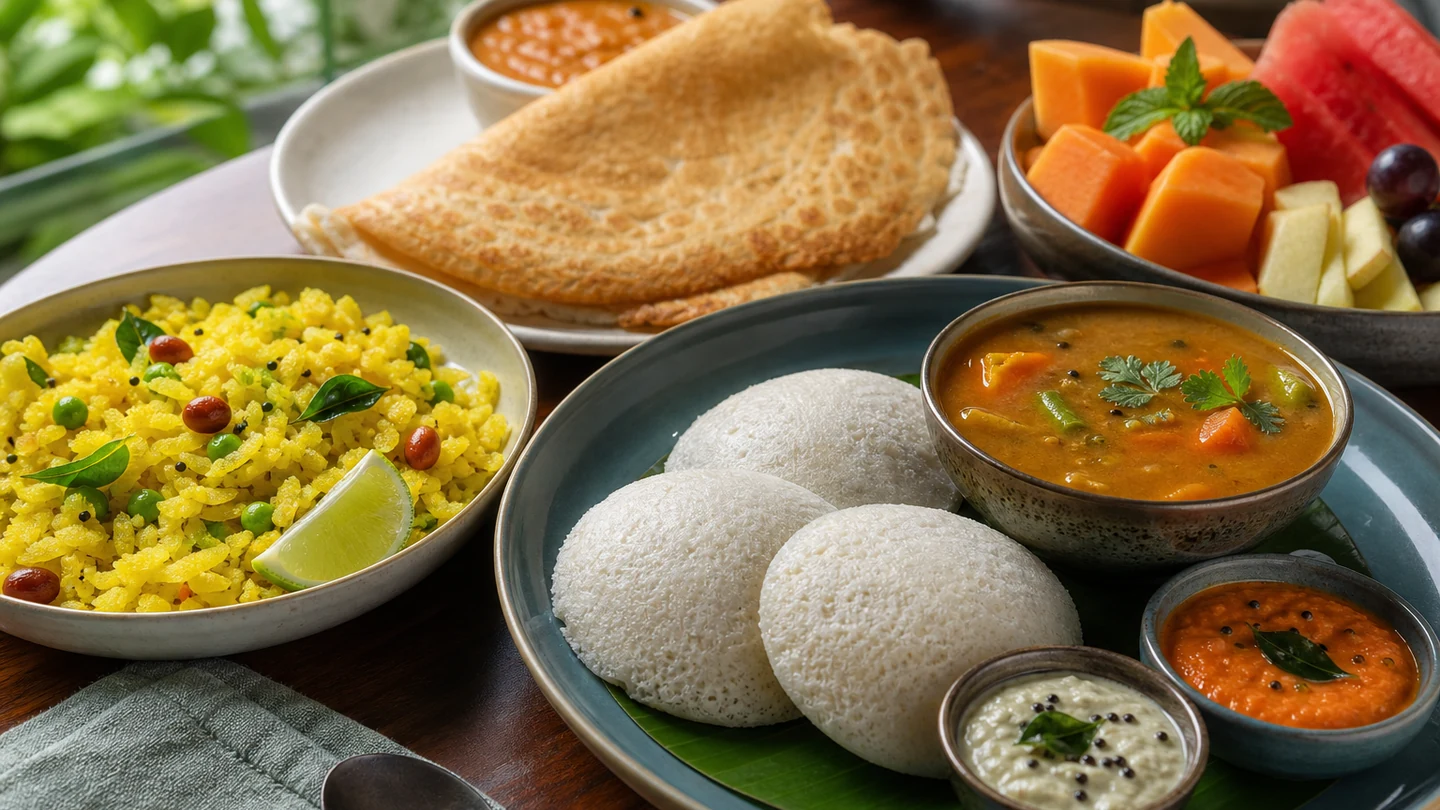
Use a bounded comparison
Indian breakfast is not one fixed menu. A named dish can change substantially with recipe, vegetables, pulses, dairy, eggs, nuts, added fat, sugar and accompaniments. This guide compares formats for time, portability and preparation constraints rather than making medical, weight-loss or universal nutrition claims. Food Safety and Standards Authority of India public material provides a broad food-choice context; it does not prescribe an individual diet.
Compare the options on the same criteria
| Option | Base and method | Useful starting situation | What can change the decision |
|---|---|---|---|
| Vegetable poha | Flattened rice, sautéed and steamed through | Quick warm bowl | Vegetables, peanuts, added fat and the flake type vary |
| Idli with sambar | Fermented batter, steamed; pulse-based accompaniment | Prepared batter and steamer available | Planning time and sambar preparation |
| Besan chilla | Pulse flour batter, pan-cooked | Savoury pan breakfast | Batter thickness, fillings and pan attention |
| Vegetable upma | Semolina, one-pan cooking | One-pot or one-pan morning | Semolina suitability and moisture control |
Use the table as a starting range of formats, not as a ranking. A dish name alone does not establish a nutrition value or suitability for a health condition.
Decision tree for a weekday morning
- Check known allergens, labelled ingredients and household restrictions first.
- If time is short and a spoonable meal is wanted, start with vegetable poha or upma.
- If batter and a steamer are already available, compare idli with sambar.
- If a pan is the available equipment and a pulse-flour format appeals, compare besan chilla.
- Then decide on vegetables, a compatible accompaniment and a practical fruit or other fresh component.
Scenario guidance
Commute or packed breakfast
Choose a format that can be packed and safely held according to its ingredients and local guidance; a vegetable sandwich or a prepared portion of a suitable breakfast may fit better than a dish that needs immediate steaming. Do not turn “portable” into a shelf-life claim.
Weekend preparation time
Idli with sambar can be a useful choice when its batter, steaming and accompaniment fit the household plan. The comparison advantage is the planned workflow, not a claim that fermentation guarantees a health outcome.
One pan available
Besan chilla or vegetable upma keeps the work on one cooking surface. Select one and keep accompaniments simple rather than adding a second pan-dependent dish.
Recommendation by reader type
| Reader situation | Start with | Why |
|---|---|---|
| Needs a warm bowl quickly | Vegetable poha | It is a direct route to a quick, spoonable format. |
| Has prepared batter and equipment | Idli with sambar | Existing preparation changes the time calculation. |
| Wants a savoury pan option | Besan chilla | It is built around a pulse-flour batter and pan method. |
| Needs a one-pan household dish | Vegetable upma | The method can keep cooking equipment simple. |
Preparation and label checks
Wash produce under running water and separate it from raw animal products. For eggs, meat or poultry used in an accompaniment, consult current official safe-temperature guidance for that ingredient. For packaged breads, mixes, sauces or toppings, use the actual label. The FDA explains that labels identify major allergen sources on many packaged foods, but individual needs and local products differ.
Build a realistic starting range
For a very short morning, choose one cooked main plus one ready fresh component instead of attempting several hot dishes. With prepared batter or pre-cooked accompaniment available, a steamed or more involved option becomes practical. With only one pan, select one pan-led format and keep the side cold or ready to serve. These ranges describe planning capacity, not prescribed portions or nutrition targets.
| Available setup | Starting range | Decision boundary |
|---|---|---|
| Minutes and one pan | One hot format plus a simple side | Do not add another pan-dependent dish |
| Prepared batter and steamer | Idli plus a planned accompaniment | Choose only if the preparation is already in place |
| Flexible weekend window | One named breakfast format with vegetables or fruit alongside | Keep the complete plate visible rather than relying on the title |
Keep “healthy” from becoming a shortcut
Compare the complete plate: base, cooking fat, vegetables or fruit, pulses or other substantial additions, sauces, sweetness and portion context. Traditional, homemade, steamed or plant-based are descriptions, not guarantees. If a person needs a medically controlled diet, a named breakfast guide cannot replace their clinician’s or dietitian’s advice.
Final verdict
Start with the constraint you can observe—time, equipment, portability and ingredients—then choose poha, idli with sambar, besan chilla or upma on the same criteria. The useful result is a source-faithful, practical choice among real Indian breakfast formats, not a universal best-breakfast claim.
Sources and editorial references
- Food Safety and Standards Authority of India, Eat Right India —
https://eatrightindia.gov.in/ - U.S. Food and Drug Administration, “Selecting and Serving Produce Safely” —
https://www.fda.gov/consumers/consumer-updates/selecting-and-serving-produce-safely - USDA Food Safety and Inspection Service, “Safe Minimum Internal Temperature Chart” —
https://www.fsis.usda.gov/food-safety/safe-food-handling-and-preparation/food-safety-basics/safe-temperature-chart - U.S. Food and Drug Administration, “Food Allergies” —
https://www.fda.gov/food/nutrition-food-labeling-and-critical-foods/food-allergies