Healthy breakfast for 12 year olds
At Pancakes World, a practical healthy breakfast for a 12-year-old combines two or three whole, nutrient-dense food groups: a protein food or dairy item, vegetables or fruit, and a fiber-rich whole grain, with water or another unsweetened drink. Examples include oatmeal with berries and plain yogurt; egg, whole-grain toast and fruit; or a bean-and-vegetable breakfast wrap. Choose the amount for the individual child’s appetite and full-day needs rather than copying a universal calorie target. Check medical, allergy and school care plans, compare packaged-food labels, and let the 12-year-old help select and assemble foods within their demonstrated kitchen skills. This is a planning guide, not a pediatric prescription. The current Dietary Guidelines for Americans, 2025–2030 classifies ages 11–18 as adolescence and notes that individual calorie needs depend on age, sex, height, weight and physical activity. A caregiver cannot derive the right portion, protein target or growth plan from age alone. Use the ideas below as flexible assemblies, then adjust with the child and, where necessary, their pediatrician or a registered dietitian. Find more formats in the American Breakfast: Pancakes, Diner Plates, and Brunch Context , or browse the editorial platform for the larger editorial collection.
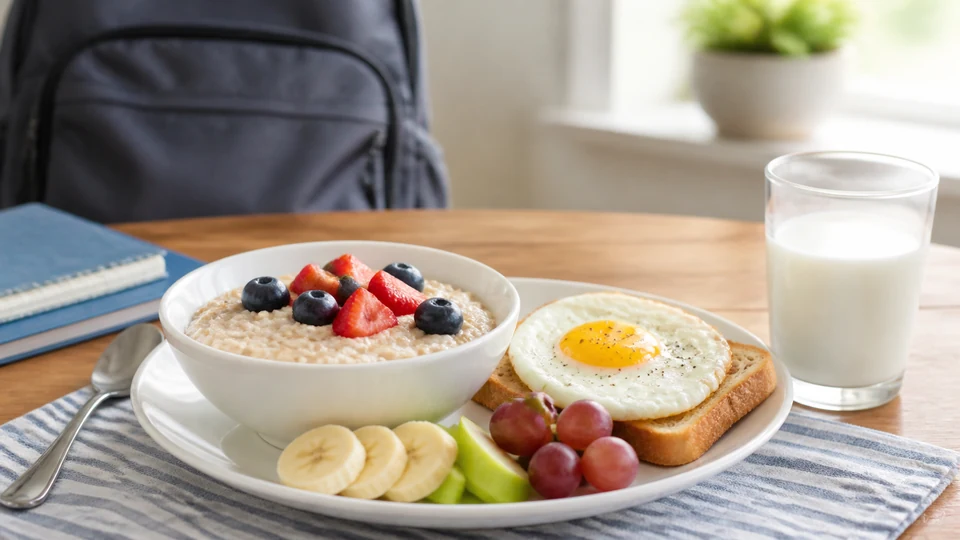
For adjacent decisions around Healthy breakfast for 12 year olds, compare breakfast recipes for a practical start, a flexible healthy breakfast framework, and five-morning breakfast preparation.
For broader context, continue with Healthy Pancake Guides.
A three-part breakfast framework
Instead of asking whether one named food is “healthy,” build a breakfast from parts. The 2025–2030 federal guidance prioritizes whole, nutrient-dense foods including varied protein foods, dairy, vegetables, fruits, healthy fats and whole grains, while reducing highly processed foods, added sugars, refined carbohydrates and excess sodium.
For a workable morning, select:
- One anchor: egg, plain yogurt, milk, cheese, beans, tofu, nut or seed butter, fish or another appropriately prepared protein food.
- One plant component: whole fruit, vegetables, or both.
- One whole-grain component: oatmeal, whole-grain bread, a whole-grain tortilla, or another correctly labelled grain food.
- A drink: usually water or another unsweetened option.
Breakfast does not have to contain all four every day. Dairy and protein categories can overlap, and a bean-and-grain bowl works differently from yogurt and fruit. The framework exists to prevent a common planning failure: choosing one sweet packaged item and treating its breakfast branding as evidence that the meal is complete.
Do not turn the framework into a rigid rule that overrides appetite, culture, sensory needs, vegetarian or vegan practice, an allergy plan, diabetes management, gastrointestinal needs, medication instructions or an eating-disorder treatment plan. Those require individualized professional guidance.
What “healthy” means on this page
Here, “healthy breakfast” means a meal assembled in line with current federal food-based guidance and the child’s established care needs. It does not mean:
- a food that guarantees concentration, grades, mood, athletic performance or weight change;
- a fixed number of calories for every 12-year-old;
- a high-protein contest;
- a meal that is automatically safe because its ingredients sound wholesome;
- a substitute for care when growth, appetite, fatigue, gastrointestinal symptoms or food avoidance are concerns;
- a reason to moralize food as “good” or “bad.”
The practical objective is simpler: make an acceptable breakfast available, choose recognizably whole or minimally processed foods when possible, include variety across the day, and create a routine the child can actually use.
Twelve breakfast ideas with decision notes
These are editorial assemblies, not Pancake World-tested recipes. Choose a complete formula for cooked items and use the package directions for exact products. No generic calories or portions are assigned.
1. Oatmeal, berries and plain yogurt
Use cooked oats as the whole-grain base, berries or another fruit as the plant component, and plain yogurt as the dairy anchor. Keep yogurt cold until serving. If using frozen berries, follow the package preparation directions; “frozen” does not always mean ready to eat without further handling.
Decision point: compare oat types before scheduling. Instant, quick, rolled and steel-cut oats require different liquid ratios and times. Do not apply one method to another product.
2. Egg, whole-grain toast and fruit
Cook the egg by a reliable method, toast correctly labelled whole-grain bread and add whole or cut fruit. For shell eggs, federal guidance says to cook until the yolk and white are firm; mixed egg dishes have a 160°F (71°C) endpoint.
Decision point: if the child will cook, match the method to demonstrated skill. A toaster and pre-cooked refrigerated egg may be appropriate under a household plan when a hot skillet is not.
3. Plain yogurt, fruit and a labelled grain topping
Combine plain yogurt with fruit and a measured amount of labelled muesli, oats or granola. Keep the dry topping separate until eating if crunch matters.
Decision point: granola, muesli and cereal are not nutritionally identical categories. Check the actual serving size, added sugars, sodium and allergens instead of transferring values from another product.
4. Bean-and-vegetable breakfast wrap
Use a whole-grain tortilla, properly heated beans, prepared vegetables and an optional labelled cheese or spread. Keep the filling modest enough to close the wrap.
Decision point: canned beans, home-cooked beans and refrigerated leftovers have different preparation and storage histories. Rinse or heat only as the package or complete recipe directs, and reheat leftovers to 165°F (74°C).
5. Whole-grain waffle with yogurt and fruit
Start with a complete waffle formula or a product whose instructions and label are available. Add plain yogurt and fruit rather than assuming syrup is the only possible topping.
Decision point: “whole grain” should be verified from the package or recipe, not inferred from brown color. A homemade formula needs exact flour identities and yield before any nutrient calculation.
6. Cottage cheese, fruit and toast
Pair a refrigerated cottage-cheese product with fruit and whole-grain toast. This is mainly assembly, making it useful when there is little morning cooking time.
Decision point: cottage cheese labels can differ in serving size and sodium. Compare products on the same serving basis; do not assign the category a single generic value.
7. Smoothie plus a chewable side
Blend a source-specific combination of fruit, plain dairy or fortified alternative, and any other planned ingredient. Add whole-grain toast, an egg or another chewable side so the smoothie is not required to carry every meal component.
Decision point: use a formula sized for the blender. Fruit drinks, sweetened yogurt, juice and syrups can change added-sugar and ingredient information. A homemade smoothie does not inherit the nutrition of a vaguely similar database entry.
8. Leftover grain bowl with egg or beans
Use a safely cooled cooked grain, add properly stored vegetables, and choose egg or beans as the anchor. Reheat the leftover components to 165°F, then add cold toppings with clean utensils.
Decision point: use only leftovers with a documented refrigerator history. Food left out too long cannot be made safe merely by reheating.
9. Nut- or seed-butter toast with banana
Spread a labelled nut or seed butter on whole-grain toast and add banana slices or a whole banana. This is fast and requires little equipment.
Decision point: peanut, tree-nut and seed products are not interchangeable in an allergy plan. Sesame is one of the nine major allergens under US federal labeling law. Follow the child’s established plan and prevent cross-contact.
10. Overnight oats prepared under refrigeration
Use a complete overnight-oats formula with an explicit grain-to-liquid ratio and cold-storage period. Add fruit according to the recipe or at service.
Decision point: “overnight” means a controlled refrigerated process, not a jar left on the counter. Label the container with the preparation date and keep it at 40°F (4°C) or below.
11. Breakfast sandwich with egg and vegetables
Combine a fully cooked egg portion, whole-grain bread and a prepared vegetable. Add cheese if it fits the plan and label review.
Decision point: assemble after the egg reaches its endpoint. If transporting, keep the sandwich under safe hot or cold control; foil or a paper wrapper does not provide temperature control by itself.
12. Cold breakfast box
Pack two or three components such as whole-grain crackers or bread, cheese or a labelled spread, whole fruit and prepared vegetables. An egg can be included under a safe refrigeration plan.
Decision point: use an insulated bag and adequate cold source for dairy, egg, cut produce or other perishables. Keep wet foods in separate containers so the child receives the intended texture.
A five-minute selection routine
On a busy morning, use this sequence:
- Check the day: Is breakfast at home, in the car, at school or after early practice?
- Pick the anchor: Choose one refrigerated, pantry or cooked protein/dairy item that fits the child’s plan.
- Add a plant food: Select an available fruit or vegetable requiring no more preparation than time allows.
- Add grain if useful: Choose a whole-grain item with a verified label or a prepared grain.
- Check transport and safety: Decide whether the food will be eaten now or needs cold or hot control.
If the child will eat a reimbursable school breakfast, review the current school menu and decide what, if anything, is needed at home. Do not automatically serve a full home breakfast and then demand a second full meal. Appetite and the day’s schedule matter.
How school breakfast standards help—and where they stop
USDA’s School Breakfast Program meal pattern for grades 6–8 offers a useful example of institutional structure: schools plan breakfast around fruit, grains and/or meats or meat alternates, and fluid milk. The standards include daily and weekly requirements and dietary specifications averaged across the school menu.
That pattern is not an individualized home prescription. It does not establish what one 12-year-old must eat at one sitting, and its calorie ranges and nutrient specifications apply to planned school meals over the relevant averaging period. A child may be in a different grade band, have a disability accommodation, use an approved milk substitute, or follow a medical meal plan.
Use the school pattern for two practical tasks only:
- recognizing that a school breakfast is intentionally built from components rather than one branded snack;
- reading the actual menu so home and school food are coordinated.
For questions about the school meal, allergy accommodation or disability-related modification, contact the school’s nutrition office or designated care-plan contact. Do not ask a child to negotiate a serious allergy alone at the serving line.
Let the 12-year-old participate safely
The current Dietary Guidelines encourages adolescents to participate in food shopping and cooking. Participation works best when responsibility matches demonstrated skill rather than age alone.
A 12-year-old may be able to:
- choose between two caregiver-approved breakfast plans;
- read a serving size and servings-per-container line;
- wash whole fruit and vegetables;
- assemble yogurt, fruit and oats;
- use a toaster according to household rules;
- pack a cold component beside an ice pack;
- label an overnight container with the date;
- clean the preparation surface and return chilled food promptly.
Tasks involving a chef’s knife, hot skillet, oven, blender blades, boiling water or raw egg require instruction and whatever adult supervision is appropriate for that child and household. Do not assume competence because another 12-year-old performs the task.
Create one repeatable station: bowls on a reachable shelf, safe utensils together, fruit visible, labelled dry items closed, and cold foods returned to the refrigerator. A clear routine reduces missed steps without turning breakfast into a test.
Read a breakfast label in four passes
FDA explains that Nutrition Facts values apply to the stated serving size and that serving size is not a recommendation of how much to eat. Use the label as product information, not as a personalized meal plan.
Pass 1: identity and serving basis
Confirm the exact product, servings per container and serving size. If two cereals use different serving weights, do not compare only the front numbers. Put them on the same amount or use the label amounts with their difference clearly understood.
Pass 2: ingredients and allergens
Read the complete ingredient list and Contains statement. FDA’s nine major allergens are milk, egg, fish, crustacean shellfish, tree nuts, peanuts, wheat, soy and sesame. Check every component, including bread, spreads, granola, cooking spray and flavored yogurt.
Pass 3: added sugars and sodium
Review Added Sugars and sodium on the stated serving. The current Dietary Guidelines recommends reducing highly processed foods, added sugars and excess sodium. Do not describe total sugars as all “added”: plain milk and whole fruit contain naturally occurring sugars.
Pass 4: actual amount used
Record whether the child ate one labelled serving, a different amount or only part of the food. Nutrition Facts cannot describe the meal unless the amount and every component are known.
Avoid searching for one magic threshold and ignoring the rest of the meal. A product decision belongs in the context of the child’s full dietary pattern and established care needs.
Portion decisions without a generic calorie target
Two 12-year-olds can have different energy needs because of body size, growth, sex and physical activity. The current federal guideline says calorie needs depend on age, sex, height, weight and activity. That is why this page does not prescribe a calorie number or a fixed number of eggs, slices or cups.
Use a responsive household process:
- Offer an initial amount that fits the food, previous appetite and time available.
- Allow the child to request more without framing the first amount as a test.
- Keep additional components available when practical.
- Notice recurring patterns—food routinely untouched, breakfast consistently too small for the child’s own report, or time preventing eating.
- Adjust the next plan rather than forcing completion.
If there is concern about growth, significant appetite change, restrictive eating, persistent fatigue, gastrointestinal symptoms, menstrual needs, sports fueling, diabetes, a diagnosed deficiency or weight, seek individualized professional assessment. Do not calculate a treatment plan from a general article.
Vegetarian, vegan and dairy-free planning boundaries
A breakfast can use plant-sourced protein foods such as beans, lentils, nuts, seeds or soy, consistent with the guideline’s call for variety. But a substitution needs an actual product and full-day plan.
For a vegetarian breakfast, examples include:
- egg, toast and fruit if eggs are included;
- plain yogurt, oats and fruit if dairy is included;
- beans and vegetables in a whole-grain wrap;
- tofu scramble from a complete recipe with toast and fruit.
For vegan or dairy-free planning, do not assume every plant beverage equals milk. Check protein, fortification, added sugars, allergens and the role the product plays in the full diet. FDA labeling and the child’s clinician or dietitian can help resolve an individual requirement.
Do not recommend supplements from this page. The current guideline states that fortified foods or supplements may be needed in some adolescent circumstances under medical guidance. The need, product and dose are clinical decisions.
Allergy and cross-contact controls
A “healthy” ingredient can still be unsafe for a child with an allergy. Use the written allergy or emergency plan, not a general substitution chart.
Before preparation:
- review the current package every time, including a familiar product whose formula may have changed;
- confirm the exact tree nut, fish or shellfish species where relevant;
- clean the surface and use clean utensils;
- prepare the allergy-safe item before shared spreads create crumbs or smears;
- keep package labels available for the caregiver or school;
- do not use a voluntary “may contain” statement as the only cross-contact assessment.
At school or a friend’s home, the responsible adults need the plan. A 12-year-old can learn self-advocacy, but responsibility for safe systems remains with adults and the institution.
Food-safety checkpoints for common breakfast foods
Eggs
Cook shell eggs until yolk and white are firm. Cook mixed egg dishes to 160°F. Wash hands and clean tools and surfaces after raw egg contact. Do not taste raw batter containing egg.
Ground meat and poultry
Ground meat and sausage require 160°F. Poultry, including ground poultry, requires 165°F. Do not use color as the only endpoint and do not let raw-meat utensils touch toast, fruit or cooked egg.
Leftovers and casseroles
Reheat leftovers to 165°F. A meat- or poultry-containing casserole also has a 165°F endpoint. Measure the central area without touching the pan.
Refrigerator and transport
Keep the refrigerator at 40°F or below and verify it with an appliance thermometer. Refrigerate perishable food within two hours; use one hour when the ambient temperature is above 90°F (32°C). Use an insulated bag and adequate cold source for school or travel.
Cut produce and dairy
Wash intact produce before cutting, use clean equipment and keep cut produce refrigerated. Return milk, yogurt, cheese and opened fortified alternatives promptly rather than leaving family-size containers on the counter.
A one-week rotation without a rigid meal plan
Use categories to create variety while preserving choice. This is an editorial rotation, not a prescription:
| Day | Anchor | Plant component | Grain or other base | Preparation gate |
|---|---|---|---|---|
| Monday | plain yogurt | berries | oats | keep yogurt cold |
| Tuesday | cooked egg | whole fruit | whole-grain toast | firm egg or 160°F mixed egg |
| Wednesday | beans | prepared vegetables | whole-grain tortilla | heat and store beans correctly |
| Thursday | cottage cheese | peaches or another fruit | toast | check label and refrigeration |
| Friday | nut or seed butter | banana | whole-grain bread | allergy plan and separate utensil |
| Saturday | tofu or egg | vegetables | potatoes or grain | complete recipe and temperature |
| Sunday | chosen dairy or protein | fruit | whole-grain waffle or oatmeal | complete formula and actual yield |
Swap days, use school breakfast, repeat accepted foods or choose culturally familiar meals. Variety is evaluated across time, not by requiring novelty every morning.
Common breakfast problems and practical fixes
“There is no time.”
Choose a cold breakfast box, overnight oats under refrigeration, yogurt with fruit, or toast with a labelled spread. Prepare containers and safe tools the night before. Do not leave perishables out overnight to save time.
“The child is not hungry immediately after waking.”
Coordinate a smaller home option with a later school breakfast or safely packed food if allowed. Persistent appetite concerns belong with the child’s healthcare professional, not a forced generic portion.
“Only a sweet packaged item is accepted.”
Keep the accepted item visible while adding a simple component such as fruit, plain dairy, egg or a labelled spread that the child already tolerates. Avoid claiming that one added food transforms the meal medically.
“The child wants an energy drink.”
The current guideline for adolescence says to significantly limit sugary drinks and energy drinks. Make water or another unsweetened beverage the routine breakfast option. Any concern about caffeine use or symptoms should go to a clinician.
“The school menu and home breakfast overlap.”
Read the menu and decide where the child plans to eat. Coordinate components and appetite rather than demanding duplicate full meals.
“A caregiver wants exact macros.”
Do not estimate from food names. Exact analysis requires weighed ingredients, matched FoodData Central or package records, actual recipe yield and the consumed portion. Individual targets require professional assessment.
Use a night-before handoff card
A short written handoff keeps the morning plan executable without prescribing intake. Put one card beside the packed dry items or on the refrigerator:
- Breakfast location: home, school or travel.
- Chosen assembly: write the exact two or three components, not “something healthy.”
- Cold items: list what remains in the refrigerator and when it should be removed.
- Hot step: identify the adult or trained child responsible and the required endpoint.
- Allergy check: note that current packages and clean utensils were verified.
- Transport: name the insulated bag, cold source and planned eating time.
- Backup: record one acceptable shelf-stable or school option if the first plan fails.
In the morning, the child can check off steps rather than making every decision under time pressure. Discard the card if ingredients, schedule or care instructions change; it is a household workflow, not a standing medical plan.
Review the routine weekly with neutral questions: Which component was eaten? Which texture failed after transport? Was the portion easy to finish in the available time? Did an ice pack remain cold? Use the answers to change shopping, packaging or timing. Do not interpret an unfinished meal as a diagnosis, and do not hide ingredients to force acceptance.
Frequently asked questions
What is the easiest balanced breakfast for a 12-year-old?
Plain yogurt with fruit and oats, or cooked egg with whole-grain toast and fruit, are simple frameworks when they fit the child’s allergy and dietary plan. “Easiest” depends on available equipment, acceptance and whether food must travel.
How many calories should breakfast have?
This page does not assign a number. Federal guidance says calorie needs vary with age, sex, height, weight and physical activity. A school meal’s planned calorie range is an institutional weekly standard, not a personal home target.
Does every breakfast need meat?
No. Federal guidance includes both animal and plant protein foods. Eggs, dairy, beans, lentils, nuts, seeds and soy can play different roles according to preference, allergy and the full dietary plan.
Is cereal acceptable?
It can be one component. Use the actual label to check serving basis, whole-grain identity, added sugars, sodium and allergens, then decide whether fruit, milk, yogurt, nuts, seeds or another component fits. Do not judge by front-of-package imagery alone.
Can a 12-year-old make breakfast alone?
That depends on demonstrated skills, household rules and equipment. Cold assembly may be appropriate before hot pans or sharp knives. Teach one workflow, supervise as needed and keep raw-egg and appliance safety explicit.
When should a caregiver seek professional advice?
Seek individualized guidance for a medical condition, allergy, growth concern, significant appetite or weight change, restrictive eating, sports-fueling need, suspected deficiency, persistent symptoms or supplement question. General meal ideas cannot diagnose or treat these issues.
Is this a tested recipe page?
No. It is an Article with planning ideas. Pancake World has no project-owned test record for these assemblies, so no Recipe schema, generic yield or invented nutrition panel is claimed.
Explore related Pancakes World guidance on American Pancakes, American Breakfast: Pancakes, Diner Plates and Brunch, and Maple Syrup.
Sources and editorial references
- HHS Office of Disease Prevention and Health Promotion, Current Dietary Guidelines —
https://odphp.health.gov/our-work/nutrition-physical-activity/dietary-guidelines/current-dietary-guidelines - U.S. Department of Health and Human Services and U.S. Department of Agriculture, Dietary Guidelines for Americans, 2025–2030 —
https://cdn.realfood.gov/DGA.pdf - USDA Food and Nutrition Service, School Breakfast Program Meal Pattern —
https://www.fns.usda.gov/school-meals/nutrition-standards/sbp-meal-pattern - USDA Food and Nutrition Service, CACFP Breakfast Recipes —
https://www.fns.usda.gov/tn/breakfast-recipes-cacfp - U.S. Food and Drug Administration, How to Understand and Use the Nutrition Facts Label —
https://www.fda.gov/food/nutrition-facts-label/how-understand-and-use-nutrition-facts-label - U.S. Food and Drug Administration, Food Allergies —
https://www.fda.gov/food/nutrition-food-labeling-and-critical-foods/food-allergies - FoodSafety.gov, Safe Minimum Internal Temperatures —
https://www.foodsafety.gov/food-safety-charts/safe-minimum-internal-temperatures - USDA Food Safety and Inspection Service, Refrigeration and Food Safety —
https://www.fsis.usda.gov/food-safety/safe-food-handling-and-preparation/food-safety-basics/refrigeration-food-safety