Frozen breakfast sandwiches
At Pancakes World, to make frozen breakfast sandwiches safely, cook every egg and raw-meat component to its required endpoint, cool the components promptly in shallow layers, assemble only after heavy steam has stopped, wrap each sandwich tightly, freeze the packages in a single layer, then label and consolidate them. Reheat one sandwich by a complete tested method until its center reaches 165°F, checking more than one place because microwaves create cold spots. Add lettuce, tomato, avocado, mayonnaise, or other wet fresh toppings after reheating rather than freezing them inside. Do not rely on freezing to kill bacteria, and do not use one microwave time for every bread, filling thickness, freezer temperature, or appliance.
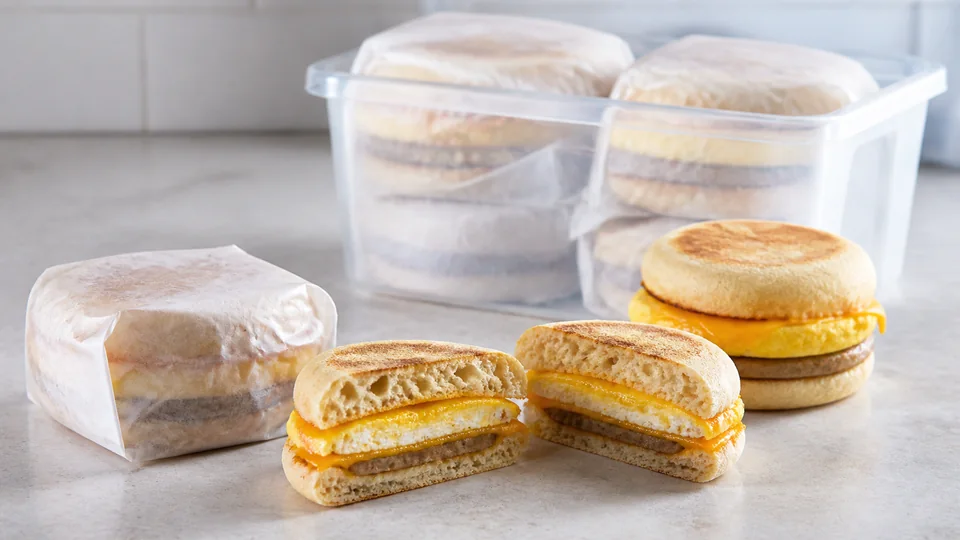
This is a production and safety guide, not a tested Pancake World freezer recipe. Browse the breakfast hub for other morning formats, and use Pancake World to navigate the wider collection.
For broader context, continue with American Breakfast: Pancakes, Diner Plates and Brunch.
Think in seven controlled steps
Batch sandwiches become manageable when production is separated into stages:
- select one complete formula;
- cook eggs, meat and vegetables safely;
- cool components promptly;
- assemble with moisture barriers and even thickness;
- wrap and label individually;
- freeze in a single layer before consolidating;
- thaw or reheat by a verified method to 165°F.
Skipping the cooling stage is the common shortcut that harms both safety and quality. Wrapping a steaming egg patty against bread traps condensation. Leaving a full batch on the counter until every sandwich is assembled stretches the time at unsafe temperatures. Plan enough tray and refrigerator space before cooking.
Start from a complete sandwich structure
University of Illinois Extension’s 4-H Cooking 201 guide frames a breakfast sandwich as a choice of bread, cooked egg, cooked meat and cheese. It lists biscuits, English muffins, bagels, sliced bread and tortillas; egg styles; already cooked breakfast meats; and cheese choices. The source method cooks the egg, heats meat, optionally toasts bread, layers the sandwich and heats until hot.
That fresh-sandwich framework helps define roles, but a freezer sandwich needs a source that also validates cooling, wrapping and reheating. Illinois Extension’s Diabetes Clinic newsletter supplies one such specific example: an English muffin with baked egg or egg white, vegetables and optional cheese. It instructs cooks to cool the sandwich before individually wrapping and freezing it, then provides a source-specific microwave defrost and heating sequence.
Use the complete Extension formula if it matches your needs. Do not carry its microwave minutes over to a thick bagel sandwich, a meat-heavy biscuit, a double egg layer or a different oven and microwave.
Choose bread for reheating, not just for fresh texture
Bread absorbs moisture from the filling during cooling, freezing and reheating. A sturdy split English muffin often tolerates the cycle better than very tender fresh bread. Bagels are dense and may stay cool in the center while the egg overheats. Biscuits can crumble. Tortillas create a wrap rather than a stacked sandwich and need their own formula.
Evaluate four properties:
| Bread property | Why it matters |
|---|---|
| thickness | changes time for heat to reach the center |
| open crumb | absorbs condensation and sauce |
| crust strength | determines whether the package survives handling |
| size | must match the egg and meat layers for even heating |
Light toasting can create a drier surface when the complete recipe allows it. Over-toasting may make bread tough after freezing. Cool toasted bread before assembly so it does not add trapped heat to the package.
Do not use a nutrition total from an English-muffin source after switching to a biscuit or large bagel. The label for the exact bread controls ingredient, allergen and nutrition information.
Build an even egg layer
An egg layer that matches the bread heats more evenly than a thick folded mass. Complete freezer-sandwich recipes often use a muffin tin, sheet pan or other defined vessel to create repeatable portions.
FDA advises keeping eggs at 40°F or below and cooking egg dishes to 160°F. Cook the batch fully before cooling. Do not intentionally undercook eggs on the theory that reheating will finish them later; that creates an unsafe and unverified two-stage process.
When adding vegetables to egg:
- chop them consistently;
- pre-cook watery mushrooms, spinach or peppers when the source directs;
- drain released liquid;
- divide the mixture evenly;
- verify thick portions, not only edges.
Let cooked egg portions stop steaming heavily before stacking, but keep the total cooling window under control. Spread them apart on a clean tray rather than leaving them in a deep pile.
For people who should avoid raw or undercooked egg, do not use a soft-yolk sandwich. A frozen sandwich is reheated for convenience, not designed to preserve a runny center.
Cook meat before assembly
Breakfast sausage, bacon, ham and deli turkey enter sandwiches in different states. Follow the source and package. Raw sausage must reach its safe endpoint before it goes into a freezer sandwich. Bacon should be cooked as the formula directs and drained. Ready-to-eat ham may require heating but not raw-meat cooking.
Keep raw meat tools away from cooked egg, bread and cheese. Wash hands after raw handling. Transfer cooked meat to a clean plate with clean utensils.
FoodSafety.gov’s category chart applies even when the final product is small:
- ground beef, pork, veal and lamb: 160°F;
- poultry, including ground poultry: 165°F;
- whole cuts of beef, pork, veal and lamb: 145°F plus a three-minute rest;
- reheated sandwich leftovers: 165°F.
If a meat patty is thicker than the egg layer, it can become the cold center during reheating. Use a complete recipe designed for that patty rather than increasing microwave time until the bread becomes hard.
Moisture determines freezer quality
Water migrates during cooling, freezing and reheating. Control it at the component level.
Good freezer candidates include:
- fully cooked egg portions with excess surface moisture removed;
- cooked and drained sausage patties;
- cooked bacon drained of excess fat;
- measured cheese slices;
- sturdy bread cooled before assembly;
- sautéed vegetables whose released water has evaporated.
Poor inside-the-freezer candidates include lettuce, fresh tomato, avocado, watery salsa and mayonnaise-heavy mixtures. USDA FSIS bag-lunch guidance specifically advises against freezing sandwiches containing mayonnaise, lettuce or tomato for quality, recommending that they be added later.
Keep sauces in a separate refrigerated container for service. If a sauce requires refrigeration, its transport and storage must be controlled just like the sandwich.
Cheese can act as a partial moisture barrier between egg and bread, but it does not make a wet filling dry. Place layers according to the tested formula.
Cool before you wrap
USDA advises refrigerating cooked leftovers within two hours, reduced to one hour when ambient temperature is above 90°F. Large amounts cool faster when divided into shallow containers. Apply that principle to sandwich components.
Use a clean sheet pan or several shallow containers:
- separate egg portions so air can move around them;
- drain meat and place pieces in a shallow layer;
- cool cooked vegetables separately;
- refrigerate promptly;
- assemble when components are cold or no longer producing heavy condensation, according to the source.
Do not stack hot eggs into a covered deep container. Do not place a hot meat patty directly on bread and then seal it in plastic. Steam becomes ice and later returns as water.
Cooling does not mean leaving food at room temperature until it feels cold. Use the refrigerator and track the time from cooking.
Assembly line without cross-contact
Clean the work surface after cooking. Lay out cooled bread, egg portions, cooked meat, cheese and individual wrappers. Keep allergen-specific or meatless batches physically separate.
For even reheating:
- center the egg and meat;
- avoid doubled folds on one side;
- keep all sandwiches a similar thickness;
- use one cheese slice or the source amount;
- omit wet fresh toppings;
- close bread without crushing it.
If making several versions, label wrappers before food touches them. Use codes that are unambiguous: “egg-cheddar,” “egg-turkey,” “egg-no dairy,” and the production date. A dairy-free sandwich needs verified bread, egg substitute or filling, separate utensils and a reliable cheese alternative label; removing one cheese slice does not resolve all allergens.
Count the finished sandwiches and reconcile them with the labels. One unidentified package in the freezer is not useful for dietary or safety decisions.
Wrap for air control and practical reheating
Illinois Extension’s freezer sandwich example calls for tight individual wrapping. Iowa State Extension’s make-ahead breakfast burritos likewise wrap each unit tightly, freeze the wrapped items in a single layer, then place them in a freezer bag after they are frozen.
Choose freezer-safe materials. Remove excess air without crushing the bread. If using foil, remember it cannot enter a microwave. If using plastic wrap, follow product directions and remove it when the source says to do so before heating.
A two-layer system can help:
- close individual food-safe wrap around each sandwich;
- place the frozen units in a labeled freezer bag or container.
The outer container limits air exposure and keeps small packages together. It does not replace the individual wrap.
Do not reuse packaging that contacted raw ingredients. Do not wrap in materials not intended for food or freezer use.
Freeze flat before consolidating
Place wrapped sandwiches in one layer in the freezer so they freeze separately. Leave space for cold air circulation. Once firm, move them into the labeled outer bag.
USDA FSIS advises maintaining a freezer at 0°F. Freezing stops microbial growth by making microbes inactive; it does not reliably destroy bacteria, yeast or mold. Once food thaws, surviving microbes can become active again. Handle thawed sandwiches like any other perishable food.
Freezer storage charts are generally quality guidance because properly frozen food remains safe indefinitely at 0°F, but texture and flavor decline. This article does not assign a universal “best by” period to homemade breakfast sandwiches. Use the complete recipe’s quality guidance, label dates and rotate older packages first.
Avoid placing a large number of hot or barely cooled sandwiches into a small freezer at once. That can warm neighboring food and slow freezing. Cool safely in the refrigerator first when the recipe directs.
Reheat from frozen or thaw safely
USDA recognizes refrigerator, cold-water and microwave thawing as safe routes for leftovers, with conditions. A breakfast sandwich is usually reheated from frozen or thawed in the refrigerator according to a complete recipe.
Refrigerator thaw
Move the wrapped sandwich to the refrigerator in advance. Keep it at 40°F or below. Reheat by the source method to 165°F.
Microwave from frozen
Use the complete recipe’s power and defrost sequence. Remove foil and any non-microwave-safe material. A damp paper towel may help some source formulas, but it is not automatically correct for every bread.
Cover and rotate as instructed. Let the sandwich stand briefly so heat redistributes, then check the center in more than one place. If below 165°F, continue in short increments and recheck.
Oven or toaster oven
Use only a method written for the appliance and packaging. Longer dry heat can improve bread texture but may overcook egg before a thick frozen center heats.
Cold-water thaw
This method requires leak-proof packaging and immediate cooking afterward. It is rarely the most convenient route for a sandwich, but USDA lists it as a safe general thaw method when executed correctly.
Never thaw a perishable sandwich on the counter.
How to measure the center
The coldest point may lie between the egg and meat or in the thickest patty. Insert a clean instant-read thermometer from the side so the sensing area reaches the central layers. Check a second location.
If the reading is uneven:
- separate the sandwich halves if the source permits;
- rotate the item;
- continue in short heating intervals;
- allow a stand time;
- recheck with a cleaned probe.
Do not eat around a frozen spot while assuming the rest is safe. Steam at the edge and melted cheese are not center measurements.
Different microwaves have different power. The same model can heat unevenly depending on load and turntable position. Record the verified program for one exact sandwich design, but recheck when ingredients or thickness change.
Restore texture after safe reheating
Microwaves heat quickly but soften bread. If the source allows, a brief toaster-oven or skillet finish after the center reaches 165°F can restore exterior texture. Avoid drying the egg.
Open the sandwich carefully so steam escapes. Add fresh toppings only now:
- washed and dried tomato;
- lettuce or spinach;
- avocado;
- salsa in a controlled amount;
- mayonnaise or another refrigerated sauce;
- fresh herbs.
Fresh additions should be prepared on a clean board with clean utensils. Do not return the reheated sandwich to a plate that held its frozen exterior packaging if that surface is wet or contaminated.
If the bread is consistently tough, reduce density or use the complete English-muffin formula. If it is soggy, improve component cooling and remove wet toppings from the frozen package.
Pack a frozen sandwich for work or school
Freezing can help a sandwich stay cold, but it does not replace an insulated lunch system. USDA FSIS recommends an insulated soft-sided bag and at least two cold sources for perishable food. Place cold sources above and below the food, and refrigerate the lunch on arrival when possible.
Pack only the amount that will be eaten. Keep reheating instructions with the sandwich. Confirm that the destination has a microwave, clean plate, thermometer access where practical, and refrigeration.
Do not assume a sandwich will thaw safely by lunchtime in a desk drawer. Time and room temperature vary. If no safe cold storage or heating is available, choose a shelf-stable breakfast instead.
Discard leftovers from a packed perishable lunch when USDA guidance calls for it. Refreezing an item that spent hours warm is not safe.
Power outage and thawing decisions
USDA says frozen foods that still contain ice crystals or remain at 40°F or below may be safely refrozen, though quality can decline. Perishable frozen entrees that fully thaw and remain above 40°F for more than two hours should be discarded.
Do not judge by smell or appearance alone. Keep an appliance thermometer in the freezer and avoid opening the door during an outage. Group packages to retain cold.
If raw meat packages leak during a thaw event and contaminate breakfast sandwiches, discard contaminated ready-to-eat items. Do not try to wipe the wrappers and return them to storage.
Keep a simple batch record
A freezer label should answer more than “breakfast.” Record the production date, filling type, major allergens, reheating source and number of sandwiches in the batch. Keep a separate kitchen note with the exact bread, egg method, meat or meatless component, wrapper system and verified appliance program. If a later batch changes thickness or ingredients, give it a new record rather than assuming the old reheating result still applies.
Arrange packages so the oldest verified batch is easiest to reach. Count removals if several people use the freezer. A quick inventory prevents forgotten packages and helps you avoid opening every wrapper to identify it. Never use color-coded tape as the only allergen label; colors can fade or be misread. Write plain names, and keep allergen-specific batches in a separate clean outer container.
If the freezer cannot hold a new batch in a loose initial layer, make fewer sandwiches. Production volume should fit available cooling and freezing capacity, not the other way around.
Troubleshooting frozen breakfast sandwiches
Bread is soggy
Hot components were wrapped, vegetables released water, or sauce was frozen inside. Cool components more effectively and add wet toppings after reheating.
Bread is hard
The bread is too dense, microwave exposure is excessive, or the sandwich is uneven. Use the source bread, verified power settings and a thinner uniform stack.
Center remains cold
The sandwich is too thick, the meat and egg are misaligned, or the microwave program does not fit. Rotate, continue in short increments and verify 165°F.
Egg turns rubbery
Reheating is too long for the bread or meat layer. Use a thinner sandwich, a lower-power source sequence, or thaw safely in the refrigerator first.
Cheese leaks out
It is off-center, too large or exposed at the edge. Center the slice and keep consistent assembly.
Ice crystals fill the wrapper
Steam was trapped or the wrap admitted air. Cool before assembly, wrap tightly and use an outer freezer container.
Labels fall off
Condensation or unsuitable labels are likely. Mark freezer-safe outer packaging before filling and repeat key data on the group bag.
Final freezer workflow checklist
- Does one complete recipe cover cooking, cooling, freezing and reheating?
- Are egg and raw-meat components fully cooked to their endpoints?
- Have components cooled promptly in shallow layers?
- Are wet fresh toppings excluded from the frozen sandwich?
- Are all sandwiches even in thickness?
- Is each package tight, freezer-safe and clearly labeled?
- Will sandwiches freeze separately before consolidation?
- Is the freezer maintained at 0°F?
- Does reheating reach 165°F in more than one central location?
- Will portable sandwiches travel with two cold sources?
Frozen breakfast sandwiches save time only when the safety and quality work happens before the freezer door closes. Fully cook, rapidly cool, assemble dry, wrap individually, label clearly and verify the reheated center. That repeatable flow is more dependable than guessing a storage life or copying one microwave minute across different sandwiches.
Explore related Pancakes World guidance on American Pancakes, Maple Syrup, and Maple Syrup Pancakes.
Sources and editorial references
- University of Illinois Extension, “Breakfast Sandwich.”
https://extension.illinois.edu/sites/default/files/diabetes_clinic_newsletter_-_may.pdf - University of Illinois Extension, “4-H Cooking 201.”
https://extension.illinois.edu/sites/default/files/4h_cooking_201_book.pdf - USDA FSIS, “Freezing and Food Safety.”
https://www.fsis.usda.gov/food-safety/safe-food-handling-and-preparation/food-safety-basics/freezing-and-food-safety - USDA FSIS, “Leftovers and Food Safety.”
https://www.fsis.usda.gov/food-safety/safe-food-handling-and-preparation/food-safety-basics/leftovers-and-food-safety - USDA FSIS, “Keeping Bag Lunches Safe.”
https://www.fsis.usda.gov/food-safety/safe-food-handling-and-preparation/food-safety-basics/keeping-bag-lunches-safe - FDA, “What You Need to Know About Egg Safety.”
https://www.fda.gov/media/82227/download