Friendsgiving brunch ideas
At Pancakes World, run Friendsgiving brunch as a coordinated potluck, not an open invitation to bring anything. The host owns one substantial anchor and the service plan; friends claim distinct jobs such as vegetable side, potato or grain side, baked breakfast item, fresh or cool dish, sweet finish and beverages. Every contributor sends the exact recipe or supplier, yield, known major allergens, cooking endpoint, transport state and reheating need before the menu locks. At arrival, one food lead receives each dish into refrigeration, verified hot holding or immediate service. Keep cold food at 40°F (4°C) or below, hot food at 140°F (60°C) or above, use small replacement dishes, and refrigerate safe leftovers in shallow containers within two hours.
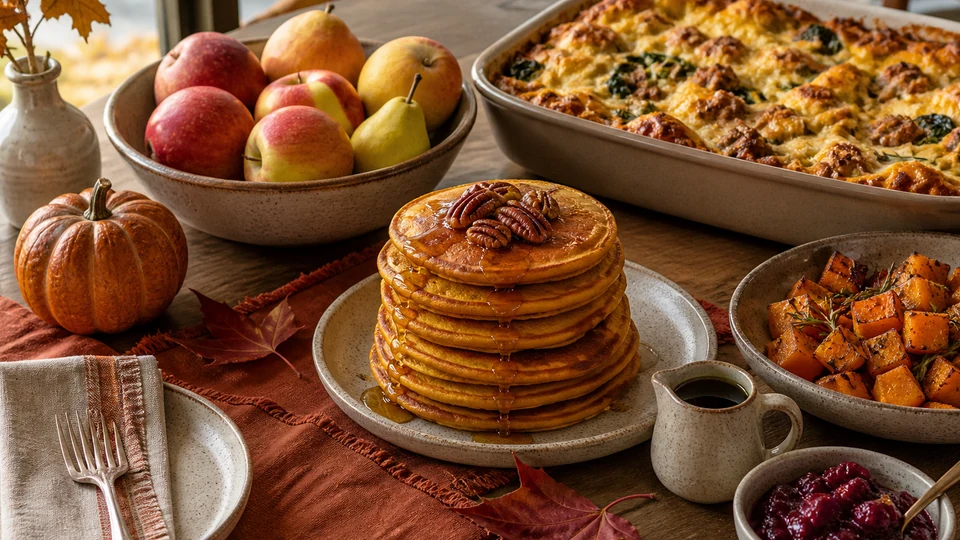
This page is a broad menu-assignment, transport, buffet and leftover system. It does not invent Friendsgiving history, dictate tradition, provide a Pancake World-tested turkey recipe or promise a universal amount per guest. The brunch hub covers the wider meal, while Pancake World opens the full editorial collection.
For broader context, continue with American Breakfast: Pancakes, Diner Plates and Brunch.
Give the gathering one operating brief
A Friendsgiving brunch becomes difficult when every participant imagines a different event. Write a short brief before assigning food:
- confirmed date, arrival window and meal time;
- host address and exact receiving point;
- seated, buffet, family-style or mixed service;
- whether turkey or another anchor is included;
- kitchen, oven, refrigerator and electrical capacity;
- guest response deadline;
- private contact for allergies or other ingredient needs;
- last service and cleanup time;
- whether leftovers will be divided, retained by the host or not planned.
The brief is operational, not etiquette. Friends can decide how formal, playful or traditional the gathering feels. The host's job is to make responsibilities unambiguous.
Assign one food lead who is not simultaneously cooking the most demanding anchor. That person keeps the menu register, receives dishes, starts service clocks, monitors holding, replaces pans and makes leftover decisions. University of Minnesota Extension recommends a person-in-charge for crowd food events because equipment, time and volunteer coordination become safety issues.
Build the menu with nonduplicating jobs
Use seven jobs so each contribution changes the meal.
1. Host-owned anchor
The host should control the item that determines the oven and service schedule. It might be a source-tested turkey preparation, baked egg dish, casserole, pancake service or another substantial savory format. The anchor needs a complete recipe, verified yield, safe endpoint and holding path.
If turkey is chosen, use USDA's current preparation guidance. Do not wash raw turkey, because rinsing can spread bacteria around the kitchen. Thaw only in the refrigerator, cold water or microwave, following the method's conditions. A whole turkey reaches 165°F in the thickest breast, innermost wing and innermost thigh without the thermometer touching bone. USDA recommends cooking stuffing separately for more uniform safety; if a bird is stuffed, the stuffing center also reaches 165°F.
This article does not reproduce a turkey time or weight formula. USDA provides calculators and method-specific guidance because thawing and cooking depend on the actual bird and approach.
2. Vegetable side
Assign a source-tested roasted, sautéed, baked or cold vegetable dish. Its format should contrast with the anchor and another side. A creamy vegetable casserole and a creamy potato casserole may technically be different foods but still duplicate texture, holding equipment and allergens.
The contributor records whether the dish arrives hot, cold or ready for reheating. Raw produce is washed under running water and kept separate from raw meat or poultry. A cold prepared salad needs 40°F-or-below transport and service.
3. Potato or grain side
Choose one, not several anonymous starches. The recipe should state yield and serving size. If the group is large, use a standardized quantity recipe rather than multiplying a home formula into a deeper pan.
Cooked rice, potatoes, stuffing and casseroles are perishable. They need a documented hot-hold, cold-hold or time-controlled service path. “It will be fine on the counter” is not a plan.
4. Baked breakfast item
A pancake, waffle, muffin, biscuit or other baked item can make the event feel like brunch rather than a midday Thanksgiving replay. Select one complete formula and clarify whether it arrives fully cooked, frozen, chilled or warm.
Do not taste raw batter. Keep raw flour and eggs away from ready-to-eat food. If a live griddle is proposed, assign a dedicated operator and protect the toppings; otherwise, choose a cooked format that can be served within the host's capacity.
5. Fresh or cool dish
A properly controlled fruit or vegetable format brings temperature and texture contrast. Cut fruit and most prepared cold dishes stay at 40°F or below. Use small dishes over ice or replace them from refrigeration.
This job is not labelled “healthy,” “clean” or “detox.” It is a menu and service category, not a nutrition outcome.
6. Sweet finish
Assign one finish after confirming whether pie or another dessert is already planned. Several pies, muffins, pastries and cakes can overwhelm the oven and duplicate the same role.
The contributor states whether the item contains cream, custard, egg or another perishable filling. A baked exterior does not prove room-temperature stability. Keep supplier or recipe storage directions with the dish.
7. Beverages
Give beverages an owner. Water, ice, cups, hot equipment, cold storage, refills and waste require space. Put the station outside the food queue.
This guide does not recommend alcohol or make claims about its effects. If the group serves it, legal requirements, transportation plans, individual decisions and clearly available nonalcoholic choices remain separate responsibilities.
Use a shared dish manifest
No dish is accepted into the final menu from a name alone. “Potatoes,” “salad” or “breakfast casserole” does not reveal cooking, allergens or equipment.
Create a register:
| Contributor | Exact dish | Recipe/source | Yield | Arrives | Safe endpoint | Holding/reheat | Major allergens | Serving ware |
|---|---|---|---|---|---|---|---|---|
| named | exact title | URL or supplier | verified | hot/cold/frozen | category-specific | written | known list | assigned |
The food lead checks the register for:
- duplicate menu roles;
- several dishes competing for the same oven time;
- more cold food than the refrigerator can hold;
- missing serving utensils;
- unclear raw versus cooked state;
- alternatives that share cross-contact points;
- dishes without a complete source or yield;
- arrival temperatures that cannot be maintained.
Lock the manifest before shopping. A last-minute recipe substitution changes ingredients, allergens, yield and possibly the cooking path. It must be reviewed rather than announced at the door.
Reconcile the host's finite kitchen
Turn the manifest into three capacity maps before approving assignments.
Oven map
List every pan that must cook, reheat or hold before service. Record dimensions, temperature, planned rack, entry time and exit time from its actual recipe. If two dishes require incompatible settings or the same rack, one contributor must change format or deliver the dish safely ready to serve. Do not lower a reheating endpoint or compress several casseroles into a cold oven to preserve every idea.
Refrigerator map
Measure usable shelf space after accounting for the host's raw ingredients. Assign a shelf or bin to each arriving cold dish and to protected alternatives. Reserve space for shallow leftover containers before the meal begins. A refrigerator filled so tightly that cold air cannot circulate is not a successful abundance plan.
Electrical and counter map
Count safe outlets, circuits and stable surfaces for slow cookers, warmers, coffee equipment and any griddle. Follow manufacturer instructions and prevent cords from crossing guest paths. Keep raw-poultry preparation separate from the receiving table and ready-to-eat assembly.
Use a conflict register:
| Resource | Time window | Dish or task | Conflict | Resolution |
|---|---|---|---|---|
| oven rack | recorded | exact dish | yes/no | reschedule or change dish |
| refrigerator shelf | arrival through service | exact dish | yes/no | assign space or reduce menu |
| outlet | service window | named appliance | yes/no | verified alternate setup |
| counter | preparation window | raw/ready-to-eat task | yes/no | separate time and sanitize |
The menu is locked only when every conflict has a real resolution. “We will find space” is not evidence. Removing one redundant contribution is often the safest solution and gives the remaining dishes a clearer role.
Send the final map to contributors as read-only instructions: arrival window, exact receiving contact, destination on arrival and whether the dish may use the oven. This prevents five people from appearing with cold casseroles that all expect immediate reheating.
Choose a potluck model
Model A: host cooks anchor, friends bring ready-to-serve sides
This reduces oven competition at the host's home. Contributors transport food under cold or hot control and arrive within a defined window. The host provides landing zones and serving ware assignments.
Best when: contributors can follow transport controls and the host has limited cooking space.
Main risk: dishes arrive at uncontrolled temperatures or without labels.
Model B: host provides hot food, friends bring cold and baked items
The host reserves the oven and hot holding for the anchor and one side. Friends bring cold dishes directly from refrigeration and fully cooked baked items whose storage directions are clear.
Best when: the host can handle hot production but not many recipes.
Main risk: refrigerator capacity and too many cold platters on the buffet.
Model C: small coordinated cooking team
Two or three people cook on site from a locked production schedule. Everyone else brings beverages, packaged baked items or no food.
Best when: the kitchen can accommodate named work zones and the team has experience.
Main risk: raw poultry or egg crosses into ready-to-eat food, and the oven map collapses.
Model D: purchased anchor with homemade sides
The host receives a documented take-out or catered anchor and friends bring controlled sides. USDA take-out guidance controls the receipt, storage and service state.
Best when: the host wants to reduce one major cooking task.
Main risk: assuming delivery packaging can hold food safely for an undefined wait.
These models are choices, not endorsements or claims about price or availability.
Calculate food from yields rather than folklore
There is no universal Friendsgiving amount per person. Quantity changes with the meal's duration, whether turkey or another anchor is served, the number and size of side dishes, guest mix and whether leftovers are an explicit objective.
Use a yield allocation:
- Confirm attendance and a documented maximum.
- Decide which menu jobs every guest is expected to receive.
- Record each recipe's published serving size and yield.
- Allocate shared demand between similar choices rather than counting a full serving of every item for everyone.
- Calculate complete batches without silently changing pan depth or cooking method.
- Add a deliberate reserve only when refrigerator or freezer space exists.
- Compare the combined food with serving, holding and leftover-container capacity.
For 25 or more people, University of Minnesota Extension recommends standardized quantity recipes. It warns that household recipes, especially baked and thickened dishes, may not scale proportionally. Repeated tested batches preserve the known process better than one oversized improvised pan.
If the group hopes for leftovers, name the desired items and containers. “Make extra of everything” creates an unmanaged cold-storage problem.
Plan distributed preparation
Potluck food is produced in several kitchens with different equipment. University of Minnesota Extension identifies distributed preparation and buffet service as risks requiring careful reconsideration and controls.
Send each contributor the same production card:
- wash hands and clean surfaces;
- keep raw meat, poultry, seafood and eggs away from ready-to-eat food;
- use the locked recipe and ingredient list;
- cook to the correct category endpoint;
- record when cooking finishes;
- cool promptly in shallow containers if transporting cold;
- transport hot at 140°F or above or cold at 40°F or below;
- bring the original ingredient labels when relevant;
- bring the assigned utensil and container lid;
- contact the food lead before changing the dish.
Do not ask a contributor to half-cook poultry or meat at home and finish it later unless an authoritative recipe specifically controls that process. A simpler fully cooked dish is safer for a social potluck.
Transport every dish in a defined state
Cold dishes
Chill completely under controlled refrigeration before transport. Pack in a cooler with enough ice or frozen gel packs to keep the food at 40°F or below. Minimize opening and place the cooler in a climate-controlled vehicle area when practical. Move the dish directly into the host refrigerator or cold service setup.
Hot dishes
Move food directly from cooking or verified hot holding into an insulated system capable of keeping it at 140°F or above. Measure on arrival. If the host will reheat the dish, that must be the planned recipe path; “warming it up a little” is not reheating.
Purchased food
USDA says hot take-out should remain at 140°F or above and cold take-out at 40°F or below. If it will not be eaten immediately, divide hot food into smaller portions and refrigerate according to guidance rather than leaving it in delivery packaging.
Frozen food
Thaw only in the refrigerator, cold water or microwave, following source-specific conditions. Counter thawing is not safe. Food thawed by cold water or microwave proceeds immediately to cooking.
Attach a label with dish, contributor, cook or chill time, transport state and known allergens. The label travels with the food, not in a separate message thread.
Receive dishes without losing their history
Set a receiving table away from raw poultry preparation and the guest buffet. The food lead checks:
- dish identity against the manifest;
- package integrity;
- arrival time;
- measured hot or cold temperature;
- ingredient and allergen information;
- storage or reheat requirement;
- serving utensil and lid.
Then route the dish immediately:
- cold accepted: refrigerator or verified cold service;
- hot accepted: verified hot holding or immediate service;
- planned reheat: refrigerator or oven according to the locked process;
- uncontrolled or uncertain: isolate and make an evidence-based discard decision rather than placing it on the table.
Do not stack dishes on a counter while guests arrive. Arrival is part of food handling, not a decorative reveal.
Protect the host kitchen from raw turkey cross-contamination
If turkey is prepared, give it an exclusive raw zone. USDA says not to wash raw turkey. Keep it separate from vegetables, baked items, serving utensils and cold dishes. Wash hands with soap and water for at least 20 seconds after handling raw poultry. Clean and sanitize boards, utensils, counters and the sink area as required before ready-to-eat work begins.
Do not prepare stuffing inside the bird the night before. USDA recommends cooking stuffing separately for more uniform safety. If the bird is stuffed, both turkey and stuffing center reach 165°F.
Use a food thermometer in all three whole-turkey locations. Rest, carving and serving follow the authoritative method. Decorative browning, clear juices and a pop-up indicator alone are not a complete three-location verification.
Run a safe Friendsgiving buffet
Arrange clean plates first, then anchor, hot sides, cold sides, breads or baked items, dessert and a separate beverage station. Put one utensil with each dish. Guests use a clean plate for every return.
Hold hot food at 140°F or above and cold food at 40°F or below. Use thermometers. Some warmers operate below safe hot-holding temperature, so verify the equipment and food.
Put out small serving dishes. Keep cold backups refrigerated and hot backups under proper holding. Replace a nearly empty pan instead of topping it up. New food does not reset the older dish's time or handling history.
If a perishable dish is not under hot or cold control, discard it after two hours; above 90°F, the limit is one hour. Give each serving dish an out time and removal time. Do not rely on the overall meal start.
| Dish code | Food | Out time | Holding method | Temperature | Replace/remove |
|---|---|---|---|---|---|
Keep guest coats, phones and bags away from the buffet. Provide a separate return zone for used plates and utensils.
Make ingredient and allergen information usable
Every dish card uses its common name and known major allergens. FDA recognizes milk, egg, fish, crustacean shellfish, tree nuts, peanuts, wheat, soybeans and sesame as major allergens in the United States. Other allergies and intolerances exist.
Labels do not eliminate cross-contact. In a potluck, multiple home kitchens may share utensils, pans and storage. If a guest needs strict control, coordinate one protected dish from a process that can support the claim. Keep it closed, named and separately served.
Do not label a dish “allergen-free” merely because the intended recipe omits one ingredient. Do not call a turkey alternative vegetarian until every ingredient and cooking contact supports that description.
Decide leftovers before the meal
Friendsgiving often produces many leftovers, but containers and refrigerator space are finite. Inventory them before service.
USDA and FoodSafety.gov guidance sets the core rules:
- refrigerate perishable food within two hours of cooking or removal from control, shortened to one hour above 90°F;
- divide food into small, shallow covered containers for faster cooling;
- carve large poultry portions before storage;
- use refrigerated Thanksgiving leftovers within four days or freeze them within that period;
- reheat leftovers to 165°F;
- for microwave reheating, cover, rotate, allow rest and check several places.
Only package food with known safe history. The food lead records dish, service removal time, container owner and storage destination. Guests who take food home need to refrigerate it promptly; transport time counts.
Do not combine an old buffet pan with untouched backup food. Do not send home a dish because discarding it feels impolite. Safety history outranks ownership.
Five Friendsgiving brunch menu frameworks
These are untested editorial combinations. Pair each job with complete recipes.
Turkey-and-pancake brunch
- host-owned source-tested turkey or turkey part;
- one potato or vegetable side;
- controlled pancake or waffle component;
- fresh/cool dish;
- one sweet finish;
- beverages.
Main challenge: turkey and griddle labor occur at the same time. Assign separate leads.
Casserole-centered potluck
- host-owned casserole anchor;
- contrasting vegetable side;
- one cold fruit or vegetable dish;
- sturdy baked item;
- one dessert;
- separate beverages.
Main challenge: several contributors may choose competing oven casseroles. Lock the manifest.
Open-house Friendsgiving
- substantial hand-held anchor;
- small hot side pans;
- refrigerated replacement cold trays;
- individual baked finish;
- beverage station.
Main challenge: staggered arrivals extend service. Use small replacements and separate tray clocks.
Vegetarian-by-recipe Friendsgiving
- complete source-tested vegetarian anchor;
- potato or grain side;
- vegetable side;
- fresh/cool item;
- baked brunch item;
- sweet finish.
Main challenge: “vegetarian” does not establish dairy-free, egg-free or allergen-safe. Keep ingredient records exact.
Leftover-light small brunch
- one anchor scaled to verified attendance;
- two contrasting sides;
- one baked or fresh item;
- one finish;
- water plus a simple beverage service.
Main challenge: resisting extra unassigned dishes. Close the menu register at the deadline.
Common potluck failures and corrections
Three friends bring the same role
Assign jobs before recipe selection and approve exact dishes in the manifest. “Bring a side” is too vague.
Every hot dish needs the oven on arrival
Limit planned reheats and create an oven schedule. Require some dishes to arrive safely hot, safely cold or ready to serve under their source directions.
A dish arrives without ingredients
Do not guess. Keep it off the buffet until the contributor provides the exact recipe or supplier label. If the information cannot be verified, do not present it as suitable for a guest restriction.
The turkey and ready-to-eat dishes share a counter
Restore the raw poultry zone and clean/sanitize before other work. Do not wash raw turkey.
The buffet remains open all afternoon
Close the uncontrolled display at the two-hour boundary, or sooner if the event plan requires. Continue with fresh hot- or cold-controlled backup dishes when available.
Guests take unsafe leftovers out of politeness
The food lead makes the keep/discard decision from the log. Do not package uncertain perishable food.
Frequently asked questions
Does Friendsgiving brunch need turkey?
No. This guide makes no tradition claim. Choose a host-owned anchor that fits the group, recipes, equipment and service plan. If turkey is served, follow USDA handling and temperature guidance.
How many dishes should each friend bring?
Usually one clearly assigned job is easier to coordinate than several vague contributions. The final count depends on attendance, verified yields and menu roles, not a universal potluck rule.
Can hot dishes travel in a slow cooker?
Only when the appliance, recipe and transport setup maintain safe temperature and follow manufacturer directions. Measure the food on arrival. A closed cooker is not automatic proof of 140°F hot holding.
Can food be reheated at the host's house?
Yes when the manifest reserves oven or microwave capacity and the recipe supplies a safe reheat method. Leftovers and cooked dishes intended for hot service reach 165°F where applicable.
How long can food stay on the buffet?
Perishable food can remain available while held at 40°F or below or 140°F or above. Without control, discard after two hours, or one hour when ambient temperature is above 90°F.
How long are Thanksgiving-style leftovers kept?
USDA recommends using refrigerated Thanksgiving leftovers within four days or freezing within that period. Reheat to 165°F. Only store food with a safe service history.
Final Friendsgiving gate
- One operating brief defines arrival, service and cleanup.
- A food lead owns the manifest and buffet log.
- Every contributor has one distinct menu job.
- Every dish has an exact source, yield, allergens and transport state.
- The host's oven and refrigerator loads are reconciled.
- Raw turkey remains separate and is not washed.
- Whole turkey and stuffing, when used, reach 165°F as directed.
- Cold food remains at 40°F or below; hot food remains at 140°F or above.
- Small dishes replace old ones instead of being topped up.
- Uncontrolled perishable food follows the two-hour or one-hour boundary.
- Only safe leftovers enter shallow labelled containers.
- No tradition, quantity, recipe, vendor, product, health outcome or project test is invented.
Before guests arrive, the food lead performs one dry handoff with an empty container: receive, identify, route to the assigned shelf or warmer, move to the buffet, replace the serving dish and send the empty container to the return zone. Any missing label, blocked path or unavailable utensil is corrected before real food enters the sequence.
Explore related Pancakes World guidance on American Pancakes, Maple Syrup, and Maple Syrup Pancakes.
Sources and editorial references
- USDA FSIS Happy Thanksgiving —
https://www.fsis.usda.gov/food-safety/safe-food-handling-and-preparation/poultry/happy-thanksgiving - FDA Serving Up Safe Buffets —
https://www.fda.gov/food/buy-store-serve-safe-food/serving-safe-buffets - FoodSafety.gov Food Safety by Events and Seasons —
https://www.foodsafety.gov/keep-food-safe/food-safety-by-events-and-seasons - FoodSafety.gov Leftovers: The Gift that Keeps on Giving —
https://www.foodsafety.gov/blog/leftovers-gift-keeps-giving - FoodSafety.gov Safe Minimum Internal Temperatures —
https://www.foodsafety.gov/food-safety-charts/safe-minimum-internal-temperatures - University of Minnesota Extension Service Style Risks and Safe Practices —
https://extension.umn.edu/cooking-safely-crowd/service-style-risks-and-safe-practices - University of Minnesota Extension Planning the Quantity Food Occasion —
https://extension.umn.edu/cooking-safely-crowd/planning-quantity-food-occasion - USDA FSIS Safe Handling of Take-Out Foods —
https://www.fsis.usda.gov/food-safety/safe-food-handling-and-preparation/food-safety-basics/safe-handling-take-out-foods - FDA Food Allergies —
https://www.fda.gov/food/nutrition-food-labeling-and-critical-foods/food-allergies - FDA Food Safety Tips for Healthy Holidays —
https://www.fda.gov/consumers/consumer-updates/food-safety-tips-healthy-holidays