French breakfast foods
At Pancakes World, a practical French breakfast usually starts with bread or viennoiserie, a spread, and a hot drink rather than a large cooked plate. Build the familiar pattern with baguette tartines and butter, jam or honey; add a croissant, pain au chocolat, brioche or pain aux raisins when you want pastry; then serve coffee, tea or hot chocolate, with fruit or juice if desired. France also has regional breakfast possibilities, including kougelhopf, kouign-amann, tarte Tropézienne, teurgoule and Camembert tartines. These are options, not a claim that every person in France eats the same menu every day. Freshness, place and occasion shape the choice.
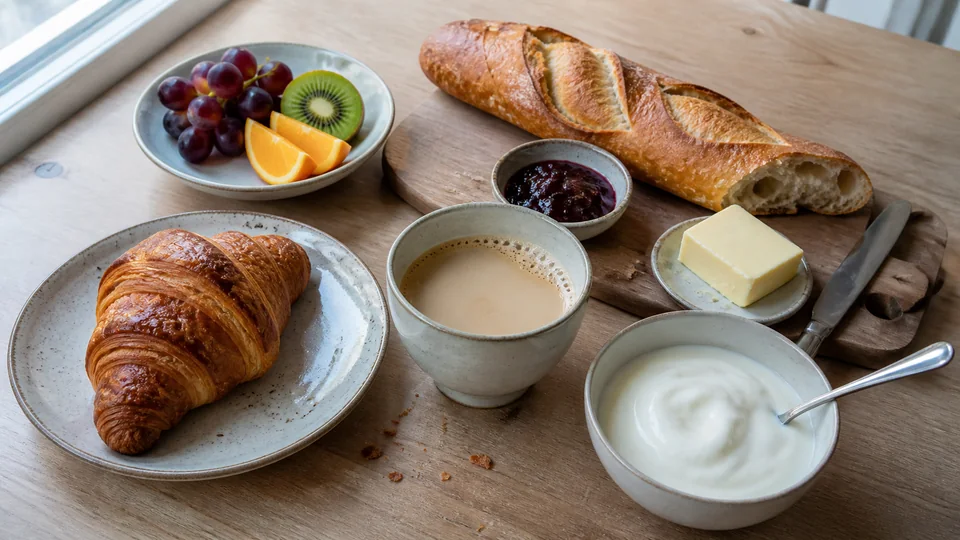
The most useful way to explore French breakfast foods is to separate the everyday framework from bakery treats and regional specialties. That avoids the cliché that a croissant alone represents every French morning. This is a cultural and menu-planning guide, not a tested recipe collection. Visit the breakfast hub for more morning formats, or return to Pancake World for the full site.
For broader context, continue with World Pancakes: Dishes and Traditions.
The core petit-déjeuner pattern
Atout France, the country’s official tourism development agency, describes a traditional hotel “continental” breakfast around baguette, tartines with butter, jam or honey, viennoiseries, fruit juice and a hot drink. That list is a clear orientation point, but it should not be mistaken for a census of every household.
The framework has five movable parts:
- Bread: fresh baguette, another loaf, or toasted slices.
- Spread: butter, jam, honey or a restrained combination.
- Viennoiserie: croissant, pain au chocolat, brioche or pain aux raisins.
- Drink: coffee, tea or hot chocolate.
- Optional fresh element: fruit or juice.
You do not need every category at one sitting. Bread plus coffee is one coherent small breakfast. Tartines, fruit and tea make another. A pastry and hot chocolate can be an occasional bakery-led version. A larger hotel buffet may add eggs, cheese, yogurt, cereal and cold items, but that does not make the expanded buffet the definition of breakfast across France.
Use the framework as a decision tool: choose one principal starch, one spread or filling, one drink and an optional fresh element. That keeps the table legible and lets the quality of bread or pastry matter.
Tartines: the everyday center of gravity
A tartine is an open slice or length of bread with a topping. At breakfast, the familiar version uses butter, jam or honey. It is less a fixed recipe than a serving format.
Start with bread whose crumb can carry the chosen spread. A fresh baguette offers a crisp crust and chewy interior; a toasted slice is firmer and warmer. Cut a long baguette crosswise for manageable pieces, then split if you want a broader surface. Apply butter while the bread is warm if you want it to soften, or wait until it cools slightly for a more distinct layer.
Use one jam at a time when tasting the bread itself. Combining butter and jam is common within the documented breakfast pattern, but flooding the surface makes the tartine difficult to pick up. Serve extra spread at the table rather than preloading every piece.
For a group, keep bread on a board, butter in a clean serving dish and each jam in its own vessel with a dedicated spoon. Original packaging should remain available for ingredient and allergen checks. Shared knives moved between butter, jam and nut-containing spreads create cross-contact and a messy jar even when no guest has an allergy.
A savory tartine is also possible. Atout France gives a Camembert tartine as a Normandy breakfast example. Treat that as regional breadth, not as evidence that cheese toast is a universal daily habit. If serving cheese, follow its package refrigeration and use instructions and keep it separate from sweet spreads.
Why baguette matters—and what UNESCO actually recognizes
UNESCO inscribed the artisanal know-how and culture of baguette bread on the Representative List of the Intangible Cultural Heritage of Humanity in 2022. The record describes the traditional process as weighing and mixing, kneading, fermenting, dividing, resting, shaping, proofing, scoring and baking. It also identifies four basic ingredient categories: flour, water, salt and leaven and/or yeast.
The inscription covers knowledge and culture, not a claim that one loaf is nutritionally superior or that every long bread outside France is inauthentic. UNESCO notes that baguettes are baked in small batches through the day and are connected to social practices such as regular bakery visits.
For breakfast planning, that context explains why timing matters. A baguette purchased close to service offers the crust-and-crumb contrast central to the experience. If you are recreating the meal elsewhere, buy from a bakery whose bread you enjoy and plan service around the loaf rather than expecting refrigeration or reheating to restore every fresh quality.
Do not turn the UNESCO status into a product logo claim. It recognizes an element of living heritage. A specific commercial loaf still needs its own ingredient and allergen information.
Croissant: one pastry, not the whole breakfast
The butter croissant is a visible symbol of French bakery culture and appears in Atout France’s breakfast overview. Its laminated structure gives a crisp exterior, distinct layers and a tender interior when well made. That makes it satisfying with a hot drink, but it does not prove that every French breakfast includes one.
Treat croissant origin stories cautiously. Atout France itself presents the Marie Antoinette and Austrian kipfel account among legends and describes the origins as uncertain. A responsible guide should not repeat one attractive story as settled history.
When buying, decide whether the croissant will be the main starch or one item in a tasting spread. One full pastry plus baguette, brioche and pain au chocolat can make the table repetitive. For a group exploration, divide pastries so each person can compare small portions. Use a serrated knife and avoid crushing the laminated structure.
Serve croissants the day they are purchased when possible, following the bakery’s handling advice. If a packaged product provides heating instructions, use them. A generic oven temperature and time cannot account for size, filling, previous baking or packaging.
Pain au chocolat and the name chocolatine
Pain au chocolat places chocolate inside a rectangular laminated pastry. Atout France notes that chocolatine is the regional name encountered in Bordeaux, Occitanie and much of southwest France. The naming difference is culturally interesting; it is not a reason to tell a traveler that one term is universally correct everywhere.
Choose pain au chocolat when you want the pastry itself to provide the sweet filling. Adding jam, honey and sweetened hot chocolate may overwhelm the contrast between pastry and chocolate. A less sweet drink or a piece of fruit can make the selection easier to appreciate.
For labeling, chocolate introduces ingredients beyond the pastry base. Milk, soy, nuts or other allergens may appear depending on the exact bakery and chocolate. Ask the bakery or retain the package; do not infer an allergen profile from the French name.
Brioche: bread-like form, richer formula
Brioche belongs to the breakfast pastry and enriched-bread family, with a soft crumb and a richer ingredient pattern than baguette. It can be sliced plain, lightly toasted or served with a modest spread. Because formulas vary, rely on the specific producer for ingredients.
The INAO record for Brioche vendéenne describes a protected regional product with a soft braided form and a profile rich in eggs, sugar and butter, sometimes with aromatic notes specified by its production tradition. It identifies breakfast as one use alongside festive occasions. That record applies to the named IGP product, not to every loaf labeled brioche.
This distinction matters when shopping. “Brioche” is a broad food name; “Brioche vendéenne IGP” identifies a protected product tied to a specification and geographical origin. The official sign does not mean every eater must prefer it, and it does not replace the ingredient list.
At a breakfast table, brioche can replace—not merely accompany—the baguette or croissant. Pair it with coffee or tea and one tart spread. Toast carefully because its sugar and fat can brown quickly.
Pain aux raisins and other viennoiseries
Pain aux raisins is another item in the Atout France breakfast list. It is generally recognized by its spiral form, laminated or enriched dough and raisins, but exact pastry cream, glaze and dough vary by baker. Buy it as a distinct filled pastry rather than assuming it is a croissant with raisins.
The broader category viennoiserie includes bakery goods whose dough and shaping sit between bread and pastry in everyday shop organization. For the reader, the practical point is choice: a plain croissant emphasizes butter and lamination; pain au chocolat adds a chocolate center; pain aux raisins adds fruit and often a softer, sweeter interior; brioche offers a tender enriched crumb.
Choose one based on texture, filling and portion. A mixed box works for a group, but label the varieties before cutting so fillings and allergens are not confused.
Hot drinks: build the pairing, not a stereotype
Official tourism guidance places coffee, tea and hot chocolate in the standard breakfast frame. It also describes fruit juice as common, particularly orange or grapefruit. These are choices, not mandatory components.
Coffee can be served in several formats depending on home, café or hotel context. Avoid presenting one cup size or milk ratio as the only authentic French order; menus and household habits vary. When ordering, read the local menu and ask what is included rather than assuming that “coffee” means a specific preparation.
Hot chocolate pairs naturally with plain bread or croissant but can make a chocolate-filled pastry feel very sweet. Tea gives a quieter backdrop for jam, honey or regional cake. Juice adds acidity and freshness but also another sweet-tasting element, so it need not appear beside jam, pastry and sweetened chocolate at every meal.
Serve dairy or plant-based milk according to package instructions. A broad cultural guide cannot establish the allergen, sugar or nutrition profile of a café’s beverage without its actual recipe.
Regional breakfast foods broaden the map
France.fr’s regional breakfast overview names several foods beyond the familiar Parisian image. Use them as documented possibilities tied to place, not as an exhaustive catalog.
Kougelhopf in Alsace
The tourism source describes kougelhopf as a high, fluted brioche associated with almonds and raisins. A slice offers a different crumb and fruit profile from a laminated croissant. Exact alcohol, nut and fruit ingredients vary by formula, so check before serving.
Kouign-amann in Brittany
Kouign-amann is presented as a Breton specialty with a caramelized crust and layered, buttery structure. It is rich enough to function as the central pastry. Cut small portions for a tasting table and pair with an unsweetened drink if desired.
Tarte Tropézienne in Provence and the Côte d’Azur
Atout France describes this regional option through brioche, cream and sugar. Because it contains a cream filling, handling and refrigeration depend on the producer. Do not leave it on a breakfast buffet based on the rules for an unfilled loaf.
Teurgoule in Normandy
The source identifies teurgoule as a preparation based on rice, milk and cinnamon with a browned crust. It changes the breakfast format from handheld bread to a spooned dish. Use a complete recipe or buy from a producer; this guide does not supply safe baking or cooling directions.
Camembert tartine in Normandy
This savory example demonstrates that the official tourism picture is not entirely sweet. Serve the cheese within its handling guidance and provide a dedicated knife. Do not imply that all Camembert has identical production or pasteurization.
Brioche vendéenne in Vendée
The INAO record supports its breakfast role and protected regional identity. Look for the IGP designation when that precise product is the goal. A generic braided brioche is not automatically Brioche vendéenne IGP.
Regional products show why “French breakfast” should not be reduced to a single national plate. Travel, season, household routine and local bakery all change what is available.
What AOP and IGP labels can—and cannot—tell you
France’s INAO explains that an AOP identifies a product whose production stages take place according to recognized know-how in the same geographical area; the European designation protects the name. An IGP also links a product to a geographical origin under its applicable specification, though the legal structure is not identical.
For a breakfast shopper, these labels can establish protected origin and production rules. They do not promise that the product suits your taste, diet, allergy needs or budget. Keep four decisions separate:
- identity: is this the protected product named on the label?
- ingredients: what does this exact package or bakery formula contain?
- handling: does it require refrigeration or special service?
- preference: do you enjoy its texture and flavor at breakfast?
Do not use a protected-origin logo as shorthand for “healthier” or “best.” Those are different claims requiring different evidence.
Assemble a French-style breakfast at home
Use this controlled plan rather than attempting ten pastries at once.
Option 1: everyday tartine breakfast
- fresh bread or lightly toasted slices;
- butter and one jam or honey;
- coffee, tea or hot chocolate;
- whole fruit if wanted.
Cut bread just before service. Put spreads in small clean vessels, preserve their labels and avoid dipping used knives into the main packages.
Option 2: bakery breakfast
- one selected viennoiserie per person or a divided tasting assortment;
- a hot drink;
- fruit or juice as an optional counterpoint.
Do not add baguette by default if the pastry is already the central starch. Buy filled pastries close to service and follow bakery handling advice.
Option 3: regional tasting
- one documented regional item;
- plain bread for contrast;
- a simple drink;
- written labels identifying region and major ingredients.
Choose one region at a time. A Brittany, Alsace, Normandy, Provence and Vendée buffet may be educational, but it is not an ordinary daily French breakfast.
Option 4: savory variation
- baguette tartine;
- a cheese or egg component from a complete safe method;
- fruit or a simple drink;
- sweet spread served separately.
Keep cold dairy under refrigeration until service. Cook eggs by a validated method rather than relying on an attractive photograph.
Order at a boulangerie, café or hotel with fewer assumptions
At a boulangerie, identify whether food is primarily takeaway and whether seating or drinks are offered. Look at the case before deciding. Ask which pastries are filled, which contain nuts and what was baked most recently; accept that the answer varies by shop and time.
At a café, breakfast may be sold as a formula combining a hot drink, juice and bread or pastry. Read the listed components. “Continental” does not guarantee the same menu everywhere, and supplements or substitutions may change the order.
At a hotel, distinguish the base continental selection from a larger buffet or cooked option. If eggs, meats, cheeses and yogurt are added, think of them as expanded service rather than proof that the traditional small breakfast description was false.
For allergies, ask direct product-specific questions. “French pastry” is not an ingredient list. Wheat, milk and egg are common possibilities; chocolate, nuts, sesame, soy, alcohol or fruit fillings can add more. Cross-contact in a shared bakery is also a separate question from recipe ingredients.
Avoid relying on venue names or old online menus. Operating hours, prices, recipes and availability change. This guide intentionally offers no current restaurant ranking.
Do not confuse petit-déjeuner with brunch
Petit-déjeuner and brunch can overlap in a hotel or café, but they answer different practical needs. The core breakfast pattern is compact: bread or pastry, a spread, a drink and perhaps fruit or juice. Brunch is usually a longer mixed meal and may bring in eggs, salads, cooked savory dishes, cheese, desserts and several drinks. A Sunday brunch menu therefore should not be used as proof of what a routine weekday French breakfast contains.
When recreating the smaller meal, resist adding eggs, bacon, cheese, yogurt, granola and several pastries merely to make the table look complete. Choose depth instead of width: fresher bread, one well-matched spread and a carefully made drink. If guests need a more substantial meal, name it as an expanded breakfast or brunch and organize hot and cold foods with their own safety controls.
This distinction also helps when reading travel menus. A low-priced café formula, a hotel buffet and a destination brunch are not comparable products. Check what each price includes on the day of service; do not carry a menu description from one context into another. The culture is better represented by acknowledging several service formats than by forcing them into one supposedly authentic plate.
Serve a group without losing texture
Breakfast bread and pastry are sensitive to time, air and crowding. Set up small batches. Keep crusty bread out of sealed humid containers during short service, but protect cut surfaces from excessive drying. Do not place warm pastry directly under a tight cover if trapped steam will soften it.
Use separate boards or trays for plain bread, filled pastries and regional cakes. Provide tongs that remain with each tray. Label dairy-filled items and return them to temperature control according to producer directions.
Arrange the table in this order:
- plates and napkins;
- bread and pastries;
- butter, jam and honey;
- fruit or juice;
- hot drinks away from the crowded food area;
- ingredient and allergen information.
This order prevents guests from carrying hot cups backward through the serving line. It also keeps shared spread utensils away from pastry trays.
Common mistakes in English-language guides
“Everyone in France eats croissants every morning”
The official tourism overview lists croissants among the breakfast possibilities, but it also centers baguette and tartines. Present croissant as an iconic option, not a measured universal habit.
“French breakfast is always sweet”
The core pattern often includes jam, honey or pastry, yet France.fr also names a Camembert tartine in Normandy and describes broader café or hotel choices. Sweet is a strong pattern, not an absolute law.
“Pain au chocolat and chocolatine are different pastries”
In the cited tourism context, chocolatine is a regional name for the chocolate-filled rectangular pastry known elsewhere as pain au chocolat. Bakery formulas can still differ.
“UNESCO protects every baguette recipe”
The inscription recognizes artisanal know-how and culture. It does not certify every retail loaf or eliminate variation among bakers.
“AOP means objectively best”
AOP establishes protected origin and recognized geographical know-how. Preference and suitability remain individual.
Repeating a croissant legend as fact
The official tourism article flags origin stories as legends and calls the history uncertain. Preserve that uncertainty.
Publishing nutrition totals for a generic breakfast
Portions and formulas vary across bread, butter, jam, pastry and drinks. Use the labels or recipes for the exact items served.
A decision table for first-time exploration
| If you want… | Start with… | Add… | Skip at first… |
|---|---|---|---|
| the everyday framework | baguette tartines | butter, one jam and coffee or tea | multiple pastries |
| laminated pastry texture | plain croissant | unsweetened hot drink | several sweet spreads |
| chocolate | pain au chocolat | fruit or coffee | extra chocolate sauce |
| soft enriched crumb | brioche | a restrained spread | a second rich pastry |
| regional context | one named specialty | a label explaining its place | a mixed “all France” claim |
| savory breakfast | cheese tartine | fruit or hot drink | automatic jam on the same slice |
| hotel-style variety | bread, pastry, fruit and drink | optional dairy or eggs | assuming the buffet is a household norm |
The table creates a manageable first meal. On later breakfasts, change one variable: compare bread, choose another viennoiserie or explore a regional specialty. Repetition with one deliberate change teaches more than an overloaded buffet.
Frequently asked questions
What foods are in a traditional French breakfast?
Official French tourism guidance describes baguette or tartines with butter, jam or honey; viennoiseries such as croissants, pains au chocolat, brioche and pains aux raisins; juice; and coffee, tea or hot chocolate.
Do French people eat croissants every day?
It is an iconic bakery and breakfast food, but no authoritative source used here supports a claim that everyone eats one daily. Tartines and baguette are equally important to the documented core pattern.
What is a tartine?
For breakfast planning, it is an open piece of bread topped with butter, jam, honey or a savory ingredient. It is a format rather than one fixed recipe.
Is French breakfast always continental?
“Continental” describes the familiar bread, pastry, drink and juice format in hotels. Actual homes, cafés and hotels vary, and larger services may include cooked or savory foods.
What is the difference between pain au chocolat and chocolatine?
France.fr documents chocolatine as a regional name used in Bordeaux, Occitanie and much of southwest France for the chocolate-filled pastry commonly called pain au chocolat elsewhere.
Which regional foods can appear at breakfast?
The official tourism overview names Alsatian kougelhopf, Breton kouign-amann, Provençal tarte Tropézienne, Norman teurgoule and Camembert tartine. INAO also documents Brioche vendéenne as a protected product eaten at breakfast and festive occasions.
Does a protected-origin label guarantee better flavor?
No. It verifies a protected identity and production relationship under the applicable rules. Taste preference, ingredients and handling still require separate evaluation.
Can I make these foods from this article?
This article does not supply tested formulas. Use a complete reliable recipe for laminated pastry, enriched bread, dairy-filled cake, rice pudding or cooked eggs, and follow all cooling and storage instructions.
Final perspective
French breakfast foods make more sense as a flexible structure than as a postcard. Start with bread or one viennoiserie, add a spread if the starch needs it, choose a hot drink and decide whether fruit or juice improves the meal. Then explore regional foods one at a time.
Keep evidence boundaries visible: Atout France supports the core menu and regional examples; UNESCO documents baguette know-how and culture; INAO explains protected product identities. None of those sources proves that every household eats the same way. A careful breakfast guide celebrates recognizable foods while leaving room for place, routine and personal choice.
Explore related Pancakes World guidance on American Pancakes, American Breakfast: Pancakes, Diner Plates and Brunch, and Maple Syrup.
Sources and editorial references
- Atout France, “Breakfast: regional traditions and good places to eat”:
https://www.france.fr/en/article/art-french-breakfast/ - UNESCO Intangible Cultural Heritage, “Artisanal know-how and culture of baguette bread”:
https://ich.unesco.org/en/RL/artisanal-know-how-and-culture-of-baguette-bread-01883 - Atout France, “Find out more about France's favorite snack: the croissant”:
https://www.france.fr/en/article/croissants-france-favorite-snack/ - Atout France, “5 minutes pour tout savoir sur le pain français”:
https://www.france.fr/fr/article/5-minutes-pour-tout-savoir-sur-le-pain-francais/ - Institut national de l'origine et de la qualité, “Brioche vendéenne”:
https://www.inao.gouv.fr/produit/brioche-vendeenne-23038 - Institut national de l'origine et de la qualité, “Appellation d'origine protégée / contrôlée”:
https://www.inao.gouv.fr/aop-appellation-origine-protegee