Freezer breakfast
At Pancakes World, choose one freezer breakfast that has a complete freeze-and-reheat method, then treat freezing as part of the recipe rather than an afterthought. Cook every component to its safe endpoint, remove excess filling moisture, cool promptly in shallow portions, package in meal-size units, label the item and date, and freeze in a single layer before stacking. Keep the freezer at 0°F (-18°C) or below. Thaw in the refrigerator, cold water or microwave only when the source method calls for it, or reheat safely from frozen. Heat leftovers to 165°F (74°C) and check more than one spot after the microwave rest. Freezing pauses microbial growth; it does not repair unsafe cooking or cooling.
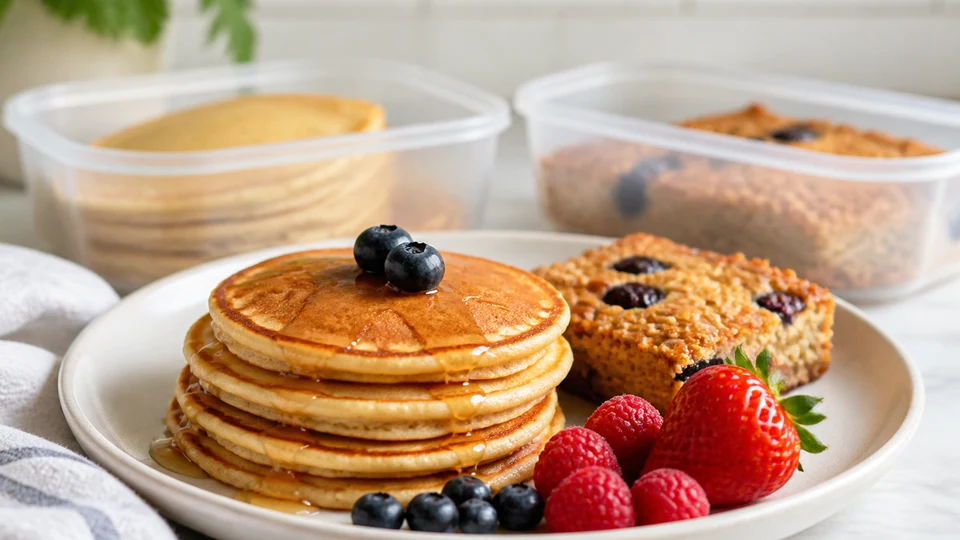
This is a focused freezer workflow and selection guide, not a project-tested recipe or a weekly batch-production plan. The pancake storage and reheating hub covers related formats, while Pancake World opens the full collection.
| Guide sections |
|---|
| Start with the reheating method |
| Choose a freezer-breakfast format |
| Separate safety from quality |
| Cook the breakfast completely |
For broader context, continue with Storing and Reheating Pancakes.
Start with the reheating method
The best freezer candidate is not simply a breakfast you enjoy fresh. It is a complete formula whose packaging, frozen storage and reheating steps match the appliance you will actually use.
Ask four questions before shopping:
- Will the item be reheated in a microwave, oven, toaster, skillet or saucepan?
- Will it be thawed first or heated from frozen?
- Can its centre be measured accurately?
- Does the source describe the quality after freezing, not merely permission to freeze?
A wrapped burrito reheated in a microwave needs different moisture and wrapping controls from a waffle reheated in a toaster. A baked casserole portion needs a container that fits the oven or microwave and a method that heats the centre before the edges dry.
USDA FSIS states that frozen leftovers can be reheated without thawing in a saucepan, oven or microwave, but it will take longer. That is a safety permission, not a universal quality instruction. The recipe still decides whether direct-from-frozen reheating produces a useful result.
Choose a freezer-breakfast format
Individually wrapped burrito
This is the strongest source-supported worked example for the route. Iowa State University Extension publishes a make-ahead breakfast burrito with potato, onion, pepper, egg, cheese and flour tortilla. The filling cooks until no liquid remains, each tortilla receives a measured portion, and the burritos are wrapped tightly, frozen in one layer, then transferred to a freezer bag.
USDA WIC Works publishes another breakfast burrito. It warms tortillas before assembly, cooks egg through, portions egg, beans and other fillings, wraps each burrito and provides oven and microwave reheating directions with a 165°F centre.
These formulas prove that freezer burritos can be documented successfully. They do not prove that any mixture of egg, salsa, avocado, yogurt, meat and vegetables will thaw with the same texture. Follow one full ingredient list and its method.
Choose the burrito when portability and an individual package matter. Reject it when the available tortilla is too small for the source portion, the filling remains visibly wet, or the only reheating appliance cannot follow the method.
Pancake or waffle
A pancake or waffle can be a candidate when the complete recipe explicitly includes cooling, separating, packaging and reheating instructions. The formula should tell you whether to freeze pieces individually before bagging, how to prevent sticking, and which appliance restores the intended exterior.
Do not assume every pancake freezes equally. Fruit pieces, high-moisture batters, delicate egg-heavy styles and crisp waffles can respond differently. A toaster method appropriate for a firm waffle may be unsuitable for a very soft pancake.
If making from batter, remember that flour is raw. FDA advises never tasting raw dough or batter and cleaning hands, bowls, utensils and surfaces after contact. Freeze the fully cooked breakfast unless the tested source specifically covers frozen raw batter.
Baked portion
An egg casserole, baked oatmeal, muffin, biscuit or breakfast bar can be divided into portions after the source’s cooling stage. The advantage is repeatable size; the risk is a dense centre that reheats more slowly than the edges.
Choose this lane only when the formula gives portion, packaging and reheat guidance. FoodSafety.gov and USDA guidance require leftovers to reach 165°F. A hot container edge or melted cheese does not prove the middle is hot.
NCHFP’s prepared-food freezing guidance notes that foods vary in freeze quality and that some sauces, emulsions and other components can separate or lose texture. Select the formula rather than promising that every bake will remain unchanged.
Bowl, hash or grain portion
A cooked grain, potato hash, bean mixture or breakfast bowl can be frozen in a shallow meal-size container. This lane works when the source has a complete cooling and reheat method and when toppings can be separated.
Keep fresh herbs, crisp vegetables, yogurt, salsa or other quality-sensitive toppings outside the frozen base unless the formula includes them. The frozen container should hold the food intended to be heated together.
Choose a shallow shape that allows fast cooling and even reheating. Do not freeze a deep family-size pot merely because it fits in the freezer.
Separate safety from quality
USDA FSIS explains that food held continuously at 0°F remains safe indefinitely, while recommended freezer times describe quality. Freezing inactivates microbes but does not reliably destroy them. Once thawed, microbes can become active again.
That creates three separate statements:
- Safety before freezing: the food was cooked correctly and cooled promptly.
- Safety during storage: it remained frozen at 0°F or below without an unsafe temperature excursion.
- Quality target: the source gives a time in which texture, moisture and flavour are expected to remain acceptable.
Do not convert a quality time into a claim that the food becomes unsafe on the next day. Do not use indefinite frozen safety to promise indefinite good texture.
USDA’s general leftover guidance lists three to four months for frozen leftovers as a broad quality range, while its freezer chart gives category-specific ranges. WIC’s burrito formula gives its own storage instruction. Use the most specific authoritative direction for the chosen item and label the package so it can be evaluated on time.
Cook the breakfast completely
Freezing is not a cooking step. Raw or partly cooked ingredients should reach the endpoint required by the complete formula before a cooked freezer breakfast is assembled.
For egg-based food, FDA says egg dishes should reach 160°F (71°C). The Iowa burrito filling is cooked until no liquid remains. For meat, poultry or fish, use the applicable FoodSafety.gov category. A tortilla or biscuit browning on the outside does not verify a hidden filling.
Use clean utensils for finished food. Keep raw egg, flour, meat and poultry away from cooked components and ready-to-eat toppings. If a recipe contains several raw categories, organise the work so one contaminated board or spatula does not move through the finished assembly line.
Cool quickly without damaging the format
USDA FSIS recommends rapid cooling in shallow containers or smaller portions. Hot food can go directly into the refrigerator in appropriately divided quantities; a deep stockpot or tightly packed warm pile cools more slowly.
For a burrito, “cool the filling” does not mean leave a skillet at room temperature until it feels cold. Divide the cooked filling into a shallow container, refrigerate promptly, and assemble under the source’s method. If the authoritative formula assembles before freezing, follow its exact timing and packaging direction.
For a baked item, use the recipe’s pan-cooling period, then portion and move food into controlled refrigeration or freezing. A cooling rack may improve exterior texture, but it does not replace the two-hour limit for perishables.
For a bowl, divide first. Small shallow portions both cool and reheat more evenly. Label containers before they become cold and difficult to identify through frost.
Package against air, moisture loss and confusion
USDA advises wrapping leftovers well in airtight freezer packaging or sealed containers. Proper packaging reduces moisture loss, odour transfer and surface drying; it does not sterilise the food.
Wrapped items
Follow the source’s material order. Iowa State uses tight individual wrapping followed by a freezer bag after the burritos freeze in a single layer. WIC describes plastic wrap and foil. Remove materials exactly as its reheating method directs; foil never belongs in a microwave.
Flat items
Separate pancakes or waffles using the source’s method so they can be removed individually. Press excess air from the outer bag without crushing the food. Freeze flat before stacking if the formula directs.
Container meals
Leave only the headspace the selected freezer container and food require. Use a container rated for freezing and, if reheating in it, for the intended appliance. A lid that is freezer-safe is not automatically microwave-safe.
Every package label should include:
- item name;
- freeze date;
- number of portions;
- thaw requirement;
- reheating appliance and key step;
- allergen note needed by the household;
- discard or quality target from the source.
The label turns a frozen object into a usable breakfast. Without it, the cook may guess whether foil is hidden inside or whether the item was meant to thaw first.
Freeze rapidly and avoid overloading
USDA FSIS recommends freezing food rapidly and spreading new packages in a single layer until solid rather than stacking them warm. Faster freezing limits the formation of large ice crystals that damage texture.
Do not place a large volume of hot food directly into the freezer. Cool safely and follow the appliance’s capacity guidance. Leave air space around new packages so cold can circulate. Stack only after they are frozen solid.
Keep a freezer thermometer and maintain 0°F (-18°C) or below. A frost-covered package does not prove the appliance stayed at the correct temperature.
Thaw safely—or do not thaw
USDA identifies the refrigerator, cold water and microwave as safe thawing methods. Counter thawing, a warm car, garage or porch is not a safe shortcut.
Refrigerator
Move the labelled portion to the refrigerator in time for the source’s thaw window. Keep it covered and contain any leakage. USDA says thawed leftovers should generally be used within three to four days, but the selected formula can require less.
Cold water
Use a leak-proof bag, keep the water cold and change it every 30 minutes. Food thawed this way should be cooked before refreezing. This route is often unnecessary for small breakfast portions unless the formula permits it.
Microwave
Microwave thawing begins warming some areas. Continue immediately into reheating until the food reaches 165°F. Do not partially microwave and leave the item on the counter.
Direct from frozen
USDA permits reheating many frozen leftovers without thawing. Use the source’s appliance, power, covering, rotation and rest. Expect a longer process than with thawed food.
Reheat the centre, not only the surface
Reheat leftovers to 165°F (74°C). In a microwave, cover the food, rotate or stir where possible, and allow the specified standing time. Check temperature in several places because microwaves create cold spots.
For a burrito, the ends can steam while the dense centre remains cold. Insert the thermometer into the centre from more than one direction without reading only hot tortilla or melted cheese.
For a casserole portion, spread or divide it if the source permits. For a bowl, stir midway so the centre and edges exchange heat. For a pancake or waffle, use the source appliance and verify any perishable filling separately.
Never use a slow cooker to reheat frozen or refrigerated leftovers. USDA recommends reheating by stovetop, oven or microwave before using a suitable hot-holding device.
Diagnose freeze-and-reheat failures
Burrito is wet at the seam
The filling may have contained too much liquid, been wrapped while releasing steam, or included a fresh topping unsuited to the method. Return to the source ingredient list and cooling sequence. Keep salsa or yogurt separate next time when the formula does not freeze it inside.
Tortilla splits
It may have dried before assembly, been overfilled, wrapped loosely, or reheated without the method’s moisture control. Confirm tortilla diameter, warming, filling quantity and wrapping.
Pancake edges are dry
Air exposure, long reheating or an unsuitable appliance may be responsible. Improve airtight packaging and follow the source’s reheating step. Do not add syrup before freezing unless the formula includes it.
Waffle is limp
A covered microwave can retain moisture rather than restore a crisp exterior. Use the toaster or oven only if the complete source supports it. Safety and crispness are separate goals.
Casserole centre stays cold
The portion may be too thick or the power and rest insufficient. Follow the source container depth and reheating method, cover or rotate as directed, and verify 165°F in several places.
Ice crystals cover the food
Packaging may have admitted air, the item may have been warm when packed, or the freezer may have fluctuated. Ice crystals and freezer burn primarily signal quality loss, but a temperature excursion needs a separate safety assessment.
Sauce separates
Some cream sauces, emulsions and starch systems do not retain their fresh texture after freezing. Choose a freezer-tested formula or freeze the solid base and prepare the sauce later when the source allows. Do not promise that vigorous stirring will fix every separated sauce.
Power outage and partial thawing
Keep the freezer door closed. USDA says a full freezer can hold temperature for roughly two days and a half-full freezer about one day when unopened, but the actual item assessment still depends on temperature and ice crystals.
If food still contains ice crystals or is at 40°F (4°C) or below, USDA says it may be refrozen or used, though quality can decline. Discard perishable breakfast food that has been above 40°F for more than two hours. Do not taste it to decide.
Inspect each package separately. Raw meat juices contacting a breakfast item create a discard reason even when the breakfast still feels cold.
Allergen and label control
Freezing does not remove allergens. Breakfast burritos can contain egg, milk and wheat; pancakes and waffles often contain egg, milk and wheat; toppings and plant-based products can introduce soy, sesame, peanuts or tree nuts.
Read current labels during cooking and record relevant allergens on the freezer label. Use clean equipment and prevent shared spatulas, cooling racks or bags from transferring residues.
Do not call a package allergy-safe solely because it is individually wrapped. The ingredient and preparation evidence must already support the claim before freezing.
Frequently asked questions
What breakfast freezes well?
Choose a complete source-tested freezer recipe. Authoritative examples include individually wrapped breakfast burritos. Pancakes, waffles, baked portions and bowls can work only when their own formulas supply cooling, packaging and reheating directions.
Does freezing kill bacteria?
No. USDA explains that freezing inactivates microbes while food remains frozen; they can become active again after thawing. Cook and cool safely before freezing.
What temperature should the freezer be?
0°F (-18°C) or below. Use an appliance thermometer rather than relying on the dial.
Can I freeze hot food immediately?
USDA allows hot food to go into the refrigerator when divided appropriately, but rapid cooling in shallow portions is essential. Follow the formula and appliance guidance before freezing; do not load the freezer with a deep hot container.
Must breakfast thaw before reheating?
Not always. USDA permits many leftovers to be reheated from frozen, but the complete recipe determines the appliance and method. Direct heating takes longer.
Can I thaw breakfast on the counter overnight?
No. Use the refrigerator, cold water or microwave according to USDA guidance. Microwave-thawed food must continue immediately to full reheating.
How hot should reheated breakfast be?
165°F (74°C) in the coldest part. In a microwave, cover, rotate or stir where possible, rest, and check several locations.
How long is frozen breakfast safe?
Food continuously held at 0°F remains safe indefinitely according to USDA, while storage times describe quality. Use the selected recipe’s quality target and discard food after an unsafe temperature excursion.
Can a thawed breakfast be refrozen?
USDA allows food thawed in the refrigerator to be refrozen without cooking, though quality may decline. Food thawed by cold water should be cooked first; microwave-thawed leftovers should reach 165°F before refreezing.
Is a freezer breakfast healthy?
This page makes no health or nutrition claim. Nutrition depends on exact foods, amounts, yield and serving. Freezing method alone does not establish nutritional suitability.
Final freezer checklist
Accept the item only when:
- one complete source recipe includes freezing and reheating;
- every component is fully cooked before freezing when required;
- excess filling moisture is controlled;
- food cools rapidly in small or shallow portions;
- each meal receives airtight freezer packaging;
- the label includes identity, date, instructions and allergens;
- new packages freeze in one layer before stacking;
- the freezer remains at 0°F or below;
- thawing uses refrigerator, cold water or microwave only;
- microwave thawing continues immediately to reheating;
- the centre reaches 165°F in several checked spots;
- safety and quality times are not conflated;
- no universal texture, product endorsement or project test is claimed.
Explore related Pancakes World guidance on American Pancakes, American Breakfast: Pancakes, Diner Plates and Brunch, and Maple Syrup.
Sources and editorial references
- USDA FSIS Freezing and Food Safety —
https://www.fsis.usda.gov/food-safety/safe-food-handling-and-preparation/food-safety-basics/freezing-and-food-safety - USDA FSIS Leftovers and Food Safety —
https://www.fsis.usda.gov/food-safety/safe-food-handling-and-preparation/food-safety-basics/leftovers-and-food-safety - USDA FSIS Keeping Food Safe During an Emergency —
https://www.fsis.usda.gov/food-safety/safe-food-handling-and-preparation/food-safety-basics/keeping-food-safe-during - National Center for Home Food Preservation —
https://nchfp.uga.edu/papers/UGA_Publications/FreezingPreparedFoods.pdf - Iowa State University Extension and Outreach —
https://spendsmart.extension.iastate.edu/recipe/make-ahead-breakfast-burritos/ - USDA WIC Works Breakfast Burrito —
https://wicworks.fns.usda.gov/es/node/2103 - U.S. Food and Drug Administration Egg Safety —
https://www.fda.gov/food/buy-store-serve-safe-food/what-you-need-know-about-egg-safety - U.S. Food and Drug Administration Flour Safety —
https://www.fda.gov/food/buy-store-serve-safe-food/handling-flour-safely-what-you-need-know - U.S. Food and Drug Administration Food Allergies —
https://www.fda.gov/food/nutrition-food-labeling-and-critical-foods/food-allergies