Fluffy vegan buckwheat pancakes
At Pancakes World, for fluffy vegan buckwheat pancakes, choose a tested formula that names the exact buckwheat flour proportion, vegan binder, plant beverage, leavener, acid if required, batter rest, portion size and pan heat. Buckwheat flour is not a one-for-one universal replacement for wheat flour, and removing egg without replacing its structural role can produce fragile pancakes. Follow the recipe’s mixing order, let any flax, chia or other binder hydrate for the stated time, portion small enough for the center to set, and flip only after the source’s edge, surface and release cues agree. For gluten control, use suitably labeled buckwheat flour and verify every other ingredient and shared surface.
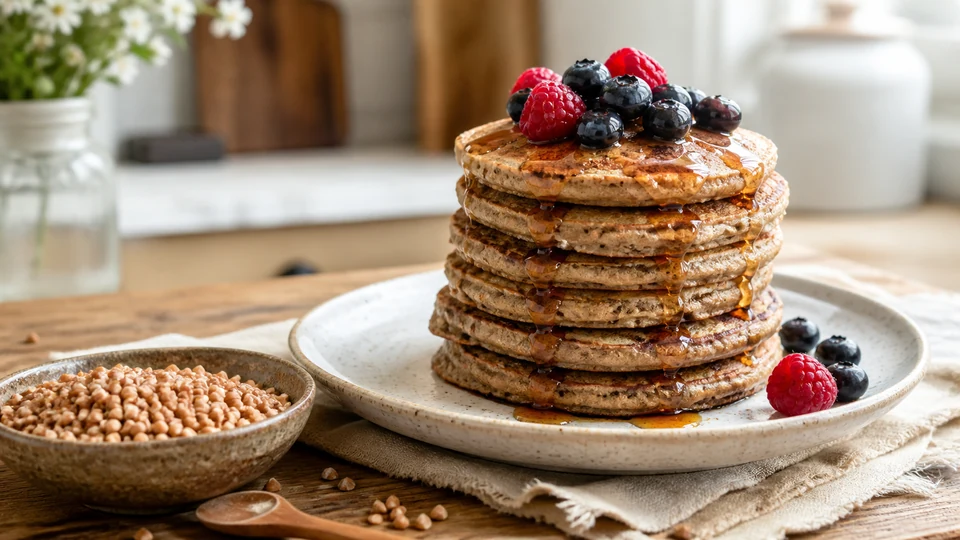
This page is a method-selection and troubleshooting guide. It does not provide an untested Pancake World formula, exact yield or nutrition panel.
| Guide sections |
|---|
| What “fluffy,” “vegan” and “buckwheat” each require |
| Select the formula before the ingredients |
| Decide between all-buckwheat and blended flour |
| Understand the vegan binder as a function |
For broader context, continue with Healthy Pancake Guides.
What “fluffy,” “vegan” and “buckwheat” each require
These three words describe different parts of the result.
Fluffy refers to the pancake’s lift and internal structure. Leavening can create gas, but the batter also needs enough structure to retain it and enough controlled heat to set before collapse.
Vegan means the complete formula and toppings exclude animal-derived ingredients according to the eater’s practice. Egg, dairy, honey and certain processed additions need review. A plant beverage alone does not make the recipe vegan.
Buckwheat identifies the flour direction. Penn State Extension notes that buckwheat flour is used in pancakes, muffins and breads. That confirms culinary use, not a universal substitution ratio or a promise that every buckwheat batter becomes fluffy.
A successful source recipe must address all three. A conventional fluffy pancake with buckwheat added casually may fail the vegan gate. A vegan pancake may contain only wheat. A 100-percent buckwheat formula may use a different structure from a blended-flour version.
Select the formula before the ingredients
Look for a complete source that provides:
- buckwheat flour type and measured amount;
- whether another flour or starch is included;
- vegan binder and its preparation;
- plant beverage type and amount;
- leavener and any required acid;
- sweetener, salt, fat and flavoring;
- mixing order and stopping point;
- batter rest or immediate-cook instruction;
- pan type and heat level;
- portion size or target diameter;
- turn cue and second-side instruction;
- verified yield and serving definition;
- storage or freezing method if claimed.
Reject a page that says “replace the flour with buckwheat” without revising the rest of the formula. Reject “use any egg replacer,” because flax, chia, banana, applesauce, tofu and commercial products behave differently. Reject nutrition attached to an undefined pancake size.
If the source offers several tested variations, choose one and follow it. Combining the flour blend from one version, binder from another and cooking time from a third produces a new unverified formula.
Decide between all-buckwheat and blended flour
An all-buckwheat pancake and a buckwheat blend are separate targets. The choice changes flavor, color, structure and the relevant gluten controls.
All-buckwheat formula
Choose this only when the source was developed with buckwheat as the entire flour component. The recipe must provide its own binder, hydration and size. Do not expect the batter to resemble a wheat-flour formula or add wheat flour when it feels unfamiliar.
All-buckwheat does not automatically mean the finished pancakes qualify as gluten-free. The buckwheat flour package, leavener, plant beverage, flavoring, binder, toppings and kitchen cross-contact all matter.
Buckwheat blend
A blend can combine buckwheat with wheat flour, another grain flour or starch. It may be the source’s chosen route to a particular texture. Preserve the exact components and proportions.
If the blend contains wheat, it is not gluten-free. If it uses only non-gluten-containing ingredients, the products and handling still need verification for a gluten-free claim.
Why percentage language matters
“Buckwheat pancakes” can mean a trace of buckwheat in a wheat-heavy blend or a complete buckwheat formula. The ingredient list and measured recipe decide. Do not infer the percentage from the finished color, because grind, roasting and other ingredients can change appearance.
Understand the vegan binder as a function
Illinois Extension explains that egg substitutes need to match the egg’s role and can change flavor and texture. In pancakes, the relevant needs can include moisture, binding, aeration and support during the turn.
Flax gel
Ground flax mixed and rested according to a tested formula can contribute binding. The grind, liquid and hydration time matter. Adding dry whole flax seed does not create the same system.
Flax also adds visible flecks and its own flavor. Use it only in a source that was developed with those characteristics.
Chia gel
Chia can form a strong gel. Whole and ground chia do not necessarily produce the same texture. A formula that uses flax does not automatically accept the same amount of chia.
Banana
Mashed banana contributes moisture, sweetness, flavor and some binding. It can make a pancake softer and changes the ingredient and nutrition calculation. Use a banana-buckwheat formula when that flavor is wanted rather than adding banana as a rescue.
Applesauce or other fruit purée
Fruit purée supplies moisture and tenderness but does not guarantee enough support for a clean flip. A recipe must balance it with the flour, leavener and portion.
Silken tofu
Silken tofu can provide body and moisture but introduces soy as a major allergen. It needs blending and measured use. Firm tofu is not the same substitute.
Commercial replacer
Packaged egg replacers have distinct ingredient systems. Check vegan status, allergens, use directions and serving label. Use the exact type specified by the recipe rather than assuming every brand performs alike.
The correct binder is the one built into the complete formula. A general substitution list is background, not permission to improvise.
Leavening must match the formula
Baking powder and baking soda are not interchangeable. Baking soda depends on sufficient acid; baking powder has its own designed system. Use the one named by the recipe and measure it accurately.
Too little lift can produce a dense pancake, while excess leavener can create unpleasant flavor or a structure that rises and collapses. A heaped spoon is not equivalent to a level measure.
Check the leavener package for freshness guidance and storage. When gluten control matters, verify the exact product label. Do not introduce vinegar or lemon simply because the batter looks flat; an extra acid changes flavor and chemistry unless the source calls for it.
Whipped aquafaba or another aerated component may appear in some vegan formulas. Its success depends on concentration, mixing stage and gentle folding. Do not add it to a formula already balanced around a gel binder without source evidence.
Plant beverage is a formula ingredient
Almond, soy, oat, coconut and blended beverages differ in solids, sweetness, flavor and allergens. Sweetened and unsweetened versions are not automatic substitutes. Use the exact type stated.
Shake the package if directed, measure it and check whether the source expects room-temperature or cold liquid. A chilled ingredient can affect batter behavior when the recipe was developed differently.
Read the full label. Almond adds a tree-nut allergen, soy adds soy, and oat products need particular attention when gluten control matters. Fortification or nutrition from one product cannot be generalized to the category.
If the batter appears too thick after the prescribed rest, use only a source-provided adjustment. Adding an unmeasured splash changes hydration and any published nutrition.
Mix to preserve the intended structure
Prepare the binder first if it needs hydration. Measure dry ingredients into one bowl and distribute leavener and salt evenly. Combine wet ingredients in the order stated.
When wet and dry meet, mix only to the source cue. Some formulas need a few small lumps left; others need a smoother batter because buckwheat does not behave like wheat. Do not apply a generic rule against the selected recipe.
Scrape the bottom and sides so no dry pocket remains. Stop before repeated stirring knocks out incorporated air or overchanges a blended batter.
Rest for the stated duration. During a rest, flour and binder can hydrate and viscosity can change. Skipping it may create spreading or breakage; extending it indefinitely may create a batter too thick for the intended yield.
Never taste raw batter. FDA says flour is a raw food and raw dough or batter should not be eaten. Wash hands and clean bowls, utensils and surfaces after flour contact.
Control pan, portion and temperature
Preheat the pan or griddle to the source setting. Use the specified cooking fat and amount. A nonstick surface may need less added fat than another pan, but the recipe and manufacturer instructions control.
Portion consistently. Small pancakes are often easier to turn because the spatula can support more of the surface, but changing size changes yield and may alter cooking time. Follow the source diameter or measured portion.
Leave room between pancakes. Crowding makes it difficult to reach the edge and can lower surface temperature. Cook one calibration pancake before filling the pan.
Use several cues together:
- the edge changes from wet to more set;
- the surface shows the recipe’s bubble pattern;
- the bottom has the intended color;
- a thin spatula slides underneath without tearing;
- the center has enough support for the turn.
Bubbles alone do not prove readiness. A thick binder can trap bubbles early, while a different leavener pattern may show fewer.
Turn once with a deliberate motion. Pressing the pancake after the turn can collapse the structure. Cook the second side according to the formula and verify the center is set before serving.
Diagnose the first pancake
The first pancake is a process check, not permission to rewrite the formula.
It spreads too far
Check flour measurement, beverage amount, binder hydration and rest. Confirm that the pan was preheated and that the correct buckwheat product was used. Apply only a source-defined correction.
It is thick but dense
Check leavener measurement, freshness, mixing order and rest. Confirm that an acid required by the formula was not omitted. Do not add extra baking powder blindly.
It rises and collapses
The portion may be too large, the center may not have set, or leavener may be excessive. Compare every measured input and the pan heat with the recipe.
It tears at the turn
Wait for the defined release cues, use a smaller source portion and slide the spatula fully underneath. Verify that the binder was prepared exactly.
The center stays gummy
Reduce heat only as needed to let the center cook before the exterior darkens, within the source method. Check whether the pancake is larger or wetter than specified.
The outside burns
Lower the heat and allow the pan to stabilize. Sweeteners and dark buckwheat flour can change apparent browning. A dark surface does not prove the center is cooked.
The batter thickens between batches
Check the source for a permitted adjustment. Otherwise finish within its intended window. Do not repeatedly thin by eye and retain the original yield claim.
Define fluffiness without a fabricated test
Fluffiness can be described through visible structure only when the actual pancake has been made and evaluated under a documented test. This page has no project test record, so it does not claim a measured height, crumb score or guaranteed texture.
When choosing a source, look for evidence that its own formula was developed and photographed consistently. Method details are stronger than adjectives. A source that states portion, pan heat, turn cue and yield gives the reader a reproducible target.
Do not compare recipes by marketing words such as “fluffiest” or “perfect.” Compare the structural choices: flour blend, binder, leavener, rest, portion and cooking surface.
Gluten-free and allergen boundaries
Buckwheat is not wheat, but buckwheat flour can encounter gluten-containing grains during growing, transport, milling or manufacturing. FDA says buckwheat may bear a gluten-free claim only when the product meets the federal definition, including limits on unavoidable gluten from cross-contact.
For a gluten-controlled pancake:
- choose buckwheat flour with a suitable gluten-free label;
- verify every other flour or starch;
- verify baking powder, plant beverage, binder and flavorings;
- clean the bowl, whisk, scoop, pan and spatula;
- keep ordinary wheat flour closed and away;
- use a separate clean griddle area and toppings;
- avoid a shared toaster or crumb-covered warming tray.
Vegan and gluten-free are separate. So are soy-free, nut-free and sesame-free. FDA requires major allergen source naming on packaged foods; read the ingredient list and Contains statement. Ask the eater what cross-contact control is required.
Buckwheat itself can be unsuitable for an individual even though it is not one of the nine US major allergens. Anyone with a known reaction should avoid it and use qualified medical guidance.
Toppings that do not hide the pancake
Choose toppings after the base formula. Fruit, a recipe-defined compote, a labeled vegan yogurt-style product, nut or seed butter, or a savory topping can work as editorial directions. They are not part of the source nutrition unless the source includes them.
Use separate utensils and labels. Almond or cashew additions introduce named tree nuts; peanut butter introduces peanut; tahini introduces sesame; soy yogurt introduces soy. A mixed topping bar can undo careful separation.
Avoid flooding the stack before assessing texture. Serve a liquid topping separately so each person can add it at the plate. That is a service preference, not a health claim.
Scaling a batch
Do not double a sensitive formula without checking whether the source supports scaling. Large bowls make leavener distribution and gentle mixing harder. A griddle with too many portions can lose temperature.
For a group, prepare separate standard batches. Measure each binder and leavener independently. Keep the uncooked batch within its intended rest window rather than making one huge bowl that waits through several pan cycles.
Use the verified yield to calculate batches. Pancake count and serving count are different fields; do not assume one pancake equals one serving.
Record the product names, measured portion and pan setting for each standard batch. That note helps identify a changed flour, beverage or heat level without pretending that an undocumented home result is a formal recipe test.
Storage, freezing and reheating
Use the selected recipe’s directions first. If cooked pancakes are saved, cool and refrigerate promptly. USDA FSIS advises refrigeration within two hours, reduced to one hour above 90°F, and shallow containers for faster cooling.
Cooked leftovers generally have a three-to-four-day refrigerator window and should be reheated to 165°F. Texture may decline sooner. Reheat only the portion needed and avoid scorching the buckwheat surface before the center is hot.
Freeze only when the source supports it. Separate pancakes as directed, label the package and date, and use the source thawing or reheating sequence.
Do not save raw batter unless the complete recipe provides a specific safe method. Cooking the planned batch is clearer.
Frequently asked questions
Does buckwheat contain wheat?
Buckwheat is not a gluten-containing wheat grain, but packaged buckwheat flour can have cross-contact. Use a product bearing a suitable gluten-free claim when that control is required.
Are buckwheat pancakes automatically gluten-free?
No. A blend may contain wheat, and other ingredients or shared equipment can introduce gluten.
Can I replace all-purpose flour with buckwheat flour?
Not as a universal one-for-one change. Choose an all-buckwheat or defined blended formula developed for that flour system.
What makes vegan pancakes fluffy?
The complete system: measured leavener, appropriate acid if needed, a source-tested binder, controlled hydration, careful mixing, suitable portion and pan heat. No single ingredient guarantees it.
Which egg substitute is best?
The one specified by the tested recipe. Flax, chia, banana, applesauce, tofu and packaged replacers change the formula differently.
Can I use buckwheat groats instead of flour?
Only in a recipe specifically developed to soak, blend or otherwise process groats. Whole groats are not a direct flour replacement.
Why are my buckwheat pancakes gummy?
Common checkpoints are excess liquid, a too-large portion, incorrect binder, skipped rest or pan heat high enough to darken the outside before the center sets. Compare the batch with the source before adjusting.
Can the batter rest overnight?
Only when the selected recipe explicitly supports overnight storage. A short hydration rest does not imply that raw batter is safe or functional the next day.
Can I freeze cooked pancakes?
Yes only when the source provides a freezing method. Follow its cooling, packaging and reheating directions.
Final formula check
- exact buckwheat flour type selected;
- all-buckwheat or blend decision matches the source;
- vegan binder prepared exactly;
- plant beverage type and sweetness match;
- leavener and acid system unchanged;
- batter rest timed;
- pan and portion match the method;
- first pancake used for heat calibration;
- turn waits for multiple release cues;
- gluten-free products and surfaces verified when needed;
- soy, nuts, sesame and other allergens checked separately;
- raw batter never tasted;
- no invented yield, nutrition, test or Recipe schema.
Fluffy vegan buckwheat pancakes come from preserving a tested system. Choose the intended buckwheat proportion, use the formula’s binder and leavening, measure the plant beverage, respect the rest, and cook controlled portions at stable heat. When a batch differs, diagnose measurements and process before changing ingredients.
Explore related Pancakes World guidance on American Pancakes, American Breakfast: Pancakes, Diner Plates and Brunch, and Maple Syrup.
Sources and editorial references
- Penn State Extension, “Food Trends 2024”:
https://extension.psu.edu/food-trends-2024 - Illinois Extension, “Egg substitutes when baking”:
https://extension.illinois.edu/blogs/live-well-eat-well/2023-02-10-egg-substitutes-when-baking - Utah State University Extension, “Plant-Powered: A Guide to Balanced Vegan and Vegetarian Eating”:
https://extension.usu.edu/nutrition/research/vegan-and-vegetarian-eating - U.S. Food and Drug Administration, “Questions and Answers on the Gluten-Free Food Labeling Final Rule”:
https://www.fda.gov/food/nutrition-food-labeling-and-critical-foods/questions-and-answers-gluten-free-food-labeling-final-rule - U.S. Food and Drug Administration, “Food Allergies”:
https://www.fda.gov/food/nutrition-food-labeling-and-critical-foods/food-allergies - U.S. Food and Drug Administration, “Handling Flour Safely: What You Need to Know”:
https://www.fda.gov/food/buy-store-serve-safe-food/handling-flour-safely-what-you-need-know - U.S. Food and Drug Administration, “How to Understand and Use the Nutrition Facts Label”:
https://www.fda.gov/food/nutrition-facts-label/how-understand-and-use-nutrition-facts-label - USDA Food Safety and Inspection Service, “Leftovers and Food Safety”:
https://www.fsis.usda.gov/food-safety/safe-food-handling-and-preparation/food-safety-basics/leftovers-and-food-safety