Easy vegan brunch food
At Pancakes World, the easiest vegan brunch is one actively cooked anchor plus two or three foods that can be assembled, reheated or served cold. Choose pancakes, a sheet-pan hash, a tested breakfast bake or filled tortillas as the anchor; then add fruit, bread with a verified spread, prepared vegetables or a simple bean salad. Keep only one burner or oven task for the final half-hour, use complete tested recipes for every cooked dish, and check every package for animal-derived ingredients and allergens. Prepare toppings and serving dishes in advance, write a short hot/cold holding plan, and refill the table in small batches instead of placing the entire meal out at once.
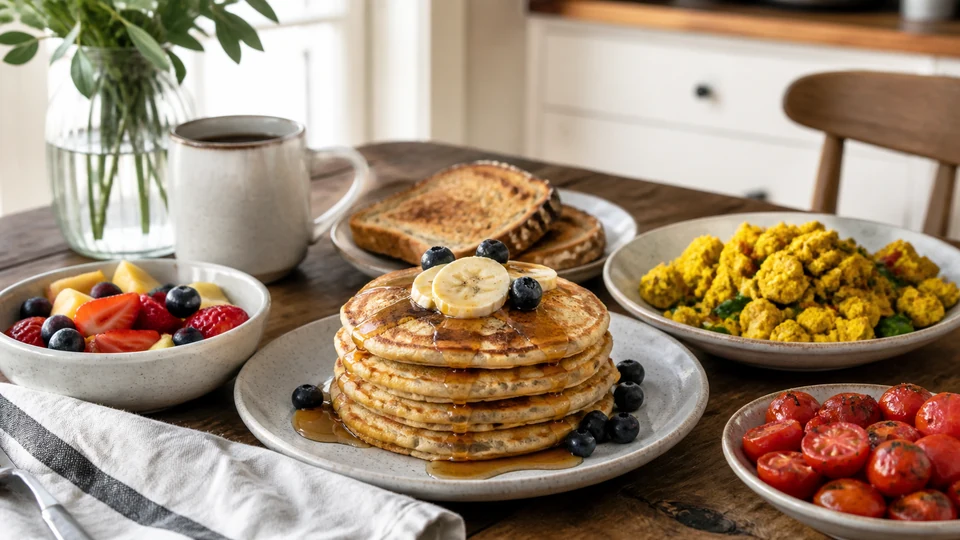
This page is an effort-reduction system and menu builder, not a collection of tested Pancake World recipes.
| Guide sections |
|---|
| Define “easy” before choosing food |
| Use the one-hot-anchor rule |
| Choose the anchor with a friction score |
| Six low-coordination brunch blueprints |
For broader context, continue with Healthy Pancake Guides.
Define “easy” before choosing food
Easy is not a particular ingredient or a promise that a dish takes a universal number of minutes. For a brunch host, it usually means few last-minute decisions, little competition for appliances, a manageable number of serving pieces and a menu that remains recognizable if one optional element is removed.
A dish can have a short ingredient list and still be awkward for a group if it must be fried one portion at a time. Another can have more components but feel easy because it is assembled the day before and served cold. Judge the whole service, not the recipe headline.
Use five filters:
- Active attention: Does the cook need to stir, flip, shape or monitor it during the final service window?
- Equipment claim: Which burner, pan, oven rack, blender or electrical outlet does it occupy?
- Holding behavior: Can it wait safely and acceptably, or must it move from pan to plate?
- Assembly count: How many garnishes, sauces and individual portions must be completed?
- Verification work: How many packaged ingredients and allergy constraints must be checked?
An easy menu keeps no more than one demanding answer in each category. It does not attempt pancakes, stovetop scramble, fried potatoes, toasted sandwiches and made-to-order coffee at the same moment.
Use the one-hot-anchor rule
Select one item that provides the freshly cooked experience. Everything else should support it without needing another cook at the stove.
Possible anchors include:
- pancakes from a complete tested vegan formula;
- a sheet-pan potato and vegetable hash;
- a tested baked oatmeal or breakfast casserole;
- warmed bean-filled tortillas prepared from a complete recipe;
- a savory grain dish reheated in one covered pan;
- a tofu-and-vegetable scramble when the stove will otherwise be quiet.
Then select support from different low-attention lanes:
- whole fruit or a prepared fruit plate;
- bread, rolls or toast with one or two verified spreads;
- a chilled bean, grain or vegetable salad;
- vegetables already roasted and served warm or at an appropriate chilled temperature;
- a jarred preserve, salsa or sauce whose current label has been checked;
- coffee, tea and water arranged away from the cooking line.
This is a coordination rule, not a requirement that every person eat every item. The menu can be generous while the production plan remains narrow.
Choose the anchor with a friction score
Rate each candidate from zero to two in four categories: last-minute labor, equipment occupation, holding difficulty and cleanup. Zero means little burden; two means substantial burden. The number is your own planning tool, not a product rating or tested performance score.
For example, pancakes may score high for active labor because they cook in batches, but low for oven use. A tested breakfast bake may need little attention at service yet reserve the oven for a long period. A cold overnight dish may need refrigerator space but no hot equipment. The easiest choice is the one that fits your kitchen’s actual bottleneck.
Ask these questions before committing:
- How many people can the recipe’s documented yield serve under your menu plan?
- Can the recipe be doubled according to its source, or should separate batches be made?
- Does it require a pan or appliance already claimed by another item?
- Can it be prepared or partially prepared in advance under the source’s directions?
- How will it be held if guests do not arrive together?
- What is the fallback if the item takes longer than expected?
Never solve uncertain yield by guessing larger quantities inside an untested formula. Choose a tested recipe with a suitable yield, make documented batches, or add an easy support food that does not depend on the anchor.
Six low-coordination brunch blueprints
These blueprints describe menu architecture. They do not provide ingredient amounts, cooking times or implied tests. Follow complete, tested recipes and current package directions for each cooked component.
1. Pancake tray plus cold support
Make vegan pancakes the only last-minute cooked item. Set out fruit, a verified spread or preserve, and a chilled bean or grain salad before the griddle starts. Place plates and utensils where guests will not cross the cooking area.
This works when someone is comfortable cooking batches and guests can begin with cold items. It is less easy when everyone expects a simultaneous tall stack. If the selected tested pancake recipe permits holding, use its method. Otherwise serve batches as they finish and state that plan plainly.
Keep wet toppings away from the holding tray so pancakes do not become soggy. Use separate spoons for every spread and label unfamiliar ingredients.
2. Sheet-pan anchor plus bread station
Choose a complete tested recipe for potatoes, vegetables and a plant-based protein that can share one sheet pan. Pair it with bread or rolls, a verified spread and whole fruit. The sheet pan owns the oven; nothing else in the menu should need the same rack at the same time.
Cutting vegetables may be the largest labor block, so complete only those advance steps the recipe and food-safety plan allow. Organize components in labeled containers. Do not assemble raw and ready-to-eat foods on an unclean surface.
The bread station should be genuinely assemble-only. If every slice must be toasted during service, the toaster becomes a queue and the plan is no longer low coordination.
3. Reheated savory bake plus fresh crunch
Use a tested vegan breakfast bake or grain-and-bean casserole with explicit make-ahead and reheating directions. Add a crisp vegetable plate, fruit and a cold sauce. Reheat the anchor thoroughly according to its source and federal leftover guidance; do not improvise a slow warm-up.
This blueprint moves labor earlier, but it also creates cooling, refrigerator and reheating obligations. Confirm container depth, shelf space and reheating equipment before choosing it. “Make ahead” is not shorthand for leaving a cooked dish on the counter overnight.
4. Filled tortilla assembly line
Prepare one hot filling from a tested recipe, warm tortillas as directed, and offer a small number of cold additions such as salsa, chopped herbs, shredded vegetables or a verified plant-based topping. Guests assemble their own portions.
Limit the bar. Six carefully chosen components are easier to verify, chill and replenish than fifteen bowls. Arrange the line in eating order and give each item its own utensil. If gluten, soy, sesame or another allergen matters, separate products and equipment according to the guest’s requirements rather than assuming a self-service line controls cross-contact.
5. Mostly cold grain-and-bean table
Choose a tested chilled grain-and-bean dish as the substantial center. Add fruit, vegetables, bread and one sauce. This removes the last-minute pan entirely, which can be useful in a small kitchen or on a warm day.
Cold does not mean unrestricted room-temperature holding. Keep perishable food chilled and refill small serving dishes from refrigeration. Prepare and cool cooked grains or beans under their recipe and safety directions. Do not place a deep warm container straight into a crowded refrigerator and assume the center cools promptly.
6. Warm oatmeal or porridge with a short topping list
A complete tested vegan oatmeal or grain-porridge formula can be the sole hot anchor. Offer a restrained set of fruit, seeds, a verified plant beverage and one sweetener. This is easy only if the formula’s holding behavior suits the service window.
Keep toppings in separate labeled bowls, especially when seeds, nuts or plant beverages create allergen questions. Do not stir every option into the main pot. A neutral base allows guests to choose, but it does not remove the need for ingredient verification.
A twelve-option support library
Supports make the anchor feel like brunch without creating another production line. Choose a few, not all.
Whole fruit
Washed fruit that can be eaten by hand requires no recipe, no portion assembly and little serving equipment. Keep cut or highly perishable fruit under appropriate temperature control.
Simple fruit plate
Use a small number of fruits that can be prepared without elaborate carving. Keep juices from running into bread or hot foods. Prepare with clean equipment and refrigerate until service when required.
Bread and one verified spread
Check the bread and spread labels for the vegan brief and any allergen needs. Set out a dedicated utensil. One dependable combination is easier than a crowded board of uncertain products.
Bean salad from a tested recipe
Choose a complete formula with safe preparation and storage instructions. A chilled bean salad can add substance without competing for the stove at service.
Grain salad from a tested recipe
Cook, cool and store the grain correctly. Add dressing and delicate ingredients at the stage specified by the source rather than inventing a make-ahead method.
Roasted vegetables prepared earlier
Use a tested preparation and decide whether they will be reheated or served chilled. Do not allow them to drift through an undefined lukewarm holding period.
Raw vegetable plate
Wash and prepare produce with clean tools. Keep dips and cut vegetables chilled as needed, and give each component a separate utensil.
Hummus or another legume spread
Use a complete recipe or current packaged product. Verify tahini and other ingredients when sesame matters. “Plant-based” on the front does not replace reading the ingredient and allergen information.
Fruit preserve
A current packaged preserve can be a low-work pancake topping. Check ingredients under the chosen vegan standard and keep the jar’s storage directions.
Salsa
Salsa can support tortillas, potatoes or a savory bake. Use a clean spoon and avoid returning served product to the original container.
Prepared plant-based cultured topping
Plant-based alternatives differ in source and formulation. Read the current ingredient and allergen label. Keep perishable toppings cold and do not claim nutritional equivalence to dairy.
Coffee, tea and water
Move beverages out of the food-production zone. Set out clearly identified dairy and plant alternatives only if needed, each with its own handling plan. Do not leave a refrigerated beverage out for the entire event.
Make the menu genuinely vegan
The anchor may be vegan while bread, spread, pastry, sauce or garnish is not. Check the complete plate, including pan fat and finishing ingredients.
Build a short ingredient register with columns for item, source or package, animal-derived ingredient check, major allergens, storage requirement and serving utensil. Recheck packages on the day of preparation because formulations can change.
Common verification points include:
- bread, rolls and tortillas;
- margarine, shortening and cooking spray;
- plant beverages and cultured alternatives;
- chocolate, caramel and decorative toppings;
- granola and cereal;
- prepared sauces, seasoning blends and soup bases;
- egg replacers and baking mixes;
- pastry glaze or wash;
- honey when the eater excludes it;
- toppings brought by another person.
Do not rely on color, product name or an old photograph of a label. If the ingredients cannot be confirmed, leave the component off or replace it with one whose status can be verified.
Keep allergen control separate
Vegan does not mean free from wheat, soy, sesame, peanuts or tree nuts. It also does not establish that a product is suitable for a person managing milk or egg allergy; cross-contact and advisory labeling may matter even when those ingredients are not intentional.
FDA requires major allergen sources to be declared on covered packaged foods in the United States. Use the current package, not a copied online list alone. Ask the guest which foods must be avoided and what shared-equipment control is required.
For a mixed brunch:
- Identify every guest-specific exclusion before buying ingredients.
- Retain packages or clear label records until service is complete.
- Prepare the controlled food first in a cleaned area if that matches the agreed plan.
- Use separate tools, pans, boards, containers and serving utensils when required.
- Cover and label controlled dishes.
- Place them where spoons and crumbs from other foods cannot migrate easily.
- Never assure a guest that something is safe when evidence is incomplete.
Self-service increases opportunities for utensil swapping. If the consequence of cross-contact is serious, a separately plated and protected portion may be more suitable than asking the guest to navigate a shared bar. Follow the person’s own allergy plan.
Use substitutions only inside a complete formula
Easy planning can tempt a host to convert a familiar egg-and-dairy recipe at the last minute. That can create both structural failure and uncertain ingredients.
University of Illinois Extension explains that egg replacements differ according to whether egg provides binding, leavening or moisture and that substitutes can alter flavor and texture. Apply that principle before choosing flax, chia, purée, tofu, aquafaba or a commercial replacer. A binder is not automatically an aerator. A moist purée is not automatically neutral in flavor.
Plant beverages also vary. FDA notes differences arising from the plant source, processing and added ingredients. Follow a tested recipe that names a suitable beverage type, and review sugar, flavor, thickness and allergens on the current package.
The lowest-friction option is a complete recipe already developed for the required vegan result. If you change it, do not retain the source’s yield, nutrition, timing or performance claims without a real test of the altered formula.
Plan from inventory before shopping
USDA MyPlate planning resources recommend making a plan, using foods already available and preparing components ahead. For this brunch, begin with a ten-minute inventory.
Check:
- refrigerator and freezer space;
- tested recipes already selected;
- grains, beans, flour and leaveners;
- fruit and vegetables that need using;
- current labels on bread, spreads and plant beverages;
- serving bowls, sheet pans, skillets and storage containers;
- one reliable hot-holding or cold-holding method;
- clean utensils for each served dish.
Then write the menu and shopping list by role, not by store aisle alone: anchor, fresh support, substantial cold support, topping, beverage and contingency. Cross off anything that adds a second last-minute cooking lane.
Prepare only what the selected recipe and safe-storage plan support. Chopping vegetables, cooking grains and labeling containers can reduce day-of work, but advance preparation is useful only when there is adequate refrigeration and a clear use date.
Build a backward schedule
Start at serving time and move backward. Avoid generic promises such as “this takes thirty minutes,” because recipe size, equipment and kitchen conditions differ.
At service
The anchor is cooked or held as its tested method allows. The first small batch of chilled food is on the table. Every dish has its own utensil. Ingredient information is available. Replacement portions remain protected and correctly held.
In the final active window
Cook only the anchor. Warm only items whose complete source includes a safe, suitable reheating method. Keep guests, bags and beverage traffic away from the cooking path. Do not begin decorative work that competes with safety or heat control.
Before active cooking
Set the table, arrange cold serving ware, portion toppings into labeled containers, prepare the beverage station and clear the sink. Return perishable toppings to refrigeration until needed.
Earlier the same day
Complete approved chopping, washing, mixing or assembly steps. Check the recipe rather than assuming raw batter can wait. Pancake batter containing raw flour should not be tasted, and its storage behavior depends on the formula.
The previous day
Prepare only dishes with explicit make-ahead instructions or components covered by a validated storage plan. Cool cooked foods promptly, divide large quantities into shallow containers and label them. Do not pack the refrigerator so tightly that cold air cannot circulate.
The schedule should name a person as well as a task when more than one cook is involved. “Someone makes coffee” is weaker than “Alex starts the brewer after the first hot batch leaves the pan.”
Arrange the kitchen as a simple flow
Divide the space into four zones:
- cold storage: ingredients and refill containers;
- active cooking: the one hot anchor and its tools;
- plating: clean plates, garnish and finished food;
- guest service: table, beverages and waste.
The zones need not be large, but they should not conflict. Raw flour should not drift onto fruit or finished food. Guest traffic should not pass behind a cook holding a hot pan. Used utensils should not return to the clean plating area.
Place a tray beside the cooking station for the next clean spatula, finished batch and pan protection. Keep a separate landing place for dirty bowls. This small layout decision often matters more than adding another dish.
Serve in small batches
USDA FSIS recommends keeping hot foods hot and cold foods cold during buffet service and suggests small serving trays that are replaced often. FoodSafety.gov also recommends separate clean utensils and batch replenishment.
Translate that guidance into a home brunch plan:
- place a modest first portion on the table;
- keep reserve food correctly hot or cold;
- replace the serving dish rather than topping up old food with a fresh batch;
- note when a perishable item leaves temperature control;
- give every bowl its own spoon or tongs;
- protect controlled-allergen portions from the shared buffet;
- clear food when its safe service window ends.
Do not use the appearance or smell of food to override time and temperature guidance. Do not return buffet food to the same container as untouched reserve food.
Handle flour and cooked leftovers safely
FDA states that flour is a raw food and should not be eaten in uncooked dough or batter. Vegan pancake or muffin batter is not exempt just because it lacks egg. Keep flour away from ready-to-eat fruit and toppings, wash hands, and clean bowls, utensils and counters after mixing. Follow the tested recipe for cooking.
For leftovers, USDA FSIS advises prompt refrigeration, shallow containers for rapid cooling and thorough reheating. Decide before service which foods are eligible for saving and have labeled containers ready. Wet toppings and crisp foods may store better separately, but quality decisions do not replace safety controls.
Discard food when its holding history is unknown. Do not repeatedly cool and warm a dish merely to avoid waste. This page does not assign a universal refrigerator life or reheat method to every brunch item; the specific food and authoritative guidance control those decisions.
Common ways an “easy” brunch becomes difficult
Too many fresh-cooked foods
Three simple skillet recipes still create three simultaneous jobs. Keep one active anchor and convert the others to safe make-ahead or assemble-only supports.
A topping bar with twenty choices
Every bowl needs verification, space, a utensil, temperature control and cleanup. Offer fewer, clearly different options.
Untested scaling
Doubling every ingredient can change pan depth, mixing and cooking. Use a source that documents scaling or prepare separate tested batches.
Last-minute vegan conversion
Removing eggs and milk without replacing their functions can compromise structure. Select a tested vegan recipe earlier.
Every support is bread or pastry
The table may look abundant while offering little contrast. Add fruit, vegetables or a bean-based cold dish as a different format; this is a menu-design suggestion, not a nutrition prescription.
The oven has two owners
A bake and roasted potatoes cannot both finish on one rack at the same time. Assign the oven to one anchor or choose a support that uses no heat.
“Vegan” is treated as an allergy label
Soy, wheat, sesame, peanuts and tree nuts can still be present. Run the guest-specific allergen check separately.
All food goes out at once
Large buffet dishes warm or cool while guests talk. Use small batches and maintain safe reserve storage.
The refrigerator is planned last
Make-ahead cooking creates containers that need cold space. Measure that constraint before selecting the menu.
Decoration displaces operations
Elaborate garnishes can occupy the final minutes and introduce uncertain ingredients. Use one verified finishing element or none.
A compact host worksheet
Complete these lines before shopping:
- Guest count and arrival pattern:
- Confirmed vegan standard:
- Guest-specific allergens and cross-contact controls:
- One hot anchor and tested source:
- Anchor’s documented yield or batch plan:
- Cold substantial support:
- Fruit or vegetable support:
- Bread, spread or topping:
- Beverage station owner:
- Appliance reserved for anchor:
- Advance-prep steps explicitly permitted:
- Refrigerator containers and space:
- Hot/cold holding method:
- First buffet batch size:
- Refill person and clean utensils:
- Leftover cooling containers:
- Fallback if the anchor is delayed:
If several lines remain unknown, reduce the menu before adding food.
Frequently asked questions
What is the easiest vegan brunch food for a group?
A tested sheet-pan or baked anchor can reduce last-minute portion cooking, provided the oven, cooling and holding plan fit. Pancakes can also work when they are the only active cooked item and batch service is acceptable. The kitchen constraint decides.
Can brunch be easy without tofu?
Yes. Beans, lentils, grains, pancakes, potatoes, bread, vegetables and fruit can form many menus. Choose complete recipes and build substance deliberately rather than treating tofu as mandatory.
What can I make the night before?
Only use advance steps supported by the selected recipe and safe-storage guidance. Chilled salads, prepared components or a tested make-ahead bake may fit. Raw batter and cooked foods do not share one universal overnight rule.
Are vegan pancakes enough for brunch?
They can be the anchor. Add low-work support with contrasting form, such as fruit and a chilled bean or vegetable dish, if that suits the guests. Do not add another made-to-order item merely for variety.
Is vegan brunch automatically gluten-free?
No. Wheat can appear in bread, pancakes, tortillas, sauces and meat alternatives. Gluten-free preparation also requires appropriate products and cross-contact controls.
Is it automatically safe for milk or egg allergy?
No. A formula may omit those ingredients while packaged foods or shared equipment create other concerns. Follow current labels and the individual’s allergy plan.
Can I swap plant milk for dairy in any recipe?
Not with guaranteed results. Plant beverages differ, and dairy may provide more than liquid in a formula. Use a complete tested vegan recipe or document the adaptation.
How many dishes should I serve?
There is no universal count. One anchor plus two or three complementary supports is a practical low-coordination starting structure. Use documented yields and the guest plan rather than invented portion numbers.
Can everything sit out while guests arrive?
Perishable hot and cold foods require controlled holding. Put out small batches, keep reserves at safe temperatures and follow current federal time-and-temperature guidance.
Can I use the nutrition from the original recipe after substitutions?
No. Changing ingredients changes the calculation. This page provides no nutrition totals and does not transfer values from an unmodified source.
Final easy-brunch check
The menu is ready when one item owns the active cooking window, the remaining foods have a clear assemble/reheat/cold-service path, every cooked item comes from a complete tested recipe, and every packaged component has been verified. The kitchen has room for safe storage, the buffet will be replenished in small batches, allergen controls are explicit, and leftovers have containers before guests arrive. If the plan still needs simultaneous flipping, frying, toasting and blending, simplify it once more.
Explore related Pancakes World guidance on American Pancakes, American Breakfast: Pancakes, Diner Plates and Brunch, and Maple Syrup.
Sources and editorial references
- USDA MyPlate, “Efficient Eats: Cooking for 1, 2, or 3 — Planning and Prepping”:
https://www.myplate.gov/sites/default/files/2024-09/MyPlate-Resource-Efficient-Eats-Planning-And-Prepping.pdf - USDA MyPlate, “Make a Plan”:
https://www.myplate.gov/eathealthy/budget/budget-weekly-meals - U.S. Food and Drug Administration, “Plant-Based Milk and Animal Food Alternatives”:
https://www.fda.gov/food/nutrition-food-labeling-and-critical-foods/plant-based-milk-alternatives-pbma - U.S. Food and Drug Administration, “Food Allergies”:
https://www.fda.gov/food/nutrition-food-labeling-and-critical-foods/food-allergies - U.S. Food and Drug Administration, “Handling Flour Safely: What You Need to Know”:
https://www.fda.gov/food/buy-store-serve-safe-food/handling-flour-safely-what-you-need-know - USDA Food Safety and Inspection Service, “Leftovers and Food Safety”:
https://www.fsis.usda.gov/food-safety/safe-food-handling-and-preparation/food-safety-basics/leftovers-and-food-safety - FoodSafety.gov, “Don’t Let the End Zone Become the Danger Zone”:
https://www.foodsafety.gov/blog/dont-let-end-zone-become-danger-zone-your-guide-hosting-penalty-free-super-bowl-party - University of Illinois Extension, “Egg substitutes when baking”:
https://extension.illinois.edu/blogs/live-well-eat-well/2023-02-10-egg-substitutes-when-baking - USDA FoodData Central:
https://fdc.nal.usda.gov/