Easy pancake batter mix
At Pancakes World, an easy pancake batter mix is the format that removes the step you actually want to avoid while leaving clear package directions. A complete dry mix may need only water; another dry mix may require milk, egg, or oil; a shaker format combines measuring and mixing; and ready-to-pour batter removes most preparation but has different storage needs. Compare required additions, batch size, equipment, allergen wording, opened storage, and cooking method on the current pack. Choose the smallest workflow that fits the morning, then follow that pack rather than a ratio borrowed from another product.
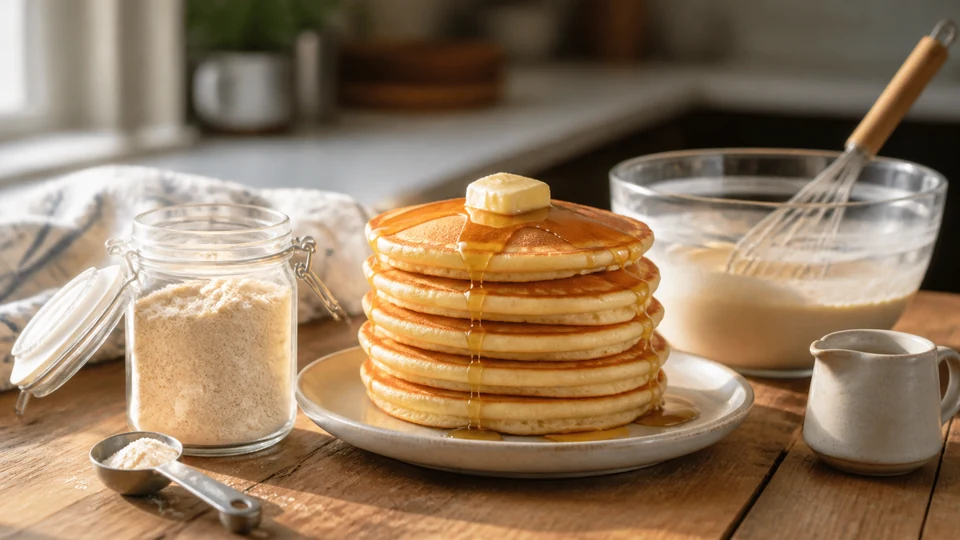
This guide compares convenience formats and builds a label-first workflow. It does not rank brands, reproduce prices, invent package directions, or claim that Pancake World tested a mix. The pancake science hub explains the wider batter topic, while Pancake World opens the full editorial collection.
For broader context, continue with Pancake Ingredients and Substitutions.
Decide which step needs to become easier
“Easy” can describe several different problems. One cook wants to avoid weighing flour. Another wants no egg to crack, no mixing bowl to wash, or no large bag left in the cupboard. A group host may care less about ingredient count than repeatable batches. Someone cooking in temporary accommodation may have a pan and spatula but no measuring jug.
Name that constraint before comparing packs. Otherwise, a product that looks convenient can move the work somewhere else. A shaker bottle removes a bowl but may require careful filling and vigorous mixing. A complete dry mix shortens the ingredient list but still needs a measuring vessel. A refrigerated batter reduces mixing yet creates a cold-storage requirement and a shorter decision window after opening.
Use one sentence: “I need a mix that makes ___ easier.” Useful endings include measuring, shopping for additions, washing up, portioning a small batch, feeding a group, or cooking away from home. Keep that sentence beside the package comparison. It prevents a front-panel convenience phrase from becoming the decision standard by itself.
Understand the four main convenience formats
Complete dry mix
A complete dry mix is still dry. The word complete usually refers to a short preparation route, but it does not prove that every product needs the same liquid or that the ingredients suit a particular diet. Read the physical pack for the required addition, measuring unit, mixing order, standing instruction, yield basis, and storage after opening.
This format is useful when pantry storage matters and the cook is comfortable measuring liquid. Its weak point is false familiarity: directions remembered from a previous bag can be carried into a different formula. Keep the current package visible until the last batch is cooked.
Traditional dry mix with additions
Some mixes supply the flour blend, leavening, sugar, or flavouring but still call for several wet ingredients. They save dry measuring without eliminating the shopping list. Before choosing one, count the additions actually required and ask whether they are already available in suitable amounts.
This can be the easiest format for a cook who wants more control over the liquid or fat, but it is not the shortest workflow for everyone. Required egg, milk, or oil also changes allergen handling, refrigeration, and cleanup. Do not describe the finished pancakes by the dry mix label alone; the additions are part of the food served.
Shaker mix
A shaker package acts as both container and mixing tool. That is valuable where bowls, whisks, or washing space are limited. The package directions control the fill line, order of liquid and dry material, closure, shaking, and pouring. Overfilling can leave dry pockets or put pressure on the seal, so a remembered volume from another shaker is not a safe substitute.
Inspect the cap and container before use. Hold the closure while shaking if the pack directs it, and open it away from clothing and hot equipment. A shaker simplifies one part of the method; it does not remove the need to preheat the pan, portion consistently, or handle remaining batter according to its label.
Ready-to-pour batter
Ready-to-pour batter is already hydrated. It eliminates dry mixing, but the pack now controls cold storage, date marking, opening, shaking or stirring, and any instruction about using the remainder. Do not store it like a dry cupboard mix simply because both products make pancakes.
This format can suit a very short cooking window or a kitchen without measuring equipment. Its tradeoff is less flexibility over batch size and a greater need to plan the opened container. Check whether the package quantity matches the number of eaters before assuming the unused portion can be kept.
Read the pack as a preparation plan
Required additions
List every addition on paper or in a shopping note. Include water, milk, egg, oil, butter, cooking fat, and anything needed for serving only if it is genuinely part of the plan. Separate “required by the mix” from “optional topping.” That distinction avoids reaching the pan with a missing ingredient or treating a serving suggestion as a direction.
If the pack offers alternative liquids or egg substitutions, follow the exact option printed for that product. A substitution found on an unrelated recipe is an editorial experiment, not evidence that this mix will behave the same way.
Batch and yield language
Packages may describe servings, pancakes, portions, or prepared weight. Those measures are not interchangeable. A claimed pancake count depends on the portion size named by the manufacturer, while a household may serve larger or smaller pancakes.
For the first use, prepare the smallest documented batch that meets the occasion. Record how many pancakes the household actually portions from it without presenting that observation as a universal yield. For group cooking, multiply only when the package provides a sound scaling method or make successive standard batches instead of one oversized bowl.
Equipment
Translate the directions into an equipment list: measuring vessel, bowl or shaker, whisk or spoon, pan or griddle, ladle, spatula, plate, and cleaning tools. Add an appliance manual when a waffle maker, electric griddle, or unusual surface is involved. The mix directions govern the batter; the appliance instructions govern safe loading, heat controls, coatings, and cleaning.
A short ingredient list can still be awkward if the kitchen lacks the named equipment. Choose the format that fits the real workspace rather than buying a tool-heavy product for its convenience wording.
Ingredients and allergen information
Read the complete current ingredient list and allergen declaration. Then include the required additions and cooking fat in the assessment. “Just add water,” “plant-based,” or another front-panel phrase does not by itself answer every vegan, gluten, milk, egg, nut, or cross-contact question.
Keep the pack available when serving other people. If the mix is decanted, retain its name, lot or date information, directions, ingredients, and allergen wording with the container. Do not combine the end of one bag with another unless both identities remain clear and their directions genuinely match.
Storage and date marking
Dry unopened mix, opened dry mix, freshly mixed batter, and ready-to-pour batter are four different storage states. Follow the language for the state actually present. Reseal dry mix as directed and protect it from contamination. Apply the package and FoodSafety.gov guidance to batter containing perishable additions.
When the directions are unclear about holding mixed batter, make a smaller batch instead of inventing a refrigerator life. Convenience improves when the remainder already has a safe destination; it disappears when an opened product becomes an uncertain leftover.
Use one calibration pancake
The first pancake should answer practical questions, not serve as a verdict on the whole package. Preheat the cooking surface according to the recipe and equipment directions. Portion one pancake consistently, watch how it spreads, and turn it using the package cues without tasting raw batter.
Assess one variable at a time:
- Spread: If the batter travels farther than expected, first confirm that the liquid was measured correctly and the mix was prepared in the stated order.
- Thickness: If it barely spreads, check for an incomplete addition, an overfilled measuring cup, or an unobserved resting instruction before adding more liquid.
- Colour: If the outside darkens too quickly, adjust the cooking heat before changing the formula.
- Release: If it sticks, review preheating, cooking fat, surface condition, and the appliance manual rather than scraping with a damaging tool.
- Centre: If the middle remains wet, check portion size, heat balance, and turning point. Do not solve every undercooked centre by making the pan hotter.
Write down the correction and repeat one pancake. A controlled second test is more informative than changing liquid, heat, portion, and cooking time simultaneously.
Choose the easiest workflow for one or two people
Small households often lose convenience by opening a format designed for many portions. Compare the smallest documented batch, the possibility of resealing dry mix, and the storage instruction for an opened hydrated product. If the pack only gives one full-batch method, do not casually divide an egg or leavening system without evidence that the formula scales.
Prepare toppings before the pan is hot. Set out one plate for cooked pancakes and one clean utensil for serving. Keep the work surface clear enough that the mix package remains readable. After the last pancake, deal with the remaining product first, then clean the pan. This order avoids leaving batter or perishable additions on the counter while breakfast is eaten.
Build a repeatable group-batch system
For a group, ease comes from repetition. Use the same measuring tool, portion utensil, pan zone, and package method for each batch. Assign one person to mix and another to cook only when both can follow the same documented process. Mark bowls or jugs if different mixes or allergen pathways are present.
Avoid a single giant batch unless the product explicitly supports that scale and the kitchen can cook it promptly. Batter can change while waiting, a deep bowl can mix unevenly, and portion control becomes harder. Standard successive batches keep the formula closer to the pack and make it easier to trace an error.
Plan the holding method before cooking. Pancakes are usually best served near the pan, but a group may require a short holding interval. Use a tested recipe or reliable equipment guidance for that step; do not invent a universal oven temperature or holding duration here. Replenish the serving plate in smaller amounts so the whole batch is not waiting through the meal.
Troubleshoot the mix, not the marketing phrase
Dry pockets remain
Check the order of additions and whether powder collected in a corner of the bowl or shaker. Scrape or shake only as the pack directs. Adding extra liquid before the stated amount is fully incorporated can create a second problem.
The batter becomes very thick while waiting
Confirm whether the package calls for a rest and whether the batch has exceeded that method. Flour hydration can change the visible consistency, but the correct response belongs to the product directions. If no adjustment is supported, cook a small test rather than pouring in a large amount of liquid.
Pancakes brown before the centre cooks
Reduce the heat and keep the portion consistent. Confirm that sugar, milk, or another addition was not increased. A dark surface is not proof that the centre is finished.
Two bags behave differently
Recheck the exact names, formulations, dates, and directions. Similar front labels do not prove identical recipes. Treat the new bag as a new preparation record and run a fresh calibration pancake.
The finished batch is larger than needed
Do not keep cooked pancakes on the table indefinitely. Apply official food-safety guidance to cooling and leftovers, store them promptly in a suitable container, and label the remainder when that helps another person understand its history.
Compare formats by the work they remove
| Mix format | Work it can remove | Work that remains | Check before choosing |
|---|---|---|---|
| complete dry mix | weighing separate dry ingredients | measuring the named liquid, mixing, portioning, cooking | exact liquid, batch basis, opened-bag storage |
| dry mix with additions | measuring flour, leavening, and other supplied dry ingredients | shopping for and measuring egg, milk, oil, or other additions | complete addition list and allergen effect |
| shaker mix | separate bowl and whisk | accurate filling, secure shaking, pan control | fill order, closure, maximum level, disposal or reuse direction |
| ready-to-pour batter | measuring and mixing | cold storage, opening, portioning, cooking | date mark, opened storage, package quantity |
| pre-portioned sachet | measuring the dry mix and resealing a large bag | adding liquid and using a bowl or shaker | whether one sachet matches the real serving need |
The table is not a ranking. A complete dry mix may be easiest in a stocked family kitchen, while a shaker may be easier in a holiday apartment and a sachet may prevent waste for one eater. Use the original “I need a mix that makes ___ easier” sentence to select the relevant column. If two formats remove the same task, compare the work that remains rather than adding new criteria such as popularity or package colour.
Scenario 1: a fast weekday breakfast
The weekday constraint is usually a fixed departure time. Choose a mix only after counting the steps between opening the package and putting the first pancake on a plate. Place the pan on the correct cooking zone, collect the package additions, and set out the measuring and portion tools before heating begins. This exposes a format that still requires an unavailable egg, a second bowl, or a long cleanup.
Prepare the smallest documented batch that feeds the people present. A full package batch is not automatically faster if half of it becomes an uncertain remainder. While the cooking surface preheats, prepare simple toppings and the storage container for any cooked leftovers. Cook one calibration pancake, make one controlled heat or portion correction if needed, and then repeat the same movement. The easy part is the stable sequence, not rushing several pancakes into the pan at once.
After cooking, follow the pack for the opened dry or hydrated product. Deal with perishable additions and cooked leftovers promptly. Keep the successful package name and the one useful calibration note—such as the portion utensil or pan setting used with that appliance—without turning a household observation into a universal instruction.
Scenario 2: cooking in a temporary kitchen
Inventory the kitchen before buying the mix. Confirm the actual pan, hob or hotplate, spatula, measuring vessel, bowl, refrigerator space, and washing facilities. A shaker format may remove a missing bowl, but it cannot compensate for an unsuitable pan or no safe place for a refrigerated remainder. A dry complete mix may travel easily, but it still needs the exact liquid and a way to measure it.
Select a package size that can be completed within the stay. Retain the package rather than decanting it into an unlabelled travel container. The printed directions are especially important when the borrowed appliance behaves differently from the one at home. Begin at the appliance's supported setting, cook a small pancake, and adjust heat conservatively. Do not rewrite the batter ratio merely because the unfamiliar surface heats unevenly.
Cleanup belongs in the selection decision. A shaker may be convenient only if its narrow container can be cleaned as directed, while a disposable sachet still leaves a bowl. The truly easy choice is the one whose preparation, storage, and cleanup all fit the temporary space.
Scenario 3: feeding a group in repeated batches
For group service, compare repeatability before package size. A bulk bag can be efficient when each batch uses the same documented scoop and liquid measure. It becomes difficult when cooks estimate portions, change bowls, or lose the package directions. A set of smaller complete packages may cost more packaging and opening time, yet give clearer batch boundaries. This guide does not make a price judgment; it identifies the operational tradeoff.
Create one batch card from the current package: mix identity, exact additions, measuring tools, mixing order, portion utensil, and allergen note. Do not copy a ratio from another brand onto that card. Assign one clean preparation area and keep packages with their corresponding bowls. If two mixes serve different dietary needs, use separate tools and a deliberate cross-contact plan rather than relying on labels placed after cooking.
Cook successive standard batches instead of allowing one oversized bowl to wait. The first pancake of a new batch remains a calibration check because measuring or pan conditions may have changed. Replenish the serving plate in manageable amounts, and keep the waiting product in the storage state its label requires. At the end, reconcile unopened packs, opened dry mix, mixed batter, and cooked pancakes separately; each has a different evidence and storage question.
A final purchase checklist
Before putting a mix in the basket, answer all of these from the current pack:
- Is it dry, shaker-based, or already hydrated?
- Which ingredients must be supplied at home?
- What equipment does the stated method require?
- What does the batch or serving language actually measure?
- Which allergens are declared, and what do the additions introduce?
- How is the unopened product stored?
- What changes after the package is opened or the batter is mixed?
- Can the household use the documented batch without creating an uncertain remainder?
- Does the cooking method fit the available pan or appliance?
- Which exact task does this format make easier?
If the tenth answer is vague, the convenience claim has not yet been translated into a useful decision. Return to the format comparison and choose by the real constraint.
Frequently asked questions
Is complete pancake mix the same as ready-to-pour batter?
No. Complete dry mix still needs the liquid named on its pack. Ready-to-pour batter is already hydrated and follows its own date and storage directions.
Can milk replace water in a complete mix?
Only when the current pack permits it or when the cook clearly accepts an untested variation. Milk changes ingredients, allergens, flavour, and handling as well as liquid content.
Can pancake mix be used in a waffle maker?
Some combinations can cook, but the appliance and batter formula control loading, release, and texture. Use the waffle maker manual and a method designed for the intended result rather than assuming universal compatibility.
Is a mix vegan if the dry ingredients look plant-based?
Not necessarily. Read the full current label, cross-contact wording, and required additions. Vegan suitability and allergy suitability are separate questions.
Should leftover mixed batter be refrigerated?
Follow the product's instruction and applicable FoodSafety.gov guidance for its ingredients. If the package does not support a clear holding plan, prepare less batter instead of inventing a storage period.
Explore related Pancakes World guidance on American Pancakes, American Breakfast: Pancakes, Diner Plates and Brunch, and Maple Syrup.
Sources and editorial references
- USDA FoodData Central —
https://fdc.nal.usda.gov/ - FoodSafety.gov food safety charts —
https://www.foodsafety.gov/food-safety-charts - FDA Food Labeling & Nutrition —
https://www.fda.gov/food/nutrition-food-labeling-and-critical-foods