Easter sunday brunch ideas
At Pancakes World, plan Easter Sunday brunch around when everyone will actually sit down. For an early meal, serve a baked egg dish, fruit and warmed buns. After a church service, walk or egg hunt, choose a make-ahead tart, salad and one item reheated or finished on arrival. For a late brunch before Easter dinner, keep portions lighter with pancakes, fruit and yoghurt or a vegetable-led egg dish. Protect the final 20 minutes: only one food should need active hob work, and only one should need the oven. Keep chilled components refrigerated until guests are ready rather than setting the whole table out at the advertised time.
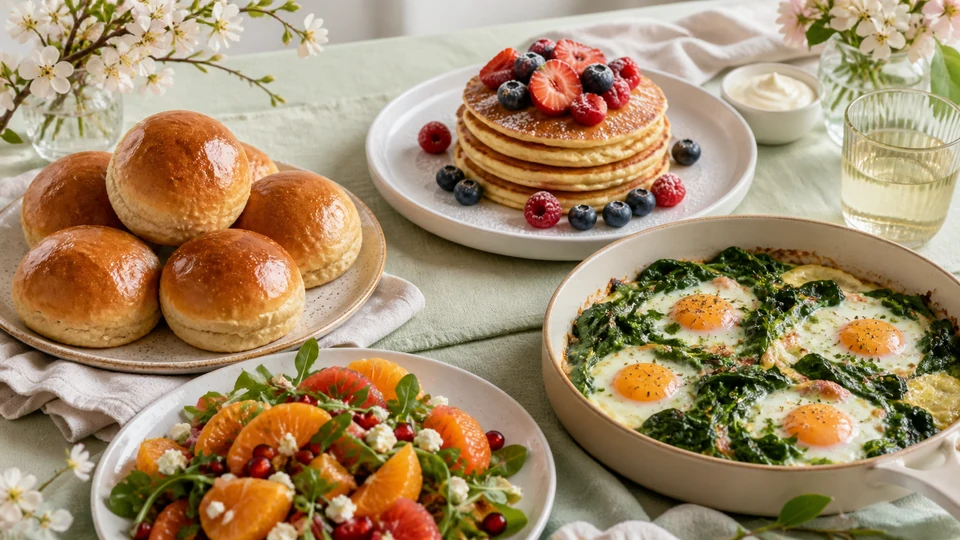
No single schedule represents every family or religious observance. This guide treats Sunday timing as the central decision. The brunch hub covers other formats, while Pancake World links the wider collection.
For broader context, continue with American Breakfast: Pancakes, Diner Plates and Brunch.
Direct answer: choose one of three Sunday schedules
| Brunch moment | Best structure | Prepare ahead | Finish near service |
|---|---|---|---|
| Early, before the day’s activities | Shared egg bake, fruit, buns or toast | Fruit, table, dry ingredients, labels | Bake eggs; warm one bread |
| After an outing or service | Tart or frittata, salad, cold fruit, small sweet | Main dish if its recipe permits, salad components, fruit | Reheat or finish one item; dress salad |
| Late, before another substantial meal | Pancakes or vegetable eggs, yoghurt, citrus | Toppings, fruit, measured pancake ingredients | Cook one griddle or egg dish |
Choose the row that fits the least predictable person. If arrival could vary by an hour, avoid poached eggs, individual omelettes and a stack that must be eaten the moment it leaves the pan. A delayed group needs a dish with explicit holding or reheating directions, plus cold components that stay refrigerated.
Schedule A: early brunch
An early meal benefits from a short menu. Guests may want to leave for an event, walk or family visit, so do not build a restaurant-style course sequence.
Use four roles:
- one shared hot dish, such as a vegetable frittata from a complete recipe;
- one bread, such as bought hot cross buns or toast;
- one fresh plate of citrus or berries;
- tea, coffee and water prepared away from the cooking zone.
The night before, set the table, check labels and serving vessels, wash fruit according to food-safety guidance, and complete only recipe-approved advance tasks. Do not mix an egg bake early unless the source specifically provides covered refrigerated assembly instructions.
In the morning, begin with the item that has the longest verified cooking and resting window. While it cooks, prepare fruit and drinks. Warm the bread only after the hot dish is close to ready. This sequence keeps the oven from being used simultaneously for a main bake, buns and an unnecessary pastry.
If children are present, put hot drinks on a separate stable surface and keep serving tools within adult reach. An Easter theme can come from colour, fruit or tableware; it does not require small hard decorations in the food.
Schedule B: brunch after an outing or service
This is the most timing-sensitive scenario because the return time can move. Build around one dish that tolerates a documented pause.
A savoury tart, frittata or baked French-toast dish may work if its complete recipe states how to prepare, chill, bake, hold or reheat it. Add a salad whose components wait separately, cut fruit kept covered and chilled, and a bought or made-ahead bun.
Before leaving:
- Refrigerate every perishable component.
- Put dressing, dairy and cooked meat in covered containers.
- Leave the oven off unless a responsible person remains to manage it.
- Write the return sequence on one note: preheat, finish main, dress salad, warm bread.
- Leave the table empty of chilled food.
On returning, start the oven or hob item first. Put out drinks and dry bread only when the finish time is credible. Add chilled food last. If the group arrives in waves, serve small cold portions and replenish from the fridge rather than exposing the full quantity.
Good Food’s Easter breakfast collection provides documented recipes with their own times and yields. Use those values to choose a dish that fits the real return window. Do not treat a collection’s preparation time as permission to leave the food assembled at room temperature.
Schedule C: late brunch before Easter dinner
A late brunch should not compete with another planned meal for oven space, appetite or host attention. Choose one cooked focus and reduce the number of sides.
Possible structures are:
- modest pancakes with citrus and yoghurt;
- vegetable eggs with toast and fruit;
- one savoury tart slice with salad;
- porridge or granola with fruit when no hot centrepiece is needed.
If pancakes are chosen, measure ingredients and prepare toppings ahead, but mix and rest the batter according to its own recipe. Cook small batches and let guests begin rather than promising a large perfect stack. If an egg dish is chosen, avoid another rich custard bake as the sweet finish.
Keep the later dinner plan visible. If it needs the oven from early afternoon, brunch should use the hob or a cold format. If both meals use the same delicate ingredients, allocate them before cooking so brunch does not consume dinner’s supply.
A Sunday timeline that can move
Work backwards from a target serving time, but include a delay branch.
Two days before
- Confirm guest count and dietary requirements.
- Choose complete recipes and check yields, vessels and chilling instructions.
- Map each hot dish to the oven or hob.
- Remove any dish that creates a second last-minute appliance conflict.
The day before
- Shop and retain ingredient labels.
- Complete permitted baking, chopping or sauce work.
- Cool and refrigerate cooked food by authoritative directions.
- Set out clean dry serving equipment.
- Make refrigerator space for covered platters.
Ninety minutes before the target
- Confirm the actual arrival estimate.
- Start only dishes whose finish can be controlled.
- Keep chilled food in the fridge.
- Prepare drink equipment and safe serving tools.
Thirty minutes before
- Check the main dish against its source instructions.
- Dress only the salad quantity likely to be served.
- Warm one bread.
- Put a small chilled portion on the table at the last practical moment.
If guests are delayed
Do not reduce cooking time below the recipe’s safe endpoint. Follow the dish’s holding instructions, or cool and store it only when authoritative guidance permits. Return chilled components to refrigeration. Delay dressing salad and slicing quick-browning fruit. A changed serving time is not a reason to leave egg, dairy, fish or meat waiting on the table.
Four low-conflict Easter Sunday ideas
Baked eggs, toast and citrus
This menu uses the oven for one main dish and keeps the sides simple. Select a complete baked-egg formula that matches the group and required egg doneness. Toast can be prepared in batches close to service. Citrus can wait chilled.
Spring frittata, buns and salad
The frittata is the shared centrepiece. Buns provide the Easter cue without another cooked filling, and salad adds contrast. Check whether the recipe is intended to be served immediately, warm or cooled; do not invent a holding instruction.
Pancakes, rhubarb and yoghurt
Good Food’s Easter brunch guide documents spelt pancakes with rhubarb, almonds and crème fraîche among its ideas. Use the complete linked recipe, identify wheat, milk and nuts, and serve toppings separately. This menu is most suitable when the hob can be dedicated to pancakes.
Tart, asparagus and fruit
A savoury tart can move labour earlier if its recipe permits. Pair it with one spring vegetable and fruit rather than a second pastry. This is useful after an outing because the finish sequence can be short.
Equipment conflict check
Fixed arrival versus open arrival
A fixed arrival means guests have agreed to sit down within a narrow window. In that case, pancakes, toast or a just-finished egg dish can be reasonable because the host can work backwards from a credible time. Send the serving time clearly and distinguish it from the earlier welcome time. Drinks can begin on arrival; the cooked food begins when everyone is ready.
An open arrival means people may come and go over a longer period. Use a tart, frittata or another complete recipe with explicit service guidance, plus fruit and bread that can be replenished. Avoid a single stack of cooked pancakes waiting for an unknown final guest. Portion cold food in several covered containers, bring out only the first, and note its time.
For two waves, design two small services rather than one prolonged buffet. Reserve the second wave’s food before the first guests serve themselves. Keep its utensils clean and its perishable components refrigerated. Reheat only by the complete recipe and official guidance; do not repeatedly warm and cool the same dish.
If plans change on Sunday morning, remove a dish before compressing every task. Bought buns, whole fruit and a correctly stored main dish can still form a complete welcome. A cancelled garnish or second bake is safer than rushed cooking or an overcrowded warm refrigerator.
Write a simple matrix before accepting the menu:
| Final task | Oven | Hob | Fridge | Person needed |
|---|---|---|---|---|
| Main dish | Yes or no | Yes or no | Before service | 1 |
| Bread | Maybe | Maybe | Usually no | 1 |
| Fresh side | No | No | Yes | 1 briefly |
| Drinks | No | Kettle or machine | Milk may need cold storage | 1 |
If three rows need the same person in the final ten minutes, simplify. A brunch that fits on paper but cannot pass through the kitchen is not ready.
Allergens without a separate “special” table
Common Easter brunch foods may include cereals containing gluten, egg, milk, nuts, sesame, soya or fish. The FSA’s allergen guidance is written for businesses, but its focus on accurate ingredient information is useful to hosts.
Retain packages, label serving dishes and use separate utensils. Prepare a required alternative before shared flour, crumbs or nuts spread. Do not describe a dish as free from an allergen merely because that ingredient is not visible. Vegan food is not automatically safe for every allergy.
Chilled food and the Sunday table
The FSA’s event food guidance says chilled food should remain out of refrigeration for the shortest time possible. It gives a four-hour outer limit for chilled buffet food under its stated conditions. Four hours is a maximum boundary, not a suggested duration.
Serve yoghurt, smoked fish, cream-filled food, egg dishes and cut fruit in small quantities. Record when they left the fridge. Replace a dish rather than adding new food to old remnants. Follow use-by dates and discard food when its safe time history is uncertain.
For cooking, follow the recipe or packet and the FSA’s cooking guidance. A browned surface cannot prove that the centre of a deep egg dish is cooked.
Final Sunday decision
Choose the serving window first, then one hot focus, one bread or starch and one fresh element. Reserve the final 20 minutes for only one active cooking process. Keep a delay branch ready and chilled food refrigerated. Easter Sunday can include worship, travel, an egg hunt, a walk, dinner or none of those; the brunch succeeds when it fits the actual day rather than an assumed tradition.
Explore related Pancakes World guidance on American Pancakes, Maple Syrup, and Maple Syrup Pancakes.
Sources and editorial references
- Good Food: Easter breakfast recipes —
https://www.bbcgoodfood.com/recipes/collection/easter-breakfast-recipes - Good Food: Easter brunch recipes —
https://www.bbcgoodfood.com/howto/guide/our-most-indulgent-easter-brunch-recipes - Food Standards Agency: providing food at community and charity events —
https://www.food.gov.uk/safety-hygiene/providing-food-at-community-and-charity-events - Food Standards Agency: cooking your food —
https://www.food.gov.uk/safety-hygiene/cooking-your-food - Food Standards Agency: allergen guidance —
https://www.food.gov.uk/business-guidance/allergen-guidance-for-food-businesses