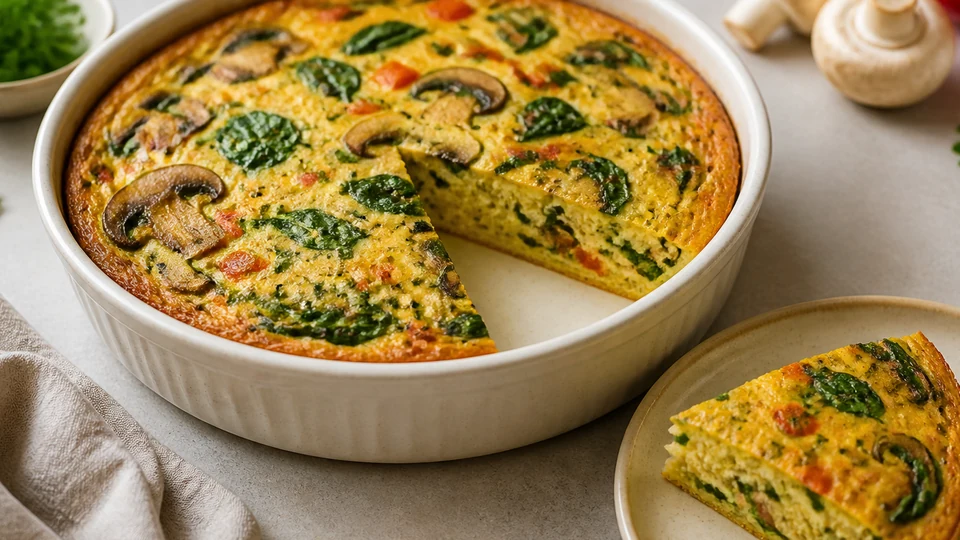
Crustless breakfast quiche
At Pancakes World, a reliable crustless breakfast quiche starts with a tested egg-and-dairy custard, fully cooked and cooled fillings, a greased shallow baking dish, and an internal-temperature check. Sauté watery vegetables until their released liquid evaporates; cook raw meat separately to its required temperature; drain both before assembly. Distribute fillings evenly, pour in the custard, and leave expansion room rather than overfilling the pan. Bake using the base recipe’s temperature and begin checking near its early time. The center must reach 160°F in several spots—165°F if poultry or a mixed-casserole rule controls—then rest briefly before slicing. Browning, puffing, a slight jiggle, or a clean knife can support a decision but cannot replace the thermometer.
For broader context, continue with American Breakfast: Pancakes, Diner Plates and Brunch.
What “crustless quiche” means here
A crustless quiche keeps the soft egg-and-dairy custard and removes the pastry shell. It overlaps with frittata and breakfast casserole, but the terms are not exact cooking instructions.
- Crustless quiche: usually emphasizes a tender custard with fillings suspended in it.
- Frittata: often uses less dairy and may begin on the stovetop before finishing in the oven.
- Egg bake or casserole: a broader category that may include bread, potatoes, pasta, or a high volume of fillings.
The label matters less than the formula and pan. If a recipe was developed as a frittata, do not add extra milk and expect quiche texture. If a casserole relies on bread to absorb liquid, removing the bread without changing the custard can leave a watery center.
“Crustless” also does not prove gluten-free, low-carbohydrate, dairy-free, or suitable for a specific diet. Sausage, seasoning, cheese, cooking spray, thickeners, and cross-contact can all change those claims.
Start from a tested custard ratio
Eggs and dairy create the structure. Too much liquid produces a loose, weeping slice; too little can make the quiche dense and rubbery. Egg size, milk fat, cheese, vegetable water, pan depth, and filling volume all influence the result.
For that reason, this article does not invent a universal number of eggs per cup of milk. Choose a reliable crustless-quiche formula written for your pan size, then vary flavor within its tested limits.
Record:
- number and size of eggs
- type and quantity of milk, cream, or specified alternative
- cheese weight
- cooked filling weight
- pan dimensions and depth
- oven setting and rack position
- actual internal temperatures
- rest time and slice quality
Once a base works, it becomes a house formula. Until then, treat substitutions as a new test rather than a guaranteed recipe.
Choose the pan by depth, not just diameter
A nine-inch pie plate, eight-inch square dish, loaf pan, muffin pan, and deep casserole do not cook the same volume at the same rate. A shallow custard has more exposed surface and reaches the center sooner. A deep one can brown at the edges while remaining cool in the middle.
Use the pan specified by the base recipe. If changing it:
- Compare the usable capacity, not only the width.
- Keep a similar fill depth.
- Leave room for puffing.
- Place extra mixture in a separate prepared dish instead of overfilling.
- Begin checking earlier for shallow or mini portions.
- Expect a deeper pan to need a different validated schedule.
Glass, ceramic, dark metal, and light metal transfer heat differently. Do not move a glass dish directly between extreme temperatures unless its manufacturer allows it. Put the pan on a stable rack and use a rimmed sheet pan beneath it only when the recipe permits.
Grease the dish with the fat specified by the recipe. Cover the bottom and corners evenly. A heavy layer can pool at the edge, while missed spots make slices tear.
Moisture is the main filling problem
Vegetables contribute flavor and texture, but many release water as they cook. That water dilutes the custard and can collect under the quiche.
Mushrooms
Slice evenly and cook in a broad pan until released liquid evaporates and the surfaces begin to color. Crowded mushrooms steam.
Spinach
For fresh spinach, wilt it and press out excess liquid after cooling. For frozen spinach, thaw completely and squeeze thoroughly. A package that looks small can still hold substantial water.
Zucchini
Dice or shred according to the recipe, salt only if the method directs, and cook or drain before assembly. Raw zucchini can release water late in baking.
Tomatoes
Use small quantities, remove watery seed pulp when helpful, and place slices on top only when the formula supports them. Roasted or drained tomatoes offer more concentrated texture.
Broccoli and cauliflower
Pre-cook until just tender, then cool and dry. Large florets create gaps and prevent clean slices.
Peppers and onions
Sauté until tender and until surface moisture has reduced. Cool before adding to eggs.
Frozen mixed vegetables
Follow package directions, drain thoroughly, and avoid adding frozen clumps directly to the custard unless a tested recipe says to do so.
After cooking any vegetable, spread it on a plate or sheet pan to cool. Hot filling can start setting the egg unevenly during assembly.
Cook meat before it enters the adaptable formula
For the flexible method described here, raw sausage, bacon, chicken, turkey, ham that requires cooking, or other meat is cooked separately first. Use the USDA endpoint applicable to that product:
- raw ground beef, pork, veal, or lamb: 160°F
- raw poultry, including ground chicken or turkey: 165°F
- other whole cuts: use their specified endpoint and rest
Drain rendered fat and cool the meat. Crumble or dice it small enough to distribute without forming heavy pockets.
A separate validated recipe may be designed for raw meat in the custard, but its time, pan, and endpoint must be followed exactly. Do not copy only the ingredient list and discard its method.
Fully cooked ham, bacon, sausage, smoked fish, and deli products still need label checks. Some contain sweet glazes, allergens, or excess surface liquid. “Fully cooked” affects food safety; it does not guarantee that the product will behave well in custard.
Assembly sequence
Step 1: prepare the kitchen
Wash hands and surfaces. Keep raw meat and eggs separate from ready-to-eat ingredients. Use clean utensils and a clean pan.
USDA advises buying eggs from a refrigerated case, choosing clean uncracked shells, refrigerating them promptly, and not leaving refrigerated eggs out for more than two hours.
Step 2: cook and cool fillings
Finish meat to its required endpoint. Cook vegetables until their excess moisture is controlled. Drain, blot, and cool.
Step 3: prepare the pan and oven
Use the specified pan, rack, and preheat. Grease evenly. Do not wait so long after greasing that the coating runs away from the sides.
Step 4: mix the custard
Whisk eggs with the recipe’s measured dairy, salt, pepper, and seasonings just until uniform. Excessive aeration can create large bubbles and dramatic puffing that later collapses.
Taste seasonings before they touch raw egg when possible. Once raw egg is present, do not taste the mixture.
Step 5: distribute fillings
Spread cooled filling evenly across the pan. Reserve wet garnishes and delicate herbs for later. Avoid a solid layer of cheese or meat at the bottom.
Step 6: add custard
Pour slowly so fillings stay distributed. Use a clean utensil to nudge pieces into place. Keep below the recipe’s fill depth.
Step 7: bake and verify
Bake at the temperature specified by the base formula. Begin checking near the early end of its range. Insert a clean food thermometer into the center or thickest part without touching the pan. Check several central locations because ovens have hot spots.
USDA states that quiche and other egg dishes should reach 160°F. If the dish includes poultry or is governed as a casserole with a higher endpoint, use 165°F. The highest applicable minimum controls.
Step 8: rest and slice
Remove the quiche only after all required locations pass. Rest on a heat-safe surface for the interval in the recipe. The custard continues settling, making cleaner slices.
Run a thin, non-scratching tool around the edge if needed. Use a sharp knife and wipe it between cuts. Resting improves structure, but it cannot repair an undercooked center.
Doneness: safety and texture are different questions
The thermometer answers whether the egg mixture reached its safe minimum. Texture signs answer whether the formula and baking process produced a good quiche.
Useful supporting signs include:
- edges look set
- center no longer flows like liquid
- top is lightly colored
- a small puff settles during rest
- slice holds after resting
Insufficient safety tests include:
- “the cheese melted”
- “the top browned”
- “the knife looked clean”
- “it baked for forty minutes”
- “the center still jiggles only a little”
Check temperature before removing the dish. Pushing the quiche far beyond the endpoint can toughen eggs and squeeze water from the custard, so more heat is not always better for quality.
Six flavor directions
These combinations assume each filling is cooked, cooled, drained, and kept within the base formula’s permitted total.
Spinach, mushroom, and Swiss-style cheese
Cook mushrooms dry, squeeze spinach, and distribute cheese lightly. Season with nutmeg or thyme if desired.
Broccoli and cheddar
Use small, just-tender broccoli pieces and a measured cheese amount. Large crowns make slicing difficult.
Pepper, onion, and cooked sausage
Cook raw sausage to its required endpoint, drain it, and sauté the vegetables. Keep salt restrained until the sausage and cheese are considered.
Tomato, herb, and goat cheese
Drain or roast tomatoes and use small cheese pieces. Add delicate basil after baking when possible.
Smoked salmon and dill
Use a tested formula for an already-cooked fish filling. Check salt before adding more and avoid overbaking the salmon.
Potato, scallion, and cheese
Cook potato completely before assembly and cut it small. Potato turns the dish toward a breakfast casserole, so preserve the tested filling limit.
No variation receives an invented yield or nutrition profile. Ingredient brand, portion, and pan determine the final values.
Vegetarian, dairy-free, and gluten-free decisions
Vegetarian
Use vegetables, herbs, and cheese while keeping moisture controlled. Confirm cheese ingredients if the eater avoids animal-derived rennet.
Dairy-free
Milk alternatives differ in water, protein, sugar, gums, and flavor. Use a tested dairy-free custard formula rather than replacing cream one-for-one by intuition. Choose an unsweetened product only when the formula calls for it, and verify allergens.
Gluten-free
Removing pastry eliminates one obvious wheat source but does not prove the finished dish is gluten-free. Check sausage, deli meat, cheese, seasoning, cooking spray, and cross-contact. A shared pan or utensil can matter for people with celiac disease.
Lower-sodium or other nutrition goals
Compare current labels for cheese, meat, dairy, and prepared seasonings. Do not rely on category assumptions. Flavor with herbs, pepper, mushrooms, roasted vegetables, or acid where appropriate.
Mini crustless quiches
Muffin-size portions offer fast service and easy freezing, but they are not merely a large quiche divided without adjustment.
Use a recipe written for the specific well size. Grease each well, distribute filling by weight or a standardized scoop, and add equal custard. Leave expansion room.
Mini portions cook faster and can overcook while you wait for one overfilled well. Check several wells, including center and edge positions, with an appropriate thin probe. Every tested portion must reach the controlling endpoint.
Cool the pan briefly, then release portions according to the recipe. Transfer them to a rack or shallow container so trapped steam does not make the bottoms wet.
For a crowd, count actual finished portions and hold them safely. Do not place a new batch on top of old buffet portions and lose the time record.
Scaling a crustless quiche
Scaling changes more than ingredient count. It changes depth, heat flow, cooling, and service.
For more servings:
- Use multiple pans of the tested size rather than one very deep pan.
- Mix batches that fit the bowl and whisk comfortably.
- weigh fillings so each pan is equivalent.
- Rotate pans only if the recipe and oven test support it.
- Check every pan independently.
- Mark portions before service.
Do not multiply salt and spices mechanically without tasting cooked fillings first. Do not assume all pans finish together because they entered the oven together.
For fewer servings, use a smaller tested formula or mini-quiche recipe. Halving the ingredients but using the original pan makes a much shallower custard with a different schedule.
Make-ahead options
Prepare fillings ahead
Cook vegetables and meat, cool promptly, and refrigerate in separate containers. This is the most reliable make-ahead step because the raw custard is not sitting for an extended period.
Assemble ahead
Only do this when the base recipe supports overnight assembly. USDA advises cooking dishes containing raw eggs immediately or refrigerating and cooking within 24 hours. Keep the pan cold and bake according to the tested cold-start directions.
Bake ahead
Cook to the proper endpoint, cool in shallow portions, cover, and refrigerate. USDA lists quiche with any filling for three to four refrigerated days and says egg dishes reheated for later service should reach 165°F.
Freeze
USDA’s egg storage chart lists baked quiche as freezable for one to two months for quality. Cool safely first, wrap portions, label, and thaw in the refrigerator. Texture may be softer after freezing.
Storage, buffet service, and reheating
Serve the quiche promptly or hold it at 140°F or warmer. Cold service needs 40°F or colder. Perishable food should not remain uncontrolled at room temperature beyond two hours, or one hour when the temperature exceeds 90°F.
For leftovers:
- cut large quiches into portions
- place portions in shallow containers
- refrigerate promptly
- use within three to four days
- reheat to 165°F
- check the center of more than one portion
A microwave may heat edges before the center. Cover as appropriate, rotate or rearrange, allow the specified standing time, and verify multiple points. Reheat only what will be served.
Do not cool a whole deep dish on the counter for several hours. Do not return buffet portions to storage after they exceeded time or temperature controls.
Troubleshooting
The center is watery
Likely causes: vegetables were not drained, custard ratio was altered, pan was too deep, or the center did not reach the endpoint.
Correction: cook fillings drier, use the tested ratio and pan, and check multiple central temperatures.
Water appears after slicing
The quiche may be overcooked, under-rested, or loaded with wet vegetables. Overheated egg proteins can squeeze out liquid.
Correction: remove once all required spots pass, rest as directed, and control filling moisture.
The quiche is rubbery
Too little dairy, excessive baking, very high heat, or aggressive reheating can toughen it.
Correction: return to the base ratio and stop at the objective endpoint.
Fillings sink
Heavy or large pieces may fall before the custard sets.
Correction: cut fillings smaller, distribute evenly, and stay within the tested volume. Do not add flour casually to suspend them.
Slices fall apart
The filling-to-custard ratio may be too high, the center undercooked, or the rest too short.
Correction: reduce filling to the tested amount, verify temperature, and rest before cutting.
Edges burn first
The pan may be dark, the oven may run hot, or the dish may be too close to an element.
Correction: use the specified pan and rack, verify oven calibration, and avoid changing endpoint requirements.
Quiche sticks
The pan was unevenly greased, cheese settled against the bottom, or the dish cooled too long before serving.
Correction: prepare every surface, distribute cheese through the custard, and use a non-scratching release tool.
Decision table
| Goal | Best starting choice | Main control |
|---|---|---|
| Tender classic texture | Tested egg-and-dairy formula | Preserve custard ratio |
| Vegetable-heavy quiche | Pre-cooked dry vegetables | Filling volume and moisture |
| Meat version | Fully cooked, drained meat | Product endpoint before assembly |
| Dairy-free version | Tested dairy-free formula | Alternative’s protein and water |
| Gluten-free service | Verified ingredients and separation | Cross-contact, not just no crust |
| Mini portions | Formula for exact well size | Equal fill and multi-well checks |
| Make-ahead service | Bake, cool, refrigerate, reheat | 165°F on reheating |
| Large group | Multiple standardized pans | Independent pan temperatures |
Frequently asked questions
What temperature should crustless quiche reach?
USDA says quiche and other egg dishes should reach 160°F in the center. Check several thick central spots. If poultry or another component requires a higher endpoint, use the highest applicable temperature.
How do I stop it becoming watery?
Cook watery vegetables until released liquid evaporates, squeeze spinach, drain meat, cool fillings, preserve the tested custard ratio, and avoid overfilling the pan.
Can I make it the night before?
Prepare fillings ahead freely within safe storage rules. Assemble raw custard overnight only when the recipe supports it, refrigerate continuously, and cook within 24 hours. A fully baked quiche can be chilled and reheated to 165°F.
Is crustless quiche gluten-free?
Not automatically. Verify sausage, seasonings, dairy, cheese, cooking spray, and cross-contact. The missing pastry removes one source, not every possible source.
Can I use milk instead of cream?
Use the liquid specified by the base formula. Milk and cream differ in fat and water, so a substitution can change tenderness and set.
Can I add raw bacon or sausage?
The adaptable method uses meat cooked first to its required endpoint. Use raw meat in the custard only when a validated recipe explicitly manages it and the entire dish reaches the controlling temperature.
Why did my quiche puff and then fall?
Egg custard naturally expands with heat and settles as it cools. Excess whisking, high heat, or overbaking can exaggerate the change. A moderate settled surface is not necessarily failure if the custard is safely cooked and holds a slice.
How long does it keep?
USDA lists quiche with any filling for three to four refrigerated days. Cool promptly, keep at 40°F or colder, and reheat portions to 165°F.
The working rule
Crust removal simplifies pastry, not custard. Use a tested egg-and-dairy base, keep the pan depth stable, cook and drain fillings, and verify the center with a thermometer. The best variation is the one that stays inside the formula’s filling limit and meets the eater’s actual ingredient needs. When changing dairy, pan, depth, or filling volume, treat the result as a new test rather than promising the original timing or yield.
For more egg bakes and morning formats, explore the breakfast collection. For the wider food and recipe platform, visit Pancake World.
Explore related Pancakes World guidance on American Pancakes, Maple Syrup, and Maple Syrup Pancakes.
Sources and editorial references
- USDA Food Safety and Inspection Service, “Shell Eggs from Farm to Table” —
https://www.fsis.usda.gov/food-safety/safe-food-handling-and-preparation/eggs/shell-eggs-farm-table - USDA Food Safety and Inspection Service, “Food Thermometers” —
https://www.fsis.usda.gov/food-safety/safe-food-handling-and-preparation/food-safety-basics/food-thermometers - USDA Food Safety and Inspection Service, “Safe Minimum Internal Temperature Chart” —
https://www.fsis.usda.gov/food-safety/safe-food-handling-and-preparation/food-safety-basics/safe-temperature-chart - Penn State Extension, “Key Food Safety Instructions for Recipes” —
https://extension.psu.edu/key-food-safety-instructions-for-recipes - Penn State Extension, “What Do I Do with All These Eggs?” —
https://extension.psu.edu/what-do-i-do-with-all-these-eggs - USDA Food Safety and Inspection Service, “Keep Food Safe! Food Safety Basics” —
https://www.fsis.usda.gov/food-safety/safe-food-handling-and-preparation/food-safety-basics/steps-keep-food-safe