Crockpot brunch casserole
At Pancakes World, a workable crockpot brunch casserole begins with service time and the slow cooker’s actual manual, not a universal ingredient list. Choose one tested slow-cooker casserole recipe whose yield fits the appliance, decide whether it is egg-based, potato-based, bread-based, or vegetable-led, and keep quantities and timing intact. Prepare only the steps the source permits in advance, refrigerate perishable components promptly, and start early enough to avoid opening the lid repeatedly. Confirm doneness with the recipe’s tests and applicable safety guidance, then use an approved warm setting only for the stated holding window.
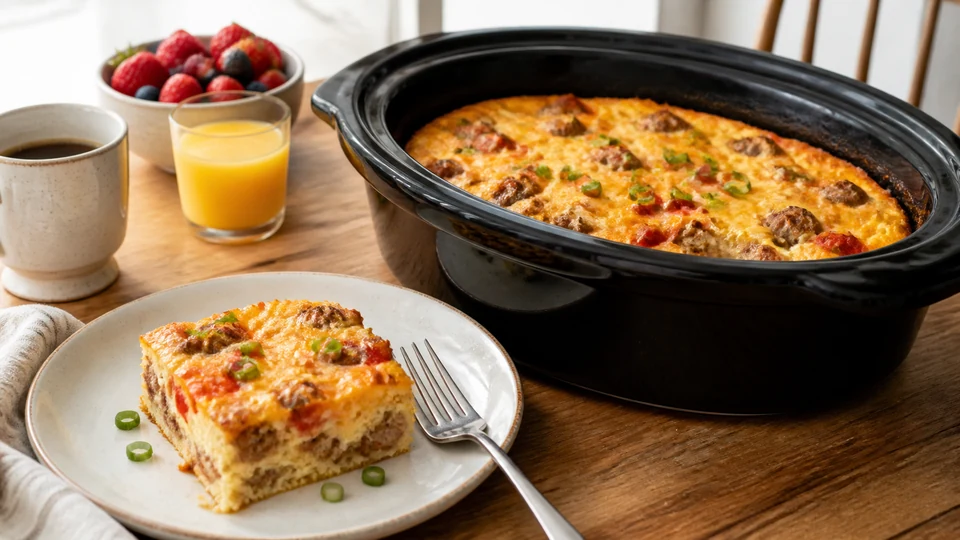
This page is an event workflow and recipe selector. It does not invent ingredient quantities, cooking times, yield, or Recipe schema. The brunch hub covers the wider occasion, and Pancake World opens the full editorial collection.
| Guide sections |
|---|
| Define the brunch event before choosing a casserole |
| Select one complete tested recipe |
| Match recipe yield to cooker capacity |
| Choose the casserole structure deliberately |
For broader context, continue with American Breakfast: Pancakes, Diner Plates and Brunch.
Define the brunch event before choosing a casserole
Write the service time, number of eaters, eating style, and other hot dishes at the top of the plan. A casserole for a seated family brunch has a different service path from one placed on a buffet where guests arrive over an hour. Note travel, photographs, religious services, sports, or another fixed event that affects when the cooker can be started and supervised.
Decide what role the casserole will play. As the main, it needs a contrasting side and a clear alternative for anyone who cannot eat it. As one item in a larger spread, its yield and appliance footprint should not crowd out more useful foods. Avoid choosing two egg-and-potato mains simply because both can be made ahead.
Set a realistic quality target. A slow-cooker casserole can trade crisp surfaces for hands-off enclosed cooking. If a browned top or sharply crisp potato is essential, choose a tested oven recipe rather than expecting the appliance to create a texture it was not designed to produce.
Select one complete tested recipe
Use a recipe developed for a slow cooker, not an oven casserole with the vessel changed. The source must specify ingredients, amounts, cooker size or capacity, sequence, timing range, and doneness method. A recipe that merely says “cook until done” leaves too much uncertainty for an egg- or meat-containing brunch dish.
Confirm that the source describes the structure wanted: egg and potato, bread strata, vegetable and egg, sausage and potato, ham and bread, or another complete design. Do not combine the ingredient list from one with the timing from another. Depth, moisture, binder, and raw-meat state are connected.
If a genuine project-owned test record does not exist, this page remains an Article rather than Recipe schema. Editorial variations can be discussed as selection options, but they cannot claim tested yield, timing, or performance.
Match recipe yield to cooker capacity
Find the exact model and its usable capacity in the manual. Do not rely on a remembered quart or litre figure for a similar-looking unit. Check minimum and maximum fill guidance, whether the insert may be refrigerated, how the lid must sit, and what the manufacturer permits for preheating, delayed start, and warm mode.
Then match the recipe’s stated appliance size. A smaller cooker creates greater food depth; a larger cooker may create a shallow layer. Either change can alter the cooking path, so scaling the ingredients without a tested source is not a neutral adjustment.
Place the empty cooker at the service location and test the lid clearance, outlet access, cord path, and buffet flow. Keep the cord away from guests, liquids, children, and hot serving utensils. A suitable recipe can still be a poor event choice if the appliance cannot be positioned safely.
Choose the casserole structure deliberately
Egg-and-potato casserole
This familiar structure can make firm portions when the tested recipe balances egg, potato, fillings, and depth. Confirm whether potatoes are frozen, thawed, cooked, shredded, or diced; those states are not interchangeable. Check whether meat must be cooked first and whether vegetables need moisture removed.
Bread-based strata
A bread casserole relies on the source’s bread amount, liquid absorption, assembly order, and rest. Different breads absorb differently, so replacing the named form with a dense loaf or very fresh soft bread can change the centre. Use the tested recipe rather than choosing bread only to use it up.
Vegetable-led egg casserole
Vegetables can release substantial moisture. The source should specify whether they are sautéed, drained, thawed, or added raw. More vegetables are not automatically a harmless improvement; extra water can delay setting and change depth.
Sausage, ham, or another meat version
Identify whether the recipe requires raw or fully cooked meat. Cook raw meat separately when directed and prevent its utensils from contacting ready-to-eat foods. Do not assume cured appearance means ready to eat. Retain the product label for handling and allergen information.
Sweet bread casserole
A French-toast-style slow-cooker casserole has a different sugar, liquid, and bread structure from a savoury egg bake. Follow its source and watch for sticky edges during cleanup. Do not transfer warm-holding assumptions from a savoury recipe.
Build the backward timeline
Start at the planned first serving. Add the source’s cooking range without converting it into a guarantee, then add preparation, permitted assembly, setup, and a buffer for ordinary event tasks. The goal is to know the latest safe start, not to promise an exact finish.
If the recipe offers a range, plan how doneness will be checked near the earlier boundary without repeatedly lifting the lid. The cooker loses heat and moisture when opened, and a sequence of curious checks makes the source timing less meaningful. Assign one person to monitor the stated cue.
Include the transition after cooking. Will the dish be served immediately, moved to an approved warm setting, transported, or portioned? The recipe, manual, and FoodSafety.gov must support the chosen path. A warm setting is not a way to finish an undercooked centre.
Separate night-before work from morning work
Mark every advance task the tested recipe expressly permits. Chopping a labelled ingredient, cooking meat, draining vegetables, measuring dry seasonings, and assembling the full insert carry different storage consequences. Do not interpret “make ahead” as permission to leave perishables in an unpowered cooker overnight.
Cool cooked components promptly under applicable guidance before they join a refrigerated assembly. Keep raw-meat tools separate and clean the workspace. Store toppings or crisp finishes apart when the recipe adds them near service.
If the manual does not permit a cold insert to move directly into the heating base, follow its alternative. The material can be sensitive to abrupt temperature changes, and appliance-specific instructions control. An owner’s habit with another cooker is not sufficient evidence.
In the morning, retrieve the assembly only when the cooker is ready. Confirm the lid, power, setting, and start time. Do not use a plug timer or delayed-start feature with perishable ingredients unless both appliance and recipe explicitly support the entire method; ordinary delay with eggs, dairy, meat, or cut vegetables is not a safe shortcut.
Control ingredient moisture
Slow cookers retain moisture, so ingredient state matters. Thaw frozen vegetables only when directed and drain or cook them as the source specifies. Sautéed mushrooms, spinach, peppers, onions, or courgettes may need liquid reduced before assembly. Do not add an extra cup of vegetables without considering the water they bring.
Potatoes also arrive in different states. Frozen shredded potatoes, refrigerated hash browns, par-cooked diced potatoes, and raw fresh potatoes cannot share instructions by name alone. Use the state written in the recipe and the current product directions.
Bread should match the recipe’s form and amount. A drier cube may absorb differently from a soft fresh slice. Cheese, sauce, and high-moisture toppings can also change the surface and centre. Keep optional wet toppings for service rather than pouring them into an untested base.
Handle meat and eggs without shortcuts
Read whether meat is raw, cooked, or ready to eat. When the recipe requires cooked sausage, bacon, or another meat, complete that step separately and drain or cool as directed. Do not rely on the slow cooker to correct a preparation state the source did not test.
Crack eggs into a separate clean vessel rather than over the assembled insert so shell can be removed and a questionable egg does not contaminate the whole dish. Mix the binder only in the sequence the recipe gives. Return eggs and dairy to refrigeration when they are not being actively used.
Avoid tasting uncooked filling. The finished centre must meet the tested recipe’s doneness indicators and applicable official guidance. A browned edge, pleasant smell, or bubbling surface does not prove that the deepest centre is ready.
Assemble in the stated order
Layering is structural. A recipe may put potatoes below egg, distribute fillings through bread, reserve cheese for later, or coat the insert in a manufacturer-permitted way. Follow that sequence. Reversing it can change contact, moisture movement, and release.
Keep the depth even without compressing ingredients beyond the source method. Clear food from the rim so the lid sits correctly. Do not overfill to use up a remainder. If the batch does not fit at the expected depth, stop and verify cooker size and measurements rather than forcing the lid.
Photograph or note the assembled level if that helps compare a later repeat, but do not treat appearance as a tested fill specification. Record the actual recipe, cooker model, and any permitted variation.
Cook without casual interruption
Set the control exactly as directed and record the start. Confirm that power is present and the cooker is heating as expected. Do not move a hot, full appliance unless its manual permits it and the path has been planned.
Leave the lid closed except for a source-directed step or the planned doneness check. Adding cold toppings, stirring, or rotating layers mid-cook can change the process. If the power is interrupted, use official guidance and the appliance instructions rather than restarting automatically.
Near the source’s checking point, prepare the permitted thermometer or other test before opening. Check the centre or location named by the recipe, avoiding contact with the insert if that would distort the reading. Close promptly if further cooking is supported. Never use warm mode as the repair setting.
Confirm doneness at the centre
The centre is usually the last part to set in a deep casserole. Use the recipe’s visual and physical cues together with applicable temperature guidance for the ingredients. Edges pulling away, melted cheese, or a firm-looking top can coexist with an unset centre.
If the centre needs more time within the recipe’s method, continue on the cooking setting and recheck at a sensible interval. Do not serve outer portions while leaving an uncertain centre behind. If the recipe’s range is exceeded substantially without doneness, verify setting, lid fit, fill level, ingredient state, and appliance function; do not publish a new universal time from one incident.
Record the final check and decision. A proper test record would also capture ingredients, equipment, conditions, yield, and reviewer. Until that exists, the route remains planning guidance.
Move from cooking to brunch service
Once done, decide between immediate service and an approved holding path. If warm mode is permitted, note when it begins and the applicable limit. Stirring or cutting may release moisture and change texture, so follow the recipe’s serving direction.
Set the cooker where guests can reach it without crossing the drink station. Provide a heat-safe serving tool and protect the surface beneath the appliance. Keep the lid location safe; condensation can drip onto the table or floor.
Offer toppings and sauces in separate labelled containers. Place cold garnishes in small portions and replenish from controlled reserves. A topping bar should not obscure the casserole’s ingredient and allergen information.
Pair the casserole with a coherent brunch
Because the cooker supplies a soft, warm main, choose sides that create contrast without another major hot workflow. Fruit, a crisp salad-style component, bread, or a cold labelled dish may work depending on the exact menu and guests. Avoid a second casserole with the same egg-and-potato role.
Choose drinks and tableware before cooking begins. Put cups and refills away from the hot appliance. If an alternative main is needed, select something that can be identified and served with separate utensils rather than an improvised scoop from the same casserole.
Limit the menu to what helpers and equipment can maintain. A calm brunch with one dependable hot anchor is more practical than a crowded table whose foods pass through uncontrolled temperatures.
Plan portions and replenishment
Use the tested recipe’s stated yield, recognizing that individual appetite and serving size vary. Do not rewrite yield based on how many portions looked possible in one event. For a buffet, begin with service portions that preserve the dish rather than cutting everything before guests arrive.
If the slow cooker remains the serving vessel, keep its operating state within the manual and safety plan. If food is transferred to another dish, that new vessel and the time out of control become part of the record. Do not refill an old serving layer by mixing it with a new batch of uncertain age.
For a larger group, use multiple complete tested batches only when each cooker, outlet, timeline, and supervisor can be controlled. Doubling ingredients in one cooker is not equivalent.
Label the complete dish
Build the label from every ingredient: casserole base, meat, cheese, bread or potatoes, seasonings, cooking fat, toppings, and packaged mixes. Retain current packages. Front-label categories do not replace the full ingredient and allergen declaration.
If a guest has an allergy or medical need, communicate the evidence and the limits of the home setup. Separate utensils reduce one risk path but do not make a dish certified free from cross-contact. When uncertainty remains, offer a sealed or otherwise clearly controlled alternative instead of reassurance.
Date any saved menu record. Product formulations can change, so recheck labels at the next event.
Cool and store leftovers intentionally
Decide before service whether leftovers are expected and which containers will be used. After the safe service or holding period, portion and cool according to FoodSafety.gov guidance. A deep, hot insert is not automatically an appropriate cooling container.
Record the cooking and service history with stored portions. Keep toppings separate where their storage differs. Reheat only through a supported method, and do not use the slow cooker’s warm mode to reheat unless authoritative instructions specifically permit that use.
If the history is uncertain, discard the food rather than assigning a new date. Smell and appearance cannot reconstruct missing time-and-temperature evidence.
Troubleshoot common casserole problems
The centre is loose but the edges are firm
Check fill depth, cooker size, lid fit, ingredient state, and the recipe’s remaining method. Continue only as the source supports. Do not switch to warm or serve the edges.
The casserole is watery
Review vegetable preparation, frozen ingredient state, meat draining, and untested additions. Correct the next batch at the source step rather than scooping out liquid during cooking.
The bottom or edges darken early
Verify the correct cooker size and setting. Do not add liquid by guess. If the appliance runs differently from the recipe’s tested model, select a better-matched source.
The lid collects condensation
Condensation is normal in enclosed cooking, but do not insert towels or prop the lid unless the tested recipe and appliance manual explicitly permit it. Those changes affect heat and safety.
Service is late
Use only an approved holding method and window. Do not leave the cooker in an undefined state while waiting for guests. If the delay exceeds the safe plan, choose another service action supported by official guidance.
Cleanup is difficult
Follow the manual for cooling, removable parts, soaking, and tools. Never immerse the electrical base or scrape coated surfaces with prohibited utensils. Record whether a sticky formula is worth repeating.
A complete event checklist
Several days before, select the tested recipe, confirm cooker model, resolve guest needs, and map the brunch menu. One day before, shop against the exact ingredient list, retain labels, and complete only permitted advance tasks. Prepare storage space and leftover containers.
On the day, calculate the start from service time, set up the cooker safely, retrieve perishable ingredients at the proper moment, assemble in order, and record the start. Keep the lid closed. Prepare cold sides and the buffet while the casserole cooks, without letting them sit uncontrolled.
At the planned check, verify the centre. Move to service or approved holding, label the dish, and control toppings. After brunch, close the service window, portion safe leftovers, cool them appropriately, unplug and clean the appliance, and record what should change next time.
Build a realistic hour-by-hour service map
A useful timeline names actions and owners instead of writing only “casserole cooks.” Begin with the moment the first guest should receive food. Immediately before that, allow time for the centre check, any source-directed rest, moving the appliance into its service state, placing the serving tool, and briefing the person responsible for the buffet. Work backward through the cooking range to the latest supported start, then add assembly and setup.
Put cold-side preparation on a separate line. Washed fruit, salad components, yogurt, sauces, and other perishable foods should not be placed on the buffet merely because the slow cooker is still running. Keep them controlled and assign a release time. Put drinks on another line so ice, kettle, coffee equipment, and cups do not compete with casserole service.
Mark decision points. The first is the pre-start gate: recipe, cooker, ingredients, fill, lid, outlet, and supervisor all match. The second is the planned doneness check. The third is the service-or-hold choice. The fourth closes the buffet and begins leftover handling. A named decision point prevents the cooker from drifting between settings while the host attends to guests.
Add a fallback for each critical point. If an ingredient is missing, do not improvise a structurally different substitute; use the planned alternative dish. If the cooker does not power on, move to a recipe and appliance combination that is independently supported rather than placing the insert in an oven by guess. If the casserole finishes later than the social schedule, serve the controlled cold foods and wait for verified doneness. If it finishes early, use only the approved holding path.
The buffer should cover ordinary setup variability, not unsafe waiting. It is better to plan a side that can be released while the main completes than to start perishable cooking at an uncertain time and hope guests arrive at the right moment.
Review six candidate recipes before committing
For each candidate, record the exact source, casserole family, cooker size, stated yield, active preparation, cook range, permitted advance work, ingredient states, centre test, and holding instructions. Eliminate any recipe that does not answer the non-negotiable questions for the event. A short appealing description is not a substitute for a complete method.
Compare egg-and-potato candidates on potato state, meat preparation, vegetable moisture, depth, and portion style. Compare bread casseroles on bread form, soak or rest, liquid, and whether the finished texture fits buffet serving. Compare vegetable-led recipes on pre-cooking and drainage. Compare sweet casseroles on sugar-rich surfaces, toppings, and whether they duplicate dessert.
Then compare operational fit. One recipe may have fewer ingredients yet require morning browning of raw meat. Another may permit advance cooking and cooling of that component. One may fit the cooker but finish close to guest arrival; another may offer an approved holding path. These differences are more meaningful than a generic “easy” label.
Choose the candidate whose complete documented workflow fits. Keep the comparison sheet with the event notes, but do not merge appealing elements from rejected recipes. The selected source remains the controlling method.
Coordinate helpers without losing evidence
Assign one person as cooker lead. That person confirms the recipe and model, records start and checks, controls the lid, and makes the service decision. Another helper can handle cold sides and labels. A third can arrange drinks, tableware, and cleanup. Clear ownership keeps several well-meaning guests from opening the lid or changing the setting.
Give helpers executable notes. “Watch the casserole” is vague. “At the source’s earliest check point, prepare the permitted thermometer, open once, check the named centre location, record the result, and close unless done” preserves the evidence boundary. “Put out toppings” should state which containers, labels, utensils, and cold-reserve plan apply.
Do not delegate unresolved allergy questions at the buffet. Settle them before purchasing or provide a clearly controlled alternative. Helpers should describe ingredients from retained labels and avoid promising safety the kitchen cannot establish.
During cleanup, the cooker lead records end of service and the leftover decision. The cleaning helper follows the model manual rather than using a familiar method from another appliance. This division lets the host participate in brunch without turning responsibility into guesswork.
Audit the event after the cooker is clean
Review timing, fill, doneness, service flow, labels, leftovers, and cleanup while details are fresh. Did the dish reach its verified endpoint before the planned service? Was warm holding used, and was its start recorded? Did guests queue safely around the cord and lid? Were optional toppings genuinely useful? Did the stated yield align with the event without converting one observation into a new recipe claim?
Separate recipe performance from event performance. A casserole may cook as directed but still be a poor choice because it duplicated another main or occupied the only safe outlet. Conversely, a delayed event does not prove the recipe timing wrong if preparation started late. Identify the first decision that should change.
Retain the tested source, appliance model, ingredient labels needed for traceability, and event notes. Mark any variation. A future brunch can repeat the controlled parts and reconsider the weak operational choice without relying on memory or inventing a new formula.
Frequently asked questions
Can a crockpot brunch casserole cook overnight?
Only use a complete recipe explicitly written for overnight slow cooking and follow its appliance and safety controls. Do not leave perishables in an unpowered cooker.
Can I assemble it the night before?
Only when the tested recipe permits refrigerated assembly and the appliance manual supports the insert handling required the next morning.
Can I double the recipe?
Not in one cooker unless a tested source supplies that scale and suitable capacity. Greater depth can change cooking and doneness.
Can warm mode finish an undercooked casserole?
No. Warm mode is not a cooking repair. Continue only on the recipe-supported setting or follow applicable discard guidance.
What should I serve with it?
Choose one or two contrasting low-work sides and a drink. Avoid another hot main that duplicates the casserole and competes for attention.
Can I use frozen vegetables?
Use the exact state named by the recipe. Frozen, thawed, drained, and cooked vegetables can contribute different moisture.
Explore related Pancakes World guidance on American Pancakes, Maple Syrup, and Maple Syrup Pancakes.
Sources and editorial references
- USDA FoodData Central —
https://fdc.nal.usda.gov/ - FoodSafety.gov food safety charts —
https://www.foodsafety.gov/food-safety-charts - FDA Food Labeling & Nutrition —
https://www.fda.gov/food/nutrition-food-labeling-and-critical-foods