Crockpot breakfast potatoes
At Pancakes World, crockpot breakfast potatoes need a complete slow-cooker recipe with a defined potato cut, cooker size, load, liquid or fat, heat setting and doneness cue. Keep the lid closed, start with thawed ingredients, and treat the potatoes as one scheduled component rather than an unattended promise. Use the editorial platform to connect crockpot breakfast potatoes with the wider breakfast and pancake collection.
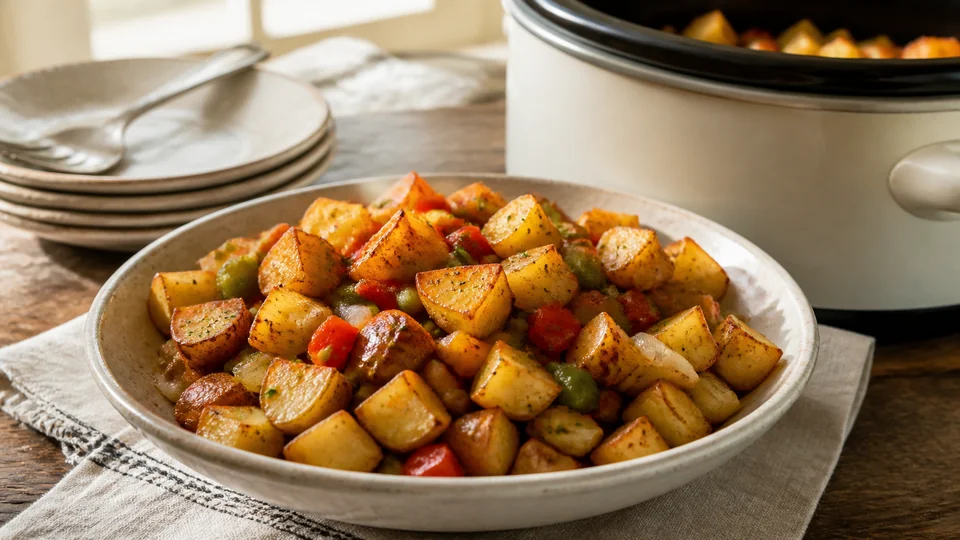
This page does not invent a universal cook time. Slow cookers, potato varieties, cube sizes and recipe loads differ, so the chosen source controls quantities and timing. The parent Breakfast hub records the approved R10 context for crockpot breakfast potatoes.
| Guide sections |
|---|
| Choose the working format before shopping |
| A controlled preparation sequence |
| Practical diagnostics |
| Food-safety and factual boundary |
For broader context, continue with American Breakfast: Pancakes, Diner Plates and Brunch.
Choose the working format before shopping
For crockpot breakfast potatoes, compare uniform pieces before seasoning, cooker capacity matters and build flavour without flooding before buying ingredients. That comparison reveals the service format, occupied equipment and required finish time. Every cooked component still needs one complete source formula with its own quantities and endpoint cues.
Uniform pieces before seasoning
Cut potatoes to the dimensions specified by the source rather than mixing wedges, dice and fragments. Even size is a control variable: small pieces can soften while large ones remain firm. Coat the pieces evenly so seasoning is not concentrated at the bottom.
Cooker capacity matters
Match the recipe to the stated slow-cooker capacity and filling guidance. A nearly empty vessel and an overloaded one do not behave like the tested batch. Do not double a recipe merely because the ingredients fit under the lid.
Build flavour without flooding
Onions, peppers and measured seasoning can support the potatoes, but each vegetable contributes moisture and volume. Follow a complete formula instead of adding several wet ingredients and then compensating with a longer cook.
Keep frozen food out of the start
USDA slow-cooker guidance advises thawing meat or poultry before it enters the cooker. If the selected breakfast potato formula includes either, thaw safely first and follow the recipe’s order rather than relying on a frozen center to catch up.
Finish texture deliberately
A slow cooker produces a moist environment. If crisp edges are the goal, choose a documented finishing step in a skillet or oven; do not claim that prolonged covered cooking will reproduce griddle browning.
A controlled preparation sequence
The crockpot breakfast potatoes sequence below connects read the full recipe, identify cooker size and thaw any frozen animal ingredient safely. with verify the stated doneness cue, serve promptly, and move leftovers into shallow containers for cooling. A written order exposes equipment conflicts before heat begins, while separate work zones protect finished uniform pieces before seasoning components from raw-food contact.
1. Read the full recipe, identify
Read the full recipe, identify cooker size and thaw any frozen animal ingredient safely.
2. Prepare equal potato pieces and
Prepare equal potato pieces and measured additions before loading the vessel.
3. Start at the specified setting
Start at the specified setting and resist lifting the lid for casual checks.
4. Verify the stated doneness cue,
Verify the stated doneness cue, serve promptly, and move leftovers into shallow containers for cooling.
Practical diagnostics
When crockpot breakfast potatoes misses its target, compare the observed result with uniform pieces before seasoning and finish texture deliberately controls first. Record one measurable variable—such as cut size, pan area, batch depth, ingredient identity, temperature, order or holding time—before changing the next attempt.
- Hard centers usually point to oversized pieces, an overloaded cooker or insufficient verified time.
- Mushy edges beside firm centers indicate inconsistent cutting rather than a need for more seasoning.
- Excess liquid can come from unmeasured vegetables or a formula moved into a different cooker.
- A pale surface is normal for moist covered cooking; crispness requires a separate validated finish.
Food-safety and factual boundary
For crockpot breakfast potatoes, USDA FSIS, “Slow Cookers and Food Safety” supports only its named domain, while USDA FSIS, “Leftovers and Food Safety” supplies a separate boundary. Neither source establishes a Pancake World test record, a medical outcome, or identical behaviour across every appliance and ingredient.
Quantities, timing, yield and storage for crockpot breakfast potatoes must come from the selected complete recipe. Keep its perishable components under appropriate temperature control; prevent cross-contact around cooker capacity matters; read current labels; and discard any batch with an uncertain time or temperature history.
Contextual routes for the next decision
- In Crockpot breakfast potatoes, compare Quick breakfast menu for uniform pieces before seasoning decisions.
- In Crockpot breakfast potatoes, compare Healthy egg breakfast recipes for build flavour without flooding sequencing.
- In Crockpot breakfast potatoes, compare Veggie breakfast for finish texture deliberately service choices.
Frequently asked questions
Can potatoes go in frozen?
Use the source recipe and USDA slow-cooker guidance; do not use frozen meat or poultry as a shortcut.
Should the lid be opened to stir?
Only when the complete recipe instructs it, because opening the cooker interrupts its controlled environment.
Can the potatoes be held all morning?
Holding limits depend on equipment and the recipe. Serve on schedule and refrigerate leftovers promptly rather than guessing.
Explore related Pancakes World guidance on American Pancakes, Maple Syrup, and Maple Syrup Pancakes.
Sources and editorial references
- USDA FSIS, “Slow Cookers and Food Safety” —
https://www.fsis.usda.gov/food-safety/safe-food-handling-and-preparation/food-safety-basics/slow-cookers-and-food-safety - USDA FSIS, “Leftovers and Food Safety” —
https://www.fsis.usda.gov/food-safety/safe-food-handling-and-preparation/food-safety-basics/leftovers-and-food-safety - FoodSafety.gov, “Safe Minimum Internal Temperatures” —
https://www.foodsafety.gov/food-safety-charts/safe-minimum-internal-temperatures