Crockpot breakfast casserole recipes
At Pancakes World, crockpot breakfast casserole recipes work best when grouped by structure before flavour: egg-and-potato casseroles for sliceable portions, bread-based casseroles for a softer strata texture, French-toast-style casseroles for a sweet option, vegetable-led egg casseroles for flexible fillings, and bean or grain casseroles when eggs are not the main binder. Select one complete recipe written for the cooker size and service time; do not combine ingredients from one with timing from another. Check advance preparation, raw-meat handling, fill level, centre doneness, safe holding, and leftovers before committing to an overnight or early-morning schedule.
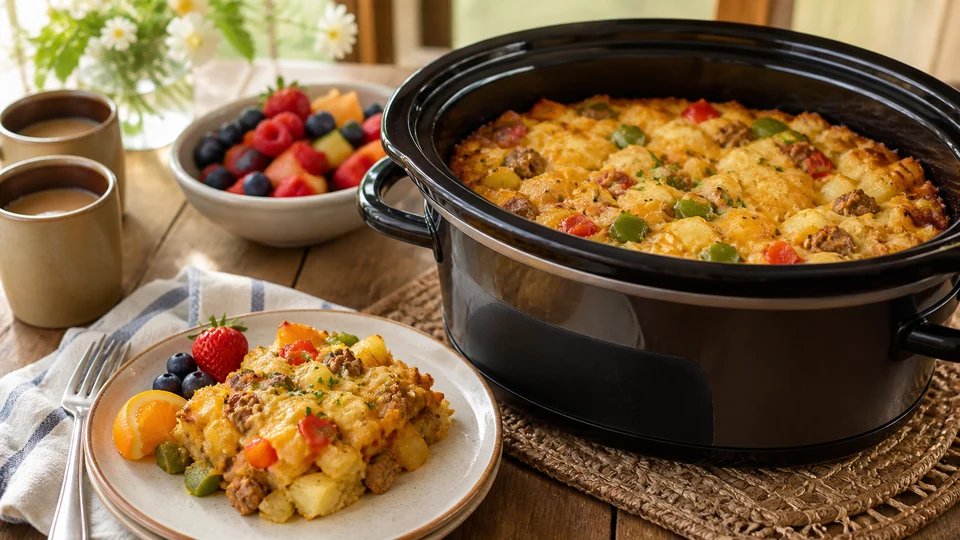
This is a recipe-family selector with an appliance workflow. Every casserole still needs its own tested source. The breakfast hub covers the wider morning topic, and Pancake World opens the full editorial collection.
| Guide sections |
|---|
| Start with structure, not a list of flavours |
| Confirm the appliance before choosing a recipe |
| Egg-and-shredded-potato recipes |
| Egg-and-diced-potato recipes |
For broader context, continue with American Breakfast: Pancakes, Diner Plates and Brunch.
Start with structure, not a list of flavours
A slow-cooker casserole succeeds or fails through the relationship among base, binder, moisture, depth, and heat path. Flavour names such as sausage, vegetable, apple, or cheese do not reveal that structure. Sort candidates into families before comparing ingredients.
The principal families are egg-and-potato, egg-and-bread strata, sweet bread or French-toast style, vegetable-led egg, bean or grain, and recipes built around a named meat. Each has different advance work, doneness evidence, and portion style. Choose the family that fits the service, then choose flavour within it.
Reject any source that omits cooker capacity, ingredient state, timing range, and centre test. A photograph of a set edge cannot replace a complete method.
Confirm the appliance before choosing a recipe
Find the model number and manual. Record usable capacity, minimum and maximum fill guidance, insert handling, lid position, settings, warm-mode limits, electrical placement, and cleaning rules. “Crockpot” is often used generically, but appliances differ.
Match the recipe’s cooker size. A smaller vessel increases depth; a larger one makes a shallow layer. Scaling ingredients to fill the cooker without a tested source changes the cooking path. The correct recipe fits the existing appliance rather than forcing the appliance to fit an appealing ingredient list.
Place the empty cooker where it can operate safely. Check outlet, cord, lid clearance, counter stability, guest traffic, and space for the hot lid. Do this before ingredients are purchased for an overnight plan.
Egg-and-shredded-potato recipes
This family can produce firm portions when the source balances egg, potato, cheese or alternative, vegetables, and meat. Confirm whether shredded potatoes are frozen, thawed, refrigerated, browned, or raw. Those states are not interchangeable.
Look for instructions on draining vegetables, pre-cooking meat, layering, and keeping potato depth even. Extra frozen vegetables can release water and delay the centre. More cheese or sauce can also change moisture and fat.
Choose this family when sliceable or spoonable savoury portions suit the service and the potato product meets label needs. Avoid it when several other potato dishes already crowd the menu.
Egg-and-diced-potato recipes
Diced potatoes create separate pieces rather than a continuous shredded layer. Cube size and pre-cooking state matter. Raw fresh dice, frozen breakfast potatoes, and cooked leftover potatoes cannot borrow one another’s times.
The source should describe how the egg binder moves around the pieces and where doneness is checked. Large dice can stay firm after the egg appears set. A browned top or edge does not prove the deepest potato is ready.
This structure can suit a hearty buffet, but its depth makes cooker matching especially important. Do not add more potatoes merely because space remains above the mixture.
Bread strata recipes
Bread casseroles rely on absorption. The source must name bread form, cube size, liquid, binder, layering, rest or soak, and whether advance refrigeration is allowed. Fresh soft bread, dense stale bread, enriched bread, and gluten-free bread behave differently.
Choose a strata when a softer cohesive texture and make-ahead assembly fit the morning. Confirm that the refrigerator can hold the assembled insert or separate dish and that the appliance manual permits the next transition.
Do not replace bread with potato while retaining the liquid. That is a different recipe family. Likewise, do not add a large volume of vegetables without a moisture plan.
French-toast-style casseroles
Sweet bread casseroles combine bread, egg or another binder, sweetener, spice, and sometimes fruit. They can have sticky edges and a softer centre. Use a recipe specifically written for the slow cooker and the named bread.
Fresh or frozen fruit can introduce water, while dried fruit can absorb liquid. Follow the source’s state and layering. Add syrup, powdered sugar, sauces, or fresh fruit at service unless the recipe includes them in cooking.
Choose this as the sweet anchor, not alongside several pastries and another sweet main. Offer a savoury or less sweet alternative when the group needs one.
Vegetable-led egg casseroles
The vegetables are structural here, not decorative. Mushrooms, spinach, onions, peppers, courgettes, tomatoes, and frozen vegetables can release different amounts of water. A complete recipe states whether they are sautéed, thawed, drained, squeezed, or added raw.
Pre-cooking can concentrate flavour and remove moisture, but only the source decides the required step. Cool cooked vegetables appropriately before refrigerated assembly. Do not place steaming filling into cold egg mixture and assume the refrigerator will correct the temperature quickly.
Select this family when vegetables should be prominent and the preparation workload fits. Do not simply double vegetables in a meat casserole.
Sausage or ham casseroles
Meat-led recipes must state whether the product is raw, cooked, cured, bulk, linked, diced, or crumbled. Brown and drain raw sausage when directed. Verify whether ham is ready to eat rather than inferring from appearance.
Sausage fat, ham moisture, salt, cheese, and potato products interact. A substitute meat can change all of them. Choose a formula developed for the exact style or use a supported variation.
Keep raw-meat tools away from bread, vegetables, toppings, and finished-food utensils. Cool pre-cooked meat properly when assembling later.
Bean and grain breakfast casseroles
Bean or grain recipes can provide a non-egg-centred structure, but they require their own tested liquid and cooking design. Do not remove eggs from an egg casserole and expect beans to replace the binder.
Confirm whether beans are canned and drained, home-cooked, or added with liquid. Confirm whether grain is raw, par-cooked, or fully cooked. The slow cooker timing and water balance depend on that state.
Choose this family when its texture and flavour fit the group, not as an improvised dietary repair. Review every packaged ingredient and topping for labels and allergens.
Dairy-free or plant-based tested recipes
A dairy-free casserole requires more than swapping milk. Cheese, butter, sausage, bread, seasoning blends, and cooking spray can contain dairy-derived ingredients. A vegan casserole also needs an egg-free structure and complete product review.
Select a recipe developed and tested around the intended alternatives. Plant beverages vary in sweetness, protein, fat, and stabilisers; plant cheeses vary in melt and moisture; egg substitutes have different binding behaviour. One-for-one substitution is not a universal rule.
Keep cross-contact and allergy questions separate from ethical labels. A vegan dish is not automatically safe for soy, nuts, gluten, or another allergy.
Small-batch slow-cooker casseroles
A small cooker needs a recipe written for its capacity. Halving a large recipe can leave partial eggs, uncertain depth, and timing that no longer applies. Find a complete small-batch source instead.
Small batches can suit two to four eaters and reduce leftovers, but the active preparation may be similar to a larger casserole. Compare whether the slow cooker genuinely simplifies the morning or whether an oven, skillet, or cold breakfast is more efficient.
Check minimum fill guidance. An underfilled large cooker is not equivalent to a small cooker, even if the ingredient amount fits physically.
Topping-bar base recipes
A deliberately neutral casserole can support separated toppings for a group. The base still needs a complete recipe. Choose toppings that do not require constant cooking and keep hot or cold as applicable.
Label sauces, cheese, herbs, vegetables, and meat additions. Use separate utensils and avoid returning a spoon from a guest’s bowl to a communal container. Keep reserves controlled and release small quantities.
Do not hide essential allergen information in the topping bar. The base label must be complete before toppings are considered.
Compare recipes with an evidence sheet
For each candidate, record source, family, cooker model and capacity, stated yield, ingredient states, meat handling, vegetable preparation, base, binder, fill depth, advance permission, cook range, centre test, holding, leftovers, and cleaning burden.
Eliminate incomplete recipes. Then compare active work, refrigeration space, service style, and whether other menu items conflict with the appliance. A recipe with fewer ingredients can still demand more morning browning and cooling.
Choose one complete source and stop combining attractive details from the others. Keep the rejected sources only as future alternatives, not a pool of substitutions.
Build a backward timeline
Start from first service. Add the recipe’s centre check, any stated rest, transition to service or approved holding, and cook range. Then add assembly, permitted preparation, appliance setup, and a buffer for ordinary household tasks.
Mark the latest safe start rather than an exact promised finish. Slow-cooker recipes often give a range because appliances and conditions vary. The buffer should not become time at room temperature.
Assign a monitor. That person records the start, keeps the lid closed, performs the planned check, and makes the service decision. Other helpers handle cold sides and table setup.
Decide whether overnight cooking is appropriate
Use overnight cooking only when the complete recipe explicitly supports it and the start time, duration, appliance, ingredients, and morning check can be supervised. Overnight assembly in an unpowered cooker is a different and unsafe idea for perishable foods.
Consider sleep and service timing honestly. A short cook range that finishes at dawn is not convenient if nobody can verify the centre then. A long method may fit better, but only when tested for that structure.
Do not use a plug timer to delay perishable cooking unless the appliance and complete method specifically support the whole path. Eggs, dairy, meat, and cut vegetables should not wait in an unpowered cooker.
Prepare ingredients by state
Write “raw,” “cooked,” “thawed,” “frozen,” “drained,” “cooled,” or “ready to eat” beside every major ingredient. This prevents a familiar name from hiding a different starting condition.
Cook raw meat separately where directed. Drain or sauté vegetables as specified. Cool pre-cooked fillings for later assembly under applicable guidance. Keep cold ingredients refrigerated until the workflow needs them.
Do not add frozen ingredients to a method written for thawed ones, or vice versa. The temperature and water they introduce affect the whole casserole.
Assemble at the tested depth
Use the source’s order: potato or bread base, filling distribution, binder, cheese, and reserved topping. Keep layers even. Do not compress them or heap leftovers above the intended fill.
Clean the insert rim so the lid closes. If the contents reach an unexpected level, verify measurements and cooker size before turning on the appliance.
When advance assembly is supported, cover, label, and refrigerate as directed. Follow the appliance manual for whether a cold insert can go into the heating base.
Cook with the lid closed
Set the correct mode and record the start. Confirm power and ordinary operation. Resist opening to stir, photograph, or smell unless the source requires a step. Each opening changes heat and moisture.
Prepare the doneness tool before the checking point. If a topping is added late, stage it without leaving the lid open while measuring. Never prop the lid with cloth or another object unless both recipe and manual explicitly permit it.
If power fails, use official safety guidance rather than automatically restarting. The elapsed history matters.
Verify the centre, not the surface
Use the recipe’s cues and applicable official guidance at the deepest centre. Melted cheese, browned edges, and bubbling liquid do not establish doneness. Avoid touching the insert with a thermometer when that can distort the reading.
If more cooking is required within the source method, close the lid and continue on the cooking setting. Warm mode is not a way to finish an undercooked centre.
If the casserole substantially exceeds the expected range, investigate cooker size, fill, ingredient temperature, power, lid, and substitutions. Do not publish a longer universal time from one mismatch.
Choose service or holding
Serve immediately when that is the recipe plan. If warm holding is supported, record when it starts and the permitted window. Do not leave the appliance between settings while guests arrive.
Place it where the cord, hot insert, lid, and serving tool can be managed. Put drinks elsewhere. Provide a trivet or protected surface as required.
Release cold toppings in small containers and replenish from refrigeration. Label the casserole and every optional addition.
Pair one casserole with useful contrasts
Let the casserole be the hot anchor. Add a cold or crisp side, fruit or vegetables, bread only if it does not duplicate the base, and a drink. Avoid another large egg, potato, or bread casserole.
For a sweet French-toast casserole, choose a savoury or less sweet alternative. For a rich sausage-potato dish, a fresh cold side can provide contrast. These are editorial menu principles, not nutrition prescriptions.
Keep the total work within the available helpers and equipment. The slow cooker is not labour-saving if the rest of the menu requires constant frying.
Label ingredients and cross-contact limits
Retain packages for meat, potato, bread, cheese, plant alternatives, seasoning, sauces, and toppings. Build the dish label from the complete set. Front-label claims do not replace ingredient and allergen declarations.
Use separate utensils when alternatives are offered. Explain the kitchen’s limits rather than certifying a dish for an allergy. If uncertainty remains, provide a more clearly controlled option.
Recheck labels for every repeat because formulations can change.
Cool and store leftovers
Close service according to FoodSafety.gov guidance. Divide safe food into suitable portions for cooling rather than leaving a deep hot insert as an informal storage container. Record its cooking and holding history.
Keep toppings separate. Reheat through a supported method and check the centre when required. Do not use warm mode to reheat unless authoritative instructions specifically permit it.
Discard when the history is uncertain. Smell and appearance cannot reconstruct missing control.
Troubleshoot by family
For egg-and-potato casseroles, watery centres point toward potato state, vegetables, depth, or binder changes. For strata, inspect bread form, absorption, and soak. For sweet bread casseroles, review fruit moisture and sugar-rich edges. For bean or grain versions, return to the exact liquid and pre-cooking state.
For every family, loose centres with firm edges raise depth and appliance-fit questions. Dry edges raise fill, timing, and cooker questions. Correct the earliest unsupported choice.
When the source and actual conditions cannot be reconciled, stop and select a recipe designed for the cooker and ingredients in hand.
Audit the chosen recipe after service
Record active work, start, checks, verified finish, holding, number and style of portions, leftovers, and cleanup. Note whether the family met its intended role: sliceable potato main, soft strata, sweet anchor, vegetable-led dish, or bean-and-grain alternative.
Separate recipe performance from event planning. A casserole can cook correctly yet be a poor menu choice because it duplicated other food or finished at an inconvenient time.
Keep the source, model, product identities, and variations with the note. Do not convert one household result into public timing or yield without a complete test record.
Match casserole family to the service window
For a fixed seated breakfast, choose a recipe whose checking range ends close to the meal and whose directed rest is short enough to keep the schedule clear. The cook can portion at the table and does not need a long buffet hold. A sliceable potato casserole or strata can fit when its exact method aligns.
For an open-house breakfast, the main challenge is arrival spread. Select a recipe with an explicit supported holding path and a structure that can be served in useful portions without continual stirring. Keep reserve sides cold and release them in waves. Do not rely on the cooker to hold indefinitely.
For a travel morning, a slow cooker may be the wrong tool unless the casserole is cooked, verified, portioned, cooled or transported under a complete supported plan. Moving a hot full insert introduces spill, power, and temperature questions. A portable tested breakfast may be clearer.
For an overnight household meal, the finish time must align with a person who can perform the centre check. A recipe whose range ends while everyone sleeps is not hands-off convenience; it is an unattended decision point.
For a workplace or community breakfast, confirm permitted appliances, outlets, transport, venue rules, serving utensils, and responsible supervision before selecting a formula. This page does not provide venue approval.
Compare advance-assembly paths
Some recipes permit the entire casserole to be assembled and refrigerated. Others permit only ingredient preparation. A third group begins cooking soon after assembly. Put each candidate in the correct lane.
Full advance assembly can reduce morning work but requires refrigerator space, covering, labelling, and a manual-supported transition for the insert. Bread recipes may rely on a directed soak; potato recipes may change when salt and moisture stand together. Use only the path written for that formula.
Component preparation keeps more flexibility. Meat can be cooked, vegetables prepared, and dry seasonings measured when the source allows, then stored separately. Morning assembly takes longer but can avoid an overnight texture change. Record which containers hold raw, cooked, and ready-to-eat items.
Immediate assembly can suit a simple recipe and eliminate the cold-insert question. It demands an earlier start and enough counter space. Compare total workload rather than assuming the night-before option is always easier.
If a candidate recipe is vague—“assemble ahead if desired”—look for a more complete source. Perishable timing, storage, and start-up should not be inferred from a casual note.
Create a no-guess handoff for another cook
Write the exact source title and location, cooker model, chosen family, ingredient states, assembly order, setting, start window, earliest check, centre test, and service decision. Attach current labels and the appliance manual. Avoid copying only the ingredient list.
Use explicit verbs. “Brown and drain the raw bulk sausage, cool it under the stated plan, then refrigerate in the labelled container” is actionable. “Prep sausage” is not. “At the earliest source check, test the deepest centre and record the result” is clearer than “check breakfast.”
Name the owner of each stage. One person handles raw meat and cooker start, another prepares cold sides, and one person closes service and stores leftovers. A handoff should also state what not to do: no delayed start with perishables, no lid opening for photographs, no warm-mode finish, and no untested ingredient swap.
Add a fallback. If the centre is late, cold sides can be served while cooking continues under the source. If the appliance fails before a safe process starts, use a separately tested alternative. Do not invent an oven conversion during the event.
Review equipment and electrical demand
The slow cooker’s low-attention reputation does not remove electrical planning. Use the outlet, cord, and placement specified by the manufacturer. Do not overload a circuit with coffee urns, kettles, toasters, warming trays, and several cookers without appropriate assessment.
Keep extension cords out unless the appliance guidance and venue permit a suitable solution. Do not route a cord under a rug, across a doorway, or near a sink. Prevent guests from lifting the lid over the cord or reaching across steam.
Test the controls with the empty appliance only as the manual allows before the event. A display, timer, or app feature does not authorize delayed perishable cooking. Confirm what happens after a brief power interruption and where the manual directs the user for faults.
Plan cooling and cleaning equipment too. Suitable leftover containers, heat-safe surfaces, permitted utensils, and a place for the hot lid are part of the recipe decision. If the kitchen cannot support them, choose another breakfast format.
Decide when to reject a recipe
Reject a recipe when it lacks cooker size, treats raw and cooked meat ambiguously, gives no centre test, or promises an overnight method while leaving perishable start-up unexplained. Reject one that requires a fill outside the manual or asks for an unsafe insert transition.
Also reject a recipe that conflicts with the actual event: a fragile sweet casserole for a long self-service window, a large sausage bake when most guests need an alternative, or a complex vegetable method when no one can do morning preparation.
An attractive photo, high rating, or short ingredient list does not repair missing controls. A well-documented simpler family provides more practical value than a fashionable formula with unclear execution.
Record why a candidate was rejected. The note prevents it from re-entering the plan when someone remembers only its title. It also clarifies whether a different cooker, service time, or guest group could make it suitable later.
Frequently asked questions
Which casserole family portions most cleanly?
Egg-and-potato recipes are often designed to set firmly, but the tested formula, depth, cooker, and rest determine the actual result.
Are overnight recipes safe?
Use only a complete recipe explicitly written for overnight cooking or refrigerated assembly. Never leave perishables in an unpowered cooker.
Can I use an oven casserole recipe?
Not by changing the vessel alone. Select a recipe tested for slow-cooker heat, moisture, fill, and timing.
Can I double a recipe?
Only with a tested scaled method and suitable cooker. Greater depth can prevent the centre from finishing with the edges.
Can warm mode cook the centre?
No. Warm mode is for supported holding after verified cooking, not for finishing an undercooked casserole.
What is the simplest family?
The simplest is the complete recipe whose ingredient states, advance work, appliance, and service time fit the household. Ingredient count alone does not answer.
Explore related Pancakes World guidance on American Pancakes, Maple Syrup, and Maple Syrup Pancakes.
Sources and editorial references
- USDA FoodData Central —
https://fdc.nal.usda.gov/ - FoodSafety.gov food safety charts —
https://www.foodsafety.gov/food-safety-charts - FDA Food Labeling & Nutrition —
https://www.fda.gov/food/nutrition-food-labeling-and-critical-foods