Cream cheese breakfast
At Pancakes World, for a cream cheese breakfast that feels complete rather than merely rich, use the cheese in one clear role—spread, filling, topping, or baked layer—then add a substantial base and a contrasting ingredient. A toasted bagel with cream cheese becomes more interesting with tomato, cucumber, herbs, or fruit; pancakes gain contrast from a thin cream-cheese-and-yogurt topping; eggs or vegetables can sit beside a savory spread instead of being buried under it. Keep cream cheese refrigerated at 40°F (4°C) or below, soften only what you need, and return the package promptly. The best choice is the format that matches your available time and desired texture.
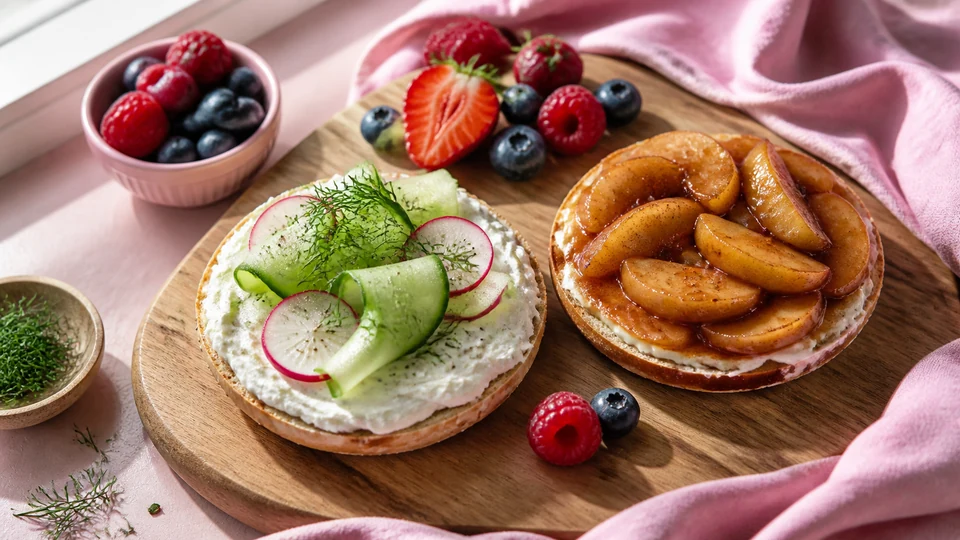
This is a practical planning guide, not a tested Pancake World recipe and not a claim that cream cheese alone creates a nutritionally complete meal. Browse the breakfast hub for other morning formats, and use Pancake World to move through the wider collection.
For broader context, continue with American Breakfast: Pancakes, Diner Plates and Brunch.
Choose the role before choosing the dish
Cream cheese is unusually flexible because it can be firm enough to hold a filling, soft enough to spread, and smooth enough to blend with another ingredient. That flexibility also creates the most common planning problem: adding it everywhere without deciding what it should do. A better breakfast starts by assigning one role.
| Role | Best when | Suitable bases | Main risk | Simple correction |
|---|---|---|---|---|
| Spread | time is short and the base is sturdy | toast, bagel, English muffin, crispbread | a cold block tears soft bread | portion first and let only that portion soften briefly |
| Filling | the food can fold or sandwich cleanly | crepe, pancake roll, stuffed toast, breakfast sandwich | too much squeezes out | use a thinner layer and leave the edges clear |
| Topping | the base benefits from cool contrast | pancakes, waffles, baked oats, fruit | a heavy mound overwhelms the dish | loosen a small portion and spoon lightly |
| Baked layer | you are preparing a casserole or pastry | French-toast bake, filled muffin, breakfast pastry | uneven lumps or a wet center | soften for mixing and follow a complete tested formula |
| Savory binder | chopped ingredients need cohesion | herb spread, vegetable toast, pinwheel | watery vegetables loosen it | drain and dry additions before mixing |
That decision immediately narrows the preparation method. If you need food in five minutes, spreading is realistic. If you want a neat portable breakfast, use a filling that stays inside a sandwich or roll. If you are serving a group, a verified casserole formula is easier to portion than eighteen separately assembled toasts.
The fastest cream cheese breakfasts
The shortest route is a toasted base, a measured spread, and one or two toppings. Toasting matters because a dry, crisp surface supports the spread and slows the bread from feeling pasty. Let the toast cool for a few seconds if you want the cheese to remain distinct; spread immediately if you want it to soften into the surface.
Try one of these construction patterns:
- toasted bagel, cream cheese, sliced tomato, black pepper, and chopped chives;
- whole-grain toast, cream cheese, pear or apple slices, and cinnamon;
- English muffin, cream cheese, strawberries, and a few chopped nuts if appropriate for the eater;
- crispbread, cream cheese, cucumber, dill, and lemon zest;
- toast, cream cheese, roasted red pepper, and a cooked egg;
- tortilla, cream cheese, thoroughly dried spinach, and scrambled egg, rolled after the eggs stop steaming heavily.
These are combinations, not complete tested recipes. The needed amount depends on the surface area, the product’s consistency, and whether another moist ingredient is present. Start thin. It is easy to add more, but a thick layer is difficult to remove once juicy tomato or fruit is on top.
University of Illinois Extension publishes a child-oriented English-muffin breakfast that uses a measured spoonful of strawberry cream cheese with kiwi, blueberries, and strawberry. The useful lesson is structural rather than nutritional: a small amount of spread can anchor cut fruit to a firm base. The source provides its own full formula and handling directions; this guide does not reproduce its nutrition calculation or claim an equivalent result from substitutions.
Build contrast instead of piling on richness
Cream cheese contributes a soft, dense, tangy element. A successful plate usually needs contrast in at least two dimensions. Choose a crisp or chewy base, then add freshness, acidity, heat, or a cooked savory component.
For texture, consider toast, seeds, chopped nuts, crisp vegetables, or firm fresh fruit. For brightness, use citrus zest, berries, tomato, pickled vegetables, or herbs. For warmth, place the spread beside hot eggs or vegetables rather than mixing everything until it becomes one uniform texture. For savory depth, use pepper, scallions, dill, smoked paprika, or a modest amount of another strongly flavored ingredient.
The point is not to create a complicated topping bar. It is to prevent every bite from feeling equally soft and rich. Two deliberate contrasts are often enough: toast plus cucumber, or warm pancake plus cool fruit.
Sweet combinations that stay balanced in texture
Sweet cream cheese breakfasts do not require turning the spread into frosting. Begin with plain cream cheese and add sweetness through fruit, a small amount of preserve, or the bread itself. Useful combinations include:
- apple with cinnamon and toasted seeds;
- berries with lemon zest;
- pear with chopped walnuts;
- banana with cocoa and a crisp base;
- peach with ginger;
- a thin stripe of fruit spread beneath cream cheese rather than mixing a large sweet bowl.
If fruit is very juicy, pat cut surfaces dry and add it just before eating. Frozen fruit releases liquid as it thaws, so it works better cooked into a separate compote or drained than placed directly over a spread hours in advance. Keep the cheese mixture refrigerated while fruit is prepared.
Savory combinations that avoid wateriness
Savory additions should be chopped small and dried well. Cucumber, thawed spinach, tomato, and roasted peppers can all dilute a spread. Remove seeds when helpful, squeeze cooked greens, drain jarred vegetables, and blot surfaces before folding anything into cream cheese.
Good starting directions are:
- chive and black pepper;
- dill and lemon zest;
- scallion and smoked paprika;
- chopped roasted pepper and parsley;
- drained spinach and garlic;
- finely chopped olive and herbs.
Salt only after tasting the full combination. Breads, smoked foods, pickles, olives, and packaged cream cheese may already contribute salt. A tasting step is more reliable than a fixed instruction because the products and accompaniments differ.
Cream cheese with pancakes, waffles, and crepes
A pancake breakfast benefits when the topping can be spread thinly or drizzled rather than sitting as a cold block. Portion cream cheese into a small bowl and blend it until smooth. If it needs loosening, add another compatible ingredient gradually. Yogurt produces a tangier, spoonable mixture; milk produces a thinner texture but can turn the blend runny quickly. Add liquid by small amounts and stop before the topping flows off the pancake.
USDA’s Healthy Lunchtime Challenge cookbook includes a zucchini-pancake recipe served with a mixture of yogurt and cream cheese. That published example supports the idea that cream cheese can be lightened into a topping for a savory pancake. It does not establish a universal ratio for every cheese or yogurt, and it does not make an improvised mixture equivalent to the source recipe.
University of Illinois Extension also publishes strawberry crepes with cream cheese whipped together with yogurt and a little sugar. Here the mixture serves a different role: a flexible filling for a thin pancake. Keep the filling inside by spreading a narrow band rather than covering the entire crepe. Add fruit in a line, fold the sides if portability matters, and roll without squeezing. If the crepe is still very hot, allow steam to subside before filling so the mixture stays distinct.
For waffles, place the mixture in the center or in a few pockets and add fruit at service time. For thicker pancakes, a small spoonful between two pancakes creates a sandwich, but the filling should be cool and fairly firm. If it runs at room temperature, use it as a topping instead of pretending it will behave as a stable filling.
A practical stuffed-toast decision
Stuffed French toast sounds simple, yet it combines bread, dairy, egg, heat, and a filling that can leak. Decide whether you want an individually cooked sandwich or a casserole.
For an individual sandwich, the bread must be thick enough to contain a modest filling. Keep cream cheese away from the edges, close the sandwich, then apply the egg mixture. A very wet soak can weaken the seam. Cook the egg-coated exterior thoroughly according to a reliable complete recipe and verify the center rather than judging only the browned surface.
For a group, an overnight bake can distribute bread, custard, and filling more evenly. University of Illinois Extension’s stuffed French-toast casserole demonstrates a complete method in which softened cream cheese is beaten into a filling, layered with bread and custard, refrigerated overnight, baked, and rested before service. Use that source or another tested formula for quantities and baking instructions. Do not improvise a large dairy-and-egg casserole by scaling a sandwich idea; depth, dish size, refrigerator time, and oven performance all affect the center.
The key decision is therefore logistical. Choose sandwiches when you can cook and serve a small number immediately. Choose a tested casserole when you need advance assembly and batch portions. Neither format is inherently better; each solves a different service problem.
Brick, tub, whipped, and flavored products
Packaging terms can indicate how a product is intended to behave, but the label is the dependable source for what is actually in a particular package. A firm brick-style product is often easier to portion for a defined filling or a baked formula. A soft tub product is convenient for immediate spreading. Whipped products can feel lighter on the knife because air changes volume and texture. Flavored products bring seasonings or sweeteners that may make other toppings unnecessary.
Do not assume two products are interchangeable by volume or nutritionally identical. When comparing them, use the Nutrition Facts panel and ingredient list. FDA explains that the labeled serving size reflects the amount people typically consume; it is not a recommendation of how much to eat. The listed calories and nutrients apply to that serving. If two packages state different serving amounts, first put the information on a like-for-like basis before drawing a comparison.
For cooking, follow the form named in the tested recipe. A spreadable tub product may contain a different balance of ingredients and water than a firm block, which can change a filling’s structure. Without a verified substitution from the recipe developer or manufacturer, treat the swap as an experiment rather than a guaranteed equivalent.
How to select without relying on marketing words
Use a four-part check:
- Purpose: spreading, blending, filling, or baking.
- Ingredient list: confirm dairy ingredients and any flavors or add-ins relevant to you.
- Nutrition Facts: compare the same amount when sodium, saturated fat, added sugars, or calories matter to your decision.
- Allergen and storage statements: follow the package, especially after opening.
Words such as “light,” “whipped,” or “garden vegetable” do not answer all four questions. The back and side panels are more useful than the front-of-pack impression.
Is cream cheese a dairy serving?
Cream cheese is made from dairy ingredients, but USDA MyPlate does not count cream cheese in the Dairy Group because foods in that category provide little calcium and have a higher fat content. This is a classification point, not a declaration that cream cheese can never fit into breakfast.
It does mean that adding cream cheese should not automatically be treated as meeting the meal’s dairy-group contribution. If that contribution matters to your plan, consult the current MyPlate guidance and consider a qualifying food such as milk or yogurt, including appropriate lactose-free or fortified soy options described there.
Avoid turning this distinction into a health verdict. A person’s needs, serving amount, rest of the day, allergies, intolerances, and medical guidance all matter. This page provides meal-assembly decisions, not individualized dietary treatment.
Add substance around the spread
Because cream cheese works primarily as a rich spread or binder, plan the rest of the breakfast deliberately. You can use a simple three-part framework:
- choose the base: bread, bagel, English muffin, pancake, waffle, crepe, tortilla, or a baked dish;
- choose a produce element: whole fruit, berries, tomato, cucumber, peppers, greens, or another vegetable;
- choose any additional protein food or dairy-group item according to your needs: egg, beans, fish, poultry, nuts, seeds, yogurt, or milk.
This is a planning framework, not a required formula. A filled crepe may already include fruit and yogurt. A savory toast may sit beside eggs. A casserole may contain several components and need only fresh fruit at service. Read the complete recipe and package labels before assuming what a dish contains.
If you are feeding several people, serve additions separately when allergies and preferences differ. A plain base and plain spread can be customized at the table, while nuts, smoked fish, or other allergens remain in labeled separate dishes with dedicated utensils.
Warm dishes: manage texture and temperature
Cream cheese softens readily in a warm dish. That is useful when you want small creamy pockets, but unhelpful when you expect a sharply defined filling. Add small pieces rather than one large block to egg mixtures, and distribute them near the end if distinct pockets are the goal. For a smooth sauce, blend deliberately and follow a tested method.
In scrambled eggs, cool cubes can lower the mixture’s local temperature and make doneness harder to judge. Cook eggs safely, avoid overloading the pan, and do not use melting cheese as evidence that the eggs are done. In a breakfast sandwich, allow very steamy fillings to settle briefly so trapped moisture does not soak the bread.
For baked dishes, surface browning does not prove that the center has cooked. Use the complete formula’s time, pan dimensions, and doneness checks. If the recipe calls for refrigeration before baking, keep the assembled dish cold; do not substitute a long counter rest.
Food-safety rules for breakfast service
Cream cheese is a refrigerated perishable food. FDA advises keeping the refrigerator at or below 40°F (4°C), refrigerating perishables promptly, and following a two-hour limit at room temperature—one hour when the air temperature is above 90°F (32°C). This matters for a leisurely brunch, packed breakfast, topping bar, or dish waiting beside a warm stove.
Use these controls:
- take out only the amount needed for preparation or immediate service;
- keep the main package closed and cold;
- use a clean utensil instead of returning a crumb-covered knife to the container;
- cover refrigerated mixtures;
- check package storage instructions;
- discard food that is moldy or otherwise suspicious rather than tasting it to decide;
- apply the shorter safe limit when another ingredient in the dish requires it.
Softening is a texture step, not permission for an extended counter display. Cut a small portion from a cold block and let that portion become workable while the rest stays refrigerated. If a package or prepared spread has exceeded safe time or temperature limits, chilling it again does not erase the exposure.
For transport, use an insulated container with an adequate cold source and minimize time outside temperature control. A cream-cheese-filled breakfast left in a warm car is not equivalent to one kept cold until eating.
Dairy, lactose, and cross-contact boundaries
Conventional cream cheese contains milk and is unsuitable for someone with a milk allergy. A lactose-free claim, when present, does not make a dairy product safe for a milk allergy; lactose intolerance and milk-protein allergy are different concerns. Read the exact label every time because formulations and facilities can change.
Plant-based spreads may perform differently when heated, whipped, or baked. Choose one labeled for the eater’s needs and the intended culinary use. Do not assume an equal-volume substitute will set like dairy cream cheese in a casserole or filling unless the recipe or product maker verifies it.
For shared breakfasts, use separate clean knives and boards. Putting a clean-looking utensil back into an allergen-free container after it touched ordinary bread can create cross-contact. Also confirm the bread, toppings, and garnishes; changing the spread alone does not make the entire meal safe.
Make-ahead choices that preserve quality
Not every cream cheese breakfast improves overnight. Separate storage is usually the safest quality strategy: refrigerate the spread in a covered container, store dry bread separately, and cut watery fruit or vegetables close to service.
Good make-ahead candidates include a tested overnight casserole, a plain herb spread, washed whole fruit, and dry toppings in sealed containers. Poor candidates include fully assembled toast, salted tomato on bread, cut fruit mixed into a spread for many hours, and hot eggs sealed against cold cheese and soft bread.
For a breakfast bar, arrange small replenished portions rather than one large bowl sitting out. Label savory, sweet, dairy-free, and allergen-containing mixtures clearly. Keep dedicated utensils with each bowl. Record when perishable items leave refrigeration if service will be prolonged.
Troubleshooting cream cheese breakfast texture
The spread tears the bread
The cheese is too cold, the bread is too soft, or the layer is too thick. Toast or choose a sturdier base. Portion a small amount into a bowl and let only that amount soften briefly. Spread from the center outward with light pressure.
The mixture turns runny
Too much liquid was added, or wet fruit and vegetables released water. Chill the mixture and reconsider its role: it may work as a drizzle even if it no longer works as a filling. Next time, drain additions and introduce liquid gradually.
The filling leaks from a crepe or sandwich
Reduce the amount, leave a border, and cool hot components slightly before assembly. A loose mixture belongs on top; a firm mixture belongs inside. Folding the sides before rolling also improves containment.
The baked layer has lumps
The cream cheese was too cold or mixing was incomplete. Follow the tested recipe’s temperature and mixing sequence. Do not compensate by adding unlisted liquid, which may change how the whole dish sets.
The dish tastes flat
Add contrast before adding more cheese. Citrus zest, herbs, pepper, fruit acidity, tomato, or a crisp element can make the existing amount more noticeable.
The breakfast feels too heavy
Use a thinner spread and increase the fresh or crisp components. You can also shift from a filled format to an open toast or from a thick topping to a cream-cheese-and-yogurt mixture supported by an authoritative formula.
Five decisions for a reliable plate
Before preparing breakfast, answer these questions:
- Is cream cheese acting as spread, filling, topping, baked layer, or binder?
- What provides the firm or crisp base?
- What creates contrast: fruit, vegetable, acidity, herbs, or spice?
- Does the chosen product match the recipe and the eater’s label needs?
- How will the food stay at a safe temperature until it is eaten?
If those answers are clear, the meal usually becomes simpler. You do not need a long ingredient list. You need a suitable base, a restrained amount of cream cheese, one useful contrast, and a safe service plan.
A practical decision map
- Need breakfast immediately? Toast a sturdy base, apply a thin spread, and add one fresh topping.
- Need something portable? Choose a firm filling, dry additions thoroughly, and keep the assembled food cold until eating.
- Serving pancakes or crepes? Loosen a measured portion for a topping, or keep it firm and narrow for a filling.
- Feeding a group? Use a complete tested casserole recipe rather than inventing bake times and quantities.
- Comparing products? Read ingredients and Nutrition Facts using equivalent serving amounts.
- Managing an allergy? Verify every component and prevent utensil cross-contact.
- Holding a brunch? Refrigerate the reserve and replenish small portions within FDA time limits.
Cream cheese earns its place at breakfast by performing a specific job. Treat it as a structural ingredient—one that spreads, binds, fills, or softens—then build the rest of the plate around that job. That approach produces clearer flavors, more dependable texture, and easier decisions than simply adding a thick layer to every available breakfast food.
Explore related Pancakes World guidance on American Pancakes, Maple Syrup, and Maple Syrup Pancakes.
Sources and editorial references
- U.S. Food and Drug Administration, “Are You Storing Food Safely?”
https://www.fda.gov/consumers/consumer-updates/are-you-storing-food-safely - U.S. Food and Drug Administration, “How to Understand and Use the Nutrition Facts Label.”
https://www.fda.gov/food/nutrition-facts-label/how-understand-and-use-nutrition-facts-label - USDA MyPlate, “Dairy.”
https://www.myplate.gov/web/eat-healthy/dairy - University of Illinois Extension, “Recipe Rescue: Stuffed French Toast Casserole.”
https://extension.illinois.edu/blogs/live-well-eat-well/2014-05-08-recipe-rescue-stuffed-french-toast-casserole - University of Illinois Extension, “Make a Healthy Valentines Dessert…Strawberry Crepes!”
https://extension.illinois.edu/blogs/nutrition-nosh/2017-02-14-make-healthy-valentines-dessertstrawberry-crepes - USDA MyPlate, “The 2013 Healthy Lunchtime Challenge Cookbook.”
https://www.myplate.gov/sites/default/files/cookbooks/HealthyLunchtimeChallengeCookbook-2013.pdf - University of Illinois Extension, “Bunny Face.”
https://extension.illinois.edu/sites/default/files/bunny_face.pdf