Chicken sausage breakfast
At Pancakes World, for a dependable chicken sausage breakfast, first determine whether the sausage is raw, partially cooked, or fully cooked; the package wording controls the method. Cook raw or not-ready-to-eat chicken sausage to 165°F in the center, checking thin links or patties from the side with a food thermometer. Fully cooked sausage needs reheating according to its label and can be sliced into a vegetable skillet, breakfast bowl, taco, sandwich, or tested egg bake. Brown color is not a safety test. Pair the sausage with one starch or grain, a vegetable, and an egg, bean, tofu, or dairy component when the meal needs it—without assuming every chicken sausage has the same sodium, fat, casing, seasoning, or allergens.
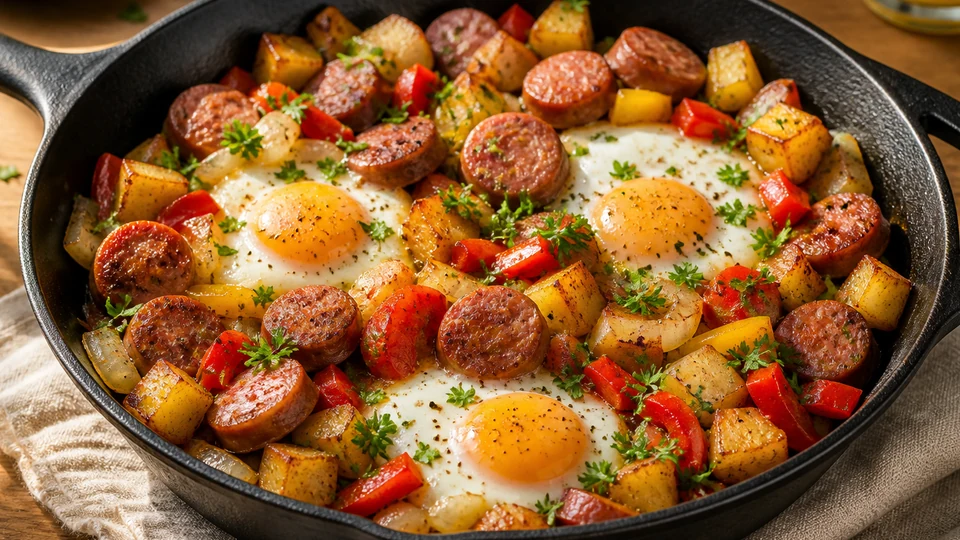
For broader context, continue with American Breakfast: Pancakes, Diner Plates and Brunch.
The package decides which cooking lane applies
Chicken sausage appears in forms that look similar but require different handling. USDA explains that sausages may be raw, cooked, smoked, dry, or semi-dry. A partially cooked product can look browned and still require full cooking.
Read the principal display panel and safe-handling section. Look for wording such as:
- “uncooked”
- “ready to cook”
- “cook before eating”
- “needs to be fully cooked”
- “fully cooked”
- “ready to eat”
Use this decision tree:
- Raw or not ready to eat: keep it separated from ready-to-eat food, follow the package method, and verify 165°F internally.
- Partially cooked: treat it as requiring cooking unless the label clearly says ready to eat; follow the package endpoint.
- Fully cooked: follow the reheat directions and avoid overcooking.
- Plant-based “chicken-style” sausage: it is not poultry. Follow its own label, storage, allergen, and cooking directions.
- Label missing or unclear: do not guess from color, casing, or store display. Ask the producer or choose a clearly labelled product.
USDA requires prominent additional statements on products that appear cooked but still need cooking. That distinction is the first factual gate for every method below.
Links, patties, and bulk sausage behave differently
Shape changes how heat reaches the center and how the sausage fits breakfast.
Links
Links keep their juices and make a clear plated portion. They can also roll in a skillet and brown unevenly. Turn them with tongs and check the center without relying on a split casing.
Best uses: plate with eggs and vegetables, breakfast sandwich, sheet-pan meal, or sliced bowl after cooking.
Patties
Patties expose more surface for browning and fit sandwiches. Thinness makes thermometer placement tricky. USDA advises inserting the probe from the side so the sensing area reaches the center.
Best uses: biscuit or English-muffin sandwich, breakfast plate, or crumbled over a bowl after cooking.
Bulk sausage
Bulk chicken sausage can be broken into crumbles for hashes, tacos, and casseroles. Raw bulk sausage contaminates the spoon, board, and any ingredients it touches before cooking.
Best uses: vegetable hash, breakfast burrito, egg bake, or savory oats.
Pre-sliced cooked sausage
Convenient pieces brown quickly but dry quickly as well. Follow the label and add them near the end of a skillet when possible.
Best uses: fast bowls, scrambled eggs, and leftovers.
One time and temperature setting cannot cover every diameter, pan, starting temperature, and product formulation. Package directions plus an objective endpoint are more reliable than a universal minute count.
How to cook raw chicken sausage safely
The controlling endpoint for raw poultry sausage is 165°F. Use a thermometer even when the exterior looks brown or juices look clear; USDA states color is not a reliable doneness indicator for ground poultry.
Skillet method
- Read the package directions and note whether the casing should remain intact.
- Heat the pan as directed. Add only the amount of fat the recipe or product requires.
- Place raw sausage in the pan without crowding.
- Turn as necessary for even surface cooking.
- Adjust heat if the exterior darkens before the center approaches the endpoint.
- Check more than one piece. Insert the thermometer from the side of a thin link or patty into its center.
- Continue until each tested piece reaches 165°F.
- Move cooked sausage to a clean plate, not the plate that held it raw.
If a package instructs adding water, covering, or using a specific sequence, follow it. Do not pierce every casing repeatedly unless instructed; that can lose moisture and does not prove doneness.
Oven or sheet-pan method
Use only a package or validated recipe that specifies oven cooking for the product shape. Arrange pieces with space, keep raw sausage juices away from ready-to-eat garnish, and verify 165°F in multiple pieces. Oven cooking is useful for volume but not self-validating.
Air fryer method
Air fryers vary in size, power, and airflow. Follow the sausage manufacturer and appliance directions. Keep the basket uncrowded and verify 165°F; do not copy a time for a different link diameter or frozen state.
Do not partially cook for later
Do not brown raw chicken sausage halfway, refrigerate it, and plan to finish later unless a validated method explicitly supports that workflow. Cook it fully in one continuous process, cool leftovers promptly, and reheat them safely.
Core breakfast skillet formula
This is an adaptable assembly method, not a tested Pancake World recipe.
Choose:
- one cooked chicken sausage form
- one sturdy vegetable or cooked potato base
- one quick-cooking vegetable or leafy green
- one seasoning direction
- one optional egg, bean, or grain component
- one fresh finishing element
Sequence
- If sausage is raw, cook it completely to 165°F first, then transfer it to a clean plate.
- Drain only excess fat; leave a thin film if useful for sautéing.
- Cook dense vegetables such as potato, sweet potato, or winter squash until tender.
- Add onion, pepper, mushrooms, or another medium-cooking vegetable.
- Add cooked sausage pieces and heat through.
- Fold in spinach, herbs, or other delicate ingredients last.
- Add acid, salsa, or sauce at serving so the skillet does not become watery.
For fully cooked sausage, the first step becomes label-directed reheating. If the pieces are thin, add them later so they do not dry out while potatoes cook.
Eight practical breakfast formats
1. Chicken sausage and potato hash
Use cooked diced potato, onion, peppers, and fully cooked sausage. Brown components in a broad pan and finish with herbs.
Decision: pre-cook potato if raw cubes would take longer than the sausage. A crowded pan steams instead of browning.
2. Sausage breakfast bowl
Layer a cooked grain or potato with sausage, roasted vegetables, greens, and a sauce. Add an egg only if wanted.
Decision: keep sauce and fresh greens separate in meal-prep containers. Reheat the hot base before adding cold toppings.
3. Egg and sausage scramble
Cook raw sausage fully and transfer it out before adding eggs. Return cooked pieces once the eggs are almost set.
Decision: raw sausage and eggs have different handling needs. Do not crack eggs into raw crumbles and rely on egg appearance as the sausage test.
4. Breakfast sandwich
Use a cooked patty or split cooked link with egg, cheese, greens, or tomato on a roll, biscuit, bagel, or English muffin.
Decision: match patty diameter to bread and keep wet condiments away from the bread until serving. For packed sandwiches, cool components safely before assembly.
5. Breakfast tacos
Combine cooked sausage crumbles with potatoes, beans, egg or tofu, and salsa in warm tortillas.
Decision: a small amount of sausage can season a larger bean-and-vegetable filling. Keep hot filling separate from tortillas until service.
6. Sheet-pan breakfast
Roast vegetables using a reliable sheet-pan method and include sausage only when its package or recipe supports that cooking process. Verify every raw poultry piece reaches 165°F.
Decision: vegetables and sausage may finish at different times. Pre-cook one component or add it later rather than accepting burnt vegetables or undercooked poultry.
7. Sausage egg bake
Use fully cooked sausage in a tested casserole or frittata formula with vegetables and cheese.
Decision: casseroles require 165°F under the USDA general chart. Do not scale pan depth or raw egg ratio casually.
8. Savory oatmeal or grits
Top cooked oats or grits with warmed sausage, greens, mushrooms, and an egg or cheese.
Decision: slice sausage thinly so a small quantity distributes through the bowl. Season after tasting because sausage and cheese may already contribute salt.
Pairing chicken sausage with vegetables
Chicken sausage can dominate a plate unless vegetables are planned intentionally.
Pepper and onion
Cook onion first, then peppers, and add cooked sausage near the end. Good with potatoes, tortillas, or eggs.
Mushroom and spinach
Cook mushrooms until released moisture evaporates before adding spinach. Good in scrambled eggs, frittatas, or savory grain bowls.
Apple and cabbage
Use apple in a measured amount and cook cabbage until tender-crisp. Good with sage-seasoned sausage. Verify the sausage label before assuming it already contains apple.
Tomato and zucchini
Remove excess moisture by cooking zucchini first and adding tomato late. Good with herbs and toast.
Sweet potato and kale
Pre-cook sweet potato cubes; kale can enter later with a splash of water. Good for meal-prep bowls.
Broccoli and cauliflower
Roast separately or steam until just tender. Good in casseroles, hashes, or bowls, but drain thoroughly before an egg bake.
No pairing creates a nutrition guarantee. The final serving depends on product, quantity, cooking fat, seasoning, and the rest of the meal.
Egg-free chicken sausage breakfasts
Chicken sausage does not need eggs. Try:
- potato and vegetable hash
- bean-and-sausage tacos
- savory oats with mushrooms
- grain bowl with greens
- toast with sausage and sautéed peppers
- sheet-pan sausage and vegetables
- polenta with tomatoes and herbs
For dairy-free or gluten-free needs, verify every sausage label. Sausages can include milk, wheat, soy, cheese, sweeteners, spice blends, or other ingredients. A product made from chicken is not automatically free of common allergens.
For a plant-based breakfast, choose a plant-based sausage and follow that specific product’s directions. Do not apply the poultry 165°F rule as if it were raw chicken; the label governs. Conversely, do not apply ready-to-eat plant-based handling to raw poultry sausage.
Compare packages without assuming “chicken” means one profile
Chicken sausage products vary in serving size, ingredients, sodium, saturated fat, total fat, protein, added sugars, and allergens. Compare current labels for an equal amount or realistic serving.
Use this workflow:
- Confirm the product is raw or fully cooked.
- Compare serving sizes; convert when they differ.
- Read calories only in the context of the actual portion.
- Compare sodium, saturated fat, added sugars, and protein if those matter to the eater.
- Read the ingredient and allergen statements.
- Check whether nutrition values apply before or after cooking.
- Choose flavor only after safety and dietary requirements pass.
Do not claim chicken sausage is always leaner, lower-fat, lower-sodium, or healthier than pork sausage. Those comparisons require two named current products and equal serving bases. This article does not rank brands or reproduce mutable product data.
Flavor names also need label checks. “Maple,” “apple,” “Italian,” “breakfast,” “spicy,” and “smoked” imply seasoning, not raw-versus-cooked status or nutrition.
Package size also affects comparison. A link described as one serving may be much larger or smaller than a competitor’s link. Compare nutrients for the amount you expect to eat, not merely the bold number in each label column. If two serving bases differ, convert both to a common weight before drawing a conclusion.
Meal-prep plan
Batch-cook safely
Cook raw chicken sausage to 165°F and cool it promptly. Prepare vegetables and starches in separate batches so they can be recombined without repeating one meal.
Portion by use
- whole links for plates and sheet-pan meals
- patties for sandwiches
- sliced links for bowls
- crumbles for tacos and egg bakes
Store
USDA’s sausage guidance lists fresh uncooked sausage for only one to two refrigerated days, while sausage cooked by the consumer and general leftovers commonly fall in the three-to-four-day range. Follow the exact package where it is more restrictive.
Refrigerate within two hours of cooking, or one hour above 90°F, in shallow containers. Date each container.
Reheat
Reheat leftovers to 165°F. Add crisp vegetables, herbs, and sauces after reheating. Do not repeatedly warm and cool the entire batch; take only the portion needed.
If freezing, package portions tightly and follow USDA storage guidance and the manufacturer’s instructions. Quality may decline even when continuously frozen food remains safe.
Date labels and opened packages
USDA explains that “Best if Used By,” “Sell-By,” “Use-By,” and “Freeze-By” dates generally communicate quality or inventory rather than a universal safety deadline, with infant formula as a notable federal exception. Storage history still matters.
For sausage, follow package use and storage directions. USDA’s sausage chart distinguishes fresh uncooked sausage from cooked sausage, dry sausage, and other cooked products. Do not transfer the unopened storage time to an opened package.
Discard sausage with spoilage signs such as off odor or texture. Also discard food that exceeded safe time or temperature limits even if it smells normal; pathogenic bacteria cannot reliably be detected by sight or smell.
Troubleshooting
Exterior burns before the center reaches 165°F
The heat is too high for the link diameter, the pan is dry, or the product needs the label’s covered or water-assisted method.
Correction: lower the heat, follow the package sequence, turn more evenly, and continue to the endpoint. Do not accept a low center temperature because the exterior is dark.
Sausage is dry
It may have been overcooked, sliced before cooking when the casing should remain intact, or reheated too long.
Correction: stop when the safe endpoint and package directions are satisfied; add fully cooked slices later in mixed dishes.
Skillet is watery
Mushrooms, frozen vegetables, tomatoes, or crowded potatoes released water.
Correction: cook high-moisture vegetables separately or in sequence and let liquid evaporate before combining.
Egg bake is greasy or splits
The sausage was not drained, cheese was excessive, or filling volume exceeded the tested base.
Correction: drain cooked crumbles, cool fillings, and use the standardized casserole ratio.
Thermometer reading changes each time
The probe may be touching the pan, sitting near the surface, or missing the center of a thin link.
Correction: insert from the side into the center, check several pieces, and clean the probe between raw and cooked checks.
Meal tastes too salty
Sausage, cheese, sauce, and seasoned potatoes may stack sodium.
Correction: season vegetables lightly, taste after sausage is added, and use acid, herbs, or pepper for contrast.
A five-breakfast rotation
| Day | Format | Advance component | Morning task |
|---|---|---|---|
| Monday | Potato-pepper hash | Cooked sausage and potatoes | Re-crisp and add herbs |
| Tuesday | Breakfast sandwich | Cooked patty | Reheat and assemble |
| Wednesday | Bean-and-sausage tacos | Cooked crumbles and beans | Warm filling and tortillas |
| Thursday | Savory oats | Sliced cooked sausage | Cook oats and add toppings |
| Friday | Vegetable egg bake | Tested casserole prepared safely | Reheat portion to 165°F |
Use or freeze components within their safe storage window; do not stretch one batch to complete a calendar.
Frequently asked questions
Is chicken sausage already cooked?
Sometimes. Products can be raw, partially cooked, or fully cooked. Read the package. Appearance, smoke flavor, or browned casing does not establish ready-to-eat status.
What temperature should raw chicken sausage reach?
165°F in the center. Check thin links or patties from the side with a food thermometer so the sensing area reaches the middle.
Can I cook eggs in the same pan?
Yes after raw sausage is fully cooked and moved to a clean plate. Drain excess fat, then cook eggs with clean utensils and return the sausage near the end. Avoid exposing cooked food to raw sausage tools or juices.
Is chicken sausage healthier than pork sausage?
Not automatically. Compare current Nutrition Facts and ingredients for equal portions. Sodium, saturated fat, total fat, protein, and added sugars vary by product.
Can I use frozen chicken sausage?
Follow the package for thawing and cooking. Do not cook from frozen unless the directions support it. Refrigerator thawing is the safest general default; food thawed by microwave should be cooked immediately.
How long does cooked chicken sausage keep?
USDA lists sausage cooked by the consumer and general leftovers in the three-to-four-day refrigerated range. Follow a more restrictive package direction and refrigerate promptly.
Can I put raw chicken sausage straight into an egg casserole?
Use only a validated recipe that explicitly handles raw sausage and reaches the controlling endpoint. The adaptable casserole lane here uses sausage cooked first to reduce uncertainty and remove excess fat.
What breakfast works without eggs?
Try a potato hash, bean taco, grain bowl, savory oats, polenta, toast, or sheet-pan vegetables with safely cooked sausage.
The working rule
Read the package before choosing the pan. Raw and not-ready-to-eat chicken sausage needs complete cooking to 165°F; fully cooked sausage needs label-directed reheating. Once that gate passes, use the sausage as one savory component rather than the entire breakfast. Match its form to the format, add vegetables and a practical base, compare labels for personal priorities, and keep raw tools, cooked food, storage time, and leftovers under control.
For more practical morning formats, explore the breakfast collection. For the wider food and recipe platform, visit Pancake World.
Explore related Pancakes World guidance on American Pancakes, Maple Syrup, and Maple Syrup Pancakes.
Sources and editorial references
- USDA Food Safety and Inspection Service, “Sausages and Food Safety” —
https://www.fsis.usda.gov/food-safety/safe-food-handling-and-preparation/meat-catfish/sausages-and-food-safety - USDA Food Safety and Inspection Service, “Safe Minimum Internal Temperature Chart” —
https://www.fsis.usda.gov/food-safety/safe-food-handling-and-preparation/food-safety-basics/safe-temperature-chart - USDA Food Safety and Inspection Service, “Food Thermometers” —
https://www.fsis.usda.gov/food-safety/safe-food-handling-and-preparation/food-safety-basics/food-thermometers - USDA Food Safety and Inspection Service, “Doneness Versus Safety” —
https://www.fsis.usda.gov/food-safety/safe-food-handling-and-preparation/food-safety-basics/doneness-versus-safety - USDA Food Safety and Inspection Service, “Food Product Dating” —
https://www.fsis.usda.gov/food-safety/safe-food-handling-and-preparation/food-safety-basics/food-product-dating - USDA Food Safety and Inspection Service, “Leftovers and Food Safety” —
https://www.fsis.usda.gov/food-safety/safe-food-handling-and-preparation/food-safety-basics/leftovers-and-food-safety - U.S. Food and Drug Administration, “How to Understand and Use the Nutrition Facts Label” —
https://www.fda.gov/food/nutrition-facts-label/how-understand-and-use-nutrition-facts-label