Chicken breakfast burrito
At Pancakes World, for a chicken breakfast burrito that folds cleanly and reheats safely, use fully cooked chopped or shredded chicken, add a dry breakfast-style filling such as firm scrambled egg and sautéed peppers, warm the tortilla, then portion and roll without overfilling. Chicken must reach 165°F when first cooked; a prepared leftover burrito should also reach 165°F when reheated. Oregon State University Extension’s Food Hero provides a verified four-burrito chicken-and-black-bean model using four nine-inch tortillas, measured filling and a thermometer check. Use that complete recipe unchanged, or use this guide to make deliberate substitutions without borrowing its nutrition, yield or cooking time.
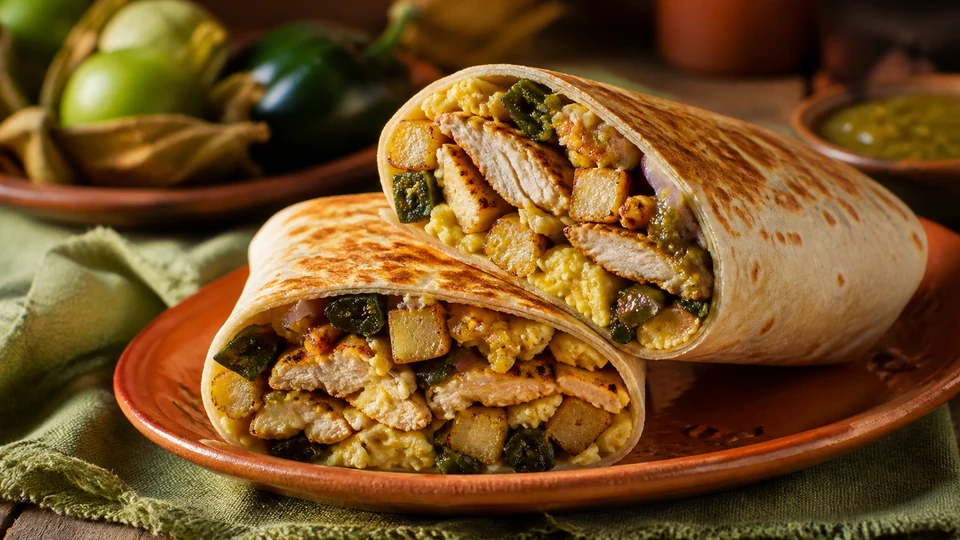
This page is an assembly and decision guide, not a newly tested Pancake World recipe. The breakfast hub offers other morning formats, while Pancake World connects the full food collection.
For broader context, continue with American Breakfast: Pancakes, Diner Plates and Brunch.
Start with the chicken you actually have
“Chicken breakfast burrito” describes a format, not one canonical recipe. The safest and most useful first decision is whether the chicken is raw, freshly cooked, safely refrigerated leftover, commercially cooked or frozen. Each starting point changes the workflow.
| Starting chicken | First action | Main control |
|---|---|---|
| Raw breast or thigh | Cook separately before assembly | Verify 165°F in the thickest part |
| Home-cooked leftover | Confirm storage history and age | Use within the verified refrigerated window |
| Hot rotisserie chicken | Portion promptly and refrigerate if not using immediately | Keep raw-food contamination away |
| Refrigerated packaged cooked chicken | Follow label storage and heating directions | Check opened-package instructions |
| Frozen cooked chicken | Thaw or heat by a safe method | Bring the final hot burrito to 165°F |
USDA Food Safety and Inspection Service guidance states that all chicken should reach 165°F. Color is not a reliable doneness test. The agency also advises against washing raw poultry because splashing can spread contamination to sinks, counters, utensils and ready-to-eat ingredients.
If the source chicken is uncertain—its refrigerator time is unknown, it sat out too long, or the package directions were not followed—do not use it as a burrito shortcut. A tortilla and hot sauce cannot correct unsafe storage.
A verified chicken-burrito reference
Oregon State University Extension’s Food Hero publishes Chicken and Black Bean Salsa Burritos as a breakfast, lunch or dinner option. The recipe makes four burritos and uses:
- one drained and rinsed 15-ounce can of black beans;
- green onions, lemon juice, cumin, salt, chili powder and pepper;
- four boneless, skinless chicken breasts;
- one cup shredded cheese;
- four nine-inch flour tortillas.
The source cooks the chicken until the thickest part reaches 165°F, cools it enough to slice, divides cheese, chicken and the bean mixture among the tortillas, rolls them and heats the assembled burritos. It directs cooks to refrigerate leftovers within two hours.
That source is useful because it documents the entire unit: ingredients, yield, chicken temperature and assembly. It does not contain egg, potato or a dedicated breakfast sauce. If you add those, reduce another component or choose a larger tortilla, the original yield and nutrition no longer transfer automatically.
For the most evidence-secure option, follow the Food Hero recipe itself. For a breakfast-specific variation, treat every change as a new household version and judge it by observable assembly, flavor and safety—not an invented claim that it is nutritionally superior.
Choose a breakfast structure
Chicken can sit beside several familiar breakfast elements. Choose one structure before shopping so the filling does not become an uncontrolled pile.
Chicken, egg and peppers
This is the clearest breakfast signal. Cook the chicken separately to 165°F, then combine chopped cooked chicken with firmly cooked scrambled egg and drained sautéed peppers or onions. Add a measured amount of cheese or salsa if desired.
The challenge is moisture. Soft egg plus watery vegetables plus salsa can make the tortilla gummy. Cook vegetables until excess water has evaporated, keep scrambled egg firm rather than runny, and place salsa sparingly inside or serve it separately.
Chicken, black beans and cheese
This follows the Food Hero source most closely. Beans make the filling cohesive and the lemon-spice mixture provides flavor without requiring egg. It can still be served at breakfast; meal labels are cultural and practical, not safety classifications.
Use the source’s full formula if relying on its yield. If reducing beans to add egg, record that as a modified version and portion by actual volume or weight.
Chicken and potato
Cooked potato gives a familiar breakfast-burrito texture but can dominate the tortilla. Crisp or dry the potato component separately, then use enough chicken and seasoning to keep the filling distinct.
Avoid combining wet potato, runny egg and juicy salsa. If all three are desired, keep the portions restrained and cool the filling slightly before wrapping so trapped steam does not soften the tortilla.
Chicken, vegetables and salsa
This is a useful way to employ leftover cooked chicken without adding egg. Peppers, onions, mushrooms, spinach or tomato can work, but each needs different moisture management. Wilt spinach and squeeze or drain it; cook mushrooms until released water evaporates; seed very juicy tomato or add fresh tomato after reheating.
Chicken and egg without cheese
Cheese is optional, but removing it changes binding and seasoning. Use a well-folded tortilla and keep the filling compact. A small amount of thick salsa, mashed beans or avocado can provide cohesion, but each has a different flavor, storage behavior and allergen profile.
Do not promise that any one structure is “healthiest.” The word is too broad without defined criteria, quantities and individual needs.
Build the filling in the right order
A reliable workflow separates raw-chicken work from ready-to-eat assembly.
1. Prepare the tortilla-zone ingredients first
Wash and cut vegetables, portion cheese, open beans and prepare seasonings before raw chicken reaches the work area. Keep ready-to-eat salsa, herbs and tortillas away from raw poultry and its packaging.
Use a clean plate for cooked chicken. Never return cooked meat to the plate or cutting board that held it raw unless that item has been properly washed.
2. Cook chicken and verify temperature
Cook chicken by the chosen method and measure 165°F at the thickest part with a food thermometer. Do not rely on a white center, clear juices, browning or a fixed number of minutes.
Resting may make slicing easier, but it does not replace the temperature check. Cut or shred the chicken only on a clean surface.
3. Cook vegetables until the moisture is controlled
Use a skillet wide enough that vegetables sauté rather than steam in a crowded mound. Observe the pan: mushrooms should stop releasing pools of water; onions and peppers should be tender enough for the desired texture; spinach should be wilted and drained.
Season the vegetables while warm. Flavor distributed through the filling reduces dependence on a large quantity of finishing sauce.
4. Cook eggs firmly if using them
FDA guidance says scrambled eggs should not be runny and egg dishes should reach 160°F. In a chicken-and-egg filling, the poultry standard remains 165°F for the chicken, and a reheated combined burrito should reach 165°F.
Keep the scramble in larger, tender curds rather than tiny dry fragments. Stop cooking based on the safe finished state and observed texture, not a guessed time.
5. Combine only what will be wrapped
Mixing every component in one pan can make portioning easy, but it can also crush egg and release more moisture. Another approach is to layer chicken, egg and vegetables separately. Either works if the final units are even and the wettest ingredient is kept away from the tortilla surface.
6. Taste a small hot portion before rolling
Adjust salt, acid and spice while the filling is accessible. Once wrapped, correcting bland chicken often means opening the burrito or adding excessive sauce.
Do not taste any component that contains raw or undercooked chicken or egg.
How to choose the tortilla
The Food Hero reference uses nine-inch flour tortillas for four substantial chicken burritos. A breakfast-specific version may need a different size depending on how much egg, vegetable or potato is added.
Judge a tortilla by function:
- it warms without cracking;
- it can fold over the planned filling;
- the side flaps overlap enough to contain small pieces;
- it does not require a second wrap;
- its ingredient and allergen statement suits the people eating it.
Large wraps hold more but invite overfilling. Small tortillas make compact units but may tear around chicken chunks. Corn tortillas bring a different flavor and typically make smaller folded formats rather than one large flour-style burrito. Gluten-free or alternative wraps vary widely in flexibility; follow the package’s warming directions.
Warm tortillas one at a time or keep the stack covered so they stay pliable. A cold, dry tortilla often cracks before the seam can be secured.
Portion and roll without guesswork
The burrito fails structurally when the center is too tall, wet filling reaches the edges or the tortilla is rolled loosely.
- Place the warm tortilla on a clean surface.
- Arrange filling in a compact horizontal band below the center.
- Leave clear margins on both sides.
- Fold the sides inward over the filling ends.
- Bring the bottom edge up and over the filling.
- Pull the enclosed filling gently toward you to tighten the cylinder.
- Roll forward until the seam is underneath.
For multiple burritos, weigh the complete filling and divide it into the intended number of portions. This is not only for nutrition math; equal portions also reheat more consistently.
If the tortilla will not close, remove filling. Do not force the seam, pin it with excess foil or add another tortilla and pretend the design is unchanged.
Three finishing methods
Serve immediately
Place the seam down for a minute so the tortilla holds its shape. Serve salsa, avocado or crisp raw toppings separately when their texture would suffer inside the hot wrap.
Toast the seam in a skillet
A dry or lightly greased skillet can set the seam and create a firmer exterior. Use moderate heat and turn carefully. This is a texture choice, not a safety substitute; chicken still needed its 165°F check.
Heat covered in the oven
Food Hero wraps its assembled burritos in foil and heats them in a 350°F oven until the cheese melts. Follow the source’s instructions for its exact formula. A modified, refrigerated or frozen burrito may require different time; verify the center rather than copying a timer.
Remove foil only when the material and appliance instructions permit. Foil must not go into a microwave.
Using leftover chicken correctly
Leftover chicken makes breakfast faster only when its history is known. USDA FSIS lists cooked chicken leftovers for three to four days in a refrigerator at 40°F or below. FDA gives the same three-to-four-day window for refrigerated cooked egg dishes.
When chicken and egg are combined, use the shorter applicable limit and count from the earliest-prepared perishable component. Adding freshly cooked egg does not restart the clock on three-day-old chicken.
Before assembly:
- verify when the chicken was cooked or opened;
- confirm it was refrigerated promptly;
- discard it if it sat at room temperature beyond the safe limit;
- remove bones, skin or gristle as desired;
- cut pieces small enough to reheat evenly;
- plan to heat the completed leftover burrito to 165°F.
Rotisserie chicken is not exempt. USDA includes takeout and store-cooked chicken in the same three-to-four-day refrigerated range when promptly handled.
Do not judge safety by smell alone. Spoilage signs can indicate a reason to discard food, but the absence of an off odor does not prove safe handling.
Meal prep: refrigerate or freeze
Prepare-ahead burritos need a documented date, filling plan and reheating method.
Refrigerated burritos
Cool hot filling promptly in shallow containers. Assemble once the filling is no longer releasing heavy steam, then refrigerate in a covered container. Label the preparation date and ingredient with the earliest use-by boundary.
Use refrigerated cooked chicken and cooked egg dishes within three to four days according to federal guidance. A commercial ingredient with a shorter label instruction controls that ingredient.
Frozen burritos
Freezing extends storage, but federal storage charts distinguish safety from best-quality guidance. Texture can change: egg may become firmer, vegetables can release water and tortillas can dry or split.
For a practical freezer build:
- cool filling before wrapping;
- avoid excess liquid salsa inside;
- fold tightly and protect against freezer drying;
- label the filling and freeze date;
- follow a reheating method that brings the center to 165°F.
Do not freeze a burrito after it has already spent most of its safe refrigerator window and assume freezing erases that history.
Reheating
USDA and FoodSafety.gov specify 165°F for leftovers. Measure the center, especially in a thick frozen burrito where the exterior can be hot while the chicken-and-egg core remains cool.
In a microwave, use a microwave-safe wrap or plate, turn the burrito, allow standing time and verify the temperature in more than one place when the unit is large. In an oven or air fryer, follow appliance-safe wrapping guidance and avoid judging the center from surface crispness.
Troubleshooting the finished burrito
The tortilla tears
Likely causes include a cold tortilla, oversized chicken pieces, too much filling or insufficient side margin.
Next time, warm the tortilla, chop chicken more finely, remove a portion of filling and keep hard-edged pieces away from the fold.
The bottom is wet
The filling probably carried too much vegetable liquid, salsa or steam.
Drain cooked vegetables, cool the filling briefly, use thick salsa sparingly and keep fresh toppings outside until service.
The chicken tastes dry
Overcooking, reheating already-dry pieces or using large exposed chunks can contribute. Food safety requires 165°F, but higher temperatures are not a quality target.
Use a thermometer during the initial cook, cut chicken against its grain where appropriate, distribute it with vegetables or beans, and avoid prolonged reheating after the center reaches 165°F.
The eggs disappear into the filling
Very small, over-stirred curds can become indistinct. Cook larger firm curds and fold them into the chicken mixture at the end rather than continually stirring everything together.
The burrito is bland
Season components before rolling. Add acidity through lemon or lime, select a measured salsa, and use herbs or spices. The Food Hero source demonstrates one coherent profile with lemon, cumin, chile and green onion.
The center is cold after reheating
Return it to the heat and continue until the center measures 165°F. Next time, make smaller, evenly portioned units and rotate or turn them during reheating.
Compare chicken breakfast burrito formats
| Format | Advantage | Tradeoff | Best check |
|---|---|---|---|
| Chicken and egg | Strong breakfast identity | Two perishable proteins to handle | Firm egg; chicken and reheat temperatures |
| Chicken and black beans | Complete Extension model available | Not egg-centered | Follow source yield and 165°F chicken check |
| Chicken and potato | Familiar hearty texture | Easy to overfill or make damp | Crisp, measured potato portion |
| Chicken and vegetables | Flexible leftover use | Vegetable water can soften tortilla | Cook and drain before rolling |
| Chicken breakfast bowl | Components easy to see | Not hand-held; portions may grow | Count and portion every component |
| Frozen make-ahead burrito | Fast later service | Texture and cold-center risk | Label date and verify 165°F center |
The table supports a decision; it does not rank nutrition or promise a result.
Buying or ordering one
For a packaged burrito, read the ingredient list, allergen statement, storage directions, preparation method and serving size. Confirm whether the package contains one or multiple servings and whether the specified heating method starts from frozen or thawed.
For a restaurant burrito, ask practical questions:
- Is the chicken cooked to order or reheated?
- Are egg, potatoes, beans and cheese all included?
- What tortilla size is used?
- Can salsa or another wet sauce be served separately?
- Is official allergen or nutrition information available for the standard build?
Do not invent facts about a venue’s chicken source, cooking method, price, availability or nutrition. If information is not published or confirmed by the operator, describe only what can be observed or directly stated.
Allergens and dietary decisions
Common chicken breakfast burrito allergens include wheat in flour tortillas, egg, milk in cheese and soy in some tortillas, sauces or prepared chicken. Cross-contact can add others.
“Chicken” does not mean dairy-free, gluten-free, high-protein, low-carb or low-calorie. Each claim requires its own evidence. A plant-based wrap does not certify the chicken filling; a gluten-free tortilla does not certify the preparation surface.
People with a diagnosed food allergy need ingredient and cross-contact information from the actual product or kitchen. Do not rely on visual inspection.
Frequently asked questions
Can chicken go in a breakfast burrito?
Yes. Food Hero explicitly presents its chicken and black bean burrito for breakfast, lunch or dinner. Egg is optional; breakfast identity can come from the serving occasion and other ingredients.
Should I use raw or cooked chicken?
Cook chicken separately before assembly and verify 165°F at the thickest point. Using safely stored leftover cooked chicken can shorten the process.
Can I add eggs?
Yes. Cook scrambled eggs until they are not runny; FDA lists 160°F for egg dishes. Keep the filling dry enough to fold and reheat a leftover combined burrito to 165°F.
How long does cooked chicken last in the refrigerator?
USDA FSIS lists three to four days at 40°F or below for cooked chicken leftovers. Count from when the chicken was cooked, not when it was later placed in a burrito.
Can I use rotisserie chicken?
Yes, if it was handled promptly and remains within its safe refrigerated period. USDA treats store-cooked and takeout chicken as cooked chicken leftovers for storage purposes.
Can I freeze a chicken breakfast burrito?
Yes, but freezing affects quality and does not undo unsafe earlier storage. Cool promptly, wrap securely, label the date and reheat the center to 165°F.
Why is my burrito soggy?
The usual visible causes are wet vegetables, excess salsa, trapped steam or under-cooled filling. Drain, cool and portion before rolling.
Is a chicken breakfast burrito healthy?
That cannot be answered from the name alone. Ingredients, quantities, serving size, dietary needs and the meaning assigned to “healthy” all matter.
Final assembly checklist
- Identify the chicken source and storage history.
- Keep raw poultry separate from tortillas, cooked food and fresh toppings.
- Do not wash raw chicken.
- Cook chicken to 165°F measured at its thickest point.
- Cook egg firmly and use the applicable egg-temperature guidance.
- Remove excess moisture from vegetables and sauces.
- Warm a tortilla large enough for the planned portion.
- Divide filling evenly and leave folding margins.
- Refrigerate prepared leftovers promptly and date them.
- Use cooked chicken and egg leftovers within the verified three-to-four-day refrigerated window.
- Reheat the center of any leftover burrito to 165°F.
- Report only observed results and source-backed facts.
A strong chicken breakfast burrito begins with safe chicken, then earns its breakfast character through a coherent filling rather than an overloaded list of ingredients. The Food Hero chicken-and-black-bean recipe supplies one authoritative complete model. When adding egg, potato or vegetables, control moisture, preserve the tortilla’s capacity and treat the result as a new household variation. Temperature, storage history and a clean work sequence matter more than color, timing guesses or marketing language.
Explore related Pancakes World guidance on American Pancakes, Maple Syrup, and Maple Syrup Pancakes.
Sources and editorial references
- Oregon State University Extension Food Hero, Chicken and Black Bean Salsa Burritos —
https://foodhero.org/recipes/chicken-and-black-bean-salsa-burritos - USDA Food Safety and Inspection Service, Chicken from Farm to Table —
https://www.fsis.usda.gov/food-safety/safe-food-handling-and-preparation/poultry/chicken-farm-table - FoodSafety.gov, Safe Minimum Internal Temperature Chart —
https://www.foodsafety.gov/food-safety-charts/safe-minimum-internal-temperatures - U.S. Food and Drug Administration, What You Need to Know About Egg Safety —
https://www.fda.gov/food/buy-store-serve-safe-food/what-you-need-know-about-egg-safety - USDA Food Safety and Inspection Service, Leftovers and Food Safety —
https://www.fsis.usda.gov/food-safety/safe-food-handling-and-preparation/food-safety-basics/leftovers-and-food-safety - FoodSafety.gov, Cold Food Storage Charts —
https://www.foodsafety.gov/food-safety-charts/cold-food-storage-charts