Canned biscuit breakfast recipes
At Pancakes World, canned biscuit dough can become five useful breakfast formats: bake-and-split sandwiches, muffin-pan cups, chopped-dough casseroles, sealed breakfast pockets, or sweet pull-apart bakes. Choose one published recipe written for the exact dough size and style you bought, then keep its cutting, shaping, filling, pan, refrigeration, temperature, and baking instructions together. Do not taste raw dough; follow the package or recipe until the flour-containing dough is fully baked. For egg casseroles, verify the center reaches 160°F, while casseroles containing meat or poultry should reach 165°F. Cook ground sausage to 160°F and poultry sausage to 165°F before using it where the recipe requires cooked filling. Refrigerate perishable leftovers promptly and reheat them to 165°F.
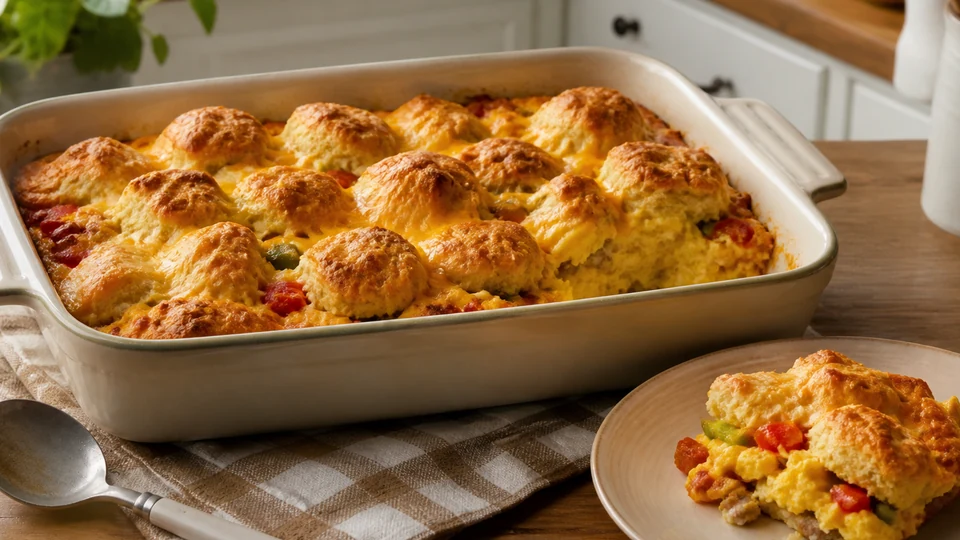
This is a source-led format and safety guide, not a Pancake World-tested collection of new recipes. For other make-ahead and savory morning ideas, browse the breakfast hub, or return to Pancake World for the complete editorial library.
For broader context, continue with American Breakfast: Pancakes, Diner Plates and Brunch.
Decide the final shape before opening the tube
Refrigerated biscuit dough begins losing its convenient, separated form as soon as the package is opened and pieces are handled. The best first decision is therefore not “what fillings are in the refrigerator?” but “what structure will hold those fillings?”
Five structures cover most breakfast uses:
| Format | What happens to the dough | Filling relationship | Best source-led use |
|---|---|---|---|
| Sandwich | Biscuits bake in their original portions and are split afterward | Cooked filling sits between baked halves | Flexible servings and last-minute assembly |
| Muffin cup | One dough piece is pressed across the bottom and sides of a standard cup | Filling bakes inside an open dough shell | Handheld portions with a visible top |
| Chopped-dough casserole | Biscuits are cut into multiple pieces and distributed through a dish | Egg mixture and other ingredients surround the dough | One-pan group breakfast |
| Sealed pocket | A biscuit is opened or flattened, filled, and sealed | Filling is enclosed before baking | Portable make-ahead breakfast |
| Sweet bake | Dough is cut, layered, or combined with fruit, spices, or a sauce | Sweet components surround or fill the dough | Brunch or dessert-like breakfast |
These formats are not interchangeable after assembly. A sandwich recipe bakes the biscuit before wet filling touches the crumb. A casserole deliberately exposes raw dough pieces to an egg mixture. A cup needs dough pressed thin enough to line a specific pan. A sealed pocket needs a dry enough filling and a reliable edge seal. Select the architecture first.
The exact can matters
“One can of biscuits” is not a standardized amount. Product families can differ in package weight, biscuit count, piece size, layers, flavor, and intended baking directions. Pillsbury’s current refrigerated Grands catalog alone contains multiple flaky-layer and southern-homestyle varieties. Other manufacturers and store brands add more variation.
Use the full product description from the chosen source:
- refrigerated or frozen;
- package weight;
- biscuit count;
- named size or product line;
- original, buttermilk, honey-butter, or another flavor;
- flaky-layer or homestyle structure.
Then compare it with the package in hand. If a recipe expects eight large biscuits and your package contains ten smaller rounds, the dough volume per muffin cup, casserole area, or pocket changes. Do not preserve the word “can” while ignoring the weight and count.
The physical package controls current ingredients, allergens, refrigeration, opening, and ordinary baking directions. Manufacturer webpages themselves warn that formulations can change. A saved screenshot or old recipe card cannot override the label on a newly purchased tube.
Format 1: baked biscuit breakfast sandwiches
The sandwich is the lowest-risk structural choice because dough and filling cook separately. Pillsbury Kitchens’ breakfast biscuit sandwich method uses individually frozen biscuits, bakes them according to the bag, scrambles eggs in a skillet, and assembles eggs, cooked bacon, and cheese between split warm biscuits.
That source demonstrates a decision rather than authorizing a universal filling list. Bake the biscuit product as its package directs. Prepare the filling safely. Split only after the biscuit is baked. Assemble close to service so steam and moisture do not soften the crumb more than intended.
When sandwiches are the right choice
- Different people want different fillings.
- Meat-free and meat-filled portions must remain separate.
- The cook wants to bake only the number needed.
- Biscuit doneness should be judged without an egg mixture hiding the bottom.
- Leftover components are easier to store separately.
A safe sandwich workflow
- Read the biscuit package and preheat the correct appliance.
- Bake only the product and number covered by those directions.
- Cook eggs until set; if using an egg patty or other thick egg dish, apply the appropriate temperature guidance.
- Use fully cooked bacon or ham as the recipe directs, or cook raw sausage to its safe temperature before assembly.
- Use a clean knife and board to split baked biscuits.
- Assemble and serve, or cool components promptly for later storage.
Avoid putting raw sausage, raw bacon, or a raw egg inside an ordinary biscuit and then using the package’s plain-biscuit time. Once raw animal food is enclosed, the source recipe and internal-temperature evidence must cover the new format.
Format 2: muffin-pan biscuit cups
Biscuit cups use the pan as structural support. The official sausage breakfast cup method centers each large biscuit over a standard muffin cup, presses the dough across the bottom and up the sides, and creates a rim above the cup. Cooked filling is spooned into this shell before baking.
Pan dimensions and biscuit size are therefore part of the formula. A mini muffin pan cannot be substituted without redesigning the portion. An oversized jumbo cup may leave the dough too short to contain filling. Use the source’s standard cup and specified dough.
What cups do well
- keep servings separate;
- expose the filling so center set is visible;
- allow portions to cool faster than one deep casserole;
- support freezing when the specific tested recipe publishes freezing directions;
- create a handheld shape without sealing wet filling inside.
Cup assembly checkpoints
Press the dough evenly enough to cover the bottom and walls, but do not tear holes. Keep filling below the rim specified by the source. A mound above the dough can spill, while a very wet filling can prevent the bottom from setting.
Cook meat and potatoes as the published recipe directs before they enter the cup. “Pre-cooked sausage crumbles” and raw bulk sausage are not interchangeable labels. If the source uses prepared gravy, do not replace it with an unmeasured liquid and expect the same structure.
The sausage breakfast cup source supplies route-specific make-ahead and reheating instructions. It recommends baking soon after preparation for texture, permits a short refrigerated hold before baking, and provides its own refrigerator, freezer, and microwave directions for the baked cups. Those directions belong to that tested cup recipe, not to every biscuit breakfast.
Format 3: chopped-biscuit egg casseroles
A biscuit casserole distributes dough pieces through an egg mixture so the center can bake as one dish. It is the most useful group format and the easiest to underbake if pan depth, dough size, chill state, or ingredient load changes.
Two official approaches reveal an important choice.
Partial-bake base
The ham-and-Swiss biscuit breakfast casserole partially bakes biscuit pieces before eggs and cheese finish the dish. That first bake gives the dough base more structure. Select this lane when the source specifically calls for a staged bake, and do not skip the first stage simply because all ingredients eventually enter the oven.
Overnight soaked casserole
The overnight hearty biscuit breakfast casserole cuts each of eight biscuits into eight pieces, layers them with potatoes, already cooked meats, green onions, and cheese, adds an egg-and-half-and-half mixture, and chills the covered dish for at least eight hours or overnight. It then bakes uncovered until the center is set and the edges are deeply browned, followed by a standing period.
This lane is intentionally chilled before baking. A cold casserole can need different oven time from a freshly assembled one. The source discusses a same-day alternative but tells the cook to begin checking earlier. Do not take the overnight bake time and apply it blindly to a warm dish, or take the fresh timing and apply it to a refrigerator-cold center.
Casserole decision checklist
- Is the baking dish the stated size and volume?
- Are biscuit pieces cut to the source count?
- Are sausage, bacon, potatoes, or other components already cooked when required?
- Is the egg mixture measured, not estimated?
- Is the dish baked from fresh or chilled state?
- Does the center reach the applicable safe temperature?
- Is the source’s standing time completed before cutting?
Color at the edge cannot prove that a deep center is safe. FoodSafety.gov lists 160°F for egg dishes such as quiche and 165°F for meat or meatless casseroles; casseroles containing meat and poultry are also listed at 165°F. Insert a clean food thermometer into the center while avoiding the pan.
Format 4: sealed biscuit breakfast pockets
Sealed pockets, sometimes marketed as biscuit bombs, enclose cooked filling in a biscuit before baking. Pillsbury’s freezer-friendly everything-bagel biscuit bombs open each large flaky biscuit to create a pocket, add a cooked egg, cheese, and fully cooked sausage mixture, then stretch and seal the dough before baking.
The filling is prepared first. That is structurally and safely important. A hot, wet filling can make sealing difficult, while raw meat creates a temperature problem the published shortcut did not design.
Sealing decisions
Use the biscuit style named by the source, because flaky layers support the opening method described there. Keep filling within the tested amount. Wipe filling from the seam before pressing; fat or egg on the edge can interfere with adhesion. Inspect the entire perimeter rather than pinching only the top.
Place the seam as directed. Leave expansion room between pieces. Bake until both the dough and center meet the source endpoints. A browned top with a leaking seam is not evidence that the thick lower dough is done.
Freezer boundary
Follow freezer and reheating directions only from a recipe that actually tests and publishes them. The 2025 pocket recipe is explicitly freezer-friendly. That does not establish a three-month life or microwave time for a different filling, biscuit size, or casserole. Ingredient moisture and portion thickness affect reheating.
Label each wrapped item with the recipe, date, and reheating directions. Reheat the center to 165°F, not merely until the outside feels warm.
Format 5: sweet biscuit breakfast bakes
Manufacturer biscuit collections include berry-and-cream-cheese bakes, monkey breads, stuffed sweet biscuit sandwiches, and fruit-centered formats. These answer a brunch or treat intent rather than a savory egg-breakfast intent.
Sweet does not eliminate raw-dough or refrigeration rules. Cream cheese, dairy, cut fruit, and eggs may require cold holding. Sugar and fruit can brown before thick dough is baked through. Use a published source that states pan, dough count, filling quantity, bake time, and final cue.
Choose among three sweet structures:
- pull-apart pieces: dough is cut and coated or layered;
- filled biscuit: a measured center is enclosed or sandwiched;
- fruit bake: dough pieces sit with fruit and a sauce in a dish.
Do not turn a savory casserole into a sweet bake by replacing meat with fruit while retaining egg quantity and bake time. Fruit releases water, sugar affects browning, and sauces change heat movement.
For a less dessert-like breakfast, use a plain baked biscuit with fruit on the side. That requires no experimental wet bake.
Raw dough is not ready-to-eat food
The FDA states that flour is a raw food and processing grain into flour does not necessarily kill harmful bacteria. It advises never eating or tasting raw flour, dough, or batter and following package instructions for flour-containing products.
That guidance applies even when the dough comes in a refrigerated tube and looks uniform. “Ready to bake” is not “ready to eat.” Do not sample a small corner to check salt or allow children to play with scraps.
Use this workflow:
- Keep the dough refrigerated according to the package.
- Wash hands before and after handling it.
- Keep raw dough and raw eggs away from ready-to-eat fruit, cheese, and cooked meat.
- Use separate or freshly cleaned tools and surfaces.
- Do not return unused handled dough to a communal package unless the manufacturer permits storage and the package can be closed safely.
- Bake under the package or selected recipe directions.
- Wash counters, utensils, pans, and hands with warm soapy water after raw-dough contact.
Home heat treatment of flour is not an approved shortcut according to FDA guidance. Do not microwave raw biscuit dough and assume it became safe based on warmth alone.
Eggs, sausage, bacon, ham, and poultry need separate decisions
Breakfast recipes often combine ingredients with different starting states. A “sausage crumble” might be fully cooked, while bulk sausage is raw. Bacon can be raw, partially cooked, or fully cooked. Ham can be ready-to-eat or require cooking. Read the label and the recipe.
FoodSafety.gov lists:
- ground meat and sausage: 160°F;
- all poultry, including ground poultry and poultry sausage: 165°F;
- raw eggs: cook until the yolk and white are firm;
- egg dishes: 160°F;
- casseroles: 165°F;
- leftovers: 165°F.
Use the temperature that applies to the finished food. A casserole containing meat or poultry uses the casserole guidance rather than declaring safety because the visible egg looks set.
Cook-before-assembly cases
Cook raw sausage before it enters a source recipe that calls for cooked sausage. Drain or handle it as directed so unexpected fat does not soak the dough. Cook bacon before use when the source specifies cooked bacon. Thaw frozen cooked crumbles only under their package or recipe directions.
Bake-together cases
Only bake raw animal ingredients together with biscuit dough when a tested source explicitly does so and supplies a method that reaches safe temperatures. Otherwise, pre-cooking is the safer source-faithful route.
Make-ahead choices should follow the format
Not every biscuit breakfast improves overnight.
Assemble close to baking
Sandwich biscuits, many cups, and sealed pockets benefit from keeping raw dough away from wet filling until near bake time. The sausage cup source specifically favors prompt baking for flaky texture, while permitting a limited chilled preparation window.
Intentionally refrigerate overnight
Use an overnight hold only when the source designs for it, as in the hearty biscuit casserole. Keep the dish covered and refrigerated for the stated interval. Make space in the refrigerator before assembly so the dish is not left on the counter while shelves are rearranged.
Bake, cool, then freeze
Use this lane when the specific cup or pocket recipe publishes freezer directions. Cool as directed, wrap portions, label them, and freeze promptly. Do not freeze an unbaked egg-and-biscuit item solely because a different baked version is freezer-friendly.
Cool and store leftovers safely
USDA FSIS says to refrigerate perishable food within two hours, or within one hour when the temperature is above 90°F. It recommends shallow containers for rapid cooling, using most cooked leftovers within three to four days, and reheating leftovers to 165°F.
For a deep casserole, divide leftovers into smaller portions rather than placing a hot, deep dish in the refrigerator indefinitely. Cover and label the portions. Sandwich components can be cooled separately to protect texture and make reheating more even.
The general three-to-four-day advice does not override a more restrictive tested recipe or product label. Conversely, one recipe’s three-month freezer instruction does not apply to every biscuit breakfast.
When reheating, verify the center. A biscuit exterior can become hot before a dense egg-and-sausage filling reaches 165°F. Rotate or turn microwave-heated food as the appliance guidance directs and allow standing time where specified.
Scale by pan capacity, not guesswork
Doubling a recipe can increase depth, crowding, and oven load. Two pans that each match the source are usually more predictable than one oversized dish. Do not double a casserole in the same pan.
For cups, count pan wells and biscuit pieces. For pockets, keep space between portions. For sandwiches, individually frozen biscuits make it easier to bake only the number needed, while a refrigerated tube may require a plan for all pieces once opened.
Before scaling, record:
- source servings;
- biscuit package weight and count;
- pan size and number of pans;
- filling quantities;
- whether ingredients are cooked or raw;
- refrigerator space;
- thermometer access to the center;
- cooling-container capacity.
Do not multiply bake time by the number of batches. Each correctly sized pan follows the source’s process, while a crowded oven may need monitored adjustment.
Run a package-to-recipe compatibility check
Before shopping for fillings, copy the dough specification from the source into a short comparison table. At the store, compare the physical package rather than the shelf tag.
| Check | Recipe requires | Package in hand | Decision |
|---|---|---|---|
| Storage state | Refrigerated tube or frozen individual pieces | Read front and directions | Must match |
| Net weight | Exact ounces printed by source | Read net-weight statement | Avoid silent volume change |
| Piece count | Five, eight, ten, or another count | Count printed on package | Must support pan and servings |
| Dough style | Flaky layers, homestyle, or another named style | Read product name | Match for shaping recipes |
| Flavor | Original, buttermilk, honey, or other | Read product name and ingredients | Confirm it fits savory or sweet use |
| Allergens | Ingredients assumed by source | Read current contains and may-contain statements | Eater-specific decision |
| Directions | Source-specific bake or transformation | Current package instructions | Resolve conflicts before opening |
If weight matches but count does not, each piece is a different size. If count matches but weight does not, the same problem remains. For a sandwich, a size difference may mainly affect the package bake. For a muffin cup or sealed pocket, it changes how much dough covers the pan or surrounds filling. For a chopped casserole, it changes the ratio of dough to egg mixture.
Do not average the mismatch by stretching some pieces and discarding others unless the source tells you to portion by weight. Select the matching package or another complete recipe. Save the receipt and photograph the package panel for your own repeatability, but treat the package—not a promotional webpage—as the current authority for ingredients and allergen declarations.
This check also prevents refrigerated and frozen products from being confused. Individually frozen biscuits are useful when only a few sandwiches are needed; canned dough is often designed to be used after opening. Their ordinary oven directions and handling are not interchangeable.
Troubleshoot by structure
Casserole center is wet while edges are dark
Check dish size, depth, chilled state, dough-piece size, and extra liquid. Shielding or lowering heat is not automatically the answer; the source may not cover an overfilled dish. Continue only within safe oven practice until the center reaches the required temperature, and revise the next batch to match the tested pan and quantities.
Biscuit-cup bottom is doughy
The dough may be too thick at the base, the filling may be overfilled or wetter than specified, or the pan may be the wrong size. Confirm that pre-cooked filling was used where required. Do not declare the cup finished from the browned rim.
Pocket opens during baking
Possible causes include too much filling, filling on the seam, insufficient pinching, or a dough style that does not match the source. Reduce to the tested filling and inspect the seal before baking. Do not use leaked food as proof the intact centers are done.
Sandwich turns soggy
Cool or drain wet filling as the recipe permits, and assemble shortly before service. Store baked biscuits and moist components separately when possible. Reheating a fully assembled sandwich may soften the crumb even when done safely.
Biscuits do not rise evenly
Check package date, refrigeration, opening damage, pan arrangement, and source instructions. Excessive flattening or repeated handling can change the layers. For cups and pockets, shape only as the chosen recipe directs.
A 10-question route selector
- Do you need individual or group servings?
- Will people choose different fillings?
- Does the source call for refrigerated canned or individually frozen dough?
- Does your package weight and biscuit count match?
- Are meat components raw, pre-cooked, or ready-to-eat?
- Does the method partially bake dough before adding eggs?
- Is the dish intentionally chilled overnight?
- Can you measure the center temperature?
- Does the specific recipe publish refrigerator or freezer directions?
- Do you have space to cool leftovers promptly?
If answers are uncertain, use the simplest split-biscuit sandwich lane. Dough and fillings cook separately, and each component can be checked before assembly.
Frequently asked questions
Can I substitute any canned biscuit brand?
Not automatically. Compare package weight, count, piece size, style, ingredients, and directions. A substitute changes the formula when its dough volume differs. Use a source written for the product in hand where possible.
Can canned biscuit dough be eaten raw?
No. FDA guidance says not to eat or taste raw flour-containing dough. Follow package and recipe baking directions, prevent cross-contact, and clean after handling.
Should sausage be cooked before going into biscuit dough?
Yes when the source calls for cooked sausage or fully cooked crumbles. Raw ground sausage must reach 160°F, while poultry sausage must reach 165°F. Only use a raw bake-together method when a tested source explicitly supports it.
What temperature should an egg biscuit casserole reach?
FoodSafety.gov lists 160°F for egg dishes and 165°F for casseroles. A casserole containing meat or poultry should reach 165°F. Check the center with a food thermometer.
Can I assemble a biscuit casserole the night before?
Only when the recipe is designed for an overnight refrigerator hold. The official overnight hearty casserole specifies at least eight hours or overnight. Other cups and pockets may become soggy or exceed their tested hold.
How long do leftovers keep?
USDA general guidance says most cooked leftovers can be refrigerated for three to four days when cooled promptly. Use a specific recipe’s shorter limit if it provides one, and reheat to 165°F.
Can biscuit breakfast cups be frozen?
The cited sausage cup recipe publishes its own baked-cup freezing and reheating instructions. Follow that exact recipe. Do not transfer its freezer life to a different filling or unbaked cup.
Is this a tested Pancake World recipe collection?
No. The page compares official manufacturer recipe lanes and federal safety guidance. Without project-owned tests, it does not publish invented quantities, yields, times, nutrition, or Recipe schema.
Explore related Pancakes World guidance on American Pancakes, Maple Syrup, and Maple Syrup Pancakes.
Sources and editorial references
- Pillsbury — Grands refrigerated biscuit product family:
https://www.pillsbury.com/products/biscuits/grands-refrigerated-biscuits - Pillsbury Kitchens — Breakfast biscuit sandwiches:
https://www.pillsbury.com/recipes/breakfast-biscuit-sandwiches/125954b3-c24a-4fbc-b720-ca05699ffe11 - Pillsbury Kitchens — Sausage breakfast cups:
https://www.pillsbury.com/recipes/sausage-breakfast-cups/17b793f3-218a-494a-b079-9f1ce32cdeb1 - Pillsbury Kitchens — Ham and Swiss biscuit breakfast casserole:
https://www.pillsbury.com/recipes/ham-and-swiss-biscuit-breakfast-casserole/c1987838-ff09-40dc-81ce-2ef86eda9905 - Pillsbury Kitchens — Overnight hearty biscuit breakfast casserole:
https://www.pillsbury.com/recipes/overnight-hearty-biscuit-breakfast-casserole/380a3c86-a6c7-41b0-9f8f-3bc4c5da7751 - Pillsbury Kitchens — Freezer-friendly everything bagel biscuit bombs:
https://www.pillsbury.com/recipes/freezer-friendly-everything-bagel-biscuit-bombs/1a4172b1-4a92-4698-a099-07dff5b425a3 - FDA — Handling flour safely:
https://www.fda.gov/food/buy-store-serve-safe-food/handling-flour-safely-what-you-need-know - FoodSafety.gov — Safe minimum internal temperatures:
https://www.foodsafety.gov/food-safety-charts/safe-minimum-internal-temperatures - USDA FSIS — Steps to keep food safe:
https://www.fsis.usda.gov/food-safety/safe-food-handling-and-preparation/food-safety-basics/steps-keep-food-safe