Buttermilk pancakes frozen
At Pancakes World, to freeze buttermilk pancakes well, cook one documented recipe completely, cool the pancakes promptly, divide them into meal-size stacks, place wax paper between individual pancakes, and seal each stack inside freezer-rated packaging with as little trapped air as practical. Label the package with the recipe, date, count, form and allergens, then keep it at 0°F (-18°C) or below. Reheat only the amount needed, taking leftovers to 165°F (74°C) and checking more than one spot when a microwave is used. Wax paper is a separator, not an adequate outer freezer wrap, and freezing does not make an undercooked pancake, unidentified batch or poorly handled leftover safe. This guide covers fully cooked homemade buttermilk pancakes, not raw batter or commercial frozen products. It uses one Utah State University Extension formula so that the batch has a traceable identity, while federal and university guidance controls cooling, packaging, storage, thawing and reheating. For the wider mechanics behind batter and cooking, use the Pancake Ingredients and Substitutions . Explore the editorial platform for other documented pancake formats.
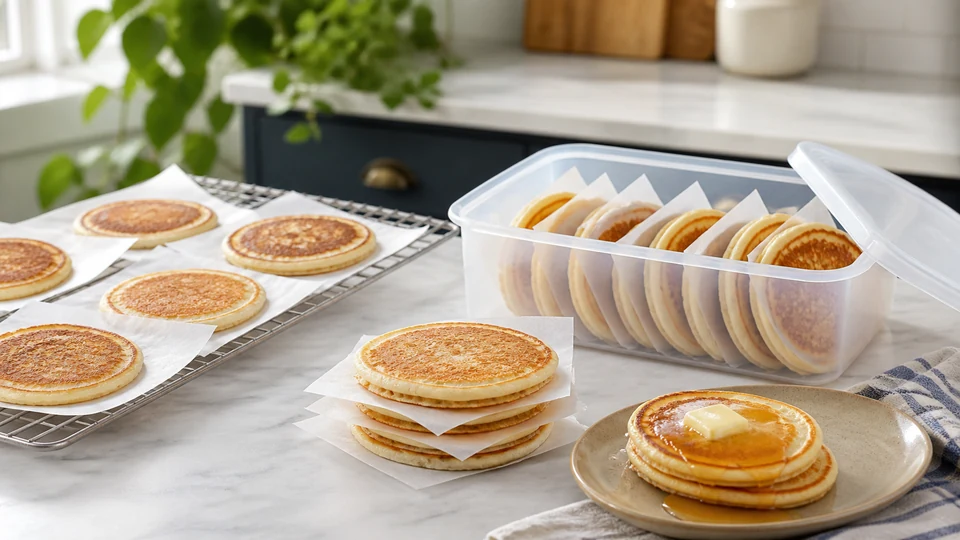
For adjacent decisions around Buttermilk pancakes frozen, compare a pancake batch production sheet, a texture-led freezer breakfast rotation, and ways to reheat frozen pancakes.
| Guide sections |
|---|
| Start with a defined buttermilk pancake batch |
| Cook for a finished pancake, not for the freezer |
| Build a freezer workflow before cooking ends |
| Separate each pancake, then add a real freezer barrier |
For broader context, continue with American Breakfast: Pancakes, Diner Plates and Brunch.
Start with a defined buttermilk pancake batch
A freezer package is only as reliable as the batch record attached to it. “Buttermilk pancakes” is not a sufficient production note when different household formulas may contain different amounts, allergens and leavening systems. For this workflow, use the Utah State University Extension formula:
- 2 cups all-purpose flour;
- 2 teaspoons baking powder;
- 1 teaspoon baking soda;
- 1/2 teaspoon salt;
- 2 tablespoons sugar;
- 2 cups buttermilk;
- 2 eggs, lightly beaten;
- 1 teaspoon vanilla.
The source directs the cook to combine the dry ingredients in one bowl, combine the buttermilk, eggs and vanilla in another, mix the wet mixture into the dry mixture, and let the batter rest for 10 minutes. It then calls for a medium skillet coated with nonstick cooking spray, one-half cup of batter per pancake, and turning when small bubbles appear, with the other side cooked until golden brown.
The source does not state how many finished pancakes the batch yields. Do not manufacture a yield by dividing the apparent batter volume by the half-cup portion. Mixing, residue, measurement and the actual portion delivered can change the count. Record the finished count after cooking instead.
Do not silently replace buttermilk, eggs or flour and keep the same batch identity. A substitution may produce a useful pancake, but it changes the formula and may change handling, texture and allergens. Give that variation its own exact record before freezing.
Cook for a finished pancake, not for the freezer
Freezing pauses change; it does not complete the original cooking step. Prepare the batter according to the documented directions, allow the stated 10-minute rest, and portion it into the prepared medium skillet. Use the source’s visual cues: turn after small bubbles appear and cook the second side until golden brown.
Those cues describe the published method, but the cook must still observe the actual pancake. A very thick or uneven portion can color outside while retaining wet batter inside. Before committing a whole batch to freezer packaging, examine the first finished pancake. Its center should be set rather than liquid or gummy, and there should be no raw flour pocket. If the exterior darkens before the center sets, correct the cooking process rather than assuming reheating will repair every pancake later.
Keep the raw batter zone separate from the finished-food zone. Do not place cooked pancakes onto a plate or tool that held uncooked batter unless it has been properly cleaned. Use clean utensils for the pancakes that will be cooled and packed.
The half-cup batter direction is part of the source recipe. Consistent portions also make a stack easier to package and reheat, but this article does not promise identical diameter, thickness or heating time. Pan geometry, spreading and heat delivery remain variable.
Build a freezer workflow before cooking ends
Set up the cooling and packing area in advance. You need:
- clean trays or plates that allow pancakes to remain separate at first;
- clean handling utensils;
- wax paper cut to fit between pancakes;
- freezer-marked bags or another freezer-suitable container;
- a permanent label or freezer-safe marker;
- space in the refrigerator for prompt cooling;
- space in a freezer maintained at 0°F or below.
Penn State Extension advises cooling foods in the refrigerator before freezing. The National Center for Home Food Preservation likewise says food should be cooled before packaging. That direction matters here: sealing a pile of hot pancakes can trap heat and moisture, while leaving them at room temperature for an improvised long cooling session conflicts with prompt leftover handling.
Arrange the cooked pancakes in a single layer or otherwise keep them from forming a dense hot stack. Move them into refrigeration promptly rather than waiting for every item in a large batch to reach room temperature. Do not publish a universal number of cooling minutes; the cited guidance does not provide a pancake-specific stopwatch rule. The practical endpoint is a cooled pancake ready to package, achieved through prompt controlled cooling rather than prolonged counter storage.
Separate each pancake, then add a real freezer barrier
Penn State specifically recommends separating single-serving pancakes with wax paper. Put one fitted sheet between adjacent pancakes so that one portion can be removed without forcing apart the whole frozen stack.
Wax paper has a narrow role. The National Center for Home Food Preservation says wax paper is not moisture-vapor resistant enough for use as an outer freezer wrap. Therefore, a wax-paper-separated stack still needs a freezer-rated outer bag or container. A loose paper parcel is not a finished freezer package.
Suitable freezer packaging should be moisture-vapor resistant, durable, resistant to leaking, cracking or brittleness at freezer temperatures, protective against odors and easy to seal and mark. Bags intended for freezer use can meet this role when they are closed correctly. A rigid freezer container can also be appropriate when it is suitable for the food and freezer.
Choose packaging based on the actual portion pattern:
- pack one pancake when the normal use is a single serving;
- pack a small stack when that is normally reheated together;
- use several small packages rather than one large stack when household demand varies;
- never rely on repeatedly opening one large bag and exposing every pancake if smaller sealed units would match actual use.
The point is not to prescribe one universal serving size. It is to make the package correspond to one realistic use, which limits repeated handling and avoids thawing more pancakes than needed.
Remove excess air without crushing the stack
Air and poor sealing work against frozen-food quality. Place the separated stack inside the selected freezer package, arrange it flat, and expel as much air as is practical before completing the seal. Do not press so aggressively that the pancakes split or the package seal becomes contaminated with crumbs.
Inspect the closure. A zipper track should be fully engaged; a container lid should sit correctly; a heat seal, if a suitable system is used, should be continuous. Do not use a damaged bag simply because it is labelled for freezer use. The material and the closure must both remain functional.
If a rigid container leaves substantial empty space, select a better-fitting container rather than inserting an unapproved loose material. If a bag has sharp trapped folds at the seal, reposition the stack and reseal. The goal is a durable closed barrier, not a visually compressed package.
Do not add syrup, fruit topping or butter to the freezer stack under this workflow. Those additions create a different product with different handling and reheating behavior. Freeze the cooked pancakes plain, and handle toppings separately under their own evidence and storage rules.
Label for identity, decisions and allergens
The National Center for Home Food Preservation recommends labels that identify the product, added ingredients, packaging date, servings or amount, and form. A useful pancake label should state:
- “Utah State buttermilk pancakes” or another unambiguous recipe identifier;
- the date frozen;
- the number of pancakes in the package;
- “fully cooked, plain, frozen”;
- known recipe deviations, if the batch is not the exact base formula;
- the major allergens actually present;
- an inventory code if several batches share a freezer.
The base formula contains milk in buttermilk, egg and wheat in all-purpose flour. FDA identifies milk, egg and wheat among the nine major food allergens. A home or shared kitchen should also retain the ingredient labels used for the actual batch, because a generic recipe list cannot reveal every packaged ingredient or cross-contact statement.
Do not label the stack “allergen-free” because a surface was wiped or a different utensil was used. If an allergy is relevant, assess the actual ingredients, manufacturing labels, equipment history and cross-contact controls. When that evidence is incomplete, communicate the uncertainty rather than making a safety guarantee.
Freeze at 0°F and manage the inventory
Place the sealed, labelled package in a freezer held at 0°F (-18°C) or below. USDA describes 0°F as the appropriate freezer temperature and explains that food kept continuously frozen at that temperature remains safe indefinitely, while recommended storage periods concern quality.
USDA gives a general freezer-quality range of three to four months for leftovers. That is not a pancake-specific promise that every package will have the same texture for that period. Formula, cooling, package integrity, freezer temperature and handling can all influence quality. Use the general range as an inventory boundary, not as a guarantee or a reason to ignore damaged packaging.
Arrange packages so labels can be read without emptying the freezer. Keep a simple list with batch code, freeze date, package count and remaining units. Use older sound packages before newer ones. Mark a package as removed when it leaves the freezer rather than relying on memory.
A package without a readable identity or date is not equivalent to a properly recorded batch. If the household cannot establish what it is, how it was handled or whether an allergy-relevant formula was used, the missing information is itself a decision constraint.
Choose a thawing route deliberately
USDA identifies the refrigerator, cold water and microwave as safe thawing methods. It also says frozen leftovers can be reheated without thawing. Buttermilk pancakes therefore have two sensible household routes: thaw under controlled conditions before reheating, or reheat directly from frozen with a method that heats the center adequately.
Refrigerator thawing
Move the sealed meal-size package to a refrigerator maintained at 40°F (4°C) or below. Keep it contained so that condensation or package damage does not affect other foods. Once thawed, treat the pancakes as refrigerated leftovers. Do not return them to the counter for an undefined wait before reheating.
Microwave thawing
If the microwave’s defrost function is used, continue promptly into reheating. USDA advises cooking foods immediately after thawing in a microwave because parts of the food may begin to warm during the process. Follow the appliance instructions and use microwave-safe serviceware.
Cold-water thawing
Cold-water thawing is an authorized general USDA method, but it requires a leakproof package and active control. Keep the food sealed, use cold water, and proceed promptly to reheating. It usually adds little convenience for separated pancakes compared with refrigerator or direct-from-frozen handling, so select it only when the package and process can be controlled.
Do not thaw pancakes on the counter. The surface can warm while the center remains frozen, and elapsed room-temperature exposure becomes difficult to verify.
Reheat only what will be served
Remove the required number of pancakes and keep the remainder frozen if they separate cleanly and the package can be resealed without compromising it. If the whole package has thawed, manage it as thawed leftovers rather than repeatedly moving it between warm conditions and the freezer.
USDA says leftovers should be reheated to 165°F (74°C). Apply that target to these cooked, cooled pancakes. The measuring point is the food, not an appliance dial or the color of the exterior. Thin pancakes can lose heat quickly after removal, so organize the serving step before reheating.
Microwave method
Place the selected pancakes on microwave-safe serviceware and cover them in a way permitted by the appliance and cover manufacturer. USDA recommends covering and rotating food for even microwave reheating, checking temperature in several places, and allowing standing time because cold spots can remain.
Do not invent one universal power level or number of seconds. Microwave wattage, pancake count, thickness, starting temperature and arrangement all matter. Use short controlled increments under the appliance instructions, rearrange or rotate as needed, allow the stated standing time, and confirm the center of more than one pancake reaches the reheating target.
Oven or toaster-oven method
Arrange pancakes in a single layer on cookware suitable for the appliance. Follow the appliance and cookware directions. Protect them from excessive drying when the approved setup permits, and check the actual food temperature before serving. A browned edge is not evidence that the center is hot enough.
This method can suit several pancakes that should warm together, but this article does not invent a universal oven temperature or duration. The equipment, load and pancake dimensions need to determine the working procedure.
Skillet method
A clean skillet can provide direct surface heat, but it needs active attention. Use a heat setting that warms the center without scorching the exterior, turn as necessary, and verify the reheating endpoint. Do not add raw batter to the skillet while reheating the cooked batch, because that mixes production zones and makes the endpoint harder to manage.
Pop-up toaster boundary
Do not assume every homemade pancake belongs in a pop-up toaster. Shape, thickness, crumbs, fillings and appliance instructions determine whether that use is allowed. This formula is frozen plain, but plain does not automatically mean toaster-safe. Use a toaster only if its manufacturer permits that food and configuration; otherwise select a controlled reheating method.
Diagnose the package before blaming the recipe
Frozen-pancake problems often reveal a handling decision. Use the observed condition to trace the process.
The pancakes are frozen into one block
Check whether each pancake had a complete wax-paper separator and whether the stack was cooled before packaging. Do not lever a solid block apart with a knife in the hand. Thaw or reheat the meal-size package under a controlled method, then correct separator coverage in the next batch.
Heavy frost is inside the package
Inspect the seal, package fit and handling history. Excess trapped air, a poor closure, warm packaging or repeated opening can all be relevant questions, but frost alone does not prove one cause. Do not wash frost from a pancake and refreeze it as a repair. Decide from package integrity, temperature history and food condition.
Edges are dry after reheating
Review freezer packaging first, then the reheating method. A package that allowed moisture loss and a reheating process that applied too much surface heat are different failure points. Use smaller controlled increments or an approved covered setup next time, but do not promise that a badly dried pancake can be restored to its original texture.
The center is cold while the outside is hot
Reduce the size of the reheating load, rearrange the pancakes, rotate when appropriate, and allow standing time. Check several locations rather than one hot edge. Continue until the reheating target is met without burning the surface.
The package has an unreadable label
Do not guess the formula, date or allergen set from appearance. Compare it with the inventory record only if that record uniquely identifies the package. Otherwise, the batch cannot support a confident service decision, especially for a person with an allergy.
The pancakes smell or look unusual
Do not taste them to decide whether they are safe. USDA warns that unsafe food cannot always be identified by smell, appearance or taste. Use verified time, temperature, package and handling evidence. When that evidence indicates unsafe exposure—or cannot resolve a serious uncertainty—discarding is safer than conducting a taste test.
Handle a freezer outage with temperature evidence
During a power interruption, keep the freezer closed as much as possible and evaluate food by temperature and remaining ice crystals. USDA guidance says food that still contains ice crystals or is at 40°F or below can be refrozen or cooked, although quality may decline. Its emergency chart includes pancakes among baked goods that can be refrozen under the stated conditions.
That does not mean every warm package is automatically acceptable. Determine the actual temperature history. Do not use elapsed clock time alone when it is unknown how warm the food became, and do not rely on a sniff or bite. When perishable leftovers have been above 40°F for more than two hours, USDA’s emergency guidance directs disposal.
If a safe package is refrozen, record the interruption and expect possible quality loss. Do not erase the original freeze date or relabel the food as a new batch. If it is reheated instead, bring the leftovers to 165°F and serve under the normal controlled process.
Decide whether refreezing makes sense
USDA says food thawed in the refrigerator can be refrozen without cooking, though moisture lost during thawing may reduce quality. For these pancakes, safety eligibility and practical quality are separate decisions.
Refreezing may be reasonable when the package thawed under refrigeration, remained at 40°F or below, retained a known identity, and was not contaminated during handling. It may still be a poor operational choice if the pancakes have already become wet, damaged or repeatedly handled. Divide packages correctly before the first freeze so that refreezing is rarely necessary.
Food thawed by microwave or cold water should proceed promptly to reheating rather than being treated like an untouched refrigerator-thawed package. If the pancakes were reheated, cool any legitimate leftover promptly and manage it as a new leftover event with a truthful record; do not simply return warm served food to the original freezer package.
Use a repeatable batch checklist
Before accepting a package into freezer inventory, verify every item:
- The exact recipe and any deviation are recorded.
- The pancakes were fully cooked before cooling.
- Clean tools and surfaces handled the finished food.
- Cooling began promptly under refrigeration rather than through a long counter wait.
- Every pancake has a separator where individual removal is intended.
- Wax paper is inside a freezer-rated outer package, not acting as the outer wrap.
- The package matches one realistic use quantity.
- Excess air was removed without damaging the food or seal.
- The closure is complete and the package is intact.
- The label states identity, date, count, form and relevant allergens.
- The freezer is held at 0°F or below.
- The inventory record was updated.
At service time, verify the selected thawing route, the actual temperature history, the reheating target and the package identity. This short record is more useful than a generic promise that “pancakes freeze well,” because it supports a decision about the particular stack in hand.
Questions about frozen buttermilk pancakes
Can raw buttermilk pancake batter be frozen by the same method?
No. This workflow and its evidence apply to fully cooked pancakes. Raw batter contains uncooked egg and flour, and its leavening behavior and safe handling require a separate source-supported procedure. Do not convert the cooked-pancake instructions into a raw-batter claim.
Must pancakes be thawed before reheating?
No. USDA allows frozen leftovers to be reheated without thawing. Direct-from-frozen reheating still needs an appropriate appliance method and a verified 165°F endpoint. A thicker stack may heat unevenly, which is why meal-size packaging and individual separators matter.
Is wax paper enough packaging?
No. It is useful between pancakes, but the National Center for Home Food Preservation says wax paper is not moisture-vapor resistant enough for outer freezer wrapping. Put the separated stack in a freezer-rated bag or container and seal it properly.
How long can the pancakes stay frozen?
Food continuously held at 0°F remains safe indefinitely, while quality changes over time. USDA’s general quality guidance for frozen leftovers is three to four months; it is not a pancake-specific texture guarantee. Label the date, rotate inventory and assess package condition and temperature history.
Can syrup be frozen in the same package?
Not under this documented workflow. The package contains fully cooked plain pancakes. Syrup or other toppings would create a different product and could change freezing, separation and reheating. Handle them separately using their own verified instructions.
Can a thawed package go back into the freezer?
If it thawed in the refrigerator and remained safely cold, USDA permits refreezing, though quality may decline. If it thawed by microwave or cold water, proceed promptly to reheating. Any uncertain warm exposure must be evaluated by time and temperature, not taste.
Why record the finished count if the batter portion is one-half cup?
Because the source gives a portion amount but no finished yield. The number actually produced depends on accurate delivery and normal process losses. Recording the observed count avoids presenting an inferred number as a published fact and makes the freezer label match the real package.
What is the final acceptance rule?
Accept the frozen batch only when it has a known fully cooked recipe, prompt controlled cooling, individual separation where intended, freezer-rated sealed packaging, a complete label, 0°F storage and a workable reheating plan. Reject assumptions that freezing corrects undercooking, proves allergen safety or guarantees a particular texture.
Explore related Pancakes World guidance on American Pancakes, Maple Syrup, and Maple Syrup Pancakes.
Sources and editorial references
https://extension.usu.edu/preserve-the-harvest/buttermilkhttps://extension.psu.edu/cooking-and-freezing-food-pantry-itemshttps://nchfp.uga.edu/how/freeze/freeze-general-information/packaging-and-labeling-foods/https://nchfp.uga.edu/faqs/packaging-materials/category/faq-freezinghttps://www.fsis.usda.gov/food-safety/safe-food-handling-and-preparation/food-safety-basics/freezing-and-food-safetyhttps://www.fsis.usda.gov/food-safety/safe-food-handling-and-preparation/food-safety-basics/leftovers-and-food-safetyhttps://www.fsis.usda.gov/food-safety/safe-food-handling-and-preparation/food-safety-basics/keeping-food-safe-duringhttps://ask.fsis.usda.gov/article/What-is-the-right-temperature-for-the-freezerhttps://www.fda.gov/food/nutrition-food-labeling-and-critical-foods/food-allergies