Buttermilk hotcake
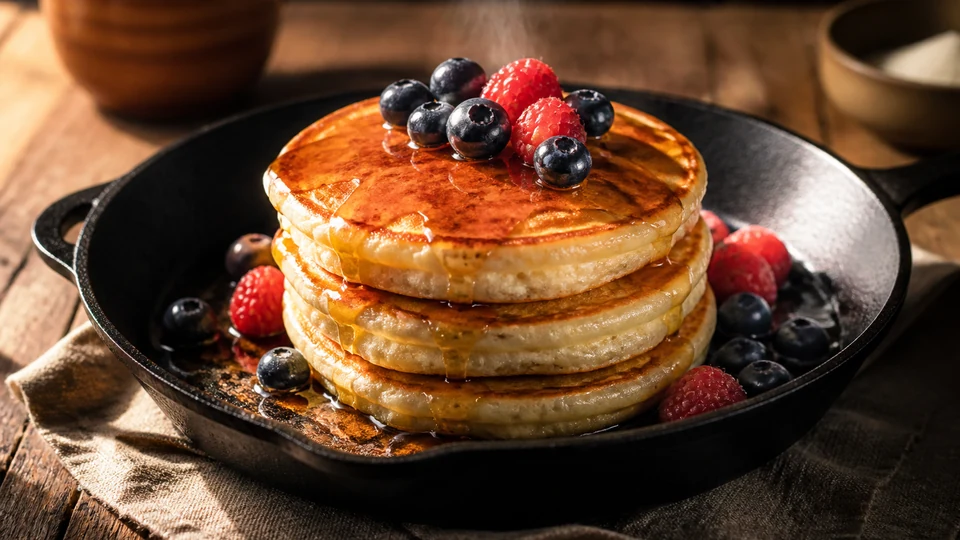
At Pancakes World, a buttermilk hotcake is a griddle-cooked pancake made from a relatively thick batter containing cultured buttermilk, flour, egg, fat, salt, and measured chemical leavening. For a tender, evenly cooked result, use a complete buttermilk-pancake recipe, stir only until the dry flour is incorporated, rest for the stated time, and portion modest rounds onto a moderately heated, lightly greased pan. Turn when the underside is browned, the edge is beginning to set, and bubbles are visible on the top. Cook the second side without pressing the hotcake flat.
For broader context, continue with American Breakfast: Pancakes, Diner Plates and Brunch.
Direct answer for buttermilk hotcake
“Hotcake” and “pancake” are often used for the same family of griddle cakes; the important technical information is the batter and method, not the label. A buttermilk version uses cultured dairy buttermilk for liquid and tang, with baking soda and/or baking powder balanced by the recipe. King Arthur Baking’s documented formula combines both leaveners, rests the batter, and portions medium rounds. Utah State University Extension also publishes buttermilk pancakes with flour, baking powder, baking soda, and cultured buttermilk.
Use one formula as a system. Do not add extra baking soda merely because buttermilk is acidic, and do not replace thick buttermilk with the same volume of an unrelated concentrated dairy product. The batter should be thick but portionable, not kneadable and not as fluid as crepe batter.
What the reader needs to know
Buttermilk does several jobs at once
Cultured buttermilk contributes water, acidity, dairy solids, viscosity, and a characteristic tang. In a formula containing baking soda, the acid participates in gas production. Baking powder supplies its own acid-base system according to the product and recipe. This does not mean more of either ingredient always produces a taller cake; an unbalanced amount can hurt flavor and structure.
The word also appears on dry mixes that contain buttermilk powder. A just-add-water mix is not handled like a scratch recipe calling for liquid cultured buttermilk. Follow the package directions. Adding fresh buttermilk to a water-only mix without manufacturer guidance changes its hydration and leavening.
Recognize a useful batter cue
| Observation | Meaning to check | First action |
|---|---|---|
| Batter runs like milk | Missing or undermeasured dry ingredient; wrong liquid | Review measurements before adding flour |
| Batter will not leave the scoop | Flour overmeasured or liquid omitted | Use only the recipe’s allowed adjustment |
| Surface browns before edge sets | Pan too hot, sweet batter, or oversized portion | Lower heat and make a smaller hotcake |
| Hotcake tears while turning | Base not set or spatula too narrow | Wait longer and support more of the round |
| Center remains wet | Portion too large or heat too high | Lower heat; portion consistently |
Make the first hotcake a calibration piece. That is a reader-run check, not first-party evidence about every brand of flour or buttermilk.
Practical options and examples
Classic scratch hotcake
Choose a recognized formula that gives weights, yield, rest time, pan heat, portion size, and flipping cues. King Arthur’s buttermilk pancake recipe provides all of those details and identifies small lumps as acceptable. Follow its quantities from the source rather than reconstructing them from this guide.
Whisk dry and wet ingredients separately. Combine them shortly before cooking and stop once the batter is fairly smooth with no dry pockets. Rest exactly as directed. A long hold can change viscosity and leavening behavior, so do not assume overnight batter is acceptable.
Hotcakes from a mix
Read whether the mix already contains dairy, leavener, and sweetener. Use the package’s additions. A mix can be convenient, but its current ingredient list determines allergy and dietary status. “Buttermilk” normally indicates dairy unless the manufacturer clearly says otherwise.
Service for a small group
Preheat one broad griddle, portion equal rounds, and keep the first batch small enough to turn without collision. Serve immediately or use only the short holding method supplied by the recipe. A towering covered stack traps steam and can soften the surfaces.
For a vegan flour-specific alternative, millet flour pancakes vegan requires a different structure. Pancakes using buttermilk focuses more broadly on using a carton across formula choices, while vegan protein powder pancakes no flour is not a buttermilk substitution.
Choosing the right approach
Use scratch batter when you want control over flour, sweetness, and portion. Use a mix when speed matters and its label meets the need. For a first attempt, choose a plain formula before adding fruit, chocolate, spices, or extra fat. This makes heat and consistency easier to diagnose.
The pancake science hub explains related ingredient functions. Pancake World uses “buttermilk hotcake” here as a cooking query, not as the name of a restaurant product or a permanent commercial menu item.
Common mistakes
- Pouring baking soda by eye instead of measuring it.
- Beating the batter until every tiny lump disappears.
- Skipping the recipe’s rest or extending it for convenience.
- Cooking in a smoking-hot pan and reading dark color as doneness.
- Making the first hotcake much larger than the formula specifies.
- Flipping repeatedly or pressing with the spatula.
- Adding berries to the whole bowl before confirming the base batter.
- Assuming cultured buttermilk, milk acidified at home, kefir, and yoghurt are identical.
- Calling an egg-and-dairy hotcake vegan because it has no meat.
Step-by-step checklist
Before mixing
- Select one complete buttermilk hotcake formula.
- Check flour, leaveners, buttermilk, egg, fat, and toppings.
- Confirm dietary and allergen requirements.
- Measure by weight where provided.
- Preheat the griddle only when the recipe instructs.
- Prepare a scoop and broad spatula.
Mix and rest
- Whisk flour, sugar, salt, baking powder, and baking soda evenly.
- Combine buttermilk, egg, and melted fat separately.
- Let hot fat cool enough that it does not scramble the egg.
- Add wet to dry and stir gently.
- Scrape the base of the bowl for dry flour.
- Rest for the source’s stated time.
- Judge consistency after the rest.
Cook
- Lightly grease a moderately hot surface.
- Portion one consistent round.
- Wait for browning, surface bubbles, and a set edge together.
- Slide the spatula fully underneath.
- Turn once.
- Cook the second side until the center is set.
- Lower heat if color outruns cooking.
- Serve without flattening.
Variations or substitutions when relevant
For a thinner hotcake, use a published thin-pancake variation; do not keep diluting a thick formula. For extra-rich hotcakes, follow a tested adjustment rather than doubling butter and egg independently. King Arthur’s buttermilk recipe links to separate documented versions for fluffy, thin, and richer styles, showing that each change belongs to a coherent method.
If buttermilk is unavailable, King Arthur’s substitution comparison found thinned plain Greek yoghurt a strong option in its specific pancake formula. That result does not establish universal equivalence. Use the source’s quantity and preserve the rest of the recipe.
For fruit, scatter small pieces onto individual uncooked tops after portioning. For savory service, choose a formula that supports reduced sweetness and keep wet cooked vegetables out of the base. For gluten-free needs, use a recipe developed with an identified gluten-free blend and suitable preparation controls.
The related gluten-free vegan potato pancakes and high-fiber breakfast solve different intents. Neither should be treated as a direct hotcake conversion.
Control the pan before changing the batter
A hotcake often fails at the cooking surface even when the bowl is correct. Preheat long enough for the pan to become evenly warm, then apply only a thin film of fat. A cold pan allows batter to spread before the base sets. A severely overheated pan creates a dark ring while the centre remains wet. Neither observation justifies adding more leavener.
Use the first portion to establish three things: diameter, first-side time, and release. Keep the scoop level consistent. When the edge becomes less glossy and the underside lifts cleanly, turn with a broad spatula. If the centre bends sharply over the spatula, support more of the round rather than throwing it into the air.
Between batches, remove crumbs that are becoming dark. They can make later hotcakes look burnt even if the pan temperature has not changed. Add another thin wipe of fat only when the surface needs it. Large pools produce uneven, fried borders and make diameter harder to control.
Burner numbers are not universal, and pan materials respond differently. Record the equipment and approximate setting that worked in the reader’s kitchen. That note is more repeatable than claiming every stove should be set to the same number.
Thick, medium, or thin: make the choice before mixing
The classic buttermilk hotcake is usually thicker than a crepe and easy to portion as a round. A diner-style pancake may spread more, while an extra-fluffy version may use a thicker batter or additional egg technique. These are intentional formats, not stages of one bowl that should be corrected back and forth.
Choose the desired format and follow its complete source. If a cook wants thin pancakes, use the publisher’s thin variation with its adjusted liquid and handling. If height is the goal, use the fluffy variation rather than adding random flour until the batter stands up. For a rich texture, use the documented rich-pancake method and accept that fat, egg, and dairy changes occur together.
Once the plain format succeeds, additions can be considered. Sprinkle blueberries, small banana pieces, or chocolate onto portioned batter so each hotcake remains easy to turn. Large cold fruit can slow centre cooking. For spices, blend a measured amount into the dry ingredients. For nuts, verify allergen requirements and keep pieces small.
Serving and batch decisions
For two people, cooking to order is usually simpler than holding a stack. For a larger table, work in consistent rounds and move finished hotcakes briefly to the warm holding method specified by the recipe. Do not cover tightly for a long time; trapped steam changes the surface.
Offer toppings separately so the hotcake formula remains identifiable. Fruit, yoghurt, syrup, butter, and nut spread each add their own allergens and dietary status. A dairy-free topping does not make the underlying buttermilk hotcake dairy-free. Similarly, vegetable oil in the batter does not remove the milk ingredient.
Cool leftovers promptly in a way that avoids condensation, then follow the recipe’s freezing or reheating directions. King Arthur’s formula allows same-day freezing and gives an oven reheating method. Apply that instruction to that formula, not automatically to every filled or substituted hotcake.
Label the stored batch with its preparation date and specific variation.
Explore related Pancakes World guidance on American Pancakes, Maple Syrup, and Maple Syrup Pancakes.
Sources and editorial references
- King Arthur Baking: Buttermilk Pancakes —
https://www.kingarthurbaking.com/recipes/buttermilk-pancakes-recipe— recognized culinary formula and evidence for batter mixing, rest, portion, griddle setting, and turning cues. - Utah State University Extension: Buttermilk —
https://extension.usu.edu/preserve-the-harvest/buttermilk— extension source identifying cultured buttermilk use and a documented buttermilk-pancake formula. - King Arthur Baking: Buttermilk substitute—what to use —
https://www.kingarthurbaking.com/blog/2019/01/28/how-to-substitute-for-buttermilk— test-kitchen comparison supporting only its stated yoghurt-and-milk substitution context.
Evidence checked 16 August 2026. Product labels and published recipes may change; verify the current source.