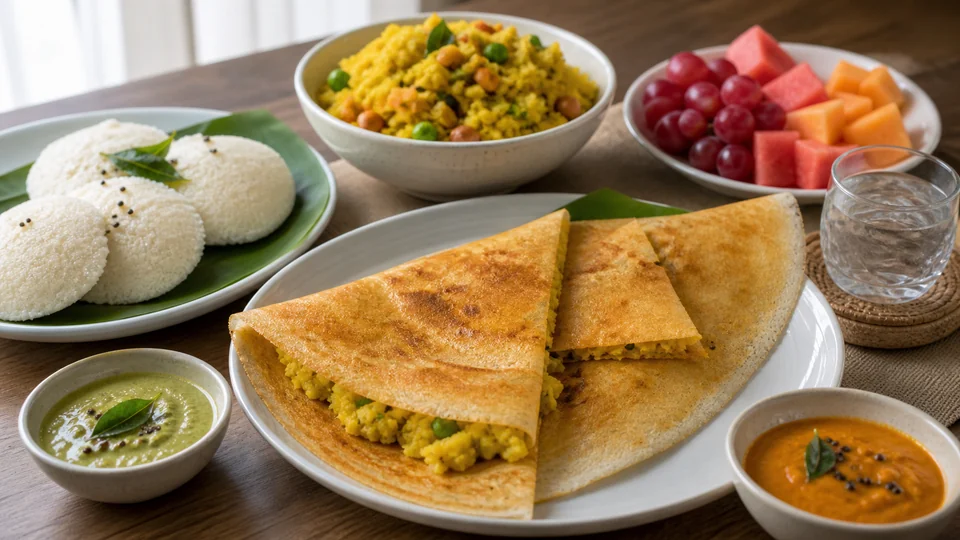
Brunch recipes indian vegetarian

An Indian vegetarian brunch should be planned as a set of named dishes with their own regional and household contexts, not as one generic Indian flavour profile. Choose a workable combination such as poha, vegetable upma, idli with sambar, besan chilla or stuffed paratha, then add fruit and a drink. Follow complete tested recipes for soaking, fermenting, pressure cooking and tempering rather than inventing universal timings. See Pancakes World.
Brunch at Mr. Pancake: Meal Guide, World Pancakes: Dishes and Traditions, Pancake Toppings and Sides, Healthy Pancake Guides.
What this brunch needs to accomplish
The target is a respectful menu of distinct dishes with a manageable equipment sequence. The suggestions are broad entry points; they do not claim one authentic national brunch or erase regional variation.
Menu formats that fit the intent
Vegetable poha
Use the rice-flake type and rinsing method specified by the selected recipe. Name the source used for Vegetable poha; its regional method, soaking and cooking cues must remain intact.
Besan chilla
Let the complete formula control batter consistency and pan heat. Name the source used for Besan chilla; its regional method, soaking and cooking cues must remain intact.
Idli and sambar
Treat fermentation and lentil cooking as a separate planned workflow. Name the source used for Idli and sambar; its regional method, soaking and cooking cues must remain intact.
Vegetable upma
Roasting and liquid addition should follow one tested method. Name the source used for Vegetable upma; its regional method, soaking and cooking cues must remain intact.
Stuffed paratha
Keep the filling dry enough to roll and use the recipe’s dough rest. Name the source used for Stuffed paratha; its regional method, soaking and cooking cues must remain intact.
Fruit and plain yogurt
Serve as optional accompaniments and label dairy clearly. Name the source used for Fruit and plain yogurt; its regional method, soaking and cooking cues must remain intact.
Build a workable sequence
- Choose dishes from complete named sources.
- Avoid scheduling idli fermentation without enough lead time.
- Assign one pan to chilla or paratha.
- Prepare chutneys under their own storage guidance.
- Hold sambar hot without repeatedly diluting it.
- Name every dish on the table.
Current-batch troubleshooting
Poha turns pasty
Verify flake thickness and the source rinsing method. Return to the named dish method instead of generalising across Indian cuisines.
Chilla sticks
Check batter consistency, pan seasoning and turning cue. Return to the named dish method instead of generalising across Indian cuisines.
Paratha filling escapes
Cool and dry the filling before rolling. Return to the named dish method instead of generalising across Indian cuisines.
Upma clumps
Follow the source order for roasting and adding liquid. Return to the named dish method instead of generalising across Indian cuisines.
The menu is too complex
Choose one batter or griddle dish, not several. Return to the named dish method instead of generalising across Indian cuisines.
Safety and evidence boundary
For Vegetable poha, keep its label, raw tools and ready-to-eat utensils separate. Never taste its raw-flour batter. Measure the applicable endpoint, refrigerate perishable portions, and require an exact formula before publishing nutrition or yield.
Frequently asked questions
Is every Indian vegetarian dish vegan?
No. Ghee, yogurt, paneer and other dairy may be present.
Can idli be a same-morning decision?
Only if a complete recipe provides a suitable no-fermentation method; traditional fermented workflows need advance planning.
Which dish is easiest for a small kitchen?
Choose one pan-based item and one make-ahead accompaniment.
Can all lentils be substituted freely?
No. Form, soaking and cooking behavior differ.
How should authenticity be described?
Name the source, dish and adaptation honestly instead of claiming a universal version.
Route-specific decision and service notes
For Brunch Recipes Indian Vegetarian, decision note 1 is to keep the named context, ingredients, equipment, preparation order, service timing, and storage boundary separate. Use the current complete source for quantities and instructions, then make one documented adjustment only when the observed result requires it. Do not treat a title, cultural reference, seasonal event, or dietary label as a promise about nutrition, safety, suitability, or quality. This makes the next batch or shared brunch decision clear and evidence-bounded.
For Brunch Recipes Indian Vegetarian, decision note 2 is to keep the named context, ingredients, equipment, preparation order, service timing, and storage boundary separate. Use the current complete source for quantities and instructions, then make one documented adjustment only when the observed result requires it. Do not treat a title, cultural reference, seasonal event, or dietary label as a promise about nutrition, safety, suitability, or quality. This makes the next batch or shared brunch decision clear and evidence-bounded.
For Brunch Recipes Indian Vegetarian, decision note 3 is to keep the named context, ingredients, equipment, preparation order, service timing, and storage boundary separate. Use the current complete source for quantities and instructions, then make one documented adjustment only when the observed result requires it. Do not treat a title, cultural reference, seasonal event, or dietary label as a promise about nutrition, safety, suitability, or quality. This makes the next batch or shared brunch decision clear and evidence-bounded.
For Brunch Recipes Indian Vegetarian, decision note 4 is to keep the named context, ingredients, equipment, preparation order, service timing, and storage boundary separate. Use the current complete source for quantities and instructions, then make one documented adjustment only when the observed result requires it. Do not treat a title, cultural reference, seasonal event, or dietary label as a promise about nutrition, safety, suitability, or quality. This makes the next batch or shared brunch decision clear and evidence-bounded.
For Brunch Recipes Indian Vegetarian, decision note 5 is to keep the named context, ingredients, equipment, preparation order, service timing, and storage boundary separate. Use the current complete source for quantities and instructions, then make one documented adjustment only when the observed result requires it. Do not treat a title, cultural reference, seasonal event, or dietary label as a promise about nutrition, safety, suitability, or quality. This makes the next batch or shared brunch decision clear and evidence-bounded.
For Brunch Recipes Indian Vegetarian, decision note 6 is to keep the named context, ingredients, equipment, preparation order, service timing, and storage boundary separate. Use the current complete source for quantities and instructions, then make one documented adjustment only when the observed result requires it. Do not treat a title, cultural reference, seasonal event, or dietary label as a promise about nutrition, safety, suitability, or quality. This makes the next batch or shared brunch decision clear and evidence-bounded.
For Brunch Recipes Indian Vegetarian, decision note 7 is to keep the named context, ingredients, equipment, preparation order, service timing, and storage boundary separate. Use the current complete source for quantities and instructions, then make one documented adjustment only when the observed result requires it. Do not treat a title, cultural reference, seasonal event, or dietary label as a promise about nutrition, safety, suitability, or quality. This makes the next batch or shared brunch decision clear and evidence-bounded.
For Brunch Recipes Indian Vegetarian, decision note 8 is to keep the named context, ingredients, equipment, preparation order, service timing, and storage boundary separate. Use the current complete source for quantities and instructions, then make one documented adjustment only when the observed result requires it. Do not treat a title, cultural reference, seasonal event, or dietary label as a promise about nutrition, safety, suitability, or quality. This makes the next batch or shared brunch decision clear and evidence-bounded.
For Brunch Recipes Indian Vegetarian, decision note 9 is to keep the named context, ingredients, equipment, preparation order, service timing, and storage boundary separate. Use the current complete source for quantities and instructions, then make one documented adjustment only when the observed result requires it. Do not treat a title, cultural reference, seasonal event, or dietary label as a promise about nutrition, safety, suitability, or quality. This makes the next batch or shared brunch decision clear and evidence-bounded.
For Brunch Recipes Indian Vegetarian, decision note 10 is to keep the named context, ingredients, equipment, preparation order, service timing, and storage boundary separate. Use the current complete source for quantities and instructions, then make one documented adjustment only when the observed result requires it. Do not treat a title, cultural reference, seasonal event, or dietary label as a promise about nutrition, safety, suitability, or quality. This makes the next batch or shared brunch decision clear and evidence-bounded.
For Brunch Recipes Indian Vegetarian, decision note 11 is to keep the named context, ingredients, equipment, preparation order, service timing, and storage boundary separate. Use the current complete source for quantities and instructions, then make one documented adjustment only when the observed result requires it. Do not treat a title, cultural reference, seasonal event, or dietary label as a promise about nutrition, safety, suitability, or quality. This makes the next batch or shared brunch decision clear and evidence-bounded.
For Brunch Recipes Indian Vegetarian, decision note 12 is to keep the named context, ingredients, equipment, preparation order, service timing, and storage boundary separate. Use the current complete source for quantities and instructions, then make one documented adjustment only when the observed result requires it. Do not treat a title, cultural reference, seasonal event, or dietary label as a promise about nutrition, safety, suitability, or quality. This makes the next batch or shared brunch decision clear and evidence-bounded.
For Brunch Recipes Indian Vegetarian, decision note 13 is to keep the named context, ingredients, equipment, preparation order, service timing, and storage boundary separate. Use the current complete source for quantities and instructions, then make one documented adjustment only when the observed result requires it. Do not treat a title, cultural reference, seasonal event, or dietary label as a promise about nutrition, safety, suitability, or quality. This makes the next batch or shared brunch decision clear and evidence-bounded.
For Brunch Recipes Indian Vegetarian, decision note 14 is to keep the named context, ingredients, equipment, preparation order, service timing, and storage boundary separate. Use the current complete source for quantities and instructions, then make one documented adjustment only when the observed result requires it. Do not treat a title, cultural reference, seasonal event, or dietary label as a promise about nutrition, safety, suitability, or quality. This makes the next batch or shared brunch decision clear and evidence-bounded.
For Brunch Recipes Indian Vegetarian, decision note 15 is to keep the named context, ingredients, equipment, preparation order, service timing, and storage boundary separate. Use the current complete source for quantities and instructions, then make one documented adjustment only when the observed result requires it. Do not treat a title, cultural reference, seasonal event, or dietary label as a promise about nutrition, safety, suitability, or quality. This makes the next batch or shared brunch decision clear and evidence-bounded.
For Brunch Recipes Indian Vegetarian, decision note 16 is to keep the named context, ingredients, equipment, preparation order, service timing, and storage boundary separate. Use the current complete source for quantities and instructions, then make one documented adjustment only when the observed result requires it. Do not treat a title, cultural reference, seasonal event, or dietary label as a promise about nutrition, safety, suitability, or quality. This makes the next batch or shared brunch decision clear and evidence-bounded.
For Brunch Recipes Indian Vegetarian, decision note 17 is to keep the named context, ingredients, equipment, preparation order, service timing, and storage boundary separate. Use the current complete source for quantities and instructions, then make one documented adjustment only when the observed result requires it. Do not treat a title, cultural reference, seasonal event, or dietary label as a promise about nutrition, safety, suitability, or quality. This makes the next batch or shared brunch decision clear and evidence-bounded.
For Brunch Recipes Indian Vegetarian, decision note 18 is to keep the named context, ingredients, equipment, preparation order, service timing, and storage boundary separate. Use the current complete source for quantities and instructions, then make one documented adjustment only when the observed result requires it. Do not treat a title, cultural reference, seasonal event, or dietary label as a promise about nutrition, safety, suitability, or quality. This makes the next batch or shared brunch decision clear and evidence-bounded.
Final route checks
For Brunch Recipes Indian Vegetarian, final check 1 is to verify the exact ingredients, serving context, and current source instruction before adapting the plan. Keep the observed result separate from health, safety, or quality guarantees, and make a single documented correction if conditions change.
For Brunch Recipes Indian Vegetarian, final check 2 is to verify the exact ingredients, serving context, and current source instruction before adapting the plan. Keep the observed result separate from health, safety, or quality guarantees, and make a single documented correction if conditions change.
For Brunch Recipes Indian Vegetarian, final check 3 is to verify the exact ingredients, serving context, and current source instruction before adapting the plan. Keep the observed result separate from health, safety, or quality guarantees, and make a single documented correction if conditions change.
Conclusion
- Sweet Breakfast and Brunch Recipes
- Baked Oatmeal
- Cinnamon Pecan Breakfast Bread Pudding
Related reading
Sources
- U.S. Food and Drug Administration — Food Allergies —
https:// www.fda.gov/ food/ nutrition- food- labeling- and- critical- foods/ food- allergies - FoodSafety.gov — Safe Minimum Internal Temperatures —
https:// www.foodsafety.gov/ food- safety- charts/ safe- minimum- internal- temperatures - USDA FSIS — Leftovers and Food Safety —
https:// www.fsis.usda.gov/ food- safety/ safe- food- handling- and- preparation/ food- safety- basics/ leftovers- and- food- safety - U.S. Food and Drug Administration — Handling Flour Safely —
https:// www.fda.gov/ food/ buy- store- serve- safe- food/ handling- flour- safely- what- you- need- know