Brunch potatoes for a crowd
At Pancakes World, for crowd-size brunch potatoes, choose a standardized quantity recipe before buying potatoes, then make the equipment fit that recipe rather than compressing more food into fewer pans. Record its yield, serving utensil, cut size, pan count, load per pan, oven type, batch time and holding method. Wash potatoes under running water, cut pieces uniformly, keep each tray at the documented depth, and leave enough oven capacity for air and heat to circulate. Cook successive batches on a written schedule; do not combine pale and browned trays into one quality claim. Hold finished potatoes at 140°F (60°C) or above for buffet service, replace small pans rather than topping them up, and cool safe leftovers promptly in shallow containers.
This is a focused selection, scaling and service guide—not a Pancake World-tested potato recipe, a universal portion formula or a promise of crispness from any oven. Use the brunch hub for the wider meal, and Pancake World for the full editorial collection.
For broader context, continue with American Breakfast: Pancakes, Diner Plates and Brunch.
Pick the potato format from the service problem
The most useful format is the one that survives the actual equipment and service interval. Compare four lanes before committing.
Roasted pieces
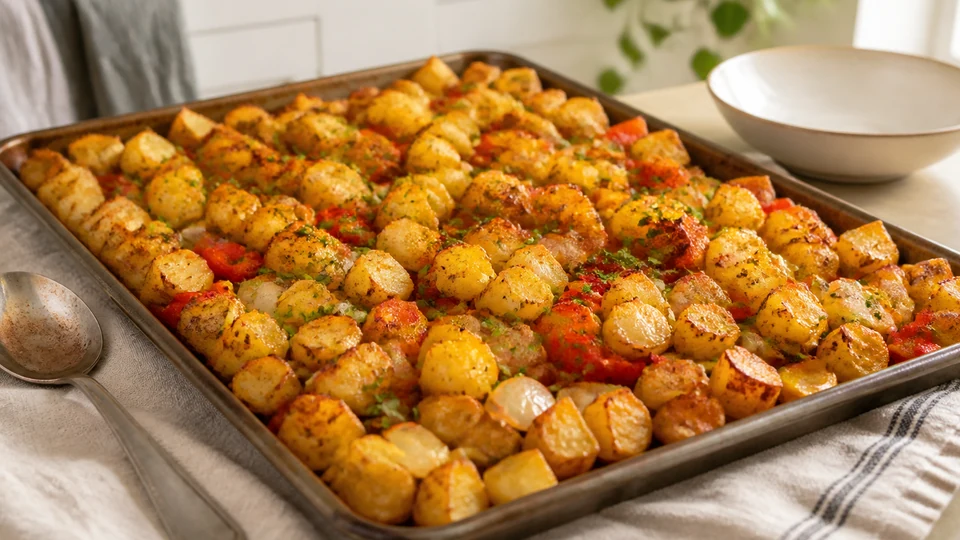
Roasted chunks or wedges provide separate portions and suit sheet-pan production. They depend heavily on documented cut size, pan load and oven behavior. Crowding several recipe batches into one pan changes the distance between pieces and can trap moisture. A larger pile is not a scaled recipe.
Choose this lane when the kitchen has enough sheet pans, oven rack positions and labor to load, turn or stir, unload and replenish in batches. Use the exact temperature and time from the selected standardized recipe. Tenderness and browning are quality checks; if meat, poultry or egg is added, that addition also needs its federal safe endpoint.
Sheet-pan breakfast hash
A hash can combine potato with peppers, onions or a fully cooked protein component. More components create more cut-size, moisture and cross-contact variables. The recipe must define whether ingredients cook together, enter in stages or are combined after separate cooking.
Use a hash when one standardized formula matches the group and the oven can support its pan plan. Do not add raw sausage, poultry or egg to a vegetable-only recipe and assume the published time still applies. The altered food category needs an authoritative recipe and temperature path.
Baked potatoes
Whole or halved baked potatoes simplify individual portioning but consume oven rack space and may take longer than a tray of small pieces. University of Minnesota Extension specifically lists baked potatoes as impractical when oven capacity is limited.
Use this lane when the oven, timing and service space support the documented recipe. A topping bar adds cold storage, utensils, labels and potential allergens. It should be treated as a second service system, not as effortless decoration.
Creamy, mashed or casserole-style potatoes
These formats can be portioned from a pan and may hold moisture differently from roasted pieces. They also introduce dairy, egg, thickener or other ingredients depending on the recipe. A family-size formula may not scale in direct proportion, particularly when baking depth or thickening changes.
Use a standardized quantity recipe for the intended group. Casseroles reach 165°F, and mixed dishes containing meat or poultry follow the appropriate category endpoint. Hold the finished dish at 140°F or above during hot buffet service.
Use a standardized recipe as the production contract
A standardized quantity recipe gives more than an ingredient list. It can define the group yield, serving size, pan count, equipment setting, method and portion tool. The Institute of Child Nutrition hosts a USDA Roasted Potatoes O'Brien recipe with separate 50- and 100-serving quantities, specific pan counts, conventional and convection oven directions, a defined serving utensil and institutional control points. Those details belong to that exact recipe; they are not copied into an invented Pancake World formula.
USDA Team Nutrition also publishes recipes at defined group yields. For a brunch, the planner can select an appropriate standardized source and keep its version intact.
Record these fields on a route card:
| Field | Required evidence |
|---|---|
| Recipe identity | exact title, organization and version |
| Yield | published number of servings |
| Serving size | published volume, weight or item count |
| Purchase amount | source or calculated from documented yield data |
| Cut | exact documented size or shape |
| Pan | dimensions, material and load |
| Oven | conventional, convection or another specified appliance |
| Method | source order, turn/stir steps and finish condition |
| Safety | applicable cooking, holding, cooling and reheat controls |
| Service | published portion tool plus event replenishment plan |
If a required field is missing, do not fill it with a confident guess. Choose a stronger source or run a genuine project-owned test before presenting a recipe.
Reject weak recipe inputs before they reach the kitchen
A crowd recipe needs evidence that matches the planned scale. A social post showing a tray can inspire a flavor direction, but it does not establish a purchase quantity, pan load or service yield. A restaurant description does not disclose its method. A manufacturer's package instruction applies only to the named product and package state. Keep those materials out of the production contract unless their exact scope matches the item being prepared.
Use a source ladder:
- Prefer a standardized institutional or extension recipe with the required yield, equipment and portion information.
- If the needed yield is smaller, use a genuinely tested complete recipe and repeat independent batches without changing its pan geometry.
- If only a general idea exists, keep it in an inspiration list and choose a different production recipe.
- If the event depends on a new formula, schedule a documented project test before the final menu is approved.
Check revisions as well as titles. Two pages called “roasted potatoes” may use different potato state, cut, oven type and portion. Record the access date and retain the exact source URL on the route card.
When purchasing, calculate from the source's usable-quantity assumptions rather than treating package weight as finished yield. Confirm whether the formula calls for fresh, frozen, canned, whole, peeled or pre-cut potato. These states are not interchangeable in a quantity calculation. If a substitution changes moisture, size or preparation, the original pan and time evidence may no longer fit. The safe decision is to keep the specified state or select another complete recipe, not to hide the change inside a scaled batch.
Calculate quantity without a universal per-person claim
No single potato quantity suits every brunch. The serving changes when potatoes are the only substantial side, one of several buffet options, a base for toppings or an individual baked item. Guest age, event duration and the size of the main dish also affect actual use.
Use yield math:
- Confirm attendance and a documented maximum.
- Decide whether every guest receives the source serving or whether potatoes share demand with another side.
- Record the standardized recipe yield and serving size.
- Calculate the number of complete batches.
- Preserve pan count and load for each batch.
- Add a deliberate reserve only when safe holding and leftover capacity exist.
- Reconcile the result with oven cycles, hot holding and serving pans.
For groups of 25 or more, University of Minnesota Extension recommends standardized quantity recipes. If only a reliable household recipe is available, it advises making the single batch repeatedly rather than assuming every ingredient and process can be multiplied into one vessel.
Avoid using potato weight alone as a serving promise. Trimming, variety, cut, recipe additions and portion tool affect the usable yield. If the source includes a marketing or food-buying guide, retain its assumptions.
Map the oven before prep begins
Draw every planned pan on an oven map. Record rack position and cycle:
| Cycle | Rack positions | Potato pans | Other brunch pans | Load time | Check/turn | Unload |
|---|---|---|---|---|---|---|
| 1 | verified | source-defined | recorded | scheduled | source method | scheduled |
| 2 | verified | source-defined | recorded | scheduled | source method | scheduled |
| 3 | verified | source-defined | recorded | scheduled | source method | scheduled |
The map prevents a common failure: planning potatoes, egg casseroles, pastries and reheating for the same oven at the same moment. If the equipment cannot support the exact pan plan, change the menu or add documented cycles. Do not stack pans, change pan depth or lower the temperature without source evidence.
Convection and conventional oven instructions are not interchangeable. A standardized recipe may give both, with different settings or times. Use the line matching the actual equipment. If the oven has uneven zones, that is an observed equipment constraint; follow the recipe's rotation instructions or test the process properly before the event.
Prepare potatoes safely and consistently
Receive and store
Choose potatoes without rotten areas. Keep them separated from raw meat, poultry and seafood during transport and preparation. Store according to the supplier and recipe requirements.
Wash
FDA advises washing all produce thoroughly under running water before preparation, even when it will be peeled. Do not wash produce with soap, detergent or commercial produce wash. Scrub firm produce with a clean produce brush, then dry with a clean cloth or paper towel.
Cut
Uniform pieces help a tray progress together. Use the source recipe's size and shape. Set one visual reference piece at the cutting station and train helpers to compare against it. Remove damaged areas and discard rotten potatoes.
Do not leave large quantities of cut potato in an improvised room-temperature holding step. Follow the recipe's documented preparation sequence. If advance cutting or water holding is needed, use a source that specifies the method and cold-control requirements.
Season and load
Measure ingredients for one complete batch. Toss in a vessel large enough to distribute oil or seasoning, then place the documented load on each pan. Keep the pieces at the specified depth.
Do not pour a second batch onto the first because a pan “looks empty.” Surface area, not visual fullness, can be the limiting factor for roasted food.
Run batches instead of one oversized cook
Assign batch codes such as P1, P2 and P3. The production sheet records:
- prep complete time;
- oven entry;
- any source-directed turn or stir;
- finish assessment;
- measured safety endpoint when the recipe includes controlled additions;
- hot-holding entry;
- service pan assignment.
Compare actual observations by batch. If P1 is evenly browned but P2 is pale with liquid on the pan, investigate load, oven recovery, cut size or ingredient moisture. Do not average the result and call the full production consistent.
When a batch is not ready, continue according to the source method and verify it. Do not mix underdone pieces beneath browned potatoes. If the schedule no longer works, serve a smaller accepted batch and replenish later rather than lowering the standard.
Keep brunch potatoes hot without sacrificing control
FDA home-buffet guidance says hot foods should be held at 140°F or warmer. Use a food thermometer. Some warming equipment holds only 110°F to 120°F, so check manufacturer instructions and measure the food rather than trusting the control dial.
Use small service pans. Keep backup potatoes under verified hot holding and replace a nearly empty pan. Do not top up an older pan with a fresh batch; the portions have different time, temperature and handling histories.
Give each pan an out time and temperature check:
| Pan code | Batch | Hot-hold entry | Service out | Temperature | Replace/remove |
|---|---|---|---|---|---|
If potatoes are not held at 140°F or above, the two-hour rule applies; above 90°F ambient temperature, the limit is one hour. Discard perishables that exceed the boundary. A warming pan that feels hot at the edges is not evidence about the center.
Add toppings without losing the system
A topping bar can overwhelm a simple potato dish. Limit additions to those that create genuine choice and can be labelled and held correctly.
Cold dairy, cooked meats, egg-containing sauces and other perishables remain at 40°F or below. Put out small containers and replace them from refrigeration. Each topping gets its own utensil. Keep packages and ingredient records available.
FDA identifies nine major allergens in the United States: milk, egg, fish, crustacean shellfish, tree nuts, peanuts, wheat, soybeans and sesame. Plain potato does not make the finished bar allergen-free. Shared spoons and dropped toppings can create cross-contact.
Use a separate protected portion for a confirmed need when the kitchen can support it. Do not rely on a sign alone.
Diagnose crowd-size potato problems
Pale pieces with wet pan surfaces
Observable causes to check include excess pan load, closely packed pieces, a cold oven after repeated door opening, or wetter-than-expected additions. Restore the documented load and cycle. Do not claim a universal fix or raise the temperature beyond the recipe without evidence.
Dark edges with firm centers
Check whether pieces exceeded the documented size, the oven ran hotter than indicated, or the pan occupied an extreme hot zone. Separate the failed batch from accepted food and correct the next cycle.
Uneven color across one pan
Check cut consistency, oil distribution, rack position and source-directed rotation. A few browned pieces do not prove the entire pan is ready.
Good first batch, weak later batches
Review oven recovery, door-open time, pan temperature and whether helpers increased the load. Batch codes make the change visible.
Soft potatoes during service
Hot holding and covered steam can change texture even while the food remains safely hot. Reduce the service-pan quantity and replenish more often. Do not compromise the 140°F holding boundary to chase crispness.
Cold center in a creamy or casserole format
Use the recipe's reheat method and check the center. Casseroles and leftovers reach 165°F. Stir when the source allows and measure more than one location.
Cool and store leftovers safely
Keep only potatoes with a known safe service history. Divide large amounts into shallow containers so they cool promptly. Cover, label and refrigerate within two hours, or one hour when ambient temperature exceeds 90°F.
USDA states that cooked potatoes and other cooked vegetables can be refrigerated for three to four days. General leftover guidance also calls for reheating to 165°F. This is a safety boundary, not a promise that roasted potatoes will regain their original texture.
Do not place one deep hot hotel pan into a crowded refrigerator and assume it cooled quickly. Divide the batch, leave room for cold air and record the cooling start. Discard food that exceeded the buffet limit or has uncertain history.
Production timeline
One week before
- lock the standardized recipe and exact version;
- calculate full batches from its published yield;
- confirm pan dimensions and count;
- map oven cycles and other brunch dishes;
- reserve hot-holding and service pans;
- assign production and buffet leads;
- prepare batch and pan codes.
The day before
- stage clean equipment, thermometers and labels;
- prepare only steps the source explicitly permits in advance;
- verify refrigerator space for ingredients and potential leftovers;
- do not improvise an advance-cut potato method;
- confirm all topping ingredients and allergens.
Event morning
- wash potatoes under running water;
- cut to the documented size;
- measure and load one recipe batch at a time;
- run the written oven cycles;
- record each batch observation;
- move accepted food to verified hot holding;
- serve in small coded pans;
- replace rather than top up;
- cool only safe leftovers promptly.
Frequently asked questions
How many potatoes are needed for a crowd?
Use the selected standardized recipe's yield and serving size, then calculate complete batches from confirmed attendance and the role of potatoes in the menu. There is no universal weight per guest for every brunch.
Can I double a household roasted-potato recipe on one pan?
Not without evidence that the pan load and method remain valid. University of Minnesota Extension recommends standardized quantity recipes for groups and suggests repeating reliable small batches rather than blindly scaling them.
Can potatoes be cooked the day before?
Only when the source recipe provides a make-ahead, cooling, storage and reheating path. This article does not invent one. Cooked leftovers require prompt shallow cooling and 165°F reheating.
What is the best potato variety for brunch?
There is no universal answer supported here. Choose the variety specified by the standardized recipe because starch, moisture, cut and method work together. A substitution needs evidence or a real test.
How do I keep roasted potatoes crisp on a buffet?
Use small service pans and frequent replacement while maintaining 140°F or above. Holding changes texture; no method guarantees original crispness. Record actual quality by batch and shorten the service interval rather than lowering safe holding temperature.
Can I serve a dairy-free or gluten-free potato option?
Use a complete recipe and verify every ingredient, utensil and preparation surface. Plain potatoes do not prove the finished dish avoided cross-contact. Label known allergens accurately and disclose limits.
Final batch gate
- A standardized quantity recipe and exact version are locked.
- Published yield and serving size control the calculation.
- Cut size, pan dimensions and load match the source.
- Oven type, rack map and cycles are documented.
- Each batch has a code and observable result.
- Produce is washed under running water without soap.
- Added meat, poultry, egg or casserole components meet their endpoints.
- Service pans stay at 140°F or above or follow the time boundary.
- Fresh pans replace older pans instead of topping them up.
- Toppings have cold holding, labels and dedicated utensils.
- Safe leftovers cool promptly in shallow containers.
- No formula, yield, timing, pan load or project test has been invented.
Explore related Pancakes World guidance on American Pancakes, Maple Syrup, and Maple Syrup Pancakes.
Sources and editorial references
- University of Minnesota Extension Planning the Quantity Food Occasion —
https://extension.umn.edu/cooking-safely-crowd/planning-quantity-food-occasion - Institute of Child Nutrition Roasted Potatoes O'Brien USDA Recipe for Schools —
https://theicn.org/cnrb/recipes-for-schools-vegetables/roasted-potatoes-obrien/ - USDA WIC Works Team Nutrition Recipes —
https://wicworks.fns.usda.gov/es/node/1976 - FDA Selecting and Serving Produce Safely —
https://www.fda.gov/food/buy-store-serve-safe-food/selecting-and-serving-produce-safely - FDA Serving Up Safe Buffets —
https://www.fda.gov/food/buy-store-serve-safe-food/serving-safe-buffets - FoodSafety.gov Safe Minimum Internal Temperatures —
https://www.foodsafety.gov/food-safety-charts/safe-minimum-internal-temperatures - USDA FSIS Leftovers and Food Safety —
https://www.fsis.usda.gov/food-safety/safe-food-handling-and-preparation/food-safety-basics/leftovers-and-food-safety - USDA FSIS Cooked Potato Storage —
https://ask.fsis.usda.gov/article/How-long-can-you-store-cooked-potatoes - FDA Food Allergies —
https://www.fda.gov/food/nutrition-food-labeling-and-critical-foods/food-allergies