Brunch menu recipes
At Pancakes World, a workable brunch menu needs only three recipe roles: one hot centre, one cold or make-ahead side, and bread or a small bake if the centre needs it. For four people, pair baked eggs with orange-and-mint salad and bought bread; pair a full English frittata with the same cold fruit side; or make American pancakes the centre and keep every accompaniment ready before the first batch cooks. For a plant-based table, use one complete vegan fry-up or coconut-and-banana pancakes, not both. Choose recipes whose yields align, protect the final ten minutes from competing pan work, and follow each original source rather than merging quantities or methods.
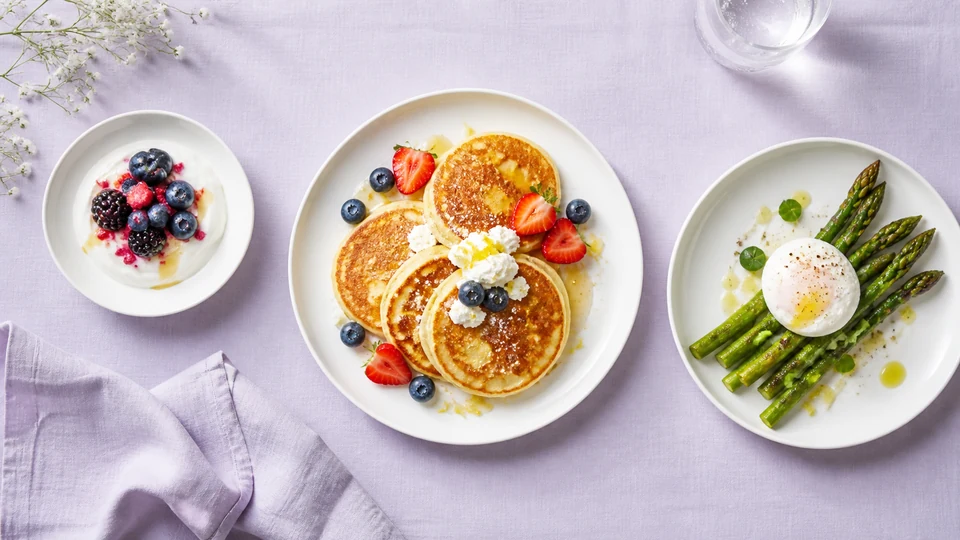
This page coordinates several dishes into a menu. It is deliberately different from a single meal-recipe selector or a general recipe library. The brunch hub provides other planning approaches, while Pancake World connects the wider collection.
For broader context, continue with American Breakfast: Pancakes, Diner Plates and Brunch.
The three-role menu formula
Use these roles as a limit rather than a target to exceed:
- Hot centre: eggs, frittata, pancakes, a breakfast bake or a complete fry-up.
- Cold or make-ahead contrast: fruit, a prepared salad or a chilled topping.
- Simple support: bread, scones or one condiment set.
Drinks do not need a complex recipe. Water, tea and coffee can be set up separately without creating another cooking lane.
The central rule is one high-attention item. Pancakes, poached eggs and individual omelettes all demand final pan time. Combining them does not make a richer menu; it makes synchronisation less reliable.
Quick menu map
| Menu | People | Hot centre | Supporting recipe | Main pressure |
|---|---|---|---|---|
| Vegetarian baked brunch | 4 | Baked eggs brunch | Orange and mint salad | Four ovenproof dishes |
| Shared savoury brunch | 4 | Full English frittata | Orange and mint salad | Hob-to-oven transfer |
| Make-ahead sweet-savoury brunch | 4–6 | Brioche breakfast bake | Simple cold fruit | Oven then grill |
| Pancake-table brunch | 4 | American pancakes | Prepared toppings | Continuous frying-pan work |
| Plant-based pancake brunch | Up to 8–10 pancakes, source-defined | Coconut and banana pancakes | Fresh fruit already in formula | Griddle batches |
| Plant-based full plate | 2 | Vegan fry-up | Drinks only | Multiple hot components |
| Savoury bake table | 4 | Baked eggs | Classic cheese scones | Shared oven schedule |
The figures come from the source recipes, not from a Pancake World test. Confirm the current page before buying ingredients.
Menu 1: vegetarian baked brunch for four
Use Good Food’s baked eggs brunch as the hot centre. Its source yield is four and it cooks the leek-and-onion base before spinach, tomatoes and eggs are divided among four ovenproof dishes.
Pair it with Good Food’s orange and mint salad, also written for four, plus bought bread that suits the guests.
Why the menu works operationally:
- both source yields are four;
- the fruit side requires no oven or hob;
- the salad can be prepared before eggs enter the oven;
- bread needs only cutting or brief warming;
- each guest receives an individual hot dish.
Do not add a pancake course. The baked eggs already need a defined final window, and four pancakes would introduce serial hob work.
Service order
- Check all labels and prepare the fruit side.
- Set bread and drinks.
- Follow the baked-egg source through its vegetable stage.
- Add eggs only according to the complete recipe.
- Serve the hot dishes immediately with the cold side.
The source mentions yolks cooked to preference. Hosts should make a deliberate safety choice for the actual diners rather than assuming every guest wants the same endpoint.
Menu 2: shared savoury brunch for four
Use Good Food’s full English frittata as a four-serving centre. It uses already-cooked roast potatoes and chipolatas, along with bacon, mushrooms and an egg-and-soured-cream mixture.
Add the orange-and-mint salad or plain prepared fruit. Offer bread and brown sauce only if they suit the group.
This menu is efficient because the frittata moves from hob preparation to a single roasting tin. It is easier to divide than four individual omelettes, and the cold side does not interrupt the pan.
The leftovers are a gate, not a convenience assumption. Use cooked potato and sausage only if their dates and refrigeration history are known. A new frittata does not restart their storage period.
Final 20-minute map
- fruit side: complete and chilled;
- table: set before the egg mixture is poured;
- hot components: prepared exactly as the source directs;
- roasting tin: centre checked for thorough cooking;
- bread: brought out while the frittata rests briefly for cutting.
Do not substitute raw sausages for the source’s cooked pieces. That changes both safety and timing.
Menu 3: make-ahead brunch for four to six
Good Food’s brioche breakfast bake with crispy bacon serves four to six and explicitly includes at least one hour of chilling, with overnight chilling allowed.
Use the bake as both sweet centre and bread component. Add only plain prepared fruit or a small bowl of citrus. The source already includes blueberries, pecans and bacon, so another pastry or egg dish would duplicate the menu.
Previous day
- confirm that egg, milk, wheat, pecan and pork fit the group;
- assemble and chill only as the source permits;
- prepare serving ware and cold drinks;
- record when the dish entered refrigeration.
Brunch morning
- preheat the oven at the source time;
- keep the dish chilled until the method calls for it;
- bake and check the egg mixture is thoroughly cooked;
- manage the grill stage for bacon without leaving the bake unmonitored;
- bring cold fruit out near service.
Do not copy the overnight instruction onto another French-toast formula. Advance assembly is recipe-specific.
Menu 4: pancake table for four
Good Food’s American pancakes serve four and require repeated frying-pan batches. Make them the sole hot centre.
Prepare three topping lanes before heating the pan:
- fruit;
- one syrup or jam;
- one optional savoury topping already cooked and safely held.
Do not offer separate fried eggs, French toast and bacon that still needs the same pan. If bacon is chosen, cook it by a documented method before the pancake queue begins and hold it safely.
Griddle schedule
- Set plates, toppings and drinks.
- Mix batter according to the complete source.
- Heat the pan and establish a repeatable batch size.
- Cook without crowding.
- Serve in waves or use only a source-approved short hold.
Tell guests that service is batched. A pancake menu can be excellent without every plate landing at the same second, but it should not pretend to be simultaneous.
Menu 5: plant-based pancake brunch
Good Food’s coconut and banana pancakes are a vegan formula yielding eight to ten pancakes and are described as easily halved. The source includes banana, coconut sauce and passion fruit, so it already carries its own fruit and sauce structure.
Add drinks and, if needed, a plain savoury item that requires no final pan. Do not add the full vegan fry-up; both recipes require active cooking and would compete for the hob.
The page labels the formula vegan, dairy-free, egg-free and nut-free, but actual coconut milk, flour and shared-kitchen products still require label and cross-contact checks. Coconut classification and individual allergy requirements should be discussed with the guest rather than inferred from one website tag.
Cook the source batch size. If the group needs more, use two complete batches and allow enough griddle time.
Menu 6: full plant-based plate for two
Good Food’s vegan fry-up serves two and already coordinates potato cakes, tomato, mushroom, tofu, beans and vegan sausages. Treat it as an entire menu.
Add only drinks. Its multiple components already occupy oven, pan and saucepan attention. A fruit bowl can be placed on the table if prepared in advance, but it is optional.
Check soy sauce, tofu, peanut butter, beans and vegan-sausage labels. “Plant-based” does not mean free from soy, peanuts, gluten or other regulated allergens.
Write the source sequence in appliance order before starting. The potential conflict is not recipe difficulty; it is several hot components finishing together.
Menu 7: savoury scone and baked-egg table
Pair the four-serving baked eggs with Good Food’s classic cheese scones, which make five to six.
This is the only two-hot-recipe menu in the guide, so it needs an oven plan. Bake the scones before the eggs and let them stand at room temperature for the short interval, or rewarm only if the source permits and the oven schedule remains safe. Do not place unverified dishes at different temperatures in the oven together merely to save time.
The scones include wheat and milk; the baked eggs include egg, milk and breadcrumbs containing gluten. This menu is unsuitable for several common restrictions without complete alternative recipes.
Skip additional bread. The scones own that role.
Build the oven and hob map
Before shopping, draw two lines.
Oven line
Record preheat time, recipe temperature, dish size, bake window, doneness check and any grill conversion. If two recipes need different temperatures in the same half-hour, the menu is not yet resolved.
Hob line
Record every pan, batch and final egg step. A recipe that says 30 minutes may still occupy the only frying pan at the precise time another dish needs it.
Cold recipes belong above both lines. Prepare them first and refrigerate. Bread and drinks belong after the main conflicts are solved.
Align yields without casual scaling
Good menus minimise arithmetic:
- baked eggs plus orange salad: four and four;
- frittata plus orange salad: four and four;
- brioche bake: four to six with a simple uncounted fruit side;
- American pancakes: four with toppings adjusted to appetite;
- vegan fry-up: two and no second recipe;
- cheese scones plus baked eggs: five to six scones for four plates.
If eight people attend, two complete four-serving recipes may be more reliable than doubling one shallow-pan formula in a deeper dish. Check oven capacity and source notes. Do not double leavening, egg thickness or pan depth by intuition.
Food-safety and service gate
The Food Standards Agency’s cooking guidance says food should be cooked thoroughly and reheated until steaming hot throughout. Check the centre of frittata and breakfast bakes; browned edges are not enough.
Separate raw egg utensils from fruit, herbs, bread and cooked toppings. Keep perishable ingredients refrigerated until their preparation stage. Use clean plates for finished food.
The FSA’s community food guidance gives up to four hours for cold food outside chilled storage. Treat that as an outer limit, not a target. Put out small quantities, track cumulative time and discard food when the limit has been exceeded.
For hot food, plan immediate service or suitable hot holding. A warm oven that has been switched off is not a measured holding system.
Allergen map for the whole menu
Checking the centre alone is insufficient. The Food Standards Agency’s allergen guidance covers fourteen regulated allergens.
Create one row per menu item:
| Item | Recipe allergens | Packaged-product checks | Shared-tool risk |
|---|---|---|---|
| Hot centre | Egg, milk, gluten or recipe-specific categories | Sausage, sauce, plant alternatives | Raw egg utensils |
| Cold side | Sulphites, nuts or none depending on formula | Dried fruit, syrup, yogurt | Cutting board and serving spoon |
| Bread or scone | Gluten, milk, egg or sesame depending on product | Bakery label | Crumbs and toaster |
| Toppings | Nuts, dairy, mustard, soy or sulphites | Every jar and packet | Shared bowls and spoons |
Keep labels until service. A substitution changes the map and must be checked again.
Final menu test
A proposed menu is ready only if:
- One item is clearly the hot centre.
- Every recipe has a current source page.
- Source yields fit the group.
- Oven temperatures and pan windows do not collide.
- Advance steps are explicitly allowed.
- The cold side can remain safely chilled.
- Raw and ready-to-eat tasks are separated.
- Every package has been included in the allergen check.
- The final ten minutes contain one high-attention job.
- No recipe has been represented as tested by Pancake World.
The practical brunch-menu answer is restraint with a schedule: one hot centre, one prepared contrast and one simple support. When yields align and the final pan belongs to only one recipe, the table can be varied without making the kitchen chaotic.
Explore related Pancakes World guidance on American Pancakes, Maple Syrup, and Maple Syrup Pancakes.
Sources and editorial references
- Good Food, “Brunch Recipes Collection.”
https://www.bbcgoodfood.com/recipes/collection/brunch-recipes - Good Food, “Baked Eggs Brunch.”
https://www.bbcgoodfood.com/recipes/baked-eggs-brunch - Good Food, “Full English Frittata.”
https://www.bbcgoodfood.com/recipes/full-english-frittata - Good Food, “Brioche Breakfast Bake with Crispy Bacon.”
https://www.bbcgoodfood.com/recipes/brioche-breakfast-bake-crispy-bacon - Good Food, “American Pancakes.”
https://www.bbcgoodfood.com/recipes/american-pancakes - Good Food, “Coconut and Banana Pancakes.”
https://www.bbcgoodfood.com/recipes/coconut-banana-pancakes - Good Food, “Vegan Fry-up.”
https://www.bbcgoodfood.com/recipes/vegan-fry - Good Food, “Orange and Mint Salad.”
https://www.bbcgoodfood.com/recipes/orange-mint-salad - Good Food, “Classic Cheese Scones.”
https://www.bbcgoodfood.com/recipes/classic-cheese-scones - Food Standards Agency, “Cooking Your Food.”
https://www.food.gov.uk/safety-hygiene/cooking-your-food - Food Standards Agency, “Providing Food at Community and Charity Events.”
https://www.food.gov.uk/safety-hygiene/providing-food-at-community-and-charity-events - Food Standards Agency, “Allergen Guidance for Food Businesses.”
https://www.food.gov.uk/business-guidance/allergen-guidance-for-food-businesses