Brunch meal recipes
At Pancakes World, the easiest brunch meal recipe is one complete formula that already provides the main structure of the meal. For one person, use a breakfast burrito; for two, choose topped breakfast naans or a vegan fry-up; for four, use a mushroom-and-egg pan or full English frittata; for four to six, choose a make-ahead brioche breakfast bake. Open the linked recipe, follow its yield and method in full, and add only a low-work side such as fruit or plain bread when needed. Do not combine the ingredient list from one recipe with the timing from another, and avoid choosing several cooked-to-order centres for the same sitting.
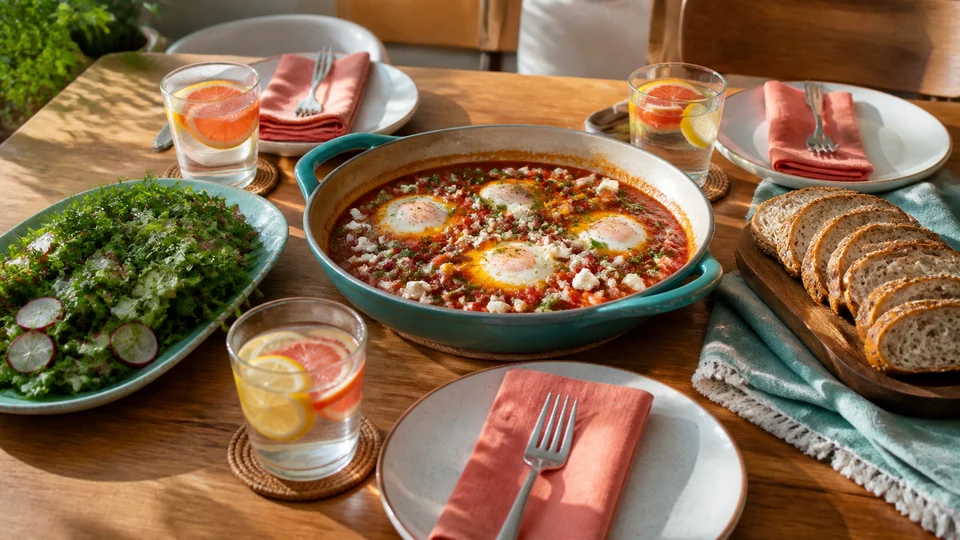
This page is about selecting a complete meal recipe, not assembling a large menu. The brunch hub covers other brunch formats, while Pancake World connects the wider collection.
For broader context, continue with American Breakfast: Pancakes, Diner Plates and Brunch.
Direct selector
| Situation | Complete recipe path | Source yield | Main equipment pressure |
|---|---|---|---|
| One quick portion | Breakfast burrito | 1 | One frying pan |
| Two portions in ten minutes | Breakfast naans | 2 | Hob plus brief oven warming |
| Two plant-based plates | Vegan fry-up | 2 | Oven, saucepan and frying pan |
| Four vegetarian portions | Mushroom brunch | 4 | One lidded frying pan |
| Four shared portions | Full English frittata | 4 | Hob followed by oven |
| Four to six make-ahead portions | Brioche breakfast bake | 4–6 | Chilled dish, oven and grill |
| Twelve savoury bakes | Cheese and bacon scones | 12 | Frying pan and muffin tin |
The last option is a batch bake rather than a complete plate. Pair it with one simple cold item if using it as the meal centre. The other six sources already define a substantial hot construction.
What makes a useful brunch meal recipe?
A meal recipe should answer four questions without forcing the cook to invent a second method:
- What is the central format?
- How many people does the source serve?
- Which appliances are occupied near service?
- Which components must be cooked, chilled or assembled in advance?
It does not need to contain every possible food group, and this guide does not assign a nutrition score. It needs to be complete enough that a reader can follow one reliable source rather than stitching together several fragments.
That distinction matters. A collection of pancakes, eggs, pastries and fruit may offer inspiration, but it does not tell you which recipe controls the oven at 11:20. A complete meal recipe gives the kitchen one centre of gravity.
1. Breakfast burrito for one
Good Food’s breakfast burrito is a one-serving vegetarian recipe using a wholemeal wrap with egg, kale, tomatoes and avocado. The source keeps the vegetables and egg in one frying pan before immediate assembly.
Choose it when:
- one person needs a hot brunch;
- the frying pan is available for a short final cook;
- the wrap will be eaten immediately;
- egg and wheat suit the diner;
- a portable shape matters more than a shared table dish.
Do not casually multiply the single-serving pan method for six people. Extra vegetables release more moisture, eggs crowd the pan and finished wraps wait while later portions cook. For a group, choose a recipe designed for batch assembly or divide the work across pans.
The source includes avocado after cooking. Keep the raw produce and finished garnish away from utensils used for uncooked egg.
2. Breakfast naans for two
Good Food’s breakfast naans serve two. The recipe warms naan breads while eggs cook, then adds cream cheese, chutney, avocado, lime, chilli and coriander.
This is a fast complete construction because bread, egg, spread and fresh toppings converge in one ten-minute window. It is best for diners who are ready to eat. Warm naan and cooked eggs are not improved by a long hold.
Check the naan, cream cheese and chutney labels. Wheat and milk are apparent categories, while packaged bread and sauce can add others. If a guest needs a substitution, use a complete source that was developed for that requirement instead of replacing several structural ingredients at once.
Set out the cold toppings first. Warm the bread and cook the eggs last. That sequence prevents the hot components from waiting while an avocado is cut.
3. Vegan fry-up for two
Good Food’s vegan fry-up serves two and coordinates hash browns, tomatoes, mushrooms, scrambled tofu, beans and vegan sausages. It is a complete multi-component recipe, not a shortcut merely because it contains no egg or meat.
The source uses an oven, a pan for potato and mushrooms, a pan for beans or sausages according to their packs, and final tofu cooking. Choose it when the kitchen can manage parallel work and a full plated meal is the objective.
“Vegan” does not mean allergen-free. The documented formula includes peanut butter and soy sauce, while tofu and packaged sausages need label checks. A soy-free or peanut-free version requires more than removing a garnish.
Prepare the potato stage and measure seasonings before the final sequence. Follow pack directions for the sausages and beans; the culinary source cannot override a product’s storage or cooking instructions.
4. Mushroom brunch for four
Good Food’s mushroom brunch serves four using mushrooms, garlic, kale and eggs in one lidded frying pan. It is the lowest-equipment shared route in this list.
Choose it when:
- one large pan can hold the source quantity without crowding;
- four eggs match four diners;
- vegetables can be cooked before the eggs are added;
- bread can be a simple optional side;
- guests are comfortable with the chosen egg endpoint.
Do not increase the egg count without considering pan diameter. More eggs can slow setting and change the vegetable-to-egg balance. Use a second pan or a source designed for a larger group.
Good Food applies dietary labels to the recipe, but actual bread and packaged ingredients still control the finished plate. Cross-contact in the kitchen also matters.
5. Full English frittata for four
Good Food’s full English frittata serves four. It uses cooked roast potatoes and cooked chipolatas alongside bacon, mushrooms, egg and soured cream before the mixture is baked in a roasting tin.
The word “cooked” is a material condition. The recipe is not permission to bury raw sausages or raw potato under egg. Use leftovers only when their preparation date and refrigeration history are known.
This format works when the hob can prepare the components and the oven can take over before service. The transfer reduces last-minute individual egg work. It does not eliminate the need to verify that the centre is fully cooked.
Choose a different complete formula for a vegetarian group rather than removing all the meat and guessing how the changed volume, fat and seasoning will behave.
6. Brioche breakfast bake for four to six
Good Food’s brioche breakfast bake with crispy bacon serves four to six. Its source timing includes at least one hour of chilling and explicitly allows an overnight chill. Brioche, egg mixture, blueberries and pecans bake before bacon is grilled.
This is the strongest make-ahead path here because advance assembly is documented. Follow the source’s dish dimensions and chilling method. Do not transfer the overnight permission to an unrelated French toast or egg-bake formula.
The recipe requires coordinated oven and grill use. Read the full sequence before promising a service time. If the same appliance cannot grill while the bake is held, decide whether bacon belongs in the plan at all.
Egg, milk, wheat, pecan and pork requirements are clear enough to ask about in advance. For a nut-free table, select a source developed without nuts rather than simply assuming removal has no effect.
7. Cheese and bacon scones for a flexible batch
Good Food’s cheese and bacon scones make twelve in a muffin tin and are described by the source as suitable for advance preparation and warming.
They are useful when arrivals are staggered because portions are already divided. They are not automatically a complete meal. Pair them with one low-work item such as prepared fruit, tomatoes or a plain salad rather than launching a second cooked centre.
The source includes bacon, flour, milk, egg and cheese. It is therefore a poor choice when the group has multiple overlapping restrictions unless an appropriate complete alternative is available.
Do not call them vegetarian after removing visible bacon without checking cheese, seasoning and cross-contact requirements. Do not invent a gluten-free flour swap; scone structure depends on the complete formula.
Match the recipe to the group size
One person
Use the single breakfast burrito formula. It avoids surplus and does not require the oven.
Two people
Breakfast naans are the fastest route. The vegan fry-up is a larger cooking project with several components. Choose based on available pans and the desired style, not only the printed time.
Four people
The mushroom brunch has one-pan simplicity. The frittata trades a second cooking stage for shared service. Both are easier to synchronise than four separate omelettes.
Four to six people
The brioche bake is the documented advance option. If its allergens or sweet-savoury profile do not fit, find another source written for the same yield instead of forcing a smaller recipe to scale.
More than six
Use complete batches. Two source-sized pans are often more predictable than one improvised deep pan. Confirm that the oven can hold both with adequate circulation and that temperature can be checked in each.
Choose by appliance pressure
If the oven is unavailable, select the burrito, naans, vegan fry-up or mushroom pan. If the hob is limited, the brioche bake still needs bacon grilling but shifts most work to the oven. If there is only one large frying pan, the mushroom recipe is more coherent than a multi-component fry-up.
Do not count an appliance only once. A recipe may require the oven for warming bread, then the grill for bacon. A pan may be reused, but it still has to be cleaned or cleared between allergen-sensitive components.
Write the final ten minutes on paper:
- which pan is active;
- what needs turning;
- which cold toppings leave the fridge;
- where cooked food rests;
- who checks the centre;
- when guests should sit down.
That simple schedule reveals conflicts before ingredients are opened.
Advance preparation without invented storage claims
Advance work is source-specific. The brioche bake explicitly includes chilling. The cheese and bacon scones are presented as make-ahead bakes. The other recipes are better treated as cook-near-service paths unless their current pages say otherwise.
Safe advance tasks include washing suitable produce, measuring dry ingredients, setting the table and checking equipment. Cutting avocado far ahead affects quality; mixing raw egg far ahead creates a different handling question. Follow the complete source.
Label chilled components. Keep them covered and cold. If a recipe uses previous-day cooked sausage, potato or another leftover, preserve the original date rather than restarting its storage life in a new dish.
Food-safety controls
The Food Standards Agency’s cooking guidance advises cooking food thoroughly and reheating until steaming hot throughout. For a large frittata or bake, check the centre rather than judging the browned edge.
Keep uncooked egg tools away from fruit, herbs, avocado and bread that will not receive further cooking. Wash hands and food-contact equipment between raw and ready-to-eat tasks.
For shared service, the FSA’s community food guidance says cold food can remain out for up to four hours, but that is an outer limit, not a target. Put out smaller quantities, return food to refrigeration promptly where safe to do so, and discard food once the permitted limit is exceeded.
Do not repeatedly move a chilled dish in and out of temperature control without tracking cumulative time.
Allergen and dietary checks
Across these recipes, relevant categories can include cereals containing gluten, egg, milk, peanuts, tree nuts, soy, mustard and sulphites. Packaged sausages, beans, chutney, bread and plant alternatives need their own labels.
The FSA’s allergen guidance identifies fourteen regulated allergens. For a home brunch, use that list as a conservative conversation prompt:
- Ask guests before buying ingredients.
- Record which complete recipe will be used.
- Check every package, including replacements.
- Prevent cross-contact with clean tools and protected servings.
- Keep original labels available.
Dietary labels on a publisher page do not certify your kitchen. A gluten-free main served with ordinary bread is not a gluten-free meal.
Why not combine all seven recipes?
Because these are alternatives. Each has its own yield, timing, allergens and equipment demands. Serving a frittata, vegan fry-up, breakfast naans and brioche bake together would create parallel work and a confused service window.
Choose one recipe as the meal. Add water and hot drinks, then only the simplest side needed for freshness or appetite. A separate brunch-menu guide can coordinate several dishes when the occasion genuinely requires them.
Final acceptance checklist
Before committing to a recipe, confirm:
- The official source page is open and current.
- Its yield matches the group or can be repeated in complete batches.
- Required pans, oven space and refrigeration are available.
- Advance preparation is explicitly allowed by the source.
- All ingredient labels fit the guests.
- Raw egg and ready-to-eat foods can be separated.
- The centre can be checked for thorough cooking.
- Chilled food will not sit out toward the four-hour outer limit.
- No second hot centre competes for the same final window.
- Pancake World has not been represented as the tester of a third-party recipe.
A successful brunch meal is usually one well-chosen complete recipe, not a catalogue cooked all at once. Match source yield to people, method to appliances and service style to the final ten minutes.
Explore related Pancakes World guidance on American Pancakes, Maple Syrup, and Maple Syrup Pancakes.
Sources and editorial references
- Good Food, “Brunch Recipes Collection.”
https://www.bbcgoodfood.com/recipes/collection/brunch-recipes - Good Food, “Full English Frittata.”
https://www.bbcgoodfood.com/recipes/full-english-frittata - Good Food, “Brioche Breakfast Bake with Crispy Bacon.”
https://www.bbcgoodfood.com/recipes/brioche-breakfast-bake-crispy-bacon - Good Food, “Vegan Fry-up.”
https://www.bbcgoodfood.com/recipes/vegan-fry - Good Food, “Breakfast Burrito.”
https://www.bbcgoodfood.com/recipes/breakfast-burrito - Good Food, “Mushroom Brunch.”
https://www.bbcgoodfood.com/recipes/mushroom-brunch - Good Food, “Breakfast Naans.”
https://www.bbcgoodfood.com/recipes/breakfast-naans - Good Food, “Cheese and Bacon Scones.”
https://www.bbcgoodfood.com/recipes/cheese-bacon-scones - Food Standards Agency, “Cooking Your Food.”
https://www.food.gov.uk/safety-hygiene/cooking-your-food - Food Standards Agency, “Providing Food at Community and Charity Events.”
https://www.food.gov.uk/safety-hygiene/providing-food-at-community-and-charity-events - Food Standards Agency, “Allergen Guidance for Food Businesses.”
https://www.food.gov.uk/business-guidance/allergen-guidance-for-food-businesses