Brunch items for party
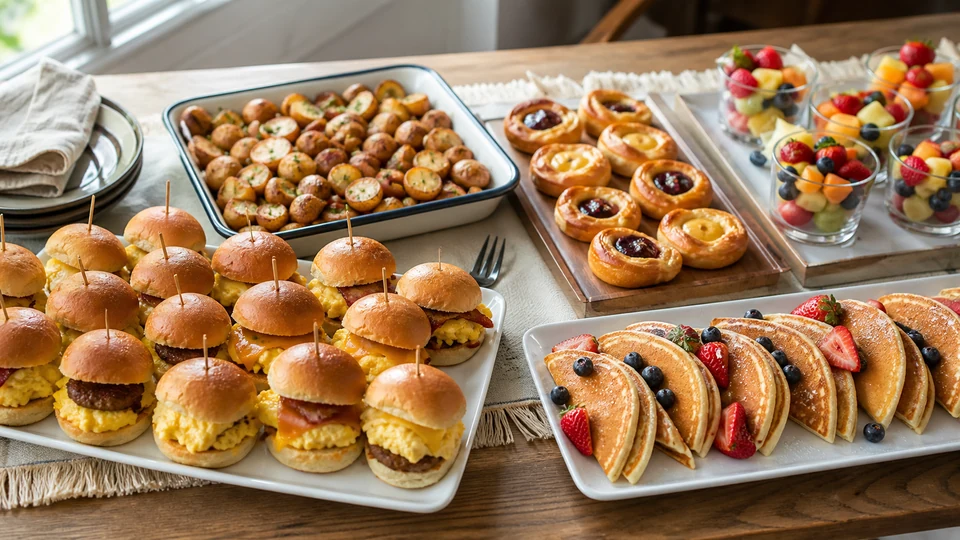
At Pancakes World, for a brunch party, choose items that move through the table without creating one long queue: a warm handheld tray, a potato or vegetable side, fruit, bread or pastry, and two drink points. Sliders, burrito halves, pancake wedges, and labeled snack cups are easier to manage than several cooked-to-order stations. Put sauces and toppings after the main items, use a separate utensil for every platter, and refill from covered backup trays. Keep perishable food chilled until needed and avoid topping up exposed leftovers with a new batch.
Use the brunch hub for other occasion formats, and Pancake World for the complete editorial library.
| Guide sections |
|---|
| The party problem is flow |
| The five-item backbone |
| Modular party trays |
| Three party layouts |
For broader context, continue with American Breakfast: Pancakes, Diner Plates and Brunch.
The party problem is flow
This route plans modular trays, guest movement, and replenishment for a general party. It is distinct from the shower route, where polite small portions must fit a gift-opening pause and separate cake service. Here, arrivals may be concentrated, people circulate, and the primary risk is a bottleneck around one station.
Build the menu around movement. Guests should be able to take a plate, choose a substantial item, add a side, and leave the line before deciding on drinks. Every dish needs a clear service role, utensil, label, backup location, and replacement trigger.
The five-item backbone
Warm handheld tray
Breakfast sliders, burrito halves, savory pancake wedges, egg-bake squares, or another complete recipe can anchor the line. Select one format. Several hot handhelds duplicate equipment and make the host track multiple temperature histories.
If eggs are present, FoodSafety.gov lists 160°F for egg dishes. Ground meats and poultry have their own endpoints. Check the actual filling, not the bread or tortilla surface.
Portion before the tray enters the line. A guest should not need to cut a hot casserole while others wait.
Potato or vegetable side
Choose one side that can be scooped quickly. Roasted potatoes, a vegetable hash, salad cups, or a crisp slaw can work. Use a complete recipe and avoid a second stovetop item if the warm handheld already needs final pan work.
For a cold side, keep backup bowls refrigerated. For a hot side, use a verified holding method rather than assuming a switched-off oven or slow cooker maintains safe temperature.
Fruit
Use a platter, cups, or a mix of whole and cut fruit. Wash produce before cutting and keep cut portions refrigerated. Cups move quickly and reduce shared serving, while a platter uses less packaging.
Do not put out the complete yield at opening. A smaller fresh tray looks better and keeps reserve food under control.
Bread or pastry
One bread role is enough: toast, muffins, scones, or pastries. Retain labels and check whether dairy-, egg-, or cream-filled items require refrigeration.
Position bread after the main so guests do not stop first to compare many similar pastries. If the hot item already uses bread, choose a different side rather than adding another sandwich-like food.
Drinks at two points
Separate hot drinks from cold drinks. Coffee and tea need a stable heat-safe area; water and cold drinks can sit on another surface. This splits traffic and prevents guests carrying hot liquid through the food line.
Keep milk, cream, and other perishable additions cold. Replenish small containers instead of leaving a large package out.
Modular party trays
Slider tray
Use one complete slider recipe with a stated yield. Cook filling safely, assemble according to the source, and cut portions cleanly. Wet sauces can soften bread, so add them at the permitted time or offer a controlled amount afterward.
Burrito-half tray
A fully enclosed burrito can be dense and slow to cool or reheat. Use a tested make-ahead formula if preparing in advance. Cut only after the source’s rest step and keep wet salsa outside the wrapped center unless directed.
Pancake-wedge tray
Pancakes can become a handheld item when a complete formula produces stable cakes and toppings are controlled. Cut larger pancakes into wedges only when their texture supports it. Provide one thick dip or spread rather than several syrups that drip across the table.
Labeled snack cups
Fruit, vegetables, yogurt, salad, or dry snack components can be portioned into cups. Cups do not remove refrigeration requirements and can create substantial waste, so use them where cleanliness and flow justify the format.
Roasted side tray
Potatoes or vegetables can share one serving pan if a complete recipe was designed for that combination. Do not merge separate times and temperatures. Keep the serving utensil from touching raw-food equipment.
Three party layouts
Straight line
Place plates, hot main, hot or cold side, fruit, bread, sauces, and napkins in that order. Labels appear before each dish. This is easy to understand but needs room after the table for guests to leave.
Two-sided island
Put the main at the center with identical plate stacks at both ends. Place fruit and bread on opposite sides. This doubles approach capacity, but each dish still needs one dedicated utensil and clear direction.
Stations
Use one food station, one hot-drink station, and one cold-drink station. A separate topping station is useful only when the room is large enough. Too many stations create searching rather than flow.
Never position reserve food under a buffet table. Keep it covered in refrigeration or verified hot holding.
Refill by clean replacement
Divide production into opening, peak, and late-party batches. Label backup trays. Put out a modest opening quantity, observe demand, and replace it before the platter becomes messy.
Do not top up. Fresh food placed over an exposed remainder inherits an unclear time history and contact from hands or utensils. Remove the old vessel, make the correct storage or discard decision, and set down a clean replacement with a clean utensil.
Assign one refill monitor who knows where backup trays are and which label matches each item. This person also moves dropped utensils to washing and wipes spills without using food-preparation cloths.
Plan quantities without a universal formula
Use the yield from each complete recipe. Decide whether its listed serving is a main portion or side. Combine yields across the menu rather than multiplying every recipe to the guest count.
Build one sample plate. If it holds one main, one side, fruit, and bread comfortably, the categories are balanced. If it requires stacking or sauce runs into other foods, simplify portions.
For uncertain attendance, keep unopened bread, whole fruit, or a covered refrigerated tray as reserve. Do not expose everything simply to make the buffet appear full.
Production schedule
Two days before
Confirm guest range, dietary needs, room layout, equipment, and refrigerator space. Select complete recipes and retain packages.
The day before
Complete only source-approved make-ahead work. Bake stable goods, prepare labels, arrange empty platters, and mark refrigerator shelves for opening, peak, and late batches.
Two hours before
Cook the longest item. Separate raw egg or meat equipment from fruit, bread, and serving pieces. Cover cold components and refrigerate them.
Thirty minutes before
Verify hot food endpoints. Set out small stable and cold portions, start the first drink station, and confirm that both ends of the table remain open.
During the party
Replace trays, do not top up. Move traffic by relocating drinks rather than adding signs to a blocked line. Stop replenishing as the final service period begins.
Food safety
FDA advises clean, uncracked refrigerated eggs, careful handling, and thorough cooking. FoodSafety.gov lists 160°F for egg dishes, 160°F for ground beef and pork, 165°F for poultry, and 165°F for leftovers.
Apply the entry for the actual filling. A hot slider bun, browned tortilla, or crisp pancake edge does not establish the center temperature. Keep raw-food plates and utensils away from cooked trays.
Cold fillings, dairy, eggs, cut produce, and dips remain refrigerated until needed. Consult the official cold-storage chart by category. Track when a perishable tray enters service and do not save food with uncertain history.
Allergens and cross-contact
Common party items can contain egg, milk, wheat, soy, sesame, fish, mustard, peanuts, and tree nuts. Read bread, sauces, meat alternatives, seasonings, pastries, and drink additions.
Use clear labels and separate utensils. Prepare a verified alternative first on clean equipment, cover it, and place it away from shared crumbs. A vegan or gluten-free title does not prove suitability for an allergy.
Do not promise that spacing on a shared table prevents cross-contact. For serious allergies, follow the guest’s established requirements.
Troubleshooting flow
The food line reaches the door
Move drinks elsewhere, open both sides of the table, and reduce choices at the first position. Put sauces after the main, not before.
Guests wait for made-to-order food
Replace the station with a complete batch recipe or serve small finished waves. A party buffet should not depend on one pan for individual orders.
The hot tray empties immediately
Use smaller portions and a substantial side, then bring a clean peak-period tray. Do not overload the first batch or crowd its cooking vessel.
Fruit dries or becomes watery
Cut closer to service, keep backup portions covered and cold, and replace smaller trays. Use whole fruit as a stable reserve.
Toppings create a second queue
Limit them to two distinct functions, such as one sauce and one crisp finish. Pre-portion where appropriate and move them beyond the main line.
Late guests arrive after food service
Offer a safely stored reserve, unopened bread, or whole fruit. Do not re-present an exposed platter whose time history is complete.
Frequently asked questions
How many party items are enough?
One warm main, one side, fruit, bread or pastry, and drinks form a complete backbone. Add only an item that serves a distinct dietary or service role.
Are food stations better than a buffet?
Only when the room supports them and each station reduces traffic. Cook-to-order stations can create delay and require more controls.
Can all food be handheld?
Yes, but provide plates and napkins. Crumbly, saucy, or very hot items may be easier in cups or with a fork.
Can trays be prepared the night before?
Only where the complete source supplies a make-ahead and storage path. Empty labeled platters can be staged early without exposing food.
Is this a tested Pancake World menu?
No. It is a flow and service plan. Complete sources supply quantities, timing, yield, and storage.
Final party check
- One warm handheld tray anchors the food.
- Every dish has a distinct role.
- Hot and cold drinks use separate points.
- Both the menu and room avoid a single bottleneck.
- Backup food is covered and temperature controlled.
- A clean tray replaces each exposed tray.
- Yields are combined rather than multiplied blindly.
- Every platter has a label and utensil.
- The last service period has a defined stop.
The most useful brunch party items are modular. They move quickly, refill cleanly, and leave the host with a clear temperature and leftovers decision instead of a crowded table of competing dishes.
Simplicity supports hospitality.
Explore related Pancakes World guidance on American Pancakes, Maple Syrup, and Maple Syrup Pancakes.
Sources and editorial references
- U.S. Food and Drug Administration, “What You Need to Know About Egg Safety” —
https://www.fda.gov/consumers/consumer-updates/what-you-need-know-about-egg-safety - FoodSafety.gov, “Safe Minimum Internal Temperatures” —
https://www.foodsafety.gov/food-safety-charts/safe-minimum-internal-temperatures - FoodSafety.gov, “Cold Food Storage Chart” —
https://www.foodsafety.gov/food-safety-charts/cold-food-storage-charts - Food Network Kitchen, “Brunch Recipes” —
https://www.foodnetwork.com/recipes/photos/brunch-recipes - Good Food, “Brunch recipes” —
https://www.bbcgoodfood.com/recipes/collection/brunch-recipes