Brunch finger foods for bridal shower
At Pancakes World, plan bridal-shower brunch finger foods around how guests will actually move: one free hand for a plate or drink, short conversations, and repeated visits to the table. Choose five distinct formats—a baked bite, a cool cup or skewer, a small sandwich, a fruit or vegetable item, and one sweet finish—then give each a separate serving utensil and an accurate ingredient label. Avoid a table made entirely of bread, eggs or creamy fillings. Prepare backup food as small platters, hold cold items at 40°F (4°C) or below and hot items at 140°F (60°C) or above, replace trays instead of topping them up, and track every perishable platter's service time.
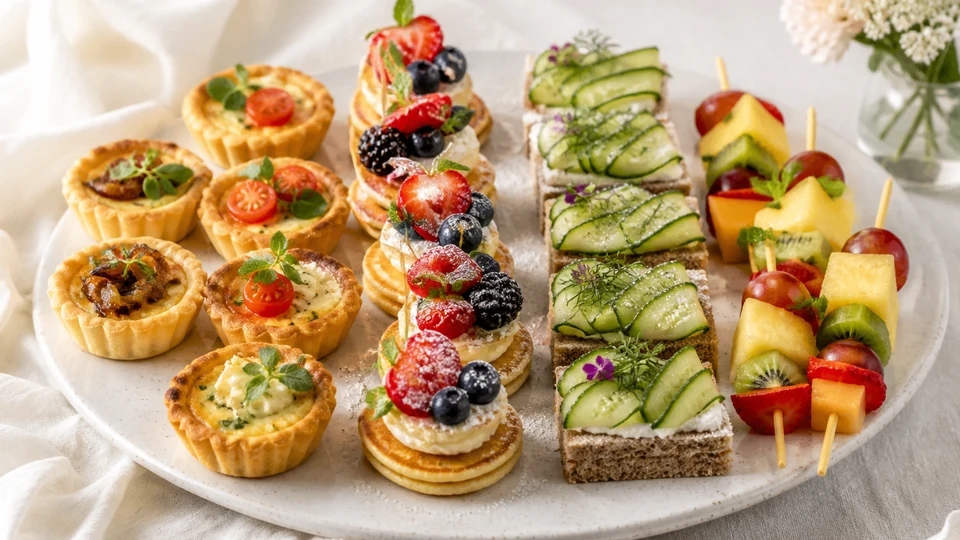
This is a focused guide to low-drip, one-hand food and safe buffet flow. It does not provide a tested recipe, a universal pieces-per-guest formula, a venue recommendation or a complete bridal-shower menu. The brunch hub covers the wider meal, while Pancake World opens the full editorial collection.
For broader context, continue with American Breakfast: Pancakes, Diner Plates and Brunch.
Define “finger food” for this event
A useful bridal-shower finger food should pass four practical tests:
- It can be lifted with fingers, a pick or one small utensil.
- It takes one or two comfortable bites rather than requiring cutting.
- Its filling stays contained when a guest pauses to talk.
- It can be replenished in small batches without rebuilding the whole display.
This definition excludes some otherwise good brunch dishes. A tall stack of pancakes, a loose salad and a full bowl of oatmeal may suit a seated brunch, but they interrupt the standing or mixed-seating flow. A miniature version is not automatically better: tiny food can still drip, crumble, roll off a plate or conceal a very hot center.
Treat appearance as a design choice, not proof of quality or safety. A neat platter does not show how long an egg bite has been at room temperature. A browned pastry does not prove that a meat filling reached its safe temperature. Styling and food control need separate plans.
Build five complementary food lanes
Five lanes create enough contrast without turning the table into unrelated samples. Select complete recipes with yields and safe preparation instructions. The examples below are format ideas, not Pancake World-tested formulas.
1. One baked savory bite
This lane could be a source-tested mini egg bake, small savory muffin, filled pastry or compact vegetable cake. Choose a recipe designed for the intended size. Simply shrinking a family casserole changes how quickly it cooks, while multiplying a household recipe many times can create equipment and timing problems. University of Minnesota Extension recommends standardized quantity recipes for groups of 25 or more and warns that some small recipes, particularly baked formulas and thickened foods, do not scale proportionally.
The bite should remain structurally sound when lifted. If it needs a sauce, place a measured small amount inside the recipe or offer a separate spooned condiment station rather than balancing sauce on every piece. For egg dishes, use a food thermometer and the applicable federal endpoint. If they were cooked, chilled and later served hot, FDA buffet guidance says to reheat egg dishes such as quiche to 165°F before service.
2. One cool cup, skewer or pick
A cool format adds temperature and shape contrast. Possible structures include a source-tested vegetable cup, a fruit skewer assembled under clean conditions, or a composed bite on a pick. Avoid pieces that release a puddle as they wait. Cut fruit is perishable and belongs under cold control; whole uncut fruit has a different handling profile.
Picks create a physical safety and disposal task. Make them visible, provide a discard cup away from fresh food, and do not use decorative pieces that can break or resemble edible garnish. Cups need a stable base and enough headspace to move without spilling.
Keep backup portions refrigerated. On the table, nest the cold platter in ice or use another verified method that holds the food at 40°F or below. A decorative bowl of ice that barely touches the serving dish is not temperature evidence; check the food with an appropriate thermometer.
3. One small sandwich or wrap
The sandwich lane provides a more substantial bite without requiring a fork. Choose a filling that can be spread or layered evenly, then cut the finished item into a size the wrapper or bread can support. Wet tomato, loose slaw and excess dressing can migrate into the bread and onto guests' hands, so select a documented formula that controls moisture.
Cold sandwiches containing meat, egg, seafood, dairy or another perishable filling must stay cold. If purchased as a party platter, verify pickup or delivery timing, transport temperature, package instructions and refrigerator space before ordering. USDA advises keeping cold take-out at 40°F or below and refrigerating perishables within two hours of purchase or delivery—one hour when the air temperature is above 90°F.
Put only a small tray out at once. Do not add fresh sandwiches to a tray that has been handled throughout the event. Replace the nearly empty tray with a newly chilled one and record the new tray's service time.
4. One fruit or vegetable format
This lane brings color and a less dense bite without making a nutrition claim. Use whole items that are naturally manageable, or cut produce into stable pieces under clean conditions. Rinse fresh fruit and vegetables under running water, including produce with skins or rinds that will not be eaten; scrub firm produce with a clean produce brush.
Decide whether the format truly works one-handed. A large fruit wedge with rind, a rolling grape on a flat plate or a tall vegetable stick in a shallow cup can be awkward. Use a rimmed platter, modest cup or visible pick as appropriate. Keep cut produce cold and rotate it in small batches.
5. One sweet, low-mess finish
A small baked item, cookie or tested pastry can close the selection. Avoid describing it as healthier, guilt-free or suitable for a medical diet without evidence. The useful decision is mechanical: does it hold together, can it be eaten without a knife, and does its topping remain stable under the planned service conditions?
Cream-filled and custard items need perishable-food control. A shelf-stable-looking exterior does not make a perishable filling safe at room temperature. If the recipe or supplier requires refrigeration, keep backups cold and treat each serving tray as timed.
Use a balance grid before choosing exact recipes
Write candidate foods in rows and score only observable service features:
| Candidate | Hot, cold or ambient | One-hand test | Crumb/drip risk | Major allergens | Holding equipment | Backup space |
|---|---|---|---|---|---|---|
| Baked savory bite | recipe-defined | pass or revise | low/medium/high | label from ingredients | warmer or cold hold | refrigerator/oven |
| Cool cup or skewer | cold | pass or revise | low/medium/high | label from ingredients | ice or refrigeration | refrigerator |
| Small sandwich | cold or recipe-defined | pass or revise | low/medium/high | label from ingredients | cold hold or warmer | refrigerator/oven |
| Produce format | usually cold after cutting | pass or revise | low/medium/high | cross-contact review | ice or refrigeration | refrigerator |
| Sweet finish | recipe-defined | pass or revise | low/medium/high | label from ingredients | recipe-defined | appropriate storage |
Reject a draft menu if every item needs the same scarce resource. Five cold platters can overwhelm a small refrigerator. Five hot bites compete for oven and warming space. Five bread-heavy formats provide little textural contrast. University of Minnesota Extension specifically advises checking equipment, refrigerator space, serving style and the people available to run a large food occasion.
Also reject menus that hide the same major allergen in every lane without an intentional alternative. An alternative must be prepared and protected according to the guest's actual need; changing an ingredient on paper does not eliminate cross-contact.
Calculate quantity from the event, not a magic number
There is no authoritative universal number of bridal-shower finger-food pieces per guest. Appetite and consumption change with event duration, time of day, whether this is the main meal, the number of choices, piece size, beverage service, guest age and whether cake or another dessert follows.
Build the quantity plan from verified recipe yields:
- Confirm the invitation count and the deadline for responses.
- Decide whether finger food is the whole meal or supports another course.
- Record the tested or standardized yield and serving size of each recipe.
- Assign a planned share of guests to each lane instead of assuming everyone eats every item.
- Add a clearly documented operational reserve based on the host's risk tolerance and storage capacity.
- Check the total against oven, refrigerator, transport and small-platter capacity.
For 25 or more people, use standardized quantity recipes or prepare repeated independent batches of a smaller recipe when an authoritative source supports that approach. Do not multiply leavening, thickener, pan depth and cooking time mechanically. A calculator can scale arithmetic, but it cannot validate a changed cooking process.
Track yield after production without claiming a recipe test. If an authoritative recipe says it yields a stated number but the chosen cut size changes the count, record the actual usable pieces as an event-planning observation. Do not rewrite the source recipe's published yield.
Draw the service flow before styling the table
People should be able to enter, choose and leave the food area without crossing guests who are returning used plates. A simple flow is:
- clean plates and napkins;
- cool produce or cup;
- sandwich or wrap;
- baked savory item;
- sweet finish;
- condiments and clearly labelled alternatives;
- drinks on a separate surface;
- used-plate and pick disposal away from fresh food.
Put a dedicated utensil with every platter. A food that can be picked up by hand can still benefit from tongs so multiple guests do not touch neighboring pieces. Keep replacement utensils ready. Do not lay handles where they fall into the food.
Separate the beverage station because guests linger there, ice melts and cups take space. If the event includes gifts or games, keep those activity surfaces out of the food replenishment route. The person bringing a fresh cold tray should not have to squeeze through a group while the tray warms.
Run small-platter replenishment
FDA and USDA buffet guidance converge on a strong operating pattern: prepare several small platters, keep backups under safe temperature control and replace nearly empty dishes with fresh ones. Do not top up an old dish. Hands and utensils can contaminate a platter during service, and adding new food resets neither its temperature history nor its clock.
Assign one food lead. That person needs a written platter log:
| Platter code | Food | Out time | Holding method | Temperature check | Removed or replaced time |
|---|---|---|---|---|---|
The lead checks cold food at 40°F or below and hot food at 140°F or above. Equipment must be capable of maintaining those temperatures. FDA warns that some warmers hold only 110°F to 120°F, so the product instructions and measured food temperature matter.
If a perishable platter is not held hot or cold, the federal two-hour rule applies; when air temperature is above 90°F, the limit is one hour. Discard food that exceeds the boundary. Do not return it to the refrigerator, mix it with a new batch or taste it to decide.
Late arrivals should receive food from refrigerated backup trays or properly held hot backup food, not pieces that have been sitting since the opening. This is another reason to reserve presentation space for small dishes rather than displaying the full event quantity at once.
Create useful food labels
Each label should use the exact food name and list the major allergens known from the recipe or packaged ingredients. In the United States, FDA recognizes nine major allergens: milk, egg, fish, crustacean shellfish, tree nuts, peanuts, wheat, soybeans and sesame.
Labels support decisions, but they do not prove absence of cross-contact. If a guest reports an allergy, clarify whether the kitchen, supplier and serving setup can meet the needed controls. Use separate utensils and protected placement for an alternative. When assurance is not possible, say so plainly rather than improvising an “allergen-free” sign.
Avoid vague names such as “garden bites” when the item contains egg, cheese or nuts. A practical label might state the food's common name, key filling, major allergens present and whether the platter is vegetarian by its actual ingredients. Do not add health, pregnancy or medical-suitability claims.
Plan for pregnant guests and other higher-risk people
A bridal shower may include a pregnant guest, but pregnancy should not be assumed and no guest needs to disclose medical information to use the table. Design the whole buffet around clean, separate, cook and chill practices. FDA's event guidance for people who are pregnant uses these same controls.
Avoid recipes relying on raw or lightly cooked eggs. FDA's buffet guidance advises heating the egg with the recipe liquid to 160°F or using pasteurized egg products for traditional preparations that would otherwise use raw or undercooked egg. For this finger-food table, the clearer path is often a fully cooked source recipe.
Obtain perishable food from reliable sources, keep cold items cold, cook category-specific foods to their federal endpoints and prevent raw-to-ready-to-eat contact. These controls reduce avoidable risk; they do not make a guarantee about an individual health outcome.
Schedule preparation by risk and quality
Two or more days before
- finalize complete recipes and verified yields;
- confirm guest needs without promising unsupported accommodation;
- audit refrigerator, oven, warmer, transport and serving space;
- assign the food lead and helpers;
- prepare labels and platter codes;
- identify which foods the recipe explicitly permits making ahead.
The day before
- make only components whose source instructions permit advance preparation;
- cool cooked food promptly in shallow containers;
- keep fillings and ready-to-eat components covered and refrigerated;
- wash and stage platters and dedicated utensils;
- mark refrigerator zones for backup trays;
- verify refrigerator temperature at 40°F or below.
Event morning
- begin with clean hands, surfaces and equipment;
- keep raw meat, seafood, eggs and flour away from cooked food;
- cook each recipe to its correct endpoint;
- assemble cold items in controlled small batches;
- preheat hot-holding equipment and verify capability;
- put only the first small platters on display;
- start the platter log when food leaves control.
During service
- replace trays rather than topping them up;
- monitor time and actual food temperatures;
- swap contaminated or dropped utensils immediately;
- keep guests' used dishes out of the fresh-food route;
- discard perishables that cross the federal time boundary;
- refrigerate safe leftovers promptly in shallow containers.
Solve common finger-food failures
The plate requires two hands
Too many foods need a fork, sauce cup or careful balancing. Remove one loose format, contain a sauce, or replace a large piece with a genuinely tested bite-size formula. Do not shrink a recipe arbitrarily and assume its cook time remains valid.
Every item is soft and beige
Use the five-lane balance grid. Add a cleanly handled produce format and choose contrasting shapes, colors and temperatures. This is a presentation correction, not a nutrition claim.
Sandwiches become wet
Select a source recipe that manages filling moisture, assemble at the supported time and keep wet condiments separate when appropriate. Cold holding remains required for perishable fillings; leaving sandwiches out to “dry” is not a safe solution.
Hot bites cool too fast
Reduce display quantity and replenish from verified hot holding at 140°F or above. Check whether the warmer can actually maintain that temperature. Do not rely on the serving dish feeling warm.
Cold cups warm on the table
Nest the platter effectively in ice, use a cold-serving system or put out a smaller batch. Measure the food temperature. Replace with refrigerated backup before the control fails.
Guests cannot identify alternatives
Use exact labels and a simple table map. Keep the alternative protected with its own utensil. If cross-contact cannot be controlled, disclose that limit rather than presenting a guarantee.
Frequently asked questions
Do all bridal-shower brunch foods need to be miniature?
No. They need to be manageable in the chosen service style. A naturally small fruit, compact sandwich segment or single baked portion may work without decorative miniaturization. The cook method must still match the actual size.
How many finger foods per guest should I make?
There is no dependable universal count. Use attendance, event length, whether this is the main meal, verified recipe yield, piece size, number of choices and storage capacity. Standardized quantity recipes are preferable for large groups.
Can cold platters sit out for the whole shower?
Only if a verified holding method keeps the food at 40°F or below. Otherwise the two-hour rule applies, shortened to one hour above 90°F. Small chilled replacement trays are easier to control.
Can I add fresh food to a half-empty platter?
No. FDA advises replacing the serving dish. Topping up combines new food with a platter that has an older temperature and handling history.
Is a vegetarian label the same as allergen-safe?
No. A vegetarian item may contain milk, egg, wheat, soy, sesame, peanuts or tree nuts, and shared preparation can introduce cross-contact. List known major allergens and avoid unsupported “free from” promises.
What should be done with leftovers?
Promptly refrigerate only food that stayed within its safe holding or time boundary, using shallow containers when appropriate. Discard perishable food left at room temperature beyond two hours, or one hour above 90°F. Do not send uncertain food home.
Final decision checklist
- Five lanes provide shape, temperature and texture contrast.
- Every chosen item has a complete source recipe and verified yield.
- The intended size can be cooked and measured safely.
- Each item passes the one-hand, low-drip and replenishment tests.
- Quantity derives from event facts, not a magic per-person number.
- Refrigerator, oven, warming, transport and service capacity are sufficient.
- Cold food stays at 40°F or below; hot food stays at 140°F or above.
- Small backup platters replace old trays instead of topping them up.
- Every perishable platter has an out time and responsible monitor.
- Known major allergens are identified without an absence guarantee.
- Late arrivals receive controlled backup food.
- Leftovers are kept or discarded from recorded time and temperature evidence.
Explore related Pancakes World guidance on American Pancakes, Maple Syrup, and Maple Syrup Pancakes.
Sources and editorial references
- FDA Serving Up Safe Buffets —
https://www.fda.gov/food/buy-store-serve-safe-food/serving-safe-buffets - USDA FSIS Buffet Safety —
https://ask.fsis.usda.gov/article/How-do-I-keep-foods-safe-at-a-buffet - USDA FSIS Safe Handling of Take-Out Foods —
https://www.fsis.usda.gov/food-safety/safe-food-handling-and-preparation/food-safety-basics/safe-handling-take-out-foods - FoodSafety.gov Safe Minimum Internal Temperatures —
https://www.foodsafety.gov/food-safety-charts/safe-minimum-internal-temperatures - University of Minnesota Extension Quantity Food Occasion —
https://extension.umn.edu/cooking-safely-crowd/planning-quantity-food-occasion - FDA Entertaining All Year —
https://www.fda.gov/food/people-risk-foodborne-illness/entertaining-all-year-food-safety-moms-be - FDA Egg Safety —
https://www.fda.gov/food/buy-store-serve-safe-food/what-you-need-know-about-egg-safety - FDA Food Allergies —
https://www.fda.gov/food/nutrition-food-labeling-and-critical-foods/food-allergies - FDA Food Safety in Your Kitchen —
https://www.fda.gov/food/buy-store-serve-safe-food/food-safety-your-kitchen