Brunch crock pot recipes
At Pancakes World, choose brunch crock pot recipes by the job the appliance must do: cook an overnight grain, cook a tested egg or potato casserole, finish a moist savory main, or hold food that was already reheated safely elsewhere. Use one complete slow-cooker recipe matched to the cooker’s size and fill range; do not convert an oven recipe by guesswork. Keep perishable ingredients refrigerated until startup, thaw meat or poultry first, start cooking immediately rather than using a delayed timer, keep the lid in place, and verify the applicable final temperature with a food thermometer. A slow cooker can cook or hot-hold brunch, but USDA does not recommend using it to reheat cold leftovers.
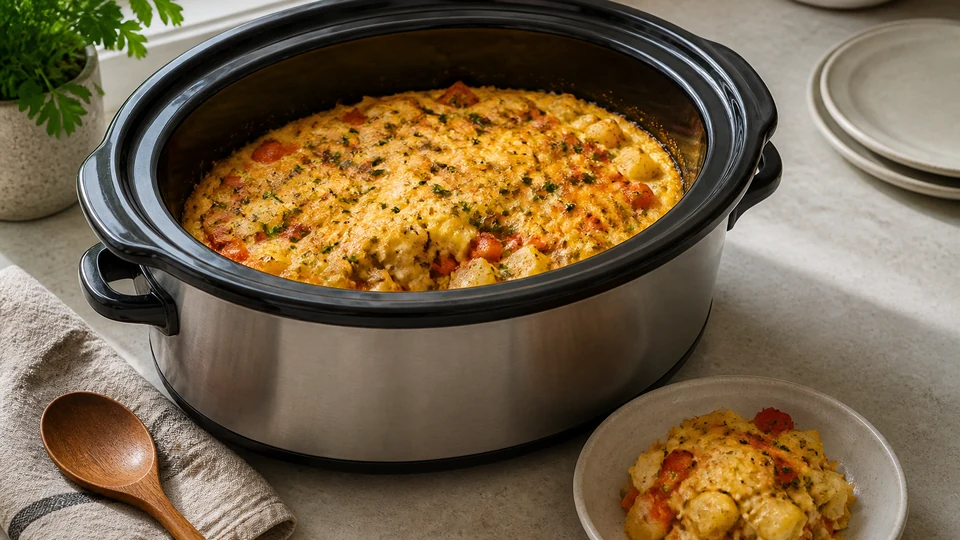
This is a recipe-selection and operating guide, not a set of tested Pancake World formulas. The brunch hub covers broader menu planning, while Pancake World opens the complete collection.
For broader context, continue with American Breakfast: Pancakes, Diner Plates and Brunch.
Separate cook, hold and reheat
“Put it in the crock pot” can describe three different operations. Treating them as interchangeable creates weak recipes and unsafe service plans.
Cook
Raw or assembled ingredients begin refrigerated and follow a complete slow-cooker formula through a defined setting and time to a verified endpoint. The recipe accounts for cooker size, moisture, ingredient order and fill.
Hold
Food is already fully cooked and hot. A preheated, operating slow cooker keeps it hot for service, with temperature checked periodically. FoodSafety.gov describes low or warm settings for holding fully cooked food above the required hot-holding level.
Reheat
Cold leftovers move from refrigerator temperature back to a safe serving temperature. USDA FSIS advises using a stove, microwave or conventional oven for this step, not a slow cooker. After the food reaches 165°F, it may move to a preheated slow cooker for hot holding.
Write the appliance job beside every menu item. If the line says “reheat cold casserole in crock pot,” change the plan before cooking day.
What makes a slow-cooker brunch recipe usable
A good source does more than promise an effortless morning. It provides enough detail to reproduce the process and identify its safety controls.
Require:
- exact cooker capacity or supported size range;
- complete ingredient quantities;
- ingredient starting condition, including thawing and precooking;
- layer or mixing order;
- liquid amount appropriate to slow cooking;
- low or high setting;
- formula-specific cooking window;
- an observable quality cue;
- applicable final-temperature check;
- documented yield;
- safe holding and leftover directions.
A recipe that says only “cook overnight” is incomplete. Overnight length varies by household, appliance and intended serving time. A complete formula defines the window and the cooker it was developed for.
Choose one of four brunch lanes
Slow cookers are most useful when they remove one substantial task from the final hour. Select a lane before browsing recipes.
| Lane | Typical structure | Main planning question |
|---|---|---|
| Overnight grain | steel-cut oats or mixed whole grains | Does the exact grain and cooker support the full cook window? |
| Egg casserole | eggs with bread, potatoes, vegetables or cooked fillings | Does the formula specify starting state, endpoint and serving time? |
| Savory main | potato, bean, vegetable or meat-based dish | Are raw proteins thawed and ingredient order validated? |
| Hot-hold support | fully cooked food reheated elsewhere | Can the cooker maintain safe temperature without degrading the food? |
Do not choose several lanes for one cooker. An oatmeal cannot be served and the same crock immediately used for an egg casserole without a second complete cooking cycle, cleaning and enough time.
Lane 1: overnight grain
University of Illinois Extension and Utah State University Extension each host slow-cooker breakfast collections that include oatmeal or whole-grain formulas. Those sources demonstrate why grain identity matters. Steel-cut oats, rolled oats, barley, bulgur and wheat berries do not share one absorption rate or cook window.
Select a complete formula that names the grain exactly. Do not replace steel-cut oats with quick oats and retain the same overnight period. The result may move from distinct grains to paste or may absorb liquid differently.
Check:
- dry grain form, not just the word “oats”;
- cooker size and whether the crock is greased;
- water, milk or other liquid in the tested formula;
- dried fruit added at the start versus fresh fruit added at service;
- nut, milk, wheat or gluten restrictions;
- low or high setting;
- whether stirring is permitted;
- documented yield.
An overnight grain is a strong choice when guests arrive in a narrow morning window and toppings can be prepared separately. It becomes less convenient when every topping needs cutting or when a guest requires cross-contact controls that the shared bar cannot meet.
Keep perishable milk and cut fruit under the formula’s temperature controls. Do not leave a dairy mixture sitting in an unplugged cooker on a delayed start.
Lane 2: egg casserole
A slow-cooker egg dish may combine eggs with bread, potatoes, cheese, vegetables or a cooked filling. It is not automatically the same formula as an oven casserole. The crock heats from its walls, retains steam and has a different surface-to-depth relationship.
Use a recipe developed specifically for the appliance. The Utah State collection includes an egg-and-cheese bake as a reference category, but its quantities, cooker and timing stay with that source. Pancake World has not tested a replacement formula.
Before selecting an egg recipe, confirm:
- whether meat is raw, precooked or omitted;
- whether frozen potatoes or vegetables are thawed;
- whether bread is dry, toasted or fresh;
- whether the crock is lined or greased;
- whether ingredients are layered or mixed;
- the cooker capacity and fill depth;
- the exact setting and window;
- where to place a thermometer;
- whether the recipe permits overnight cooking rather than overnight uncooked holding.
FoodSafety.gov gives 160°F for egg dishes without meat or poultry and 165°F for egg dishes containing meat or poultry. A dense casserole may require checks in more than one location. Visible set around the edge does not prove the center is ready.
Lane 3: potato, bean or savory main
A brunch main can use a slow cooker without being an egg casserole. Potatoes with vegetables, beans with a sauce, a moist grain dish or a tested meat-based preparation can anchor the table.
Choose a source whose moisture and ingredient order were designed for the cooker. Penn State Extension notes that slow cookers retain liquid differently from conventional cooking and that vegetables and meat can require deliberate placement. That does not authorize an untested conversion; it explains why a complete slow-cooker formula is preferable.
For a meat or poultry main:
- thaw it safely before loading;
- keep it refrigerated until preparation;
- separate raw-protein tools from ready-to-eat garnish;
- observe the manufacturer’s size guidance;
- use the recipe’s liquid and layer order;
- start the appliance immediately;
- keep the lid in place;
- verify the applicable endpoint with a thermometer.
For beans, potatoes or vegetables, the recipe still needs an endpoint and safe handling. “Meatless” does not mean time and temperature no longer matter.
This lane works well when pancakes, bread or fruit will be served alongside the slow-cooked main. Avoid a second hot centerpiece that requires the same outlet or counter space.
Lane 4: hot holding
Sometimes the best crock-pot role is not cooking a recipe. It can hold a fully cooked dish during a staggered brunch.
USDA and FoodSafety.gov guidance support hot holding in an operating slow cooker, but the food must enter hot. Reheat chilled food to 165°F on the stove, in a microwave or in a conventional oven first. Preheat the slow cooker as directed and confirm that the food remains at least 140°F for federal consumer guidance.
Good holding candidates have enough moisture to tolerate the period and can be stirred without damage. A crisp potato or delicate pancake may lose its intended texture even when the temperature is safe. Quality and safety are separate decisions.
Record:
- time fully cooked food enters the crock;
- entry temperature;
- selected holding setting;
- periodic temperature checks;
- clean serving utensil;
- time service ends.
Do not turn the appliance off for convenience while food remains in it.
Match the recipe to the appliance
“Crock-Pot” is a brand name often used informally for a slow cooker, but appliances vary. A recipe developed for one capacity or shape may not transfer cleanly to another.
Read the manual for:
- stated capacity;
- recommended fill range;
- low, high and warm functions;
- whether a delayed-start function exists and its food-safety limits;
- removable-crock temperature restrictions;
- whether the lid locks only for transport;
- electrical and clearance requirements;
- cleaning instructions;
- power-loss behavior.
FoodSafety.gov gives a general half-to-two-thirds-full guide, while USDA also tells cooks to consult the appliance booklet for supported sizes. Use the tighter instruction when the manual or tested recipe specifies one.
An overfilled crock can heat too slowly or overflow. An underfilled crock can cook faster and lose more moisture relative to the food. Do not pad a small recipe with arbitrary liquid simply to reach a fill line.
Build a recipe evidence card
For each candidate, record:
- source and exact title;
- source access date;
- cooker size and shape;
- recipe yield;
- low or high setting;
- minimum and maximum source time;
- raw-protein state;
- egg, meat or poultry endpoint;
- advance-prep instructions;
- holding method;
- leftover method;
- intended allergens;
- substitutions required;
- fit with service time.
Disqualify candidates missing cooker size, ingredient state or credible endpoint guidance. A photo of a browned edge cannot replace those fields.
If a recipe needs three substitutions and a different cooker, find another source. After so many changes, its published timing and yield are weak evidence.
Plan backward from the serving time
Slow cooking is not flexible merely because the window is long. Work backward from the earliest time the food should be ready.
Service time
The food has reached its applicable final temperature and passed the recipe’s quality cues. The cooker changes to a validated holding mode only after cooking is complete. Toppings and utensils are ready.
End of cooking window
Schedule the source’s stated range so there is time to check temperature without repeatedly lifting the lid. If the food finishes early, follow a documented holding method; do not assume several extra hours on low will preserve quality.
Startup
Load refrigerated ingredients in the specified order, plug in the appliance and start it immediately. Confirm the indicator and setting. Do not rely on a delayed timer that leaves perishable food warming before cooking begins.
Preparation
Wash produce, thaw meat or poultry safely, precook ingredients when specified and keep separate containers refrigerated. Assemble only as the complete recipe allows.
Previous day
Do shopping, label review, vegetable cutting and other source-approved prep. Store raw protein separately from vegetables and ready-to-eat toppings. Do not put a full crock of perishable ingredients on the counter for the morning.
Include a wake-up or checkpoint alarm if the recipe needs an early temperature check. “Overnight” is not permission to ignore the source’s upper window.
Keep the lid in place
The slow cooker depends on retained heat and steam. USDA instructs cooks to keep the lid in place, removing it only when stirring or checking is required. Penn State notes that lid removal can lower temperature and extend cooking.
Use a lid plan:
- Confirm ingredients and setting before covering.
- Note the earliest source-approved check.
- Prepare the thermometer before opening.
- Lift the lid away from your face to avoid steam.
- Check quickly at the thickest or coldest likely points.
- Replace the lid promptly if cooking continues.
Do not open every half hour to smell, photograph or stir unless the tested recipe directs it. Each opening changes the process.
Use a thermometer for the endpoint
Long cooking time does not prove safety. FoodSafety.gov says a thermometer is the only reliable way to verify that the required temperature has been reached.
Use the applicable category:
- egg dishes without meat or poultry: 160°F;
- ground beef or pork mixtures: 160°F;
- poultry and egg dishes with meat or poultry: 165°F;
- reheated leftovers: 165°F;
- fully cooked hot-held food: at least 140°F under federal consumer guidance.
Other ingredients may impose additional requirements. Follow the tested recipe and current federal chart.
Insert the probe into the thickest food zone without touching the ceramic. For a layered egg bake, check the center and another cold-prone location. Clean the probe before and after use.
Do not use delayed start for perishables
FoodSafety.gov specifically advises starting the cooker immediately after preparation rather than setting a timer to begin later. A delayed start can allow portions of the food to warm while remaining below a safe cooking temperature.
The safe morning shortcut is not “load at bedtime and start at dawn.” It is either:
- use a complete overnight recipe that starts cooking immediately;
- prepare components under refrigeration and load at the actual start time;
- choose a cold make-ahead dish instead;
- choose a recipe with a shorter high-setting window.
An outlet timer is not a food-safety control and may conflict with appliance instructions.
Treat raw meat and poultry conservatively
USDA says to thaw meat or poultry before slow cooking. Do not place frozen raw pieces into a brunch recipe and add hours by guesswork.
Thaw in the refrigerator or another approved method. If cold water or microwave thawing is used, begin cooking immediately under federal guidance. Keep raw juices away from fruit, bread, herbs and toppings.
Precooking is formula-specific. Some recipes brown ground meat for flavor, fat control and structure; others provide a validated raw start. Follow the source. Do not partially cook meat, refrigerate it and finish later without an authoritative process.
If the recipe uses cooked ham, sausage or another prepared product, verify whether it is ready-to-eat or cook-before-eating and follow the package. “Smoked” or “cured” does not answer every cooking question.
Manage egg dishes separately
Keep shell eggs refrigerated at 40°F or below, discard cracked eggs and wash hands and tools after raw contact. FoodSafety.gov advises prompt cooking or refrigeration of egg foods.
Do not taste an uncooked egg mixture. Do not use a raw-egg topping or sauce unless pasteurized eggs are specified and the complete method supports it.
For an overnight slow-cooker egg recipe, cooking must start immediately. Assembling raw eggs in the crock and letting them stand before a delayed start is outside the safe source plan.
Verify allergens across the whole brunch
Slow-cooker breakfast recipes may contain milk, egg, wheat, soy, tree nuts or sesame, and meat substitutes or seasoning packets can add more. FDA requires major allergen sources on covered packaged-food labels in the United States.
Check:
- bread, tortillas or grains;
- cheese, milk and cultured dairy;
- egg products;
- sausage, ham or meat alternatives;
- broth, soup, salsa and seasoning blends;
- cooking spray and liners;
- nuts, seed toppings and granola;
- plant beverages;
- garnishes brought by guests.
Use a separate serving utensil for every dish. If a guest needs stronger cross-contact control, reserve and protect an appropriate portion rather than relying on a shared topping bar.
Four complete brunch architectures
These are planning patterns, not recipes. Each cooked item still needs a complete tested source.
Oatmeal-centered table
Use one tested slow-cooker steel-cut oat or grain formula. Add whole fruit, a small topping set, bread and beverages. Keep milk and cut fruit chilled until service.
Egg-casserole table
Use a tested slow-cooker egg bake as the only hot main. Add a cold fruit plate, verified bread and a chilled salad. Check the center temperature in more than one place.
Savory potato or bean table
Use a complete moist potato, bean or vegetable slow-cooker dish. Add pancakes cooked separately, fruit and a cold sauce. Avoid another dense hot casserole.
Staggered open-house table
Cook or reheat the main safely, then use the slow cooker only for verified hot holding. Refill cold foods in small dishes and track time outside refrigeration.
The most reliable menu gives the cooker one job and keeps the remaining foods simple.
Choose by arrival pattern
The same recipe can fit a seated brunch and fail an open house. Add the guest arrival pattern to the evidence card.
For a single seating, target the tested recipe’s completion window just before service. Allow only the source-approved rest, then portion with a clean utensil. This suits egg casseroles and other foods whose texture changes during extended holding.
For a rolling arrival, choose a moist formula with an explicit holding plan. Cook it completely first, switch to the documented holding setting, and verify temperature rather than assuming the warm light is sufficient. Serve toppings in small chilled batches and keep the traffic path away from the electrical cord.
For a very early meal, an immediate-start overnight grain may fit better than a raw-egg casserole whose upper cooking window arrives before anyone wakes. For a late brunch, a shorter high-setting formula started after waking may give better control than stretching an overnight recipe.
If departure time is uncertain, avoid a recipe that requires a narrow finish while the cook is away. Slow cooking reduces hands-on work but does not remove responsibility for startup, power, endpoint and service. The appliance manual may also contain unattended-use warnings; follow them.
Write three times on the plan: cooking starts, the earliest endpoint check, and service ends. Those anchors determine whether the recipe truly fits the event better than an oven, stovetop or cold make-ahead alternative.
Plan for a power interruption
USDA gives different responses depending on whether the cook is home and whether food was fully cooked before power failed.
If nobody was present during the cooking process and the power went out, discard the food even if it appears done. The temperature history is unknown.
If someone is present and cooking is incomplete, finish immediately by another safe method if possible. If food was already fully cooked before the outage, USDA states it should remain safe for up to two hours in the cooker with power off. Record the time and do not stretch the window.
Never taste food to decide whether it survived an outage.
Cool and store leftovers
Transfer leftovers out of the deep crock. USDA advises shallow covered containers and refrigeration within two hours after cooking ends. A ceramic crock is designed for cooking, not rapid refrigerator cooling.
Label containers with the dish and date. Separate toppings when that improves quality and reduces cross-contact. Do not combine an older leftover batch with new food.
For reheating, use the stove, microwave or conventional oven and verify 165°F. Only then may the food enter a preheated slow cooker for hot holding. Do not use the slow cooker to bring cold leftovers gradually through the temperature danger zone.
The source recipe should control freezing and quality claims. This page does not promise that egg, potato or grain dishes keep the same texture after freezing.
Common failures and corrections
The cooker is filled to the rim
Move to a recipe designed for the appliance or make separate batches. Do not compress ingredients or extend time blindly.
The recipe finishes hours before guests arrive
Use its validated holding method and monitor temperature, or choose a formula whose window matches service. “Low” is still cooking in many recipes and can degrade quality.
Oatmeal scorches at the edge
Check grain type, cooker size, liquid amount, duration and whether the formula requires greasing. Do not add water to every future batch without a documented test.
Egg bake looks set at the wall but wet in the center
The crock heats from the outside. Check the center with a thermometer and follow the source. Do not serve based on the edge.
Guests are late
Shift to measured hot holding only after the dish is fully cooked. Keep cold toppings refrigerated and bring them out in small batches.
A frozen package goes directly into the crock
Stop and follow USDA thawing guidance or the manufacturer’s exact commercially frozen meal directions. Do not assume extra time compensates.
Leftovers are placed back on low
Reheat them rapidly outside the slow cooker to 165°F, then hot-hold if needed.
The lid is lifted repeatedly
Plan one source-approved doneness check and prepare the thermometer first. Every opening changes heat and time.
Frequently asked questions
What brunch foods work in a crock pot?
Tested slow-cooker formulas exist for steel-cut oats and mixed grains, egg-and-cheese bakes, potato or vegetable dishes, and moist savory mains. A slow cooker can also hold fully cooked hot food.
Can I convert any breakfast casserole?
Not reliably. The cooker retains moisture and heats differently from an oven. Choose a formula developed for the appliance or complete a documented test.
Can I assemble it at night and use delayed start?
Do not delay the start with perishable ingredients. Use a tested overnight recipe that begins cooking immediately, or keep components refrigerated until startup.
Can frozen sausage or chicken go straight in?
USDA says to thaw meat or poultry before slow cooking, except when following the exact manufacturer instructions for a commercially frozen slow-cooker meal.
Is it safe to cook on low all night?
Only when the complete recipe and appliance support that setting and time. Start immediately, keep the lid in place and verify the endpoint.
Can the warm setting cook the dish?
Warm is generally a holding function, not a substitute for the tested cooking setting. Follow the appliance manual and recipe.
Can I reheat brunch in the slow cooker?
USDA does not recommend reheating leftovers in a slow cooker. Reheat to 165°F using a stove, microwave or oven, then transfer hot food for holding.
How full should the crock be?
FoodSafety.gov gives a general half-to-two-thirds range, but the appliance manual and complete recipe may be more specific. Follow the tighter evidence.
Does an egg casserole need a thermometer?
Yes. Use the applicable endpoint: 160°F for an egg dish without meat or poultry and 165°F when it contains meat or poultry.
What if the power goes out overnight?
If nobody was present during cooking, USDA says to discard the food because its temperature history is unknown.
Final slow-cooker brunch check
The recipe was designed for a slow cooker, matches the appliance capacity, names every starting condition, and states setting, window, yield and endpoint. Perishables remain cold until immediate startup, meat or poultry is thawed, the lid stays in place, and a thermometer verifies doneness. The cooker has one declared job—cook or hold—and cold leftovers will be reheated elsewhere. That is a controlled brunch plan rather than an unattended guess.
Explore related Pancakes World guidance on American Pancakes, Maple Syrup, and Maple Syrup Pancakes.
Sources and editorial references
- USDA Food Safety and Inspection Service, “Slow Cookers and Food Safety”:
https://www.fsis.usda.gov/food-safety/safe-food-handling-and-preparation/food-safety-basics/slow-cookers-and-food-safety - FoodSafety.gov, “Warm Up with a Safely Slow-Cooked Meal”:
https://www.foodsafety.gov/blog/warm-safely-slow-cooked-meal - USDA Food Safety and Inspection Service, “Leftovers and Food Safety”:
https://www.fsis.usda.gov/food-safety/safe-food-handling-and-preparation/food-safety-basics/leftovers-and-food-safety - FoodSafety.gov, “Keeping Hot Foods HOT and Cold Foods COLD”:
https://www.foodsafety.gov/blog/your-holiday-how-keeping-hot-foods-hot-and-cold-foods-cold - FoodSafety.gov, “Salmonella and Eggs”:
https://www.foodsafety.gov/blog/salmonella-and-eggs - University of Illinois Extension, “Slow Cooker Handout and Recipes”:
https://extension.illinois.edu/sites/default/files/slow_cooker_handout_and_recipes_0.pdf - Utah State University Extension, “Slow Cooker Booklet”:
https://extension.usu.edu/utah/files/SlowCookerbooklet.pdf - Penn State Extension, “Plan Great Weeknight Meals With a Slow Cooker”:
https://extension.psu.edu/plan-great-weeknight-meals-with-a-slow-cooker - U.S. Food and Drug Administration, “Food Allergies”:
https://www.fda.gov/food/nutrition-food-labeling-and-critical-foods/food-allergies