Brunch charcuterie board ideas
At Pancakes World, build a brunch charcuterie board from six roles: one bread or breakfast base, one savory protein, two fruits or vegetables, one creamy or spoonable element, and two small accents. A practical eight-person board might use mini pancakes, fully cooked eggs, cheese, berries, orange wedges, yogurt, jam, and nuts served in a separate labeled bowl. Keep the display modest and refrigerate backup portions. Refill by replacing the entire nearly empty platter, not by adding fresh food to food that has been handled. If meat is the focus, add sliced cooked meat; if not, call it a brunch board and let the ingredients describe it accurately.
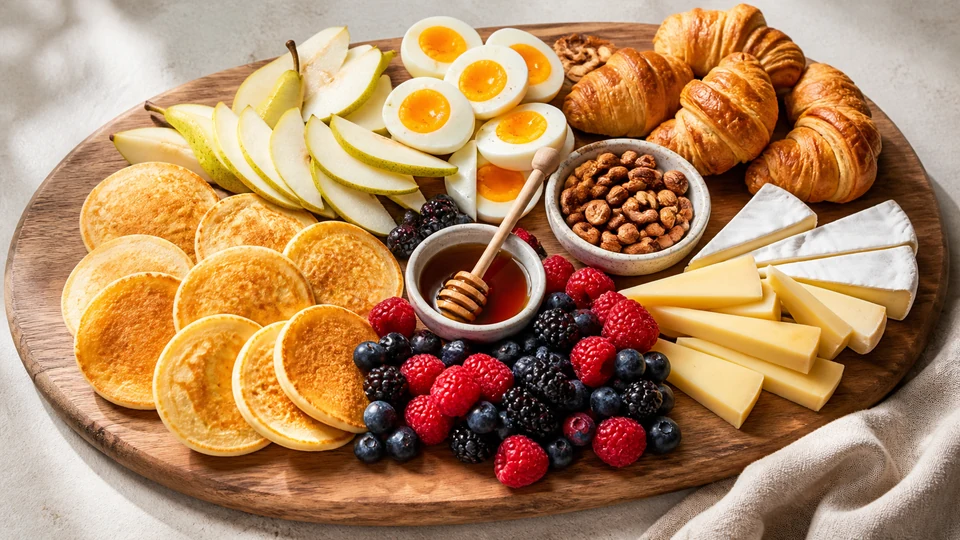
This is a planning and food-safety guide, not a recipe claimed as tested by Pancake World. See the brunch hub for other formats, and use Pancake World to explore the broader collection.
For broader context, continue with American Breakfast: Pancakes, Diner Plates and Brunch.
Direct answer: use a six-role board formula
The easiest board to shop and serve has six jobs rather than a target number of ingredients.
| Board role | Choose | Examples | Service note |
|---|---|---|---|
| Breakfast base | 1 | Mini pancakes, waffle quarters, bagel halves, toast, muffins | Keep crisp items away from wet fruit and dips |
| Savory protein | 1 | Fully cooked eggs, cooked sausage, bacon, sliced deli meat, beans | Treat eggs and meat as perishable |
| Produce | 2 | Berries, citrus, grapes, tomatoes, cucumber, melon | Wash and cut safely; chill cut produce |
| Creamy element | 1 | Yogurt, cream cheese, hummus, soft cheese | Use a bowl, dedicated spoon and cold control |
| Sweet accent | 1 | Jam, maple syrup, fruit spread, honey | Use a small bowl or pourer to limit spills |
| Savory or crunchy accent | 1 | Pickles, olives, nuts, seeds, herbs | Label allergens; keep loose pieces contained |
For a larger group, do not necessarily buy a larger board. Prepare two smaller platters and keep the second refrigerated until it replaces the first. That protects texture, makes replenishment easier and follows the FDA’s small-platter approach for home buffets.
Is it really charcuterie?
Charcuterie refers most precisely to prepared meat products. Many modern “breakfast charcuterie” searches use the word for any arranged grazing board. There is no need to police a family table, but accurate naming helps guests understand what is offered.
- A board centered on cured or cooked meats and cheese can reasonably be described as brunch charcuterie.
- A board centered on pancakes, fruit, yogurt and spreads is clearer as a brunch board or breakfast grazing board.
- A vegetarian board should not be advertised with imagery or labels that imply hidden meat.
- A meat-free board is not automatically vegan, dairy-free, egg-free or allergen-free.
The useful question is not whether a platter earns a fashionable name. It is whether every guest can identify the food, serve it cleanly and keep perishable ingredients at safe temperatures.
Idea 1: mini pancake brunch board
Use mini pancakes as the base, then offer one savory path and one sweet path. Fully cooked eggs or cooked breakfast sausage can provide the savory anchor. Berries, banana added just before service, and orange wedges support the sweet side. Put yogurt, fruit spread and syrup into separate bowls.
Food Network Kitchen publishes a complete breakfast charcuterie board for 8 to 10 servings with mini pancakes, waffle pieces, French-toast sticks, bacon, summer sausage, hard-boiled eggs, fruit and three prepared toppings. It demonstrates how broad a breakfast board can become; it is not a requirement to place all those hot bases on one platter.
For a manageable version, choose pancakes alone. Three bread bases become stale at different rates and demand separate cooking. If pancakes must be held, follow the complete pancake recipe’s holding instructions. Do not bury warm pancakes under cold fruit because condensation softens both.
Useful layout:
- Place yogurt and syrup bowls first.
- Create one curved lane of pancakes with slight overlap.
- Put eggs or sausage on a separate removable plate.
- Fill two zones with washed fruit.
- Keep nuts or seeds in their own labeled bowl.
- Add a clean turner and individual spoons for every sauce.
Idea 2: bagel and smoked-fish board
Arrange sliced bagels, cream cheese, cucumber, tomato, capers, herbs and a refrigerated smoked-fish component. This board is visually simple but temperature-sensitive. Cream cheese, cut produce and smoked seafood should not sit decoratively at room temperature for an open-ended morning.
Keep most fish and cream cheese chilled. Present small amounts in dishes nested over ice if service will be extended, and replace the dishes with clean, cold ones. Provide separate utensils for fish and dairy. Do not lay fish directly across the bagels, because that removes choice and transfers fish to the shared bread.
USDA FSIS identifies refrigerated smoked seafood among foods that deserve special attention for people at higher risk from Listeria. Pregnant guests, adults 65 or older and people with weakened immune systems should follow their health professional’s advice and the USDA Listeria guidance. A host should offer a clearly separated alternative rather than pressuring a guest to assess an ambiguous platter.
Idea 3: waffle and fried-chicken-style board
A waffle board can pair waffle quarters with a thoroughly cooked savory item, fruit and small sauce bowls. If chicken is included, cook or purchase it from a complete, reliable process and maintain the temperature required for safe service. A decorative room-temperature pile of chicken is not a holding method.
Separate syrup from hot sauce and identify each. Keep butter in a small dish and replenish it rather than setting out the whole supply. Add a crisp fruit such as apple only shortly before service, or use citrus and berries that are easier to portion without browning.
This idea creates significant hot-food pressure. One person may need to finish waffles while another handles chicken. If the kitchen cannot hold both safely, buy one component from a trusted source, choose a fully cold board, or switch to baked waffle pieces made according to a complete formula with clear holding directions.
Idea 4: continental-style bread and fruit board
Use croissants or small rolls, one cheese, butter, two fruit choices, jam and a modest savory addition. The format is low on active cooking and works for staggered arrivals, but dairy and cut fruit still require refrigeration.
Choose one bread family instead of a bakery assortment that creates many leftovers. Slice only what is needed for the first round. Keep extra bread covered away from the cold board so it does not absorb refrigerator moisture.
A simple arrangement has cheese in one chilled dish, butter and jam in two small bowls, bread in a dry basket, and fruit on a separate washable platter. This is safer and crisper than forcing every item onto a single wooden surface.
Idea 5: savory egg and vegetable board
Build around fully cooked egg portions, roasted potatoes, tomatoes, cucumber, greens, cheese and toast. This feels like a deconstructed cooked breakfast while allowing guests to choose portions.
Do not assume hard-cooked eggs can remain out all morning. Keep backup eggs refrigerated and replace the serving plate. If potatoes are served hot, hold them hot; if the selected recipe is designed for chilled service, cool and store them by that method. “Room temperature” should come from a complete recipe, not from neglecting a hot or cold control.
Keep moist tomatoes away from toast. Put salt, pepper and dressing at the edge rather than seasoning the entire board for every guest. A small herb bowl adds color without making an unsupported health claim.
Idea 6: vegetarian cheese, bean and vegetable board
Choose one or two cheeses, a bean spread or hummus, roasted vegetables, fresh vegetables, fruit, crackers and bread. This is a substantial meat-free board when the bean element and starch are planned rather than added as garnish.
Hummus commonly contains sesame through tahini. Crackers and bread may contain wheat, sesame, soy or milk. Cheese adds milk. Keep packages available and label the bowls. If a guest needs a sesame-free option, do not simply scrape hummus from the board: shared crumbs and utensils mean the surrounding surface may already have contact.
For a vegan variation, select a verified plant-based spread and breads whose labels meet the guest’s needs, omit dairy cheese, and add beans, tofu prepared from a complete recipe or another suitable component. Vegan labeling does not remove soy, sesame, wheat, peanut or tree-nut concerns.
Idea 7: yogurt and granola breakfast board
Use individual yogurt cups or one chilled yogurt bowl, two fruits, granola, seeds, nuts and one fruit sauce. This board needs almost no cooking and can work for an early gathering, but it creates many small loose toppings.
Contain every topping in a cup or bowl. Whole nuts can be a choking concern for young children, and an adult should select age-appropriate foods for them. Do not sprinkle nuts across all fruit if some guests avoid them.
Keep yogurt at 40°F or below and offer a small amount at a time. If dairy-free yogurt is provided, preserve its original label and use a separate spoon. A plant-based package can still contain one of the major allergens.
Granola crumbs travel quickly across a board. If gluten avoidance matters, a shared grazing format may be inappropriate even when one granola is labeled gluten-free. Separate sealed servings may be the more honest option.
Idea 8: Southwest-inspired brunch board
Arrange warm tortillas held according to package directions, fully cooked eggs or beans, avocado prepared close to service, tomato salsa, cheese, herbs and lime. Keep hot and cold items on separate removable dishes rather than turning the whole board into one temperature zone.
Salsa, cut avocado, cheese and cooked egg are perishable. Put out small portions and retain backup in the refrigerator. Identify hot sauce separately so guests control heat. If using corn tortillas for a gluten-avoidant guest, verify the package and preparation surface; corn as an ingredient does not prove the finished service is free from wheat contact.
This board is easier when the host chooses either eggs or beans as the main filling. Offering eggs, bacon, sausage and beans together creates quantity uncertainty and more temperature controls.
Idea 9: sweet brunch board for a celebration
Use one breakfast base—French-toast sticks, mini pancakes or waffle pieces—plus berries, citrus, a chocolate or fruit sauce, yogurt and a crunchy accent. A sweet board should still have contrast; several frostings, candies and syrups make individual ingredients hard to distinguish.
Choose one rich sauce and one unsweetened or tart component. Keep chocolate candies away from a hot surface where coatings may melt into shared food. Identify tree nuts and peanuts precisely rather than writing “nuts.”
If French toast contains egg and milk, cook it thoroughly using a complete recipe. Do not let appearance replace doneness. Place a small warm batch on a clean platter and retain the rest under a suitable hot-holding method, or schedule immediate service.
Idea 10: child-friendly build-your-own board
Offer small pancakes or toast shapes, soft fruit prepared in age-appropriate sizes, fully cooked egg, yogurt and one spread. Keep skewers, hard toothpicks and choking-risk foods away from young children. An adult should adapt sizes and ingredients to the specific child.
Use low bowls with short-handled spoons. Put syrup in a controlled pourer rather than an open bowl. Keep adult hot sauces, whole nuts and ambiguous garnishes on another surface.
The board should not turn allergen management over to a child. Adults retain labels, prepare required alternatives with clean equipment and supervise serving. A separate plate assembled before the shared board may be necessary.
A quantity method that avoids invented serving claims
There is no universal ounces-per-person number that fits a light coffee gathering, a full meal and a board served beside hot dishes. Use portions from the actual product labels and complete recipes.
Plan in four steps:
- Decide whether the board is the meal or one part of it.
- Write the labeled serving size or recipe yield for every substantial item.
- Estimate how many guests can and will eat each item.
- Add a modest backup amount, stored safely, instead of crowding the first platter.
For example, if pancakes are the only base, use the chosen recipe’s yield and the group’s expected appetite. If bagels, muffins and potatoes also appear, reduce duplication instead of counting a full serving of each for everyone. Children, teenagers and adults may take different amounts; the first small platter is a feedback mechanism.
Track high-cost or perishable components separately from inexpensive dry backups. Extra crackers can remain sealed. Extra sliced fish cannot sit out as decoration merely because it was purchased.
Board, sheet pan or separate platters?
A single wooden board looks cohesive but is often the least practical surface for a mixed brunch.
Use a washable board for dry bread, whole fruit and contained bowls. Use rimmed sheet pans or ceramic platters for foods that release juice or fat. Use a bowl over ice for cold dairy, fish or egg. Use a hot appliance approved for holding rather than placing a hot skillet on a decorative board.
University of Minnesota Extension’s food-safety guidance emphasizes that the material and maintenance of cutting surfaces matter. A cracked, deeply scored or difficult-to-clean decorative board is not a wise direct-contact surface. Line only with food-safe material suitable for the item and temperature; paper alone does not fix an unsanitary board.
Separate platters also make replacement possible. When the egg plate is empty, a clean cold plate can replace it without disturbing fruit, bread and labels.
Assembly order
Prepare in an order that protects both food and appearance.
Two to three days before
- Confirm guest allergies and dietary requirements.
- Select complete recipes and check their yields.
- Inventory platters, bowls, serving tools, ice and refrigerator space.
- Buy shelf-stable items whose labels can be retained.
- Reject a menu that needs more hot holding than the kitchen provides.
The day before
- Cook only items whose recipes permit advance preparation.
- Cool and refrigerate them according to authoritative directions.
- Wash serving pieces and let them dry fully.
- Write labels and assign one utensil per bowl.
- Group sealed backup ingredients by platter.
Before guests arrive
- Wash produce under running water and prepare it safely.
- Portion spreads, cheese and meat into small covered containers.
- Set the empty board with bowls, labels and utensils.
- Record the planned put-out time.
- Keep every perishable component refrigerated until the final assembly.
At service
- Put dry bases on first.
- Add contained spreads and accents.
- Add the first small portions of cold perishable food last.
- Bring hot food directly from cooking or approved holding.
- Start the exposure clock.
Temperature control is part of the design
The FDA’s safe buffet guidance says cold foods should be kept at 40°F or colder and hot foods at 140°F or warmer. Perishable foods left at room temperature for more than two hours should be discarded unless held hot or cold. When the ambient temperature is above 90°F, that limit falls to one hour.
The rule changes the board plan:
- use small serving dishes;
- keep backup dishes in the refrigerator;
- nest cold dishes over ice when needed;
- use a thermometer rather than touching a platter;
- label the time a perishable batch leaves refrigeration;
- replace the nearly empty dish with a clean fresh one;
- never add fresh food to the exposed remnants.
USDA FSIS gives the same core advice in its buffet safety answer: monitor time, hold cold food at 40°F or below, and use small platters or ice. Harmful bacteria cannot reliably be detected by smell or taste, so a board that “seems fine” is not evidence.
Dry crackers, unopened shelf-stable spreads and whole uncut fruit have different storage needs from eggs, dairy, meat and cut produce. Follow the package after opening; do not assume that every accent can stay out because the cracker beside it can.
Allergen map for a brunch board
The FDA identifies nine major food allergens in the United States: milk, eggs, fish, Crustacean shellfish, tree nuts, peanuts, wheat, soybeans and sesame. Read the agency’s current food allergy guidance and every product label.
Map likely sources before assembly:
| Ingredient family | Possible major allergens to verify |
|---|---|
| Pancakes, waffles, toast, bagels | Wheat, milk, egg, soy, sesame |
| Cheese, yogurt, cream cheese | Milk |
| Granola and crunchy toppings | Wheat, tree nuts, peanuts, sesame, soy |
| Hummus | Sesame; verify other ingredients |
| Smoked fish | Fish |
| Sauces and meat products | Check the complete label; formulations vary |
| Plant-based substitutes | Soy, tree nuts, wheat or sesame may still appear |
Layout reduces accidental mixing only when guests use the intended utensils. It does not erase cross-contact that happened in manufacturing, preparation or earlier service. For a serious allergy, use the guest’s required protocol and consider an individually packaged or separately prepared plate.
Higher-risk guests
Pregnant people, adults 65 and older, young children and people with weakened immune systems may need stricter choices around deli meat, smoked seafood, soft cheese and eggs. Do not make personal medical decisions for a guest.
Ask privately before shopping. Provide ingredient labels and source information. USDA FSIS advises higher-risk groups to avoid certain foods or use specific heating controls in its Listeria guidance. Follow that authoritative advice and the guest’s clinician rather than assuming a beautiful board is appropriate.
Pasteurized dairy, thoroughly cooked eggs and carefully held food can simplify the menu, but they do not create a universal guarantee. Keep the alternative physically separate and clearly labeled.
Keep bread crisp and fruit clean
Food safety comes first, but board quality also depends on moisture control.
- Put wet fruit in a rimmed zone or bowl.
- Keep syrup and yogurt away from bread edges.
- Add banana, sliced apple and avocado close to service.
- Drain pickles and olives before placing their bowls.
- Let cooked hot items stop steaming excessively before placing them near crisp bread, without leaving them in an unsafe temperature range.
- Replace soft or handled food rather than rearranging it repeatedly.
Do not use nonfood greenery, painted decorations or loose flowers unless they are verified as food-safe for the intended contact. Decorative gaps are acceptable. The board does not need to be covered edge to edge.
Common board failures and fixes
Everything is beige
Add two genuinely different produce zones, such as berries and cucumber, rather than colored candy. Use herbs only when they belong to the food and are edible.
Guests cannot tell what is in the bowls
Label them. “White dip” is not useful when yogurt, cream cheese, mayonnaise and nut-based spreads have different ingredients.
The first guests get all the protein
Hold back a clean refrigerated replacement platter and swap it at a planned time. Do not hide all protein under bread where it is difficult to portion.
Bread becomes soggy
Move fruit and spreads to bowls, keep bread on a dry surface and refill smaller amounts. Do not refrigerate the assembled dry bread board merely because the dairy on it needs refrigeration; separate the components.
The board is too large for the refrigerator
That is a design failure. Use several small trays that fit the available shelf. Assemble the dry frame separately and add a removable cold plate at service.
No one uses the provided utensils
Use obvious, appropriately sized tools and place each one with its bowl. For an allergy-sensitive service, a communal board may still be unsuitable.
Final board plan
Scaling from six guests to a larger gathering
Scale the number of service units before scaling the size of the display. A long board may hold more food, but it does not solve refrigeration, utensil access or exposure time. For a larger group, repeat the same six roles across two stations or prepare a sequence of replacement trays. Give each station the same labels so guests do not have to cross the room for one allergen-sensitive option.
Use the yield on each complete recipe and the serving information on packaged items to create a worksheet. Record the number of guests expected to eat the base, the savory anchor and each restricted option. Then convert those totals into batches that fit the cooking appliance and refrigerator. If one pancake recipe produces a known yield, it is safer to prepare complete batches than to multiply ingredients casually beyond the mixer, bowl or griddle capacity.
Assign one person to monitor perishable trays and one to manage hot replacements. The host should know which refrigerated container replaces which serving dish. Matching labels or removable tape can prevent a dairy yogurt refill from being placed in the bowl reserved for a plant-based product.
For an outdoor brunch, design around the one-hour limit that applies when the air temperature is above 90°F. Shade does not cancel that rule. Bring enough ice and a thermometer, protect food from insects and dust, and keep the cooler closed rather than using it as a constantly open display. If those controls are not realistic, choose shelf-stable packaged foods and whole fruit or move the gathering indoors.
Do not send guests home with perishables whose time history is unknown. A generous-looking leftover container is not useful if the food has exceeded its safe exposure limit.
Before serving, verify every line:
- The board has one base, one savory anchor, two produce choices, one creamy element and two accents.
- Every substantial item has a yield or package-based quantity.
- Every perishable component fits in refrigeration before service.
- Cold foods can remain at 40°F or below and hot foods at 140°F or above when held.
- A clock or label will track any room-temperature exposure.
- Clean replacement platters are ready; topping up is not the plan.
- Each sauce and spread has its own utensil.
- The nine major allergens have been checked against labels.
- Higher-risk guests have a suitable, clearly separated option.
- The serving surface is washable, intact and appropriate for food contact.
- Decorative items are food-safe and do not obstruct labels.
- Leftovers will be assessed by time and temperature, not smell.
A successful brunch charcuterie board is a controlled sequence of small, clear choices. The visual arrangement comes last; identification, temperature and replenishment make the board genuinely usable.
Explore related Pancakes World guidance on American Pancakes, Maple Syrup, and Maple Syrup Pancakes.
Sources and editorial references
- FDA: serving up safe buffets —
https://www.fda.gov/food/buy-store-serve-safe-food/serving-safe-buffets - USDA FSIS: keeping food safe at a buffet —
https://ask.fsis.usda.gov/article/How-do-I-keep-foods-safe-at-a-buffet - FDA: food allergies —
https://www.fda.gov/food/nutrition-food-labeling-and-critical-foods/food-allergies - USDA FSIS: Listeria questions and answers —
https://www.fsis.usda.gov/food-safety/foodborne-illness-and-disease/illnesses-and-pathogens/listeria - Food Network Kitchen: breakfast charcuterie board —
https://www.foodnetwork.com/recipes/food-network-kitchen/breakfast-charcuterie-board-18219764 - University of Minnesota Extension: food safety —
https://extension.umn.edu/food-health-and-nutrition/food-safety