Brunch buffet recipes

A reliable brunch buffet uses one hot anchor, two cold or room-temperature components, fruit, bread or pancakes, and a clearly labelled drink station. Build the menu around safe holding and replenishable small trays instead of placing every cooked dish out at once. Use Pancakes World to connect brunch buffet recipes with the wider breakfast and pancake collection.
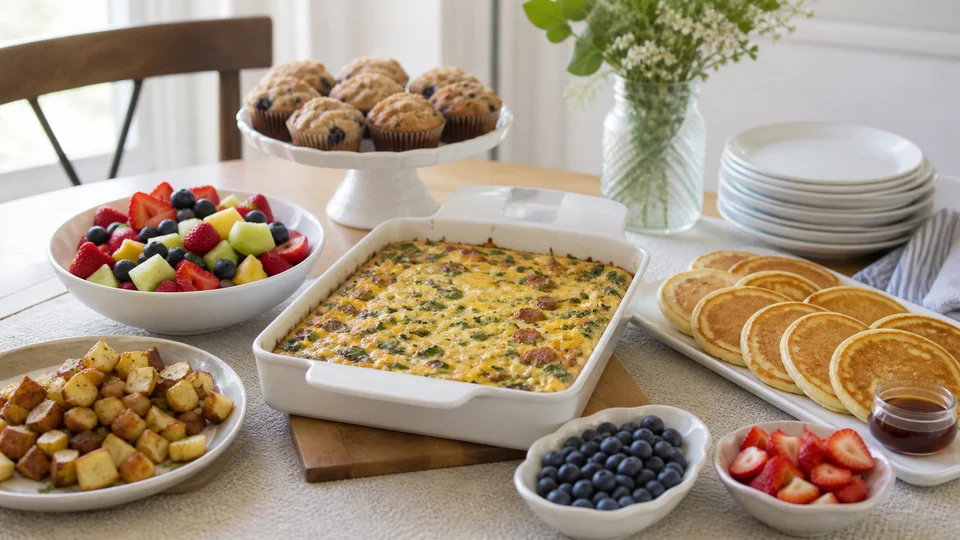
A buffet is a service system, not just a recipe list. Guest count, holding equipment, allergens, room temperature and replenishment control what is practical. The parent Brunch hub records the approved R10 context for brunch buffet recipes.
Choose the working format before shopping
For brunch buffet recipes, compare casserole as the hot anchor, pancake station without raw batter and chilled yogurt and fruit area before buying ingredients. That comparison reveals the service format, occupied equipment and required finish time. Every cooked component still needs one complete source formula with its own quantities and endpoint cues.
Casserole as the hot anchor
Choose a complete egg, grain or savoury bake with a defined pan size and cooked-center cue. Divide service into smaller pans when the formula allows, so one tray can stay protected while another is on display.
Pancake station without raw batter
Cook pancakes completely in the kitchen and move finished batches to the approved holding method. Do not set raw batter beside guests; offer labelled toppings in small containers and replace them rather than mixing old and new portions.
Chilled yogurt and fruit area
Keep perishable cups or bowls cold and provide separate utensils for fruit, yogurt, nuts and seeds. Small replenished containers improve temperature control and make allergen boundaries easier to understand.
Bread and spread table
Toast close to service or offer bread intended for room-temperature eating. Label dairy, nut, sesame and other spreads, give each its own utensil and avoid letting crumbs travel across containers.
Beverage station away from food traffic
Place water, coffee, tea and any juice where refills do not cross the hot-food queue. Keep milk or plant beverages at safe temperature and label them by actual product, not by cup colour.
A controlled preparation sequence
The brunch buffet recipes sequence below connects map the table and guest flow before finalizing recipes, including power and cold-holding needs. with remove food at its documented limit, cool eligible leftovers promptly and discard items whose history is uncertain. A written order exposes equipment conflicts before heat begins, while separate work zones protect finished casserole as the hot anchor components from raw-food contact.
1. Map the table and guest
Map the table and guest flow before finalizing recipes, including power and cold-holding needs.
2. Assign every dish a preparation
Assign every dish a preparation time, service vessel, allergen label and replacement plan.
3. Put out small quantities, monitor
Put out small quantities, monitor time and temperature, and replenish with fresh containers.
4. Remove food at its documented
Remove food at its documented limit, cool eligible leftovers promptly and discard items whose history is uncertain.
Practical diagnostics
When brunch buffet recipes misses its target, compare the observed result with casserole as the hot anchor and beverage station away from food traffic controls first. Record one measurable variable—such as cut size, pan area, batch depth, ingredient identity, temperature, order or holding time—before changing the next attempt.
- A long queue often means drinks, toppings and hot service occupy the same narrow point.
- Empty labels or shared spoons make ingredient and allergen planning unreliable.
- A deep tray that cools at the edges and stays hot in the center is a service-vessel mismatch.
- Constant last-minute cooking indicates too many hot anchors; move components to chilled or make-ahead formats.
Food-safety and factual boundary
For brunch buffet recipes, USDA MyPlate, “What Is MyPlate?” supports only its named domain, while USDA FSIS, “Leftovers and Food Safety” supplies a separate boundary. Neither source establishes a Pancake World test record, a medical outcome, or identical behaviour across every appliance and ingredient.
Quantities, timing, yield and storage for brunch buffet recipes must come from the selected complete recipe. Keep its perishable components under appropriate temperature control; prevent cross-contact around pancake station without raw batter; read current labels; and discard any batch with an uncertain time or temperature history.
Contextual routes for the next decision
- In Brunch buffet recipes, compare Air fryer brunch recipes for casserole as the hot anchor decisions.
- In Brunch buffet recipes, compare Apple brunch recipes for chilled yogurt and fruit area sequencing.
- In Brunch buffet recipes, compare Asparagus brunch recipe for beverage station away from food traffic service choices.
Frequently asked questions
How many hot dishes are needed?
One dependable anchor is often enough when the rest of the menu has real variety and clear portions.
Can food be topped up in the same tray?
Replace containers rather than mixing a fresh batch into food with an older unknown service time.
How should allergens be handled?
Keep current ingredient information, clear labels and dedicated utensils visible, while warning that shared kitchens still carry cross-contact risk.
Route-specific planning notes
For Brunch Buffet Recipes, planning note 1 keeps the route grounded in its stated source. Identify the actual ingredient, equipment, storage, headcount, or serving context before adapting it. Observe the current result, use one bounded correction if needed, and avoid turning a familiar phrase into a guarantee about nutrition, safety, suitability, or quality. Record the decision so the next preparation can begin from the same clear boundary.
For Brunch Buffet Recipes, planning note 2 keeps the route grounded in its stated source. Identify the actual ingredient, equipment, storage, headcount, or serving context before adapting it. Observe the current result, use one bounded correction if needed, and avoid turning a familiar phrase into a guarantee about nutrition, safety, suitability, or quality. Record the decision so the next preparation can begin from the same clear boundary.
For Brunch Buffet Recipes, planning note 3 keeps the route grounded in its stated source. Identify the actual ingredient, equipment, storage, headcount, or serving context before adapting it. Observe the current result, use one bounded correction if needed, and avoid turning a familiar phrase into a guarantee about nutrition, safety, suitability, or quality. Record the decision so the next preparation can begin from the same clear boundary.
For Brunch Buffet Recipes, planning note 4 keeps the route grounded in its stated source. Identify the actual ingredient, equipment, storage, headcount, or serving context before adapting it. Observe the current result, use one bounded correction if needed, and avoid turning a familiar phrase into a guarantee about nutrition, safety, suitability, or quality. Record the decision so the next preparation can begin from the same clear boundary.
For Brunch Buffet Recipes, planning note 5 keeps the route grounded in its stated source. Identify the actual ingredient, equipment, storage, headcount, or serving context before adapting it. Observe the current result, use one bounded correction if needed, and avoid turning a familiar phrase into a guarantee about nutrition, safety, suitability, or quality. Record the decision so the next preparation can begin from the same clear boundary.
For Brunch Buffet Recipes, planning note 6 keeps the route grounded in its stated source. Identify the actual ingredient, equipment, storage, headcount, or serving context before adapting it. Observe the current result, use one bounded correction if needed, and avoid turning a familiar phrase into a guarantee about nutrition, safety, suitability, or quality. Record the decision so the next preparation can begin from the same clear boundary.
For Brunch Buffet Recipes, planning note 7 keeps the route grounded in its stated source. Identify the actual ingredient, equipment, storage, headcount, or serving context before adapting it. Observe the current result, use one bounded correction if needed, and avoid turning a familiar phrase into a guarantee about nutrition, safety, suitability, or quality. Record the decision so the next preparation can begin from the same clear boundary.
For Brunch Buffet Recipes, planning note 8 keeps the route grounded in its stated source. Identify the actual ingredient, equipment, storage, headcount, or serving context before adapting it. Observe the current result, use one bounded correction if needed, and avoid turning a familiar phrase into a guarantee about nutrition, safety, suitability, or quality. Record the decision so the next preparation can begin from the same clear boundary.
For Brunch Buffet Recipes, planning note 9 keeps the route grounded in its stated source. Identify the actual ingredient, equipment, storage, headcount, or serving context before adapting it. Observe the current result, use one bounded correction if needed, and avoid turning a familiar phrase into a guarantee about nutrition, safety, suitability, or quality. Record the decision so the next preparation can begin from the same clear boundary.
For Brunch Buffet Recipes, planning note 10 keeps the route grounded in its stated source. Identify the actual ingredient, equipment, storage, headcount, or serving context before adapting it. Observe the current result, use one bounded correction if needed, and avoid turning a familiar phrase into a guarantee about nutrition, safety, suitability, or quality. Record the decision so the next preparation can begin from the same clear boundary.
For Brunch Buffet Recipes, planning note 11 keeps the route grounded in its stated source. Identify the actual ingredient, equipment, storage, headcount, or serving context before adapting it. Observe the current result, use one bounded correction if needed, and avoid turning a familiar phrase into a guarantee about nutrition, safety, suitability, or quality. Record the decision so the next preparation can begin from the same clear boundary.
For Brunch Buffet Recipes, planning note 12 keeps the route grounded in its stated source. Identify the actual ingredient, equipment, storage, headcount, or serving context before adapting it. Observe the current result, use one bounded correction if needed, and avoid turning a familiar phrase into a guarantee about nutrition, safety, suitability, or quality. Record the decision so the next preparation can begin from the same clear boundary.
For Brunch Buffet Recipes, planning note 13 keeps the route grounded in its stated source. Identify the actual ingredient, equipment, storage, headcount, or serving context before adapting it. Observe the current result, use one bounded correction if needed, and avoid turning a familiar phrase into a guarantee about nutrition, safety, suitability, or quality. Record the decision so the next preparation can begin from the same clear boundary.
Additional route decisions
For Brunch Buffet Recipes, additional decision 1 is to review the actual source and the immediate kitchen or host context before proceeding. Keep ingredients, tools, temperature, timing, storage, and service as separate questions. This prevents an appealing name or broad dietary label from replacing evidence. A single documented adjustment is easier to evaluate than several changes made at once, especially when guests, leftovers, or package instructions are involved.
For Brunch Buffet Recipes, additional decision 2 is to review the actual source and the immediate kitchen or host context before proceeding. Keep ingredients, tools, temperature, timing, storage, and service as separate questions. This prevents an appealing name or broad dietary label from replacing evidence. A single documented adjustment is easier to evaluate than several changes made at once, especially when guests, leftovers, or package instructions are involved.
For Brunch Buffet Recipes, additional decision 3 is to review the actual source and the immediate kitchen or host context before proceeding. Keep ingredients, tools, temperature, timing, storage, and service as separate questions. This prevents an appealing name or broad dietary label from replacing evidence. A single documented adjustment is easier to evaluate than several changes made at once, especially when guests, leftovers, or package instructions are involved.
For Brunch Buffet Recipes, additional decision 4 is to review the actual source and the immediate kitchen or host context before proceeding. Keep ingredients, tools, temperature, timing, storage, and service as separate questions. This prevents an appealing name or broad dietary label from replacing evidence. A single documented adjustment is easier to evaluate than several changes made at once, especially when guests, leftovers, or package instructions are involved.
For Brunch Buffet Recipes, additional decision 5 is to review the actual source and the immediate kitchen or host context before proceeding. Keep ingredients, tools, temperature, timing, storage, and service as separate questions. This prevents an appealing name or broad dietary label from replacing evidence. A single documented adjustment is easier to evaluate than several changes made at once, especially when guests, leftovers, or package instructions are involved.
For Brunch Buffet Recipes, additional decision 6 is to review the actual source and the immediate kitchen or host context before proceeding. Keep ingredients, tools, temperature, timing, storage, and service as separate questions. This prevents an appealing name or broad dietary label from replacing evidence. A single documented adjustment is easier to evaluate than several changes made at once, especially when guests, leftovers, or package instructions are involved.
For Brunch Buffet Recipes, additional decision 7 is to review the actual source and the immediate kitchen or host context before proceeding. Keep ingredients, tools, temperature, timing, storage, and service as separate questions. This prevents an appealing name or broad dietary label from replacing evidence. A single documented adjustment is easier to evaluate than several changes made at once, especially when guests, leftovers, or package instructions are involved.
For Brunch Buffet Recipes, additional decision 8 is to review the actual source and the immediate kitchen or host context before proceeding. Keep ingredients, tools, temperature, timing, storage, and service as separate questions. This prevents an appealing name or broad dietary label from replacing evidence. A single documented adjustment is easier to evaluate than several changes made at once, especially when guests, leftovers, or package instructions are involved.
For Brunch Buffet Recipes, additional decision 9 is to review the actual source and the immediate kitchen or host context before proceeding. Keep ingredients, tools, temperature, timing, storage, and service as separate questions. This prevents an appealing name or broad dietary label from replacing evidence. A single documented adjustment is easier to evaluate than several changes made at once, especially when guests, leftovers, or package instructions are involved.
For Brunch Buffet Recipes, additional decision 10 is to review the actual source and the immediate kitchen or host context before proceeding. Keep ingredients, tools, temperature, timing, storage, and service as separate questions. This prevents an appealing name or broad dietary label from replacing evidence. A single documented adjustment is easier to evaluate than several changes made at once, especially when guests, leftovers, or package instructions are involved.
Conclusion
Sources
- USDA MyPlate, “What Is MyPlate?” —
https:// www.myplate.gov/ eat- healthy/ what- is- myplate - USDA FSIS, “Leftovers and Food Safety” —
https:// www.fsis.usda.gov/ food- safety/ safe- food- handling- and- preparation/ food- safety- basics/ leftovers- and- food- safety - FoodSafety.gov, “Safe Minimum Internal Temperatures” —
https:// www.foodsafety.gov/ food- safety- charts/ safe- minimum- internal- temperatures