Bridal shower brunch menu ideas
At Pancakes World, build a bridal shower brunch menu from seven jobs, not a long recipe wish list: one substantial anchor, one secondary savory dish, one fresh or cool item, one baked or griddle item, one restrained sweet finish, hot and cold beverages, and clearly protected alternatives for confirmed guest needs. Give every dish a verified recipe yield, serving size, cooking endpoint, holding method and named piece of equipment. Remove any item that duplicates another dish’s texture or creates an oven, refrigerator or service bottleneck. For buffet service, use small replacement platters, keep cold food at 40°F (4°C) or below and hot food at 140°F (60°C) or above, and track each perishable tray from the moment it leaves control.
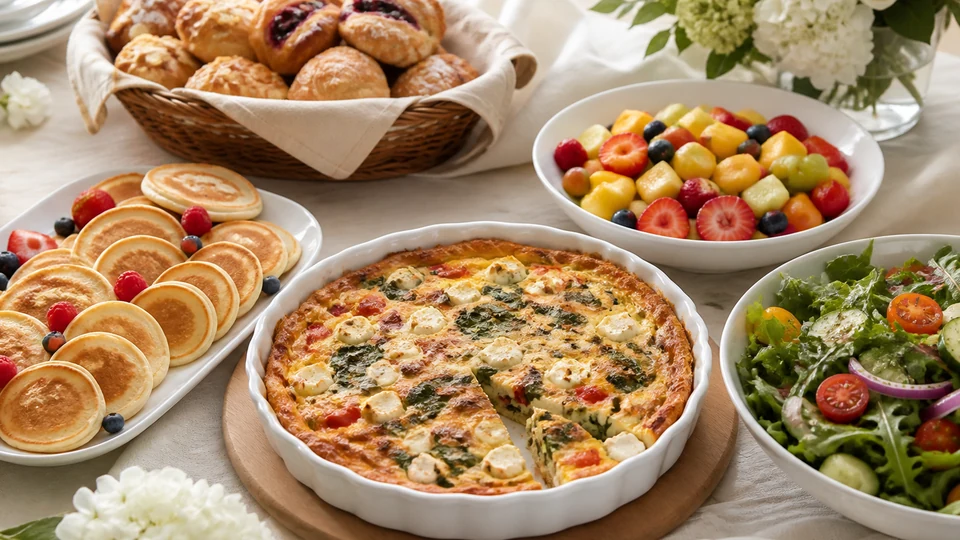
This page is about complete menu construction. It does not prescribe a bridal theme, limit the event to finger foods, schedule the wedding party's morning or claim that these untested combinations are universally popular. The brunch hub provides broader planning context, and Pancake World opens the full editorial collection.
For broader context, continue with American Breakfast: Pancakes, Diner Plates and Brunch.
Start with a seven-job menu architecture
A complete menu does not need many dishes. It needs each dish to do a different job.
- Anchor: the main savory item that makes the service feel like a meal.
- Secondary savory: a contrasting format or a simpler alternative, not another version of the anchor.
- Fresh or cool item: a produce-led or chilled component with a different temperature and texture.
- Baked or griddle item: bread, pancake, waffle or another source-tested format that supplies a neutral base.
- Sweet finish: one clearly portioned item rather than a second full dessert buffet.
- Beverages: water plus deliberately chosen hot and cold options with their own equipment and refill plan.
- Confirmed alternative: a protected dish for an identified need when the preparation and service process can genuinely support it.
The jobs prevent menu drift. If the anchor is a baked egg casserole, a second egg bake does not create useful choice. If the anchor is a pancake station, three additional breads overload the menu with similar structure. If fresh fruit, fruit salad and fruit cups all appear, they may compete for the same refrigerator space and cold-holding equipment.
These categories are editorial planning tools. They do not specify ingredients, nutrition or quantities. Every selected dish still requires a reliable recipe and food-safety path.
Define the event facts before selecting dishes
Write a menu brief with the information that changes production:
- confirmed and maximum attendance;
- whether brunch is the main meal;
- start, last-service and finish times;
- seated, buffet, station, family-style or mixed service;
- kitchen and serving location;
- usable oven, stovetop, refrigerator, freezer and electrical capacity;
- number and experience of helpers;
- transport time for food prepared elsewhere;
- privately reported ingredient, allergy or accessibility needs;
- cake, dessert or another course supplied separately.
University of Minnesota Extension advises planners to consider the occasion, group, service style, equipment, space and labor. Those facts determine whether a menu can be executed safely. A beautiful six-item hot menu is not viable with one small oven and no holding equipment. A large cold spread is not viable without measured refrigerator and ice capacity.
Decide the invitation deadline early enough to select yields. Avoid purchasing or producing from an unconfirmed maximum unless there is a documented plan for safe storage and later use.
Choose the anchor by service model
The anchor consumes the largest share of production attention, so choose it first.
Baked anchor
A source-tested egg dish, savory bread pudding, vegetable bake or casserole can be portioned at a table or buffet. It occupies oven space and requires category-appropriate temperature verification. FoodSafety.gov lists 160°F for egg dishes and 165°F for casseroles; the actual formula and food category determine the endpoint. Color, puffing and a clean knife are not substitutes for a thermometer.
For a buffet, decide whether it is cooked immediately before service, held hot at 140°F or above, or cooked, cooled and later reheated according to authoritative directions. FDA says refrigerated egg dishes such as quiche should be thoroughly reheated to 165°F before serving. Do not use an unsupported low warming setting as a reheating method.
Griddle anchor
A pancake or waffle station creates fresh output and guest choice. It also demands a trained operator, protected raw batter, enough electrical capacity and a queue plan. Raw flour and raw eggs stay away from ready-to-eat toppings. Finished items need a controlled path to service rather than accumulating in a lukewarm stack.
Use a recipe with verified yield and repeat independent batches rather than multiplying it into an untested vessel. Count the operator as dedicated labor; that person cannot simultaneously refill drinks and monitor a cold buffet.
Hand-held anchor
A documented breakfast sandwich, wrap or substantial savory pastry can suit circulating guests. The item must have a complete cooking, assembly and holding method. Cold fillings remain at 40°F or below; hot service requires holding at 140°F or above. A hand-held shape does not make a perishable filling safe at room temperature.
Select this anchor when the room lacks dining tables or the program includes movement. It still needs seating for guests who require it.
Bowl or composed anchor
A bowl base can offer controlled components and easy temperature checks when it can be stirred. Keep toppings that need cold control in small chilled containers. Use dedicated utensils and place the finishing area after the hot base so guests do not cross back through the line.
This model increases the number of containers, labels and possible cross-contact points. Use it only when staff and table space support the complexity.
Add a secondary savory that solves a different problem
The secondary savory should contrast with the anchor in at least two dimensions: temperature, texture, eating method, main ingredient or holding demand.
If the anchor is a hot egg casserole, the secondary might be a source-tested cool sandwich segment or vegetable-led bite. If the anchor is a griddle station, a prepared savory cup may serve guests who do not want to wait. If the anchor is a cold hand-held item, a single hot baked bite can add temperature contrast.
Do not describe the alternative as healthier, lighter or high-protein without evidence. Its job is service resilience and variety. Confirm that it does not merely relocate the same allergens. An egg-free item can still contain milk, wheat, soy, sesame or nuts.
Give the secondary its own yield and serving assumption. Do not plan one full serving of every savory item for every guest by default. Instead, decide how the choices share expected demand, then preserve an operational reserve within storage limits. That allocation is an event decision, not a universal consumption formula.
Select the fresh or cool component
This component changes texture, color and temperature. Possible formats include properly handled cut fruit, whole fruit, a source-tested vegetable salad, vegetable cups or another chilled preparation. Choose the form by service style.
Whole fruit may reduce cutting and cold-holding work, but it can be awkward on a formal plate. Cut fruit fits a buffet but becomes perishable and must remain cold. A dressed salad needs utensils and may lose quality as it waits. Individual cups control portions but consume refrigerator volume and packaging.
Rinse fresh produce under running water, including produce with skins or rinds that will not be eaten; scrub firm produce with a clean brush. Keep cut produce refrigerated and move only small batches to service. If the dish will stay on the table longer than two hours, FDA advises placing cold food on ice to maintain 40°F or below.
Do not use decorative flowers or leaves in contact with food unless their identity, food-use suitability and handling are established. Visual styling must not add an unknown ingredient.
Add one baked or griddle support item
This is the neutral support, not a second anchor. It could be a tested pancake, waffle, biscuit, muffin, toast or other bread-like format. Choose one whose production schedule fits the anchor.
If the anchor already occupies the oven, a baked support may create a bottleneck. If the anchor uses a griddle operator, adding another live griddle food is redundant. A make-ahead item is useful only when the source recipe explicitly supports advance preparation and storage.
Control accompanying spreads and dairy products as perishable foods when applicable. Put small dishes out and replace them from refrigeration. Use separate utensils. Do not leave butter, cream cheese, yogurt or similar foods on the table for an undefined event window.
Choose one sweet finish with a clear role
Ask whether a cake or another celebration dessert will be served later. If yes, the brunch menu may need only a small baked finish or none at all. Repeating pastries, muffins, cake and dessert cups can consume production time without improving the meal's structure.
Select a recipe that can be portioned consistently and stored under its actual ingredient requirements. Plain cookies and unfilled cakes have different safety needs from custard, cream or dairy-filled items. Appearance does not establish shelf stability.
Use exact language on labels. “Lemon square” communicates more than a decorative event name, especially when paired with known major allergens. Avoid “guilt-free,” “clean,” “detox” and medical-suitability language.
Treat beverages as a production lane
Beverages need water, ice, cups, refill stock, waste handling and sometimes heat or refrigeration. Put them on a separate table to prevent the food line from stopping while guests prepare drinks.
Water
Provide an easily accessible water option and a refill method. If fruit or herbs are added, treat the container and additions as prepared food: use clean produce, clean equipment and an appropriate service window.
Hot beverages
Coffee, tea or another hot option requires a stable appliance, safe cord route and someone responsible for refills. Do not place hot dispensers where children, sleeves or a crowded line can contact them. Keep milk or cream additions under cold control.
Cold beverages
Use a chilled dispenser or small containers with a refill plan. A drink containing dairy or fresh prepared ingredients may be perishable even when served over ice. Measure storage and service requirements rather than assuming a beverage is low risk.
This guide does not recommend alcohol or make claims about alcohol and pregnancy. If alcohol is considered, the host must follow applicable law, venue rules and individual decisions outside this menu framework. Always provide clear nonalcoholic choices without framing them as lesser substitutes.
Create menu combinations from the seven jobs
The following combinations demonstrate structure. They are not tested recipes, fixed quantities or endorsements.
Menu A: seated baked brunch
- Anchor: source-tested baked egg dish or casserole.
- Secondary savory: cool vegetable or bean-based bite from a complete recipe.
- Fresh/cool: controlled fruit plate or vegetable salad.
- Support: one bread or pancake format prepared within equipment capacity.
- Sweet: one small baked finish.
- Beverages: water, managed hot drink and one cold nonalcoholic option.
- Alternative: a protected, verified dish for a confirmed need.
Why it works: the anchor can be portioned at a table, while the remaining jobs add temperature and texture contrast. Main risk: oven competition and cooling or reheating if the anchor is made ahead.
Menu B: circulating shower buffet
- Anchor: documented substantial hand-held item.
- Secondary savory: small baked bite.
- Fresh/cool: individual produce cup or small cold platter.
- Support: one sturdy baked item.
- Sweet: one low-mess portion.
- Beverages: separate self-service station.
- Alternative: separately placed and labelled hand-held option where controls allow.
Why it works: guests can move and talk. Main risk: too many perishable trays at room temperature. Use small replacement platters and time logs.
Menu C: pancake-centered brunch
- Anchor: controlled pancake station with a tested formula.
- Secondary savory: prepared item that does not use the griddle.
- Fresh/cool: chilled fruit or vegetable element.
- Support: omit another bread unless it fills a real need.
- Sweet: restrained finish, since the anchor may already take sweet toppings.
- Beverages: separate hot and cold station.
- Alternative: independently verified base or dish, not an improvised batter substitution.
Why it works: one interactive focal point. Main risk: operator and electrical bottlenecks plus raw batter separation.
Menu D: cool open-house menu
- Anchor: source-tested cold sandwich, wrap or composed portion.
- Secondary savory: one safely cooled baked item served under proper cold control, or a shelf-stable format supported by its recipe.
- Fresh/cool: produce-led platter.
- Support: one baked bread item.
- Sweet: individually portioned finish.
- Beverages: replenished small batches.
- Alternative: clearly protected option.
Why it works: staggered guests can receive fresh replacement trays. Main risk: refrigerator and ice capacity.
Menu E: family-style table
- Anchor: portionable hot dish.
- Secondary savory: one cool, easily passed dish.
- Fresh/cool: contained salad or fruit serving.
- Support: basketed bread or source-tested griddle item.
- Sweet: served after main dishes are cleared.
- Beverages: placed without crowding shared food.
- Alternative: individual protected plate when cross-contact at the shared table cannot be controlled.
Why it works: guests remain seated. Main risk: utensil migration, cooling during passing and insufficient table space.
Calculate quantities from verified yields
No authoritative single “pieces per guest” number fits every bridal shower menu. Quantity depends on whether brunch is the main meal, event duration, guest mix, serving size, number of choices, service model and later cake or dessert.
Use this method:
- Record confirmed attendance and a documented maximum.
- Decide how many guests each of the seven jobs is expected to serve.
- Record the authoritative recipe's yield and serving size.
- Calculate independent batches; do not alter pan depth or cook time silently.
- Add a deliberate operational reserve only if safe storage and later use exist.
- Reconcile the result with oven, refrigerator, hot-holding and platter capacity.
- Record actual usable portions after production for event logistics, without rewriting the source recipe.
For groups of 25 or more, University of Minnesota Extension recommends standardized quantity recipes. It notes that family-size recipes, particularly baked items and thickened foods, may not scale proportionally. Repeating an established smaller batch can be safer and more predictable than creating one untested giant batch.
Build an equipment load map
List each menu item across production and service:
| Menu job | Prep surface | Cook equipment | Cooling space | Holding equipment | Serving ware | Assigned person |
|---|---|---|---|---|---|---|
| Anchor | recorded | recorded | recorded | recorded | recorded | named |
| Secondary savory | recorded | recorded | recorded | recorded | recorded | named |
| Fresh/cool | recorded | none or recorded | refrigerator | ice/cold unit | recorded | named |
| Baked/griddle | recorded | recorded | recipe-defined | recipe-defined | recorded | named |
| Sweet | recorded | recorded | recipe-defined | recipe-defined | recorded | named |
| Beverages | separate | kettle/brewer if used | refrigerator/ice | dispenser | cups/tools | named |
| Alternative | protected | recorded | protected | protected | dedicated | named |
Look for collisions by hour. If anchor, support and sweet all need the oven immediately before service, change the menu. If cold platters and drinks exceed refrigerator space, change the menu. Do not rely on a garage, porch or shaded table as temperature control.
Plan alternatives without creating a second full menu
Collect guest needs privately and confirm only what the kitchen or supplier can support. FDA identifies nine major allergens in the United States: milk, egg, fish, crustacean shellfish, tree nuts, peanuts, wheat, soybeans and sesame. Other allergies and intolerances also exist.
An alternative can be one complete protected dish rather than a modified version of every item. It needs exact ingredients, separate utensils, clear placement and a process that manages cross-contact. A vegetarian item is not automatically dairy-free, egg-free or allergen-safe. A gluten-free packaged ingredient does not by itself establish that a shared home kitchen prevented cross-contact.
If control is uncertain, disclose the limitation. Accurate uncertainty is safer than an unsupported “free from” card.
Prepare and serve with a control plan
Before cooking
- verify recipe versions, yields and endpoints;
- receive and refrigerate perishable ingredients promptly;
- label raw and ready-to-eat zones;
- clean hands, surfaces and equipment;
- stage thermometers and shallow cooling containers;
- prevent last-minute ingredient substitutions from bypassing allergen records.
During cooking
Use FoodSafety.gov's category endpoints. Poultry and casseroles reach 165°F; ground meats reach 160°F; whole cuts of beef, pork, veal and lamb reach 145°F and rest three minutes; fish reaches 145°F; egg dishes reach 160°F. Measure the correct location with a food thermometer.
Keep raw meat, seafood, eggs and flour separate from cooked food. Wash utensils and surfaces after raw use. FDA recommends pasteurized eggs or egg products for preparations that otherwise call for raw or undercooked egg; a bridal-shower menu is easier to control when egg dishes are fully cooked.
Cooling and storage
Refrigerate perishables within two hours of cooking or purchase, or one hour when the surrounding temperature is above 90°F. Divide large amounts into shallow containers for quicker cooling. Cover and label once controlled, and keep the refrigerator at 40°F or below.
Buffet service
Hold hot food at 140°F or above and cold food at 40°F or below. Measure the food, because some warming devices do not reach safe hot-holding temperature. Put out small platters and keep backups under control. Replace a tray rather than topping it up.
If perishable food is not held hot or cold, discard it after two hours, shortened to one hour above 90°F. Give every tray an out time. Do not reset the clock by refrigerating it late or adding fresh food.
Leftovers
Keep only food with a known safe history. Cool promptly in shallow containers and refrigerate. USDA says refrigerated leftovers are generally used within three to four days and reheated to 165°F. Discard food that exceeded its service boundary; do not send uncertainty home with guests.
A practical menu production timeline
Three to four weeks before
- confirm event facts and service model;
- select the seven jobs and authoritative recipe candidates;
- check verified yields and group-size suitability;
- collect guest needs privately;
- map equipment and helpers;
- replace any dish without a complete safety and holding path.
One week before
- lock recipes and ingredient lists;
- calculate independent batches;
- prepare food labels and tray codes;
- confirm supplier pickup or delivery controls;
- assign cooking, receiving, holding, replenishment and clearing;
- test the service layout with empty equipment.
The day before
- prepare only source-approved make-ahead components;
- cool cooked foods promptly in shallow containers;
- keep ready-to-eat food protected;
- stage dedicated alternative utensils and storage;
- verify refrigerator temperature and space;
- place no unlabeled food into the event inventory.
Event day
- cook category foods to safe endpoints;
- receive purchased food directly into hot or cold control;
- start with small trays;
- separate drinks from the food queue;
- log tray out times and measured temperatures;
- replace dishes and utensils rather than topping up;
- close service at the stated time;
- cool only safe leftovers promptly.
Diagnose an unbalanced menu
Too many heavy anchors
Several casseroles, sandwiches and pastries all compete to be the main dish. Keep one anchor, move one contrasting item into secondary savory and remove the rest.
Too much bread
Pancakes, waffles, muffins, biscuits, croissants and cake repeat structure. Choose one support and one sweet finish; let the other jobs provide contrast.
Every dish contains egg or dairy
The menu offers nominal variety but little ingredient diversity. Select a complete contrasting recipe and protect it appropriately. Do not improvise a substitute into an untested formula.
The menu cannot be served at safe temperatures
Reduce hot or cold items to fit verified holding equipment. Never solve the problem by planning to serve perishable food “warm” or “cool enough.”
The alternative shares utensils
Separate its storage, placement and utensil. If shared preparation prevents a trustworthy claim, describe that boundary to the guest.
The drink station blocks food
Move it. Cups, ice and refills create pauses and spills. Give beverages their own landing and waste area.
Frequently asked questions
How many dishes should a bridal shower brunch menu include?
Use jobs rather than a fixed number. An anchor, contrasting savory, fresh/cool item, support, sweet finish, beverages and one confirmed alternative can form a complete structure, but some jobs can be combined when the result remains clear and executable.
How much food per guest is needed?
There is no universal amount. Use confirmed attendance, meal role, event duration, service style, verified recipe serving size and the number of choices. Standardized quantity recipes are preferable for larger groups.
Can everything be made the day before?
Only when each source recipe explicitly supports advance preparation, cooling, storage and reheating. Do not assume a dish can be made ahead because it contains familiar ingredients.
Is buffet or plated service easier?
They move labor differently. A buffet needs line design, holding, replenishment and tray monitoring. Plated service needs assembly, carrying, portion control and clearing. Choose from room, helpers and equipment.
Can catered and homemade dishes share the menu?
Yes, when every dish has a known ingredient record, receipt temperature, storage path, holding method and responsible person. Keep supplier labels and do not endorse a vendor without evidence.
What if the guest count changes late?
Use verified recipe yields to decide whether an additional independent batch fits equipment and time. Do not change pan depth or cooking instructions arbitrarily. If capacity does not support expansion, simplify the menu rather than compromising control.
Final menu gate
- Every one of the seven jobs has a distinct purpose.
- The anchor matches the service model.
- No dish duplicates another item without a reason.
- Every recipe has a reliable yield, serving size and safe endpoint.
- Quantities come from attendance and yields, not a universal rule.
- Oven, griddle, refrigerator, holding and electrical loads fit.
- Alternative food has accurate ingredients and protected service.
- Cold food remains at 40°F or below; hot food remains at 140°F or above.
- Each uncontrolled perishable tray follows the two-hour or one-hour boundary.
- Small trays replace old trays instead of being topped up.
- Drinks use a separate service lane.
- Safe leftovers cool promptly; uncertain food is discarded.
Explore related Pancakes World guidance on American Pancakes, Maple Syrup, and Maple Syrup Pancakes.
Sources and editorial references
- University of Minnesota Extension Planning the Quantity Food Occasion —
https://extension.umn.edu/cooking-safely-crowd/planning-quantity-food-occasion - University of Minnesota Extension Cooking Safely for a Crowd —
https://extension.umn.edu/home-kitchen/cooking-safely-crowd - University of Minnesota Extension Service Style Risks and Safe Practices —
https://extension.umn.edu/cooking-safely-crowd/service-style-risks-and-safe-practices - FDA Serving Up Safe Buffets —
https://www.fda.gov/food/buy-store-serve-safe-food/serving-safe-buffets - USDA FSIS Safe Handling of Take-Out Foods —
https://www.fsis.usda.gov/food-safety/safe-food-handling-and-preparation/food-safety-basics/safe-handling-take-out-foods - FoodSafety.gov Safe Minimum Internal Temperatures —
https://www.foodsafety.gov/food-safety-charts/safe-minimum-internal-temperatures - FDA Food Allergies —
https://www.fda.gov/food/nutrition-food-labeling-and-critical-foods/food-allergies - FDA Egg Safety —
https://www.fda.gov/food/buy-store-serve-safe-food/what-you-need-know-about-egg-safety - FDA Entertaining All Year —
https://www.fda.gov/food/people-risk-foodborne-illness/entertaining-all-year-food-safety-moms-be - USDA FSIS Leftovers and Food Safety —
https://www.fsis.usda.gov/food-safety/safe-food-handling-and-preparation/food-safety-basics/leftovers-and-food-safety