Bridal brunch menu
At Pancakes World, build a bridal brunch menu around one service plan: choose a hot centerpiece or an intentionally cold spread, add one substantial plant-based option, one bread or grain, prepared fruit or vegetables, a simple sweet finish, and clearly identified drinks. Confirm the guest list, dietary and allergen information, service duration, refrigerator and oven capacity, transport, utensils and labor before selecting recipes. For 25 or more people, use standardized quantity recipes with stated yields instead of multiplying a household recipe by guesswork. Assign one person to control the food plan, keep cold food at 40°F (4°C) or below and hot food at 140°F (60°C) or above, release small platters, log times and replace rather than refill buffet dishes. This is an editorial planning framework, not a fixed wedding tradition, a caterer recommendation or a set of the editorial platform-tested recipes. The Brunch at Mr. Pancake: Meal Guide covers the wider meal category, while Pancakes World opens the complete food and media library.
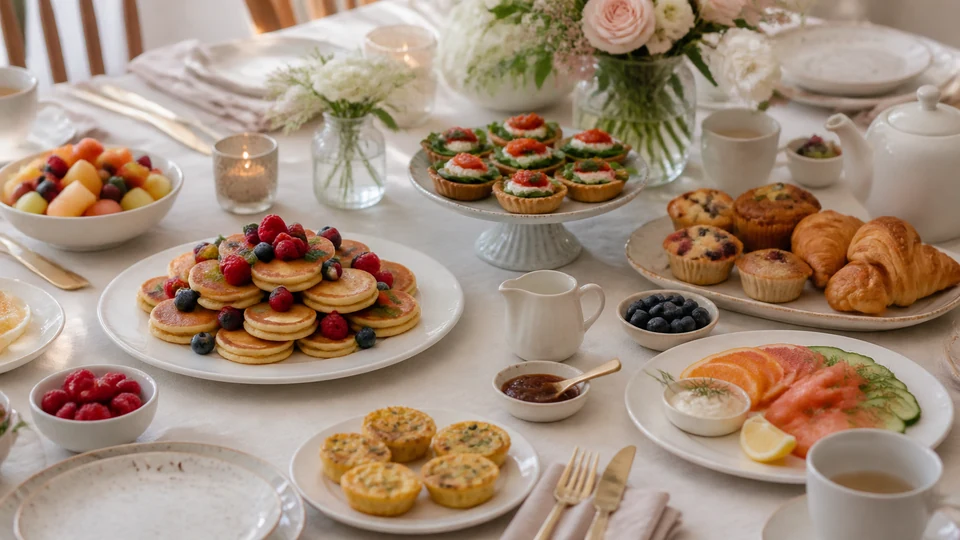
For adjacent decisions around Bridal brunch menu, compare a broad collection of brunch ideas, a one-hour family brunch plan, and an autumn brunch menu system.
| Guide sections |
|---|
| Start with the event constraints, not a list of attractive dishes |
| Choose the service style before the menu |
| Build the menu in functional modules |
| Four editorial menu blueprints |
For broader context, continue with American Breakfast: Pancakes, Diner Plates and Brunch.
Start with the event constraints, not a list of attractive dishes
A bridal brunch menu succeeds operationally when guests can identify what they can eat, the kitchen can produce the selected food on time, and the service team can keep it at safe temperatures. Styling comes after those conditions. A long menu is not automatically more generous: every additional hot pan, chilled platter, garnish and drink dispenser requires space, equipment, labor, utensils and monitoring.
Create a one-page event brief before choosing recipes. Record:
- confirmed and pending guest counts;
- the meal’s start, expected service window and room-access time;
- buffet, family-style or plated service;
- preparation location and any transport between kitchens;
- refrigerator, freezer, oven, stovetop and holding-equipment capacity;
- sink, handwashing, dishwashing and waste arrangements;
- known food allergies and dietary requirements reported by guests;
- available cooks, runners, servers and cleanup staff;
- local rules that apply to the preparation and service arrangement;
- the person who has final authority over food safety and timing.
University of Minnesota Extension advises matching a group menu to the occasion, the people being served, equipment, location, labor and type of service. Its guidance also recommends standardized quantity recipes for 25 or more people because household recipes do not always scale proportionally, especially baked foods and preparations that use thickeners. This does not establish a universal cutoff for professional catering; it gives a prudent planning boundary for group cooking.
Choose the service style before the menu
The same foods behave differently in a buffet, on shared tables and on composed plates. Decide which system the room and team can actually support.
Buffet
A buffet lets guests choose among identified dishes, but portion control is less predictable. It also creates temperature, replenishment, utensil and traffic tasks. Select foods that can be served cleanly without complex last-minute assembly. Plan small platters with cold or hot backup rather than one oversized display.
Use a buffet when the team has reliable holding equipment, enough serving pieces, a clear replenishment route and someone assigned to the line. Do not choose it merely because it appears informal or easy.
Family-style tables
Family-style service can create a shared-table atmosphere, but every table needs the correct dishes, serving utensils and allergen information. Hot food cools and cold food warms while it waits to circulate. Guests may also pass utensils between dishes, which complicates cross-contact control.
Use this format only when table space, server coverage and replenishment are sufficient. Keep portions modest and replace dishes on a controlled schedule.
Plated service
Plated service gives the kitchen better portion control and creates a clear handoff, but it demands coordinated assembly and accurate guest records. Alternate meals must reach the correct people. The pass needs enough space, clean plates and staff to prevent the first plates from waiting while the last are assembled.
Use plated service when the team can manage seat information and simultaneous service. A beautiful plate that waits at an unsafe temperature is not a successful plan.
Boxed or individually wrapped service
An individual format can reduce shared handling and make labels easier to attach. It also shifts the work to packing, storage and distribution. Each package needs a clear identity, and perishable contents still require temperature control.
This format suits a short, mobile or outdoor gathering only when cold storage, transport and disposal are planned. Packaging alone does not make food shelf-stable.
Build the menu in functional modules
Use modules to control complexity. Each module should answer a distinct guest or service need, and every dish should justify the equipment and labor it consumes.
1. A substantial anchor
Choose one main item that establishes the meal. It might be an egg casserole from a standardized quantity recipe, a baked savory dish, a composed cold plate, or another group-tested formula. If the anchor is hot, confirm cooking, holding and reheating equipment. If it is cold, confirm refrigeration and ice-supported service.
Do not offer several competing anchors unless the kitchen can hold each one correctly. A second anchor should solve a real requirement, such as a separately prepared plant-based lane, not simply add visual abundance.
2. A clearly separate plant-based option
Build this as a complete plate component, not a garnish. Beans, grains, vegetables, fruit, nuts, seeds, soy products and breads can all introduce allergens or other restrictions, so “plant-based” is not a safety label. Keep its preparation utensils and service identity distinct when cross-contact control matters.
Select a formula with an explicit yield. Confirm whether it needs reheating, refrigeration or last-minute dressing. If it requires the same oven shelf and service minute as the main anchor, it is not operationally independent.
3. Bread, grain or another simple base
This module can add structure without another temperature-sensitive pan. Choose a standardized baked formula, purchased bread with labels retained, or a grain dish that the team can safely cool, hold and serve. Avoid assuming that a familiar household bake can be multiplied directly for a large group.
Keep spreads and accompaniments separately labelled. Butter contains milk; nut and seed spreads require specific identification; jams and packaged products need their original labels available for review.
4. Fruit or vegetables
Whole fruit can reduce cutting and cold-storage work. A cut-fruit platter offers easy service but must stay refrigerated at 40°F or below until service and remain cold on display. Vegetable salads and cooked vegetable sides need their own temperature and dressing plan.
Choose color and texture contrast as University of Minnesota Extension suggests, but treat that as menu variety, not a nutrition or health promise. One well-managed produce item is better than several trays competing for refrigerator space.
5. A sweet finish
The sweet lane should be portionable, labelable and compatible with the remaining equipment. A room-temperature baked item without perishable filling may simplify service; a custard, cream-filled pastry or chilled dessert adds cold-holding demands. Recipes involving raw or lightly cooked eggs require the egg-safety controls described later.
Keep the sweet finish small enough to eat without complex cutting on the buffet. If slices must be cut during service, assign a utensil and a clean work area.
6. Drinks
List water first as an operational item: dispenser capacity, cups, refill route and spill control. Then add coffee, tea, juice or another drink only when brewing, chilling, ice, milk, sweetener and allergen identification are covered.
Milk and many alternatives are perishable. Put out small quantities, keep backup cold and replace containers rather than combining old and new product. Alcohol decisions depend on the host, venue, guest group and law; this guide does not establish an occasion rule.
Four editorial menu blueprints
These are modular ideas, not tested menus, quantity prescriptions or claims that a particular bridal event should follow a theme. Replace each placeholder with a reliable standardized recipe and document its yield.
Blueprint A: one hot pan, mostly cold support
- standardized hot egg or savory casserole;
- separately prepared plant-based grain-and-vegetable dish;
- purchased or standardized bread with labelled spreads;
- washed, cut fruit held cold;
- portioned room-temperature baked sweet;
- water, coffee and a cold drink.
This arrangement concentrates oven work in one anchor. It still requires 160°F cooking for egg casseroles, 140°F or warmer hot holding, and 165°F reheating if a cooked egg dish was refrigerated for later service. Cold fruit and milk service need a 40°F-or-below plan.
Blueprint B: cold assembled brunch
- composed cold grain or bean cups from a quantity recipe;
- labelled sandwiches or wraps with a separately prepared alternative;
- whole fruit plus one chilled cut-fruit tray;
- individually portioned baked item;
- cold beverages with controlled ice and refill.
This removes hot holding but increases refrigeration, wrapping and label work. “Cold” does not mean low-risk. Perishable sandwiches, cut produce, dairy and prepared grains must remain cold, and the team needs a controlled release plan.
Blueprint C: plated savory brunch
- one standardized savory main;
- one vegetable component;
- one bread or grain element;
- a small fruit finish;
- a separately plated alternate meal using distinct utensils;
- table water and staffed hot-drink service.
This can simplify buffet traffic, but plate assembly becomes the critical path. Test the service sequence on paper: how many clean plates fit, who portions each component, where alternate meals wait, who verifies the seat, and how hot and cold components avoid a long shared hold.
Blueprint D: tea-table style with controlled replenishment
- small sandwiches from documented formulas;
- one warm bite released in batches;
- labelled plant-based savory item;
- whole and cut fruit;
- small baked sweets;
- tea, coffee and water.
The visual effect comes from smaller pieces, not from leaving all food out at once. Use replacement platters. Keep cold backups refrigerated and hot backups in verified hot holding. Retain ingredient labels for breads, fillings, spreads and sweets.
Determine quantities from yields, not folklore
There is no authoritative evidence here that every brunch guest eats a fixed number of pastries, eggs or sandwiches. Appetite, event length, service type, menu overlap, age mix and whether this is the day’s main meal all matter. Avoid internet rules presented without a tested recipe or service context.
Use a yield worksheet:
- Record the current confirmed guest count and a separately approved contingency count.
- For each standardized recipe, copy its stated total yield and serving size.
- Decide which guests can eat the dish based on reported requirements and the exact ingredient list.
- Set the intended portions per eligible guest as an event decision, not a universal fact.
- Calculate the required number of complete recipe batches.
- Check whether the oven, pans, refrigerator, mixer and cooks can produce those batches.
- If capacity fails, simplify the menu or choose a true quantity recipe; do not silently shrink portions.
For 25 or more, University of Minnesota Extension recommends quantity recipes designed for group yields. If only a family recipe exists, its advice is to make a single batch repeatedly rather than treating a large multiplication as automatically proportional. Baked foods and thickened preparations are specifically called out as scaling concerns.
Record actual yield during preparation only if the team has genuinely made the recipe. Do not invent a yield to make the spreadsheet balance. Until a project test exists, Pancake World should present menu architecture as editorial guidance and leave Recipe schema unused.
Run a capacity test before accepting the menu
Create a grid with dishes as rows and resources as columns. Mark every period when a dish occupies a refrigerator shelf, freezer area, oven rack, burner, mixer, sink, worktable, hot holder or transport cooler.
Ask these questions:
- Can the refrigerator hold ingredients, prepared cold food and backup platters without crowding airflow?
- Can the oven cook the anchor and any baked sweet at their required times and temperatures?
- Is verified hot-holding equipment available after cooking?
- Does each cold platter have refrigerator or ice support until release?
- Are enough food thermometers available and assigned?
- Can raw animal foods remain separated from ready-to-eat fruit, bread and garnishes?
- Is there a clean handwashing point for every preparation location?
- Do servers have a route that does not cross dirty dish return?
- Is there a labelled holding area for alternate meals?
If two critical dishes require the same oven rack at the same time, the menu is not ready. Move one item to a cold, room-temperature-safe or earlier production lane, or remove it. Complexity should be reduced before staff are asked to improvise.
Design the make-ahead schedule by food state
Do not label an entire dish “make ahead” without specifying what state is safe and useful at each step.
Procurement state
Retain packaged labels and lot information where practical. Keep refrigerated ingredients cold during transport. Separate raw meat, poultry, seafood and eggs from produce and ready-to-eat food in carts, bags and storage.
Washed or cut state
FDA advises washing produce under running water and does not recommend soap, detergent or commercial produce wash. Wash hands for at least 20 seconds, use clean surfaces and keep produce tools separate from tools used for raw animal foods. Refrigerate perishable and cut produce at 40°F or below.
Cooked and cooling state
Use a food thermometer and the safe minimum temperature for the selected food. FoodSafety.gov lists distinct targets for poultry, ground meats, whole cuts, seafood, eggs and leftovers. Do not infer safety from color or texture. Divide large amounts of leftovers or cooked food intended for later use into shallow containers for faster cooling, label them and refrigerate promptly.
Ready-to-reheat state
FDA says refrigerated egg dishes prepared for later service should be thoroughly reheated to 165°F. USDA also uses 165°F for reheating leftovers. Reheating is a separate step from hot holding: first reach the reheating target, then move the dish to equipment verified to hold it at 140°F or warmer.
Ready-to-serve state
Release a small hot or cold platter with a clean utensil and start its service clock. Keep backups in controlled holding. Do not combine fresh food with a partly used dish. Replace the nearly empty platter and remove it from service.
Create a realistic production timeline
The exact hours depend on recipes, guest count, equipment and access, so use dependencies rather than a copied wedding countdown.
First planning pass
Confirm the service style, guest information, responsible food lead and local requirements. Select modular dishes and source a standardized recipe for each prepared item. Reject any option whose yield or safety instructions are unclear.
Capacity pass
Map oven, refrigeration, worktable and transport usage. Confirm holding equipment can achieve required temperatures; a warming device that only reaches 110°F or 120°F does not satisfy FDA’s 140°F hot-holding target. Assign thermometers, pans, platters and utensils.
Procurement and label pass
Buy from reliable sources. Keep original packaging or create an accurate ingredient record. Confirm every substitution before purchase because a different bread, stock, spread or milk can change the allergen profile.
Preparation pass
Complete only tasks supported by the recipe and safety plan. Label containers with dish, production state, time, temperature requirement and responsible person. Keep raw and ready-to-eat lanes separate.
Service pass
Record cooking or reheating temperatures, holding temperatures and platter release times. Use small batches. The food lead decides when to replace or discard food; decorative staff should not refill a used dish from fresh stock.
Closeout pass
Remove perishable food before its time limit, cool appropriate leftovers in shallow containers and record disposition. Do not automatically send food home with guests unless cold transport and prompt refrigeration are credible. Discard food when its time or handling history is uncertain.
Assign roles that match the risk
One person should be in charge of the food event, consistent with University of Minnesota Extension guidance. That lead needs authority to simplify service, hold a dish back or discard it.
Useful roles include:
- food lead: owns menu, recipes, safety log and final decisions;
- cold lead: verifies refrigerators, ice and cold platter release;
- hot lead: records cooking, reheating and holding temperatures;
- allergen and alternate-meal lead: retains labels and verifies named plates;
- buffet runner: replaces platters and watches utensils and service times;
- beverage lead: manages water, hot drinks, cold milk and refill sanitation;
- dish and sanitation lead: separates dirty returns from clean service items;
- closeout lead: records leftovers, cooling and disposal.
At a small event, one person may hold more than one role, but the responsibilities must still be explicit. A helper who does not know the formula, label or service clock should not improvise substitutions or consolidate trays.
Handle allergens as a communication and separation system
FDA identifies nine major food allergens: milk, eggs, fish, crustacean shellfish, tree nuts, peanuts, wheat, soybeans and sesame. A bridal brunch can contain several in breads, pastries, egg dishes, nut toppings, spreads, plant-based milks and sauces.
Collect guest-reported information privately and early, but do not make medical decisions for guests. For each dish:
- retain the complete ingredient and packaged-label record;
- identify the major allergens in plain language;
- document substitutions;
- use distinct preparation equipment where the plan requires it;
- cover and label alternate meals;
- provide a dedicated service utensil;
- train servers not to guess;
- state honestly when cross-contact cannot be controlled.
“Gluten-friendly,” “dairy-free” or “vegan” should not be used as an allergen guarantee. A food may omit an ingredient and still encounter cross-contact. A guest with a diagnosed allergy should follow their established medical plan and decide whether the documented controls are sufficient.
Apply egg safety to the centerpiece and sauces
Egg casseroles, quiches, custards and sauces are common candidates for brunch, but this article does not claim they are required. If selected, follow FDA egg guidance.
Keep eggs refrigerated at 40°F or below. Cook casseroles and other egg dishes to 160°F, verified with a food thermometer. If an egg dish is cooked, refrigerated and served later, reheat it thoroughly to 165°F. Keep it at 140°F or warmer during hot service and release small platters.
For recipes served raw or undercooked, such as some sauces or custards, FDA directs consumers to use pasteurized shell eggs or pasteurized egg products. Do not assume lemon juice, alcohol, whipping or a familiar family method controls the hazard. When the team cannot execute the egg control confidently, choose a fully cooked or commercially pasteurized alternative with its label retained.
Control the buffet, not just the kitchen
FDA recommends cold food at 40°F or below and hot food at 140°F or above. Perishable food left at room temperature for more than two hours should be discarded unless it has been kept hot or cold; when the ambient temperature is above 90°F, the limit becomes one hour.
Use a service log with dish name, release time, starting temperature, holding method, check time, action and initials. Put out small platters. Store cold backups in the refrigerator and hot backups in appropriate hot holding. Replace a nearly empty dish instead of adding fresh food to it.
Give each platter its own utensil. Position handles so they do not fall into food. Replace a dropped or contaminated utensil with a clean one. Keep guest traffic away from backup storage and alternate meals. If the event continues longer than planned, do not extend a platter’s safe time because food remains.
Leftovers need a decision before the event
Decide in advance which prepared foods are eligible for cooling and which will be discarded after service. A platter that has spent an uncertain time on a table is not a suitable take-home gift.
Refrigerate eligible leftovers promptly in shallow covered containers. USDA’s general guidance uses a three-to-four-day refrigerator boundary and 165°F for reheating leftovers. A standardized recipe may have a shorter direction; follow the stricter applicable limit. Label the container with the food and refrigeration date.
If guests will take food, provide it only when the service history is known and cold transport is available. FDA’s two-hour rule still applies during travel, and the hot-weather boundary is one hour. When in doubt about time or temperature control, discard the food.
Final menu acceptance checklist
A bridal brunch menu is ready for production only when every item can answer “yes” to the relevant checks:
- Does it have a reliable recipe with a stated yield and serving size?
- Does the guest count calculation use that yield rather than an invented portion rule?
- Does it solve a specific menu function?
- Is its ingredient and allergen record complete?
- Is preparation ownership assigned?
- Are refrigeration, cooking, cooling, reheating and holding requirements known?
- Is the required equipment available at the correct time?
- Does it have a clean service utensil and labelled backup location?
- Is the release and discard clock defined?
- Can the menu still run if a decorative element is late?
- Are alternate meals protected and matched to the correct guests?
- Is closeout and leftover disposition defined?
If a dish fails one of these questions, simplify or replace it before production. The event does not need more menu items than the team can execute safely.
Frequently asked questions
How many dishes should a bridal brunch menu include?
There is no universal authoritative number. Use functional modules: an anchor, a substantial alternative where needed, a bread or grain, produce, a simple sweet and drinks. Remove duplication and test each item against equipment, labor and holding capacity.
How much food should I plan per guest?
Use standardized recipe yields and an event-specific portion decision. Record the eligible guest count for each dish, intended servings per person and full recipe batches required. Do not rely on unsupported pastry, egg or sandwich rules.
Is a buffet easier than plated service?
Not automatically. A buffet reduces individual plate assembly but increases temperature monitoring, replenishment, utensil, traffic and less predictable portion tasks. Select the format the venue and team can support.
Can everything be prepared the day before?
Only when each selected recipe and safety plan supports that production state. Some items can be mixed, cooked, cooled or portioned ahead; others need last-minute cooking or assembly. Record the safe state, storage, reheating target and service plan for each item.
What temperature should brunch food be held at?
FDA advises keeping hot food at 140°F or warmer and cold food at 40°F or colder. Cook and reheat foods to their separate required internal temperatures before holding them; hot holding is not a substitute for cooking or reheating.
How should egg dishes be handled?
Keep eggs cold, cook casseroles and other egg dishes to 160°F, and reheat refrigerated egg dishes to 165°F before service. Keep hot egg dishes hot, cold egg dishes cold, and use pasteurized eggs or egg products for recipes served raw or undercooked.
How do I offer an allergy-aware option?
Start with the exact guest requirement, retain all ingredient labels, prevent cross-contact as far as the preparation environment allows, cover and identify the alternate meal, use a dedicated utensil and train servers not to guess. Never promise an allergen-free environment unless it is genuinely controlled and verified.
Is this a tested Pancake World menu?
No. The blueprints are editorial planning examples grounded in authoritative group-planning and food-safety guidance. Individual dishes still require reliable quantity recipes and their own evidence or genuine project test records.
Explore related Pancakes World guidance on American Pancakes, Maple Syrup, and Maple Syrup Pancakes.
Sources and editorial references
- University of Minnesota Extension, “Planning the quantity food occasion”:
https://extension.umn.edu/cooking-safely-crowd/planning-quantity-food-occasion - FoodSafety.gov, “Food Safety by Events and Seasons”:
https://www.foodsafety.gov/keep-food-safe/food-safety-by-events-and-seasons - USDA Food Safety and Inspection Service, “Cooking for Groups: A Volunteer's Guide to Food Safety”:
https://www.fsis.usda.gov/food-safety/safe-food-handling-and-preparation/food-safety-basics/cooking-groups - U.S. Food and Drug Administration, “Serving Up Safe Buffets”:
https://www.fda.gov/food/buy-store-serve-safe-food/serving-safe-buffets - U.S. Food and Drug Administration, “What You Need to Know About Egg Safety”:
https://www.fda.gov/food/buy-store-serve-safe-food/what-you-need-know-about-egg-safety - FoodSafety.gov, “Cook to a Safe Minimum Internal Temperature”:
https://www.foodsafety.gov/food-safety-charts/safe-minimum-internal-temperatures - U.S. Food and Drug Administration, “Selecting and Serving Produce Safely”:
https://www.fda.gov/food/buy-store-serve-safe-food/selecting-and-serving-produce-safely - U.S. Food and Drug Administration, “Food Allergies”:
https://www.fda.gov/food/nutrition-food-labeling-and-critical-foods/food-allergies - Centers for Disease Control and Prevention, “Preventing Food Poisoning”:
https://www.cdc.gov/food-safety/prevention/ - USDA Food Safety and Inspection Service, “Leftovers and Food Safety”:
https://www.fsis.usda.gov/food-safety/safe-food-handling-and-preparation/food-safety-basics/leftovers-and-food-safety