Bridal brunch ideas
At Pancakes World, choose a bridal brunch idea by deciding what the gathering must do before choosing food. A relaxed shower needs conversation space and easy self-service; a formal celebration needs assigned places and controlled pacing; a drop-in event needs small replenished platters; a planning brunch needs a quiet table and a firm finish time. Match one service model—seated, buffet, stations or mixed—to the room, guest count, refrigerator, oven and available helpers. Then repeat a simple visual cue across linens, labels and one focal display instead of turning every dish into decoration. Keep perishable cold food at 40°F (4°C) or below, hot food at 140°F (60°C) or above, and give one person responsibility for the service clock.
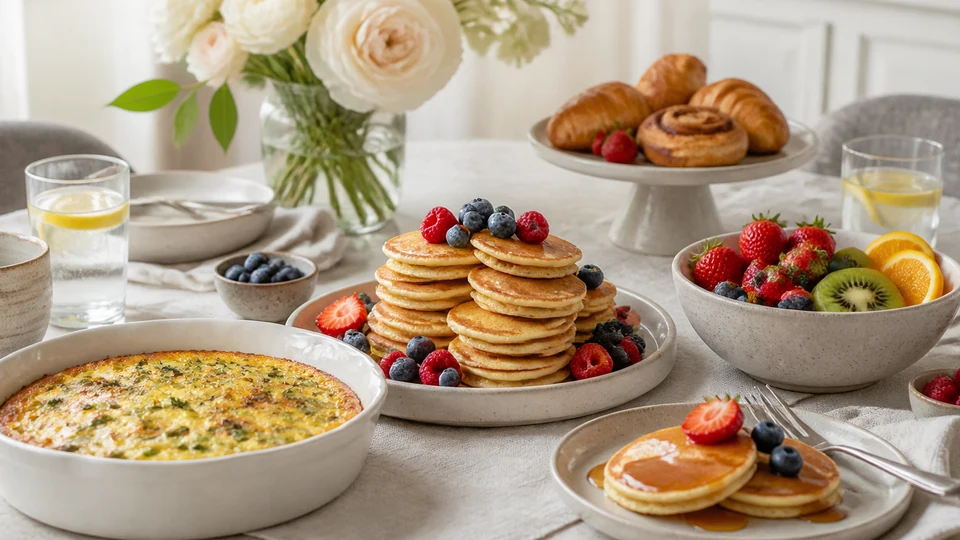
This guide helps select and operate a coherent event concept. It is not a tested recipe collection, a complete menu, a list of compulsory bridal traditions or a wedding-day party schedule. Visit the brunch hub for the wider topic, or Pancake World for the full editorial collection.
For broader context, continue with American Breakfast: Pancakes, Diner Plates and Brunch.
Begin with the purpose of the brunch
“Bridal brunch” can describe several genuinely different gatherings. Before saving decoration ideas, write one sentence that completes this prompt: “When guests leave, the event should have accomplished…” The answer might be welcoming two families, celebrating with a gift shower, giving distant guests a calm visit, thanking helpers, or creating time for wedding planning.
That sentence controls the practical design:
- Conversation first: choose low-noise service, generous seating and food that does not require constant announcements.
- Gift opening or activities: keep the food area out of the viewing path and build a pause between eating and the activity.
- Introductions: use mixed seating or light movement so the same small groups do not stay isolated.
- Planning or decisions: give the meeting a separate agenda; do not expect guests to discuss logistics while balancing plates in a buffet line.
- Drop-in hospitality: design for staggered arrivals, small tray replacement and clear self-service labels.
- Thank-you gathering: reduce host labor during service so the people being thanked are not immediately recruited to run the event.
No purpose is automatically more elegant or traditional. The useful choice is the one that matches the people, room and available labor.
Choose the service model before the aesthetic
University of Minnesota Extension distinguishes buffet, family-style and plated service because each changes handling, portion control, equipment and labor. A bridal brunch can also combine models, but each transition adds work.
Seated and plated
Use a seated model when conversation, speeches or a more controlled sequence matters. Guests receive defined portions and do not form a line. The tradeoff is labor: someone must plate, carry, clear and keep hot and cold components under control. The kitchen needs enough landing space to assemble plates without confusing allergen-related alternatives.
A plated concept works best when the selected recipes can be produced consistently for the group. For 25 or more people, Extension guidance favors standardized quantity recipes. A household recipe multiplied on paper may change pan depth, mixing behavior and cook time, especially for baked or thickened foods.
Buffet
A buffet supports choice and informal conversation. It also loosens portion control and exposes food to repeated handling. Use an entry and exit direction, put plates first, move drinks to another surface and prevent guests with used plates from crossing the replenishment route.
FDA recommends several small platters rather than putting the full quantity out. Cold backups remain refrigerated; hot backups remain under verified hot holding. Replace a nearly empty dish instead of adding new food to it. This model needs a food lead who tracks time, holding temperature and utensils throughout the event.
Stations
Stations distribute people across the room. A griddle or pancake finish, fruit area, savory table and beverage station can reduce one long queue, but only if every station has the equipment, staff and safety control it needs. An interactive station is not self-operating. A hot appliance needs a competent attendant, a safe cable route, a landing zone and protection from children or crowded sleeves.
Use stations for meaningful decisions, not for novelty. If each station offers the same breads and toppings in different containers, the room becomes more complicated without adding real choice.
Family-style
Shared dishes at the table feel communal and keep guests seated. They require enough serving utensils, reachable table space and a plan for replenishment. Passed hot dishes cool while they travel, and guests may accidentally move a utensil between foods. Keep the number of shared dishes modest and label alternatives clearly.
Mixed service
A practical hybrid might seat guests for one prepared centerpiece while offering cold fruit and baked items from a controlled buffet. It can combine calm pacing with choice. Define exactly where the transition occurs; otherwise, staff may try to plate, replenish and clear at the same time.
Eight bridal brunch concepts with distinct operating logic
These are editorial frameworks, not claims about universal preferences or complete tested menus. Each still requires authoritative recipes, verified yields and the appropriate safety plan.
1. Conversation-table brunch
Arrange one or more tables so guests can hear across them. Use seated or family-style service with a restrained number of components. Put drinks within reach without crowding the food, and leave space for place cards that carry accurate ingredient or allergen information when needed.
This concept suits introductions and a deliberate pace. Its constraint is table real estate. Tall centerpieces, multiple shared platters and individual glasses can compete for the same surface. Mock the table with empty serving dishes before event day.
2. Open-house bridal brunch
For staggered arrivals, keep the display small and refresh it from controlled backups. Choose food formats that can be portioned into successive platters. Record when each perishable tray leaves refrigeration or hot holding; a late guest should receive a new tray, not food that has waited since opening.
Create a simple arrival path: welcome point, clean plate, savory choice, lighter or fresh choice, sweet finish, drinks, seating. Invitations need a clear arrival window and final service time so “drop in” does not imply unlimited food availability.
3. Garden-inspired indoor brunch
The concept comes from color, herbs, flowers and produce shapes, not from exposing food outdoors or using unsafe decorations. Use one repeated botanical cue on labels or linens. Confirm that anything touching food is intended for food contact and that decorative plants cannot shed soil, petals or chemicals onto platters.
An indoor version reduces weather uncertainty while keeping the visual direction. If doors are open or guests move outside, plan insect protection and temperature control. Do not use outdoor air temperature as a refrigerator.
4. Pancake finishing station
Build the idea around a controlled base and separate finishes. The source recipe determines batter handling, cooking and yield. Keep raw batter away from ready-to-eat toppings, never let guests taste uncooked batter, and assign an operator to the hot surface.
The station can offer clearly labelled finishes without turning each option into a medical or nutrition claim. Keep cut fruit and dairy-based additions cold. Use small containers and replace them rather than topping up handled dishes. This concept consumes labor and electrical capacity, so it works only when an operator can remain at the station.
5. Tea-table brunch without etiquette theater
Use smaller portions, cups and a calm seated rhythm without claiming that a particular arrangement is historically mandatory. The design can repeat one china color, napkin fold or label style. Avoid fragile stacks that guests must dismantle and food that requires balancing several tiny plates.
Hot beverages need a stable service point away from the main food queue. Handles should face safely, cords should not cross walking paths, and refills should be managed by someone who can see the temperature and traffic risks.
6. Seasonal color brunch
Choose a color family from produce, linens and one baked or savory presentation. Seasonality is a creative cue here, not a claim that a food is locally available, cheaper or more nutritious. Verify actual availability before finalizing recipes.
Contrast still matters. A table of foods chosen only because they are pale pink or green can repeat the same soft texture. Use a service matrix that varies shape, temperature and eating method while preserving the visual palette.
7. Shared-story brunch
Invite a small number of contributors to provide a written memory, recipe source or photograph for a display. Keep the story display away from food preparation and serving surfaces. If a family recipe is used, assess it as a food process rather than treating age or sentiment as evidence of safety.
Recipes with raw or lightly cooked eggs, long room-temperature holding or unclear yield need an authoritative adaptation. Document any change and do not claim the original was tested by Pancake World.
8. Calm planning brunch
Separate the meal from the agenda. Feed guests first, clear the table, then open a short list of decisions with a named facilitator and finish time. Do not combine a detailed wedding-planning meeting with an interactive cooking station.
This concept uses a simpler service model so attention can move to decisions. The host should specify which attendees are decision-makers and which are social guests; otherwise, a celebratory invitation can turn into unexpected work.
Use a concept decision matrix
Score each concept against facts rather than imagined perfection:
| Factor | Question | Evidence to check |
|---|---|---|
| Purpose | What must the gathering accomplish? | one-sentence event brief |
| Guest movement | seated, circulating or staggered? | room plan and invitation window |
| Service | plated, buffet, stations, family-style or mixed? | trained helpers and tableware |
| Cold capacity | can backups stay at 40°F or below? | measured refrigerator/cooler space |
| Hot capacity | can food stay at 140°F or above? | verified holding equipment |
| Production | do recipes have validated yields? | authoritative or standardized recipes |
| Allergens | can alternatives be identified and protected? | ingredient labels and process map |
| Labor | who cooks, replenishes, monitors and clears? | named assignments |
| Room | do food, drinks, activities and disposal conflict? | taped floor plan or empty-room walk-through |
| Finish | how does service close? | stated last service and cleanup time |
A concept fails when a critical resource is missing, even if the styling is attractive. A station brunch without an attendant is not ready. A cold buffet without refrigerator or ice capacity is not ready. A plated brunch without people to plate and clear is not ready.
Translate the concept into zones
Every room needs functions, even when those functions share furniture.
Arrival zone
Keep greetings, gifts and coats away from the food line. A guest should not have to place a handbag on a buffet table to free a hand. Put an event note here: where to sit, whether food is already open, and when any activity begins.
Food zone
Create a clear start with clean plates. Arrange food in the intended sequence and give every item its own utensil. Leave enough space to remove a tray without reaching over other food. Reserve a route behind or beside the table for controlled replacements.
Beverage zone
Separate drinks from food. Cups, ice, kettles and refills create congestion and spills. Cold perishable additions stay at 40°F or below. Hot-water equipment needs a stable surface and managed cords.
Seating zone
Match seating to the purpose. A circulating open house still needs places for guests who cannot or do not want to stand. A planning brunch needs a writing surface. A gift-opening layout needs sight lines that do not block the buffet.
Backup zone
This is controlled food storage, not decorative overflow. Cold platters remain refrigerated, hot food remains at or above 140°F, labels stay with the correct dish, and the food lead can retrieve replacements without moving personal items.
Return and waste zone
Used plates, cups and picks travel away from fresh food. Provide a visible place for waste and a separate landing area for reusable service ware. Do not let used utensils migrate back to a clean buffet.
Turn one visual cue into a coherent design
Choose one anchor—perhaps a botanical line drawing, a pair of colors, a fabric texture or a simple monogram—and repeat it in three places: invitation or welcome note, food labels, and the main table. Stop there. Repetition creates cohesion more reliably than adding a different theme object to every dish.
Keep decorations out of temperature-control equipment, serving space and the replenishment path. Never disguise a warmer, extension cord or ice bath so completely that staff cannot inspect it. Food labels should remain readable under actual lighting and should not use ornamental names in place of ingredient clarity.
Height can organize a display, but raised stands must be stable and reachable. Place heavy or hot dishes low. Do not create a vertical arrangement that requires guests to reach across uncovered food.
Plan invitations and guest information
The invitation should state the start and finish window, service style when it affects dress or arrival, and how to communicate dietary or accessibility needs. Do not ask guests to broadcast medical details to a group. Give one private contact and a response deadline early enough to confirm what can actually be accommodated.
If the event is open house, explain the arrival window and any fixed activity time. If it is seated, request a firm response. If food service ends before the social event, state that plainly.
Guest communication is not a promise that every request can be safely met. The host should verify ingredient labels, kitchen controls and vendor information before confirming an accommodation. FDA identifies nine major allergens in the United States: milk, egg, fish, crustacean shellfish, tree nuts, peanuts, wheat, soybeans and sesame. Other allergies and intolerances also exist.
Build the production boundary
This concept page deliberately does not supply a full menu, but every selected food still needs a controlled production record:
- exact recipe source and version;
- verified yield and serving size;
- planned number of independent batches;
- raw-food separation steps;
- safe cooking endpoint;
- cooling and storage method;
- transport method if prepared elsewhere;
- hot or cold holding requirement;
- serving platter size and replacement plan;
- known major allergens;
- leftover disposition.
For large groups, avoid changing pan depth or multiplying a home recipe mechanically. Extension guidance notes that larger quantities take different time and equipment, and some recipes do not scale in direct proportion. Use standardized quantity recipes or repeat validated batches.
When several people bring food, one coordinator needs the records before event day. “Homemade” is not a safety method. Each contributor should know the arrival time, required temperature, package label and who receives the dish.
Control the buffet clock
FDA guidance sets clear buffet boundaries. Hold hot foods at 140°F or warmer and cold foods at 40°F or colder. Use a food thermometer. Some warmers operate below the required hot-holding temperature, so check equipment instructions and measure the food.
When perishable food is not under hot or cold control, discard it after two hours at room temperature; the boundary becomes one hour when the surrounding air is above 90°F. Track each platter separately. Do not reset the clock by moving an old tray into a refrigerator or mixing it with fresh food.
Use a simple log:
| Tray code | Food | Out time | Holding method | Checked temperature | Removal time |
|---|---|---|---|---|---|
Small trays protect both quality and control. Keep backups refrigerated or properly hot-held. Replace a nearly empty tray rather than topping it up, because handled food and new food have different histories.
Handle delivered and take-out food
Confirm whether the order arrives hot, cold, frozen or ready to serve. USDA advises hot take-out be kept at 140°F or above and cold food at 40°F or below. If service is later, divide hot food into smaller portions and refrigerate it promptly according to guidance rather than leaving it merely warm.
Record delivery or pickup time, observed package condition, temperature when appropriate, storage location and supplier instructions. Do not order more refrigerated platters than the venue can hold. A table in an air-conditioned room is not cold storage.
Keep supplier labels until service and copy known allergens accurately to guest-facing cards. This article does not rate or endorse any supplier.
Include pregnant and other higher-risk guests without assumptions
FoodSafety.gov explicitly includes weddings and large groups in event-safety planning. FDA's pregnancy-aware entertaining guidance emphasizes clean, separate, cook and chill. Those are sensible controls for the entire event, so no guest must disclose a condition to benefit from them.
Use fully cooked recipes with federal category endpoints. Avoid raw or lightly cooked egg preparations unless an authoritative process uses pasteurized egg products and the host can follow it exactly. Keep raw seafood, meat and eggs separate from ready-to-eat food. Refrigerate perishable items promptly.
Do not label an item “pregnancy safe,” “immune boosting” or medically suitable. Accurate ingredients and controlled handling allow guests to make informed decisions; they do not guarantee a health outcome.
Plan a realistic event timeline
Four to six weeks before
- write the one-sentence purpose;
- choose service model and concept;
- measure the room and major equipment;
- identify the food lead and service helpers;
- collect dietary and accessibility information privately;
- select authoritative recipes and verify yields.
One to two weeks before
- finalize the room zones and traffic flow;
- confirm refrigerator, oven, warmer and transport capacity;
- create production cards and allergen records;
- assign recipes and prohibit unapproved last-minute substitutions;
- prepare the tray and holding log;
- test the table layout with empty service ware.
The day before
- make only components whose source allows advance preparation;
- cool cooked food promptly in shallow containers;
- keep raw and ready-to-eat items separated;
- stage clean platters, utensils, labels and thermometers;
- verify refrigerator temperature at 40°F or below;
- clear the backup zone of personal items.
Event day
- cook each food to its category endpoint;
- receive delivered food into proper holding immediately;
- put out only the first small platters;
- start each tray clock when it leaves control;
- monitor actual hot and cold temperatures;
- replace trays and utensils rather than topping them up;
- close food service at the stated time;
- cool safe leftovers promptly in shallow containers.
Common concept mistakes and corrections
The concept requires too much live cooking
Reduce the number of interactive stations or convert one to a prepared, controlled display. One well-run hot station is more useful than three unattended appliances.
Guests cannot tell whether to sit or circulate
State the service model in the welcome note and make the room support it. Place enough seats for those who need them, even at an open house.
Decorations consume the buffet
Keep one focal element and move the rest to arrival or seating zones. Restore landing space for trays, utensils and temperature equipment.
Every dish competes for the oven
Return to the equipment column in the decision matrix. Select a concept with a mix of controlled cold, ambient-stable and hot items, using complete recipes. Do not solve an oven bottleneck by serving perishable food lukewarm.
Alternatives are mixed into the main line
Use clear labels, separate utensils and protected placement. Confirm whether cross-contact can genuinely be controlled. If it cannot, disclose that limitation rather than using an unsupported “free from” label.
The host cannot enjoy the event
Assign a food lead and reduce service complexity. The host should not be the only person who knows the tray clock, replacement location and cleanup plan.
Frequently asked questions
What is the simplest bridal brunch concept?
A seated or small buffet gathering with one clear purpose, a limited number of complete recipes, a separate beverage area and one named food lead is operationally simpler than multiple live stations. “Simple” depends on room and equipment, not a fixed style.
Does a bridal brunch need a theme?
No. A repeated color, material or label style can create coherence without a named theme. The event purpose and service model matter more than decorative terminology.
Can guests bring dishes?
Yes only when the coordinator can collect source, allergen, transport, temperature and arrival information. Distributed preparation increases coordination needs. Unlabelled food should not be placed directly on the buffet.
How much food should be prepared?
Use confirmed attendance, whether the brunch is the main meal, event duration, service style and verified recipe yields. There is no universal pieces-per-person rule. For large groups, standardized quantity recipes are preferred.
How long can the buffet stay open?
Perishable foods can remain available while held at 40°F or below or 140°F or above. Without those controls, the federal two-hour boundary applies, shortened to one hour above 90°F. Track each tray rather than the event as a whole.
Can leftovers be sent home?
Only food with a safe time and temperature history should be kept. Refrigerate it promptly in shallow containers. USDA says properly refrigerated leftovers are generally used within three to four days and reheated to 165°F. Do not send uncertain food with guests.
Final concept checklist
- The purpose fits in one sentence.
- The chosen service style matches the room and guest movement.
- One concept is clearly distinct from a full menu or wedding-day schedule.
- Recipes have reliable yields and safe endpoints.
- Large-group quantities use standardized recipes or repeated validated batches.
- Refrigerator, oven, holding and transport capacity are measured.
- Food, drinks, seating, backups and used dishes have separate zones.
- A named food lead controls trays, time, temperature and replacement utensils.
- Hot food stays at 140°F or above; cold food stays at 40°F or below.
- Perishable trays without control follow the two-hour or one-hour boundary.
- Guest labels identify known major allergens without guaranteeing absence.
- The event closes food service at a stated time and handles leftovers from evidence.
Before committing money or invitations, run one tabletop rehearsal with empty platters, labels, cups and the actual holding equipment. Walk the guest route and the staff replenishment route separately. Confirm that a cold backup can move from refrigerator to table without crossing used dishes, and that a hot tray has a safe landing place. Record any blocked doorway, overloaded outlet, unreadable label or missing utensil as a design failure to correct before the event, not a problem to improvise around while guests are present.
Explore related Pancakes World guidance on American Pancakes, Maple Syrup, and Maple Syrup Pancakes.
Sources and editorial references
- University of Minnesota Extension Planning the Quantity Food Occasion —
https://extension.umn.edu/cooking-safely-crowd/planning-quantity-food-occasion - University of Minnesota Extension Cooking Safely for a Crowd —
https://extension.umn.edu/home-kitchen/cooking-safely-crowd - University of Minnesota Extension Service Style Risks and Safe Practices —
https://extension.umn.edu/cooking-safely-crowd/service-style-risks-and-safe-practices - FDA Serving Up Safe Buffets —
https://www.fda.gov/food/buy-store-serve-safe-food/serving-safe-buffets - USDA FSIS Safe Handling of Take-Out Foods —
https://www.fsis.usda.gov/food-safety/safe-food-handling-and-preparation/food-safety-basics/safe-handling-take-out-foods - FoodSafety.gov Food Safety by Events and Seasons —
https://www.foodsafety.gov/keep-food-safe/food-safety-by-events-and-seasons - FoodSafety.gov Safe Minimum Internal Temperatures —
https://www.foodsafety.gov/food-safety-charts/safe-minimum-internal-temperatures - FDA Food Allergies —
https://www.fda.gov/food/nutrition-food-labeling-and-critical-foods/food-allergies - FDA Entertaining All Year —
https://www.fda.gov/food/people-risk-foodborne-illness/entertaining-all-year-food-safety-moms-be - USDA FSIS Leftovers and Food Safety —
https://www.fsis.usda.gov/food-safety/safe-food-handling-and-preparation/food-safety-basics/leftovers-and-food-safety