Breakfast treats
At Pancakes World, the best breakfast treats fit the occasion, travel well enough for the plan, and still taste intentional at serving time. Choose muffins, scones or quick bread for easy portions; coffee cake or sweet rolls for a shareable centerpiece; pancakes or waffles when people can eat immediately; and filled pastries only when you can protect their temperature and texture. For a useful spread, offer one featured sweet item, something fresh such as fruit, and a savory or protein-containing partner rather than six competing pastries. Check package serving sizes before comparing store-bought choices, label allergens clearly, and refrigerate custard, cream, cheese, egg or meat-filled items promptly.
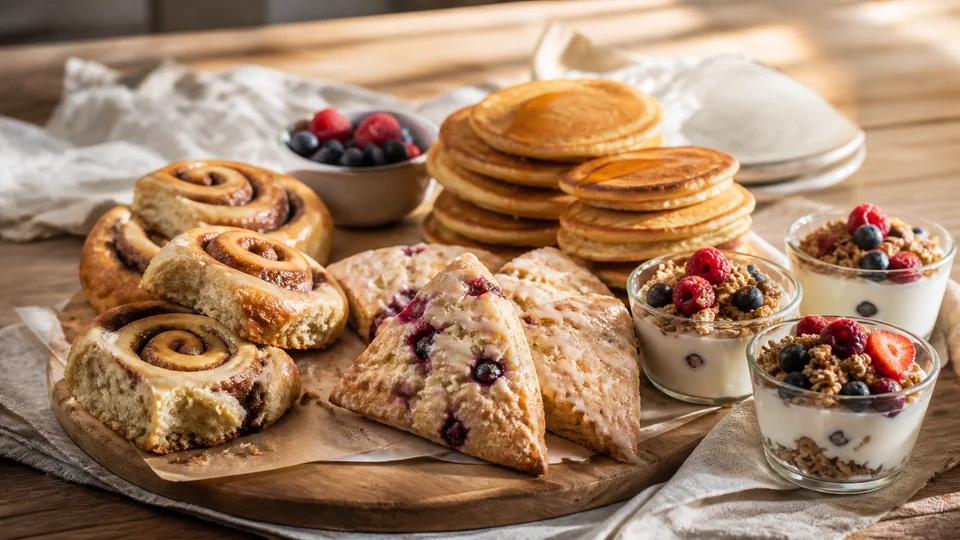
“Treat” describes the role of the food, not a regulated recipe category and not a promise about nutrition. A blueberry muffin can be an everyday breakfast in one household and a celebratory extra in another. This guide helps you select, portion, transport and serve the right format without pretending that every pastry is interchangeable. Browse the breakfast hub for other morning formats, or return to Pancake World for the broader collection.
For broader context, continue with American Breakfast: Pancakes, Diner Plates and Brunch.
What counts as a breakfast treat?
A breakfast treat is a food chosen partly for pleasure, novelty or occasion value during the morning meal. It may be sweet, rich, decorative or simply different from the usual routine. The useful boundary is purpose rather than a fixed ingredient list.
Common formats include:
- muffins, mini muffins and quick-bread slices;
- scones, biscuits and other cut or portioned bakes;
- coffee cake, crumb cake and simple snack-style cakes;
- cinnamon rolls, sticky buns and other sweet yeast rolls;
- croissants, Danish-style pastries and turnovers;
- doughnuts and other fried or baked individual sweets;
- pancakes, waffles, crêpes and French toast served with special toppings;
- fruit bakes, hand pies and tart-like portions;
- cookies or bars deliberately presented as a small morning extra.
The label does not automatically make an item suitable for every breakfast. A loaf that slices cleanly can solve a meeting break; it may be awkward in a moving car. Waffles can be wonderful at a table but deteriorate when stacked under a lid. A cream-filled pastry can look convenient yet create a refrigeration problem during a long buffet.
Start with the service problem, then choose the food. This reverses the common habit of selecting the most attractive photograph and discovering later that the item cannot be portioned, transported or held safely.
A quick decision table
| Treat format | Strongest use | Main advantage | Main risk | Best service plan |
|---|---|---|---|---|
| muffins | office, school event, travel | already portioned | oversized portions or dry texture | pack individually after cooling |
| quick bread | home brunch, gifting | make-ahead and sliceable | uneven slices or crushed loaf | slice shortly before service |
| scones | coffee or tea table | distinct, tidy portions | drying during long holding | bake or refresh near serving |
| coffee cake | relaxed group meal | one-pan centerpiece | messy crumb topping | cut with a serrated knife at the table |
| sweet rolls | celebration | aroma and visual impact | proofing time and sticky transport | serve warm in the baking dish |
| pancakes or waffles | immediate table service | customizable and interactive | rapid loss of texture | cook close to eating time |
| laminated pastries | purchased spread | variety without home production | fragile layers and fillings | use shallow trays; avoid stacking |
| filled pastries | small controlled gathering | clear special-occasion signal | perishable filling and leakage | keep chilled when required |
| doughnuts | casual group treat | easy count and sharing | glazing and staling | buy or finish close to service |
| fruit-forward bake | brunch or dessert-like breakfast | seasonal flavor flexibility | juicy filling softens crust | cool and portion with support |
No row is a universal winner. “Best” means best for your constraints: number of people, available time, eating location, temperature control, cleanup and the role of the treat in the rest of the meal.
Choose by occasion, not by trend
An ordinary weekday
Keep the treat easy to portion and pair. One muffin, one small scone or one quick-bread slice can sit beside fruit, yogurt, eggs or another familiar breakfast component. The goal is a pleasant addition, not a buffet that requires weekday catering.
If buying a package, decide how many pieces actually equal the labeled serving. The FDA explains that Nutrition Facts normally describe one serving and that packages can contain more than one. A single wrapped item can still represent multiple labeled servings, while several small pieces may form one serving. Read the numbers instead of judging by the wrapper.
A weekend breakfast at home
Choose a format that benefits from immediate service. Pancakes, waffles, French toast and warm scones make sense when the cook and diners share the same clock. Build a simple sequence: cold accompaniments ready first, table set, hot item cooked last. That protects texture and lets the cook sit down sooner.
Avoid committing to three hot formats. Pancakes plus eggs plus fried potatoes can overload the stovetop and turn a relaxed morning into a queue. One hot centerpiece with room-temperature or chilled companions is usually easier to execute.
A celebration brunch
Select one visual centerpiece and one practical backup. Sweet rolls, a coffee cake or a fruit-topped bake can provide ceremony. Muffins or sliced quick bread can cover late arrivals and people who want a smaller piece. Label fillings and major allergens; do not force guests to reverse-engineer a glaze or nut topping.
Variety should come from contrast, not count. A soft cinnamon roll, a crisp fruit plate and a savory egg dish provide more meaningful choice than four similar iced rolls in different shapes.
An office or community table
Favor clean portions, minimal utensils and stable transport. Mini muffins, small scones, unfrosted loaf slices and simple bars are easier to distribute than a tall cake or syrup-heavy waffle station. Bring tongs or a serving spatula instead of expecting people to use their hands.
Plan waste before purchasing. Count expected guests, decide whether the treat is the entire breakfast or one component, and allow a modest buffer. An enormous mixed box can look generous while leaving a pile of drying half-pastries.
A gift or doorstep delivery
Choose a food that tolerates the journey and state storage needs clearly. A plain quick bread or sturdy muffin generally handles movement better than a custard-filled pastry or a heavily glazed stack. Cool baked goods fully before wrapping so trapped steam does not soften the exterior. Protect the item from crushing with a rigid container.
Do not present a perishable filled item as shelf-stable simply because it is baked. If the filling, frosting or topping requires refrigeration, keep it cold and tell the recipient.
Build a focused treat spread
Use a four-part planning grid.
1. The featured treat
Pick one item that earns the attention: warm rolls, berry muffins, a cardamom coffee cake, a seasonal quick bread or crisp waffles. This is where texture, aroma and presentation matter most.
2. A fresh counterpoint
Fruit is an obvious option, but the principle is broader: offer something juicy, crisp, tart or lightly dressed to contrast with a soft, sweet bake. Citrus segments, sliced melon, berries or a simple fruit mixture can perform this role. Keep cut fruit chilled until service.
3. A savory or protein-containing partner
Depending on the meal, that could be eggs, yogurt, cottage cheese, beans, smoked fish, tofu, nuts or seeds. The item is not included to “cancel” the treat. It creates a more varied breakfast and gives guests another path through the table.
4. Drinks and condiments
Coffee, tea, water and milk-based drinks should not compete for the same last-minute equipment as the food. Set out cups, water and shelf-stable condiments before cooking the hot component. Refrigerate milk and other perishable additions until needed.
Limit optional toppings. Butter, one preserve and perhaps a simple nut or seed topping are easier to understand than twelve jars. If a baked item already has filling, glaze and streusel, more sweetness rarely solves a service problem.
How to compare store-bought breakfast treats
Packaging can make two items look comparable when their serving bases differ. Use a consistent sequence.
Step 1: read serving size and servings per container
The FDA states that serving sizes are based on amounts people typically consume, not on a recommendation for how much an individual should eat. Note the household measure and gram weight, then note how many servings are in the container.
If one label describes half a muffin and another describes one full muffin, comparing the printed numbers directly will mislead. Put both on the same actual portion or gram basis before deciding.
Step 2: compare the fields relevant to your choice
The Nutrition Facts label provides calories, saturated fat, sodium, total carbohydrate, fiber, total sugars, added sugars, protein and listed micronutrients. For a treat comparison, added sugars, saturated fat, sodium and serving size often reveal differences that the package front obscures. That does not declare one product “good” and another “bad”; it gives the buyer common data.
Use percent Daily Value as the FDA intends: a navigation aid for how much a nutrient in one labeled serving contributes to a daily diet. It is not a personal prescription and does not replace advice for a specific medical condition.
Step 3: check the ingredient and allergen statements
Look for the ingredients that matter to your guests. Wheat, milk, egg, soy, peanuts, tree nuts and sesame commonly appear across baked goods, glazes and fillings. Shared equipment and cross-contact statements can matter even when the item name sounds simple.
Do not infer that “fruit,” “oat,” “bran” or “whole grain” in a product name settles the entire comparison. Read the full label. Likewise, a miniature item is not automatically lower in anything if several pieces make the usual portion.
Step 4: assess freshness and handling
Look at the sell-by or use-by information provided by the seller, package integrity and any refrigeration statement. Reject damaged packaging or items that have been held contrary to their label. Ask how a bakery wants a perishable product stored if the instructions are unclear.
Step 5: buy the format you can serve well
A slightly less elaborate pastry served intact and fresh is often a better choice than a fragile item crushed in transit. Count, tray dimensions, transport time and refrigeration space are legitimate selection criteria.
Baking at home: choose a tested formula
This page is a selection guide, not a tested recipe. For quantities, yield, oven temperature and timing, use a complete, reliable formula and follow it as written the first time.
Utah State University Extension’s adaptable quick-bread framework demonstrates why a formula matters. It organizes acidified dairy or an alternative, eggs or a stated flax option, a measured fat or puree, flour, oats, sugar, leaveners, salt and controlled additions. The wet and dry stages have defined roles. Its suggested loaf and muffin times belong to that source formula, not to every batter.
The University of Illinois Extension oatmeal-muffin lesson likewise separates dry ingredients from egg, milk and oil, then directs the baker to mix only until the dry ingredients are wet. That instruction protects the intended muffin structure. It does not justify applying a fixed stir count to every recipe, but it illustrates the principle: quick-bread batter generally should not be worked as though it were kneaded yeast dough.
Use this workflow with any tested breakfast bake:
- Read the whole recipe, including yield and pan size.
- Confirm that the oven, pan and cooling equipment are available.
- Measure ingredients before combining time-sensitive leaveners and liquids.
- Prepare pans exactly as directed.
- Keep wet and dry components separate until the formula calls for mixing.
- Add fruit, nuts or chips in the stated amount and stage.
- Fill pans consistently so portions bake at a similar rate.
- Use the recipe’s doneness cues rather than color alone.
- Cool as directed before glazing, slicing or wrapping.
- Record any deliberate change so a successful batch can be repeated.
Do not improvise several structural substitutions at once. Replacing wheat flour, egg, dairy, fat and sugar simultaneously creates a new formula. It can change hydration, binding, browning, rise and keeping quality. Select a recipe developed for the dietary need instead of promising that a one-for-one swap will work.
Match the format to the texture you want
Muffins and quick breads
Choose these for defined portions and make-ahead convenience. Muffins expose more crust; loaf slices provide a softer interior and flexible portion width. Both can carry fruit, spices, nuts or seeds when a tested formula allows them.
Common planning failures are overmixing, inconsistent cup filling, slicing a loaf while too warm and wrapping before fully cool. The solution is procedural: follow the formula, portion evenly, cool on the specified rack or pan schedule, and package only after excess heat and steam have dissipated.
Scones and biscuits
These suit a table where crumbly texture is acceptable and spreads are available. They travel best in a shallow rigid box rather than a deep container where layers press down on one another. Serve small scones if the table includes multiple foods; use a larger size only when the scone is the breakfast’s main event.
Do not promise that a scone can be “fixed” by microwaving. Rewarming method depends on the recipe, filling and glaze. Follow the baker’s instructions or test one piece before treating the entire batch.
Coffee cake and crumb-topped bakes
These create a shareable centerpiece with relatively simple service. The main operational issue is clean cutting. Let the bake reach the recipe’s specified cooling state, use a suitable knife, and wipe between cuts if filling or glaze builds up.
Crumb topping migrates during transport. Carry the cake in its pan or on a rigid board with enough headroom, not in a soft bag. Provide a server that supports the whole slice.
Sweet yeast rolls
These reward advance scheduling. Mixing, fermentation, shaping, proofing and baking all occupy separate time. An overnight method is useful only when the source explicitly provides one; placing an ordinary room-temperature recipe in the refrigerator can alter timing and does not automatically preserve the planned result.
Serve rolls in the baking dish when possible. This reduces handling and keeps sticky filling contained. Offer a small utensil if the rolls do not separate cleanly.
Pancakes and waffles
Select these when immediate cooking is part of the occasion. Waffles rely on an exposed crisp surface; pancakes rely on a tender hot interior. Both lose their best contrast under a tight cover where steam accumulates.
If people arrive over a long window, consider changing formats rather than holding a first batch indefinitely. A quick bread, coffee cake or muffin can absorb timing uncertainty more gracefully.
Croissants and other laminated pastries
These are fragile and visually distinctive. Keep them in a single layer when practical. Avoid sealing a warm pastry in plastic, which traps moisture against the crust. Filled versions need handling based on the filling, not on the flaky exterior.
Doughnuts
Doughnuts work when clear counts and casual service matter. Glazed surfaces stick when stacked, and filled versions can require different storage from plain rings. Ask the producer for storage instructions rather than creating a generic rule from the category name.
Fruit, chocolate, nuts and glaze: use additions deliberately
Additions should support one clear idea.
Fruit contributes flavor, moisture, acidity and color, but fresh, frozen and dried fruit do not behave identically. Frozen berries can release juice; dried fruit absorbs differently; apples and pears vary by cut and variety. Use the form and quantity specified by the recipe.
Chocolate can be a minor accent, a ribbon or the dominant flavor. Decide which before adding chips, cocoa, glaze and spread to the same item. More layers do not necessarily create more contrast.
Nuts and seeds provide crunch and an obvious visual cue, but they also introduce allergen considerations. Label them even when ground into streusel or hidden in filling. Keep a genuinely nut-free option separate from shared utensils and crumbs if cross-contact matters.
Glaze is most effective when the baked good is cool enough for the intended finish. A warm surface can melt a thick glaze into a thin coating. That may be desirable, but it should be planned. Transport glazed foods in one layer or with sufficient vertical clearance.
Portion without making the table feel restrictive
Portioning is hospitality, not punishment. It lets guests see the available choices, reduces awkward cutting and protects the display.
For a multi-item brunch, use smaller units: mini muffins, narrow loaf slices, modest scones or coffee cake cut into more pieces. For a treat-only coffee break, a standard individual portion may make more sense. Match the unit to the number of other foods.
Pre-cut only when the food tolerates it. Loaf cake and coffee cake can dry at cut surfaces, while sticky rolls may stay neater in the pan until separated. If slicing early, cover according to the product’s storage needs and avoid trapping heat.
At a buffet, put plates before food and utensils beside the item they serve. Place labels where guests can read them before lifting food. Refill in smaller batches instead of crowding every piece onto one tray.
If using packaged treats, the labeled serving is useful comparison information, not a command to divide the food in a specific social setting. Decide the served portion in context, then use the label to understand what that portion represents.
Make-ahead, freezing and refreshing
Make-ahead success depends on choosing a product built for it.
Plain muffins and quick breads are strong candidates. Colorado State University Extension lists baked muffins and baked quick breads as foods that can be frozen for quality. Wrap only after cooling, protect against freezer air, label the item and date, and thaw by the recipe or storage source’s method. Perishable fillings or toppings can change that plan.
Scones may be frozen as baked items or as prepared dough only when a reliable recipe gives instructions. Yeast rolls need a formula that specifies where chilling or freezing fits in fermentation. Custard, cream and fresh-cheese components require their own verified handling.
Create a simple production timeline:
- two or more days ahead: shop, verify labels, clear freezer and refrigerator space;
- one day ahead: bake items proven to hold, prepare labels and serving equipment;
- morning of service: thaw or refresh according to instructions, prepare fruit and cold partners;
- just before eating: cook hot short-lived items, add glaze or garnish when appropriate;
- after service: refrigerate perishables promptly and discard food held beyond safe limits.
Do not home-can bread or cake in jars as a shelf-stable gift. Utah State University Extension warns that this method is unsafe; ordinary baking followed by appropriate short-term storage or freezing is the safer route.
High-elevation baking needs a separate plan
A sea-level recipe may not behave the same at higher elevation. Colorado State University Extension explains that lower atmospheric pressure makes water boil at a lower temperature, speeds evaporation and allows leavening gases to expand faster. Quick breads range from firm muffin-like structures to delicate cake-like structures, so their response is not identical.
Use an elevation-specific authoritative table or a recipe developed for your location. Possible changes can involve leavener, liquid, flour, sugar, baking temperature or time, but the correct combination depends on both elevation and formula. Avoid the simplistic instruction to “just add more flour.”
If a familiar recipe begins failing after a move, record elevation, pan, oven behavior, ingredient brands and exact changes. Alter one controlled variable using a reputable guide rather than changing the entire formula at once.
Food safety for breakfast treats
The exterior category does not determine safety. A plain muffin and a custard-filled pastry may look similar on a tray but need different storage.
Identify the perishable component
Egg custard, pastry cream, cream cheese, fresh dairy fillings, cooked egg, meat and some cut-fruit preparations require refrigeration. Follow the recipe, producer label or authoritative storage table for the exact food. Keep the refrigerator at 40°F or below.
Respect the time boundary
FoodSafety.gov advises refrigerating perishable food within two hours, shortened to one hour when the surrounding temperature is above 90°F. This matters at summer picnics, warm cars and sunny outdoor tables. Bringing a beautiful pastry does not justify leaving its filling unprotected.
Cook and reheat the relevant foods correctly
FoodSafety.gov lists 160°F for egg dishes and 165°F for reheated leftovers. Those temperatures apply when the food fits those categories; they are not universal doneness targets for every plain muffin or loaf. Use a food thermometer where a safety temperature applies.
Serve people at increased risk carefully
For preparations calling for raw or undercooked egg, FoodSafety.gov advises pasteurized eggs or egg products when serving people at increased risk of foodborne illness. When the guest’s needs are unknown, choose a fully cooked, clearly labeled option.
Prevent cross-contact
Use clean utensils and surfaces. Keep allergen-aware portions separated from crumbs and shared tongs. A handwritten “nut-free” card is not enough if the food was made or served with uncontrolled cross-contact.
Store leftovers by what they contain
Do not assign one shelf life to all “breakfast treats.” Consult the cold-storage chart and recipe-specific guidance. Plain baked goods can have quality-based room-temperature guidance, while egg-, cream- or cheese-filled items follow refrigerated limits. When source instructions conflict with assumptions, follow the source.
Common mistakes and better decisions
Mistake: treating every attractive bake as travel-friendly
Better decision: test the container, height, glaze, serving utensil and travel time before committing. A single-layer box may matter more than another garnish.
Mistake: choosing too many similar sweets
Better decision: create contrast with one featured treat, a fresh item and a savory or protein-containing option.
Mistake: comparing package fronts
Better decision: align serving sizes, read servings per container and compare the Nutrition Facts and ingredients on an equivalent basis.
Mistake: assuming fruit or oats make the whole item suitable for every goal
Better decision: describe ingredients accurately, read the full label and avoid a health halo. Individual nutrition needs vary.
Mistake: making substitutions without understanding structure
Better decision: use a tested recipe already designed for the dietary restriction or ingredient set.
Mistake: wrapping while warm
Better decision: follow the recipe’s cooling instructions before packaging so steam does not become trapped.
Mistake: leaving a filled pastry on the table because it looks like bread
Better decision: base storage on custard, dairy, egg or meat components and apply the perishable-food time boundary.
Mistake: promising an overnight shortcut
Better decision: use an overnight formula that explicitly accounts for refrigerator timing, especially for yeast dough.
Mistake: using a sea-level adjustment at altitude without checking it
Better decision: consult elevation-specific guidance for the actual formula and location.
Three reliable planning patterns
Pattern 1: the weekday treat plate
- one muffin or quick-bread slice;
- one fresh fruit portion;
- one familiar savory or protein-containing partner;
- coffee, tea, water or milk as preferred.
This pattern is fast and easy to scale down. It also keeps the special item visible rather than burying it in a giant assortment.
Pattern 2: the home brunch centerpiece
- one shareable coffee cake or pan of sweet rolls;
- chilled fruit prepared before the hot food;
- one savory dish with a clear serving utensil;
- a small condiment station;
- labels for major allergens and perishable fillings.
The centerpiece provides ceremony while the rest of the table remains manageable.
Pattern 3: the portable meeting tray
- two sturdy individual formats, such as mini muffins and small scones;
- no fragile stacked glaze;
- rigid shallow packaging;
- tongs, napkins and visible labels;
- a count matched to attendance and meal context.
This pattern minimizes cutting and cleanup. It also separates “variety” from an uncontrolled mixed box.
Frequently asked questions
Are muffins always a better breakfast treat than doughnuts?
No. Names do not settle portion, ingredients, added sugars, saturated fat, sodium or serving context. Compare packaged items on the same serving basis, or use reliable recipe information for homemade items. Then choose for the occasion and your needs.
What is the easiest homemade breakfast treat for a group?
A muffin or quick bread from a complete tested recipe is often operationally simple because it portions and travels well. “Easy” still depends on equipment, dietary needs and baker experience. A purchased item may be more realistic when time is limited.
How many kinds should I serve at brunch?
One featured sweet treat is enough when the meal includes fruit and a savory or protein-containing option. Add a second small baked format for a larger group or mixed arrival times. More kinds increase labeling, transport and leftover complexity.
Can I make breakfast treats the night before?
Yes, when the specific recipe provides make-ahead or storage instructions. Quick breads and many muffins often hold or freeze well; hot waffles and some crisp pastries do not preserve their peak texture. Perishable fillings must stay refrigerated.
Should I refrigerate all pastries?
No universal rule fits every pastry. Plain baked goods and pastries filled with custard, cream cheese, cooked egg or meat have different requirements. Follow the product label, tested recipe and authoritative storage chart for the exact item.
Can I leave cream-filled pastries out during a long meeting?
Treat them as perishable. FoodSafety.gov’s general boundary is no more than two hours at room temperature, or one hour above 90°F. Use refrigeration or a safe cold-holding method and replenish in small batches.
Is a small pastry one serving?
Not necessarily. For packaged food, read serving size and servings per container. Serving size reflects customary consumption under labeling rules; it is not automatically equal to one wrapper, one bakery piece or an individualized recommendation.
Can I swap gluten-free flour one-for-one in any muffin recipe?
Do not assume so. Flour changes can affect hydration, structure, rise and tenderness. Choose a recipe developed and tested for the intended flour blend, especially when other substitutions are also needed.
What should I do differently at high elevation?
Use a reputable high-elevation guide or a recipe developed for your altitude. Changes may affect liquid, flour, sugar, leavening, temperature or time. The correct adjustment depends on the formula and elevation.
How do I keep a treat tray from feeling monotonous?
Vary texture and role rather than collecting many flavors of the same item. Pair one soft or rich featured bake with fruit and a savory component. Use one crunchy garnish only where allergens and cross-contact are controlled.
Is it safe to bake quick bread in a jar and seal it for gifting?
No. Utah State University Extension warns against home-canning bread or cake in jars. Bake in a normal pan, cool and package for appropriate short-term storage, or freeze according to reliable guidance.
Final selection checklist
Before committing to a breakfast treat, confirm:
- the occasion and number of people;
- whether the treat is the meal or one part of it;
- a complete tested recipe or trustworthy seller;
- portion count and serving equipment;
- ingredient, allergen and cross-contact information;
- refrigeration needs for fillings, toppings and accompaniments;
- transport time and a rigid container where needed;
- a make-ahead, cooling and thawing plan;
- high-elevation adjustments if applicable;
- a clear plan for leftovers and safe holding.
A memorable breakfast treat does not require the longest ingredient list or the biggest pastry box. It requires a format that arrives intact, a portion that fits the meal, a flavor that has a clear role and handling that respects the food inside. Make those decisions first, and the treat can feel generous without creating avoidable waste, confusion or safety problems.
Explore related Pancakes World guidance on American Pancakes, Maple Syrup, and Maple Syrup Pancakes.
Sources and editorial references
- U.S. Food and Drug Administration, “Serving Size on the Nutrition Facts Label”:
https://www.fda.gov/food/nutrition-facts-label/serving-size-nutrition-facts-label - U.S. Food and Drug Administration, “How to Understand and Use the Nutrition Facts Label”:
https://www.fda.gov/food/nutrition-facts-label/how-understand-and-use-nutrition-facts-label - FoodSafety.gov, “Food Safety Charts”:
https://www.foodsafety.gov/food-safety-charts - FoodSafety.gov, “People at Risk of Food Poisoning”:
https://www.foodsafety.gov/people-at-risk - FoodSafety.gov, “Cold Food Storage Chart”:
https://www.foodsafety.gov/food-safety-charts/cold-food-storage-charts - FoodSafety.gov, “Cook to a Safe Minimum Internal Temperature”:
https://www.foodsafety.gov/food-safety-charts/safe-minimum-internal-temperatures - Utah State University Extension, “Create a Quick Bread”:
https://extension.usu.edu/createbetterhealth/blog/createaquickbread - University of Illinois Extension, “4-H Cooking 101”:
https://extension.illinois.edu/sites/default/files/4hcooking101-pressquality-book.pdf - Colorado State University Extension, “High Elevation Food Preparation Guide”:
https://extension.colostate.edu/resource/high-elevation-food-preparation-guide/ - Colorado State University Extension, “Food Storage for Safety and Quality”:
https://extension.colostate.edu/resource/food-storage-for-safety-and-quality/ - Utah State University Extension, “Canning Bread and Cake Is Unsafe”:
https://extension.usu.edu/preserve-the-harvest/research/canning-bread-or-cake-is-unsafe