Breakfast tart
At Pancakes World, for a breakfast tart that slices cleanly, choose the base and filling family before buying ingredients. Use a complete tested recipe for pastry, puff pastry, bread, potato or crustless construction; pre-cook and drain wet vegetables or raw meat; keep filling below the rim; and bake egg-based tarts until the center reaches 160°F. Cool on a rack when the source method calls for it, refrigerate perishable tarts within two hours, and reheat leftovers to 165°F. Add fresh herbs, dressed greens or watery garnishes after baking. Do not combine a crust from one recipe, custard from another and extra vegetables while retaining either source’s time, yield or nutrition.
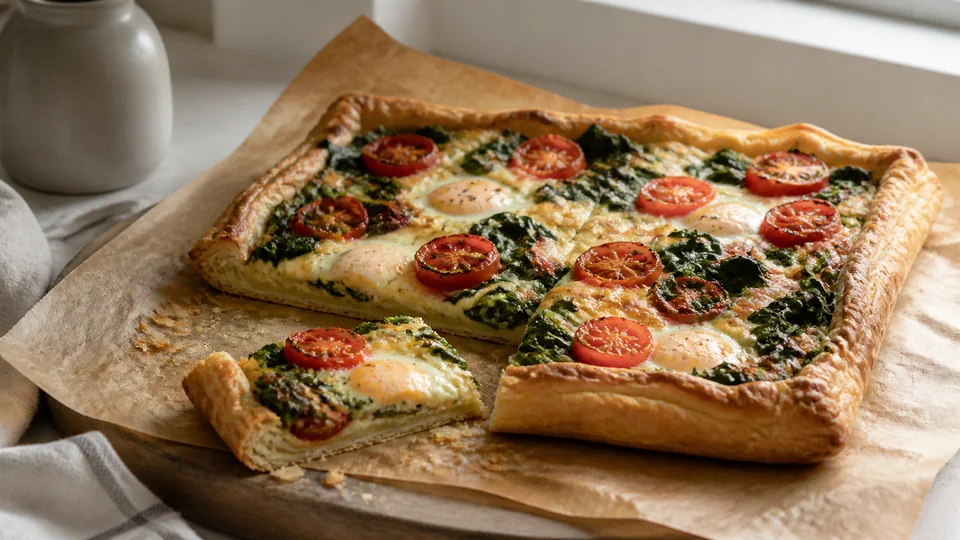
A breakfast tart is a format, not one recipe. It may be a pastry shell filled with eggs and vegetables, a puff-pastry slab with cheese, a fruit tart, or a crustless quiche-like bake. The right method depends on depth, water, fat and serving plan. This guide explains those decisions without inventing an untested formula. Explore the breakfast hub for other formats, or return to Pancake World.
For broader context, continue with American Breakfast: Pancakes, Diner Plates and Brunch.
Choose one tart architecture
Start by selecting a structure. Each one solves a different service problem.
| Tart architecture | Strong use | Main risk | Evidence needed |
|---|---|---|---|
| short pastry shell | clean wedges and firm border | soggy base or shrinkage | complete crust and filling recipe |
| puff-pastry slab | fast visual centerpiece | wet center, collapsed layers | package and complete tart method |
| mini tart or quiche | portable portions | overfilled shells and dry edges | defined cup size and yield |
| bread-lined cup | familiar breakfast texture | bread absorbs custard unevenly | complete tested formula |
| potato base | savory gluten-free possibility | weak binding and excess water | exact grated/cooked potato method |
| crustless egg tart | direct filling focus | sticking or rubbery center | tested egg-dairy-vessel formula |
| fruit tart | sweet breakfast or brunch finish | leaking fruit and underbaked base | complete fruit-specific recipe |
Do not call these versions interchangeable. Pastry insulates the filling; puff pastry needs room to expand; potatoes contribute water and starch; a crustless bake transfers heat directly from the pan. The same oven time cannot be copied across them.
Explore related Pancakes World guidance on American Pancakes, Maple Syrup, and Maple Syrup Pancakes.
Sources and editorial references
Illinois Extension’s Mini Breakfast Quiches provide a useful controlled example. The method portions dough into paper-lined muffin wells, pricks and briefly pre-bakes the small crusts, lowers the oven temperature, adds fully cooked mix-ins, pours over a defined egg-product and milk mixture, adds cheese and bakes until set. It then cools the quiches and uses a rack to protect the bottoms from trapped moisture.
That sequence demonstrates six principles:
- the vessel and yield are defined;
- the crust receives a source-specific pre-bake;
- mix-ins are fully cooked before assembly;
- the egg mixture is measured;
- filling is distributed among known shells;
- cooling is part of texture control.
Use the complete recipe when you want its result. Do not lift only the baking time and apply it to one large tart, raw vegetables, whole eggs instead of the specified egg product, or a deeper filling.
Illinois Extension’s quiche framework offers another valid route: an open pie with egg, dairy, cheese and a shell, plus a crustless alternative. It confirms that the breakfast-tart family can change structure, but a new structure needs its own tested quantities.
Select the crust for the filling
Crust is not decoration. It must hold the filling without becoming greasy, wet or brittle.
Short pastry
Choose short pastry for a tart that must release from a pan and cut into wedges. Use a source formula that defines flour, fat, salt, water, chilling, rolling and shell yield. Utah State University Extension’s pastry reference, for example, gives complete formulations and states a tart-shell yield. That yield should not be ignored when changing shell diameter or thickness.
Keep the fat cold and add water only as the source directs. Overworking can make pastry tough; too much water can create a sticky dough. Chilling and pre-baking are not universal rituals—follow the selected formula.
Puff pastry
Packaged puff pastry is convenient but highly product-specific. Thaw according to the package, keep it cool, and use the complete recipe’s scoring, docking and border instructions. A wet egg filling poured over an unprotected flat sheet may prevent lift in the center.
Read ingredients and allergens. Butter-based and shortening-based products differ. Do not assume every puff pastry is dairy-free or vegan.
Bread or tortilla bases
Bread-lined cups and tortilla shells are useful for portions, but they absorb liquid differently from pastry. Toasting or pre-baking may be required by the recipe. A thick bread slice and a thin tortilla cannot share a filling quantity without adjustment.
Potato crust
Potato must be grated, cooked, pressed or bound according to a validated method. Water is the main structural challenge. A pile of raw shredded potato under custard is not automatically a crust.
Crustless
Removing pastry changes heat flow and release. Grease or line the vessel according to the complete source. Do not keep the crusted recipe’s bake time by default.
Build a filling with controlled moisture
A tart filling needs flavor and enough structure to cut. Sort ingredients into four roles:
- egg or another binder;
- dairy, sauce or moisture;
- cooked solids such as vegetables, meat or fish;
- cheese, herbs or finishing flavor.
Every ingredient adds volume. If a recipe is designed for broccoli and cheese, adding mushrooms, spinach, tomato and sausage can raise the filling above the shell and release much more water.
Pre-cook mushrooms until released liquid evaporates. Wilt greens and press or drain them. Roast or sauté peppers and onions as the source requires. Thaw and drain frozen vegetables. Cool hot mix-ins before they enter raw egg mixture so the batch does not begin cooking unevenly.
Raw meat needs a separate safe cooking step unless the complete recipe explicitly cooks it within the tart and validates the endpoint. Illinois Extension’s mini-quiche method requires fully cooked mix-ins. That is the safe model to follow for flexible leftovers.
Keep garnishes outside the filling when their role is freshness: herbs, dressed greens, sliced avocado and watery salsa belong on the plate after baking.
Understand egg as structure and a safety checkpoint
Eggs bind water, set the center and help suspend ingredients. University of Minnesota Extension explains that eggs can provide moisture, binding and leavening in baking. Because those roles overlap, there is no universal egg replacement.
A tart with several eggs is particularly sensitive to substitution. Flax gel, starch, commercial replacer or aquafaba may solve one function but not the others. Use a recipe developed for the replacement and the filling depth. Do not improvise for a guest with an egg allergy and assume the result is safe; ingredient and cross-contact control must cover the whole kitchen.
FDA guidance sets 160°F for egg dishes. Measure the center away from the pan edge and from a chunk of hot cheese or meat. A browned rim or puffed top is not enough. The filling may rise in the oven and settle as it cools; settling alone does not prove failure.
Reheated cooked egg dishes should reach 165°F. Check the thickest part of a wedge, especially after microwave reheating.
Compare savory filling families
Vegetable and cheese
This is the most adaptable family when moisture is managed. Choose two vegetables with different textures rather than an uncontrolled mix. Pair mushrooms with spinach, peppers with onion, or broccoli with herbs. Use cheese as a defined ingredient, not a blanket over excess water.
Meat, egg and cheese
Cook sausage, bacon, ham or another meat safely before assembly unless the source says otherwise. Drain excess fat. Review sodium across meat and cheese, and keep exact allergen labels.
Fish and greens
Cooked or smoked fish can pair with greens and herbs, but storage and sodium vary. Smoking does not make every fish shelf-stable. Follow the package and a complete tart formula.
Potato and egg
This filling can be dense. Pre-cook potatoes by the source method and keep pieces small and even. A deep potato layer insulates the center, so time from a light vegetable tart is not transferable.
Tomato and herb
Fresh tomato releases substantial water. Seed, drain, roast or otherwise prepare it as the tested recipe directs. Add delicate herbs near the end or after baking if the method calls for it.
Leftover vegetable tart
Only use leftovers with a known date and safe storage history. Reheat or incorporate them through a complete recipe and bring the final egg dish to 160°F. “Leftover” is not permission to empty every container into one shell.
Compare sweet breakfast tart directions
A sweet breakfast tart may use fresh fruit, cooked fruit, custard, yogurt or cheese. Each needs different handling.
Fruit over baked pastry
Bake the shell through a complete method, cool it, add a stable filling if used, then arrange prepared fruit close to service. This protects pastry from extended contact with juice.
Baked fruit tart
Use a recipe written for the exact fruit. Apples, berries, peaches and pears release different amounts of liquid and soften at different rates. Do not substitute by volume and keep the original bake time automatically.
Custard and fruit
Egg custard remains an egg dish with a 160°F endpoint. Dairy and cut fruit require refrigeration. Cool promptly and store covered.
Yogurt tart
Some tarts use yogurt as filling or garnish. Plain yogurt and sweetened yogurt are not interchangeable nutritionally or structurally. Use a complete no-bake or baked formula and maintain refrigeration.
Honey, maple syrup and fruit concentrates count as added sugars in federal nutrition guidance even when used instead of granulated sugar. This article does not call one sweetener universally healthier.
Assemble in the right order
For a typical savory tart, the controlled order is:
- prepare the pan and base exactly as directed;
- pre-bake or chill the base only when the recipe says so;
- cook, drain and cool mix-ins;
- whisk the measured egg mixture without excessive aeration;
- distribute solids evenly below the rim;
- pour liquid gradually, allowing it to settle around solids;
- add the specified cheese or finish;
- bake to the visual cues and verified center endpoint;
- rest for the specified time;
- release or transfer to a rack as directed.
Do not fill the shell on a distant counter and carry a sloshing tart across the kitchen. Place the pan on its baking sheet first, then fill near the oven if the recipe permits. Use an oven-safe rimmed sheet to catch accidental overflow.
Avoid pouring hot vegetable liquid into the shell. Heat can soften fat layers and start setting egg before the tart is positioned.
Prevent a soggy bottom
Soggy crust usually comes from several causes, not one:
- wet vegetables were not drained;
- the shell was too thin or damaged;
- the source required pre-baking and it was skipped;
- hot filling melted the crust fat;
- the tart sat in a humid pan after baking;
- it was covered while steaming;
- the filling ratio or depth changed.
Fix the process, not the finished slice. Drain ingredients, use the correct shell, control filling depth and cool as directed. Illinois Extension specifically transfers its mini quiches to a wire rack after an initial cool to avoid soggy bottoms.
Do not brush an improvised egg layer, scatter flour or add cheese to seal the crust unless a tested recipe specifies it. Each addition changes allergens and cooking.
Get clean slices
A tart needs a resting period so steam subsides and the filling firms. Cutting immediately can make a safely cooked custard look loose. Waiting too long at room temperature creates a food-safety problem.
Use the source rest time. Cut with a sharp thin knife, wiping between slices. For mini tarts, remove liners only after the structure can support handling.
Match portion to richness and side dishes. A deep meat-and-cheese tart needs a smaller wedge than a thin vegetable slab. Serve dressed greens, fruit or a simple vegetable side after the tart is portioned; do not pile wet salad on the remaining tart.
For a buffet, put out small quantities and replace them. Keep hot tart at 140°F or warmer or cold tart at 40°F or below. Otherwise, use the USDA two-hour room-temperature limit, shortened to one hour above 90°F.
Make ahead without losing control
There are three sensible plans:
Prepare components
Cook and cool vegetables, grate cheese, prepare the source crust and hold each part as the recipe directs. Assemble near baking. This protects texture best.
Bake, chill and serve cold
Some complete recipes support cold service. Cool promptly, cover and refrigerate. Do not assume every puff-pastry tart remains pleasant when cold.
Bake, chill and reheat
USDA says refrigerated leftovers are generally kept three to four days and reheated to 165°F. The Illinois mini-quiche recipe gives its own source-specific refrigerator and freezer guidance. Follow the narrower applicable instruction.
Reheat uncovered when crust crispness matters, provided the complete method supports it. A microwave is faster but can soften pastry and create cold spots. Check several places and allow standing time.
Never leave an egg tart in a turned-off oven overnight. Appearance the next morning cannot verify safety.
Troubleshoot common failures
The crust shrank
The dough may have been stretched, insufficiently rested or made with the wrong water amount. Return to the selected crust formula and pan dimensions.
The filling overflowed
Too many solids, too much custard or an undersized shell changed the geometry. Use the source yield and leave the specified headspace.
The center is watery
Check temperature first. If it reached 160°F, excess vegetable water or an altered ratio may be responsible. Do not keep baking indefinitely and dry the edges.
The top browned before the center set
The tart may be too deep, too close to an upper element or in a pan unlike the source. Shielding or rack changes must come from a validated method.
Puff pastry stayed flat
It may have warmed, been crushed, been docked incorrectly or been covered by wet filling. Follow the package and source assembly order.
The crust is greasy
Hot filling, warm dough, excess fat from meat or an inaccurate pastry ratio can contribute. Cool and drain components, and measure crust ingredients.
Slices collapse after reheating
Reheat smaller portions to 165°F and allow a brief safe stand. Avoid flooding the tart with sauce before heating.
A decision checklist
Before baking, confirm:
- one tart architecture was selected;
- one complete tested recipe controls the vessel, yield and time;
- the crust is compatible with the filling depth;
- vegetables are cooked, drained and cooled as required;
- raw meat is not entering an unvalidated filling;
- egg or substitute follows a complete formula;
- major allergens are recorded;
- the center will be checked at 160°F for an egg tart;
- perishable food will be refrigerated within two hours;
- leftovers will reach 165°F;
- source nutrition will not be reused after changes.
Frequently asked questions
What is a breakfast tart?
It is a baked open-format breakfast with a defined base and filling. The base may be pastry, puff pastry, bread, potato or no crust; the filling may be egg-based, savory or fruit-led.
Is a breakfast tart the same as quiche?
Quiche is one member of the breakfast-tart family: an open pie with an egg-and-dairy custard, often cheese or other fillings, and sometimes no crust. Not every tart is quiche.
Should I pre-bake the crust?
Only when the complete recipe says so. Illinois Extension pre-bakes its mini-quiche shells, but the time is tied to those shells and that method.
How do I stop vegetables making the tart watery?
Cook them as needed, evaporate or drain released liquid, cool them, and use the exact quantity from the recipe. Do not add several wet vegetables beyond the formula.
What temperature should an egg breakfast tart reach?
FDA guidance sets 160°F for egg dishes. Measure the center. Reheated cooked egg dishes should reach 165°F.
Can I use an egg substitute?
Only through a recipe developed for that substitute. Eggs contribute moisture, binding and leavening, and one replacement may not perform all roles.
How long does breakfast tart keep?
Follow the recipe’s storage guidance and USDA’s general three-to-four-day refrigerated leftover limit. Use the shorter applicable period and keep the refrigerator at 40°F or below.
Can I freeze it?
Only when the selected recipe supports freezing. Illinois Extension gives source-specific freezer instructions for its mini quiches, but that does not validate every crust or filling.
Final decision
Choose a breakfast tart by architecture first and flavor second. A mini quiche, puff-pastry slab, fruit tart and crustless egg bake need different moisture, depth and heat controls. Let one complete recipe determine the crust, filling ratio, vessel, time and yield.
Pre-cook and drain wet ingredients, keep fresh toppings for service, verify egg filling at 160°F and reheat leftovers to 165°F. That produces a practical tart guide without pretending that attractive ingredients are a tested formula.
Before assembling the tart, run a moisture and service check. Spread cooked vegetables on a tray so steam can escape, blot watery ingredients when the complete recipe allows it, and cool hot fillings before they meet pastry or egg mixture. Confirm the pan depth and planned portion size before baking. After cooking, note whether the base stayed crisp, the center set evenly and the slices held together; use those observations only to choose the next complete recipe, not to invent a universal ratio.
- Illinois Extension, “Mini Breakfast Quiches”:
https://extension.illinois.edu/diabetes/recipes/mini-breakfast-quiches - Illinois Extension, “How to Make the Perfect Quiche”:
https://extension.illinois.edu/blogs/simply-nutritious-quick-and-delicious/2014-09-05-how-make-perfect-quiche - Utah State University Extension, “The Art of Pie Making”:
https://extension.usu.edu/utah/files/pantry-to-plate/The-Art-of-Pie-Making.pdf - U.S. Food and Drug Administration, “What You Need to Know About Egg Safety”:
https://www.fda.gov/media/82227/download - USDA Food Safety and Inspection Service, “Leftovers and Food Safety”:
https://www.fsis.usda.gov/food-safety/safe-food-handling-and-preparation/food-safety-basics/leftovers-and-food-safety - University of Minnesota Extension, “Egg substitutions for baking”:
https://extension.umn.edu/family-news/egg-substitutions-baking