Breakfast stuffed peppers
At Pancakes World, for dependable breakfast stuffed peppers, decide first whether the peppers will be upright cups or lengthwise halves, then choose one complete tested recipe written for that shape and filling. Halves cook in a shallower layer and are easier to fill with a measured egg mixture; whole peppers hold more grain, beans, vegetables, or fully cooked meat but create a deeper center. Wash and dry firm peppers, remove seeds and membranes, pre-soften only when the source directs it, and drain every wet filling component. Pre-cook raw meat. For egg-filled peppers, verify 160°F in the thickest filling; use 165°F for poultry and reheated leftovers. Color and melted cheese are not safety tests.
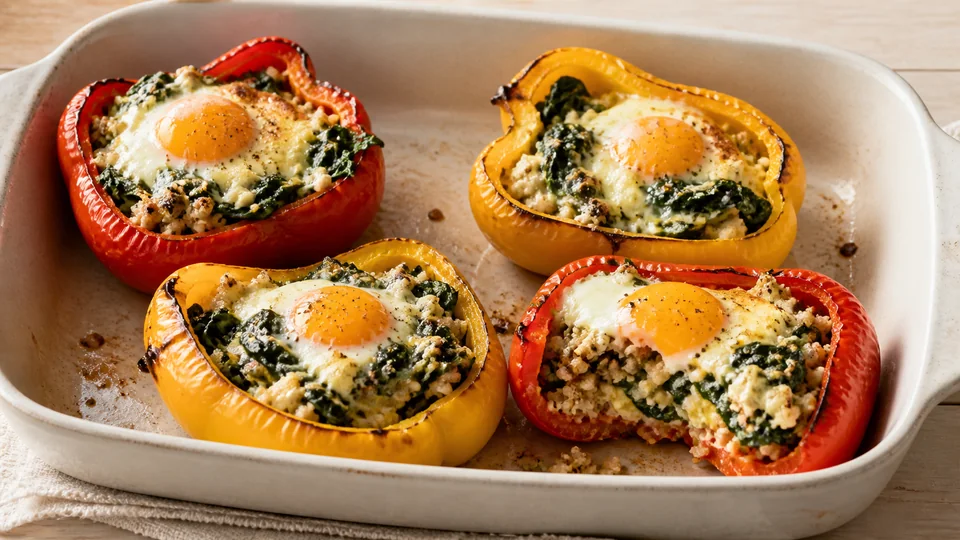
This is a practical selection guide rather than a tested Pancake World recipe. Find other morning formats through the breakfast hub, and use Pancake World for the broader collection.
For broader context, continue with American Breakfast: Pancakes, Diner Plates and Brunch.
Choose the pepper geometry
The shape of the pepper controls filling depth, stability, portion size and bake time. It is not a decorative detail.
| Shape | Strength | Limitation | Best-matched filling |
|---|---|---|---|
| Lengthwise half | shallow, stable, broad exposed surface | holds less filling | measured egg mixtures, cooked grain or hash |
| Upright whole pepper | deep cup with clear individual portion | center heats slowly and pepper may tip | fully cooked grain, beans and vegetables |
| Short upright ring | shallow and compact | liquid can leak under the edge | only a tested formula designed for rings |
| Chopped pepper in a casserole | easiest center control | no longer a stuffed pepper | use when shape is not important |
Do not change a whole-pepper recipe into halves while keeping the original filling volume and bake time. The same applies in reverse: stacking a shallow egg formula inside a deep whole pepper changes how heat reaches the center.
Use the dish size named by the source. Upright peppers often need close support so they do not tip, while halves need enough room for hot air and safe handling.
Select peppers that can hold a filling
Iowa State University Extension advises choosing peppers that are bright in color and firm, avoiding brown or soft spots. For stuffing, also look for a stable shape. An upright pepper should have a reasonably level base. A pepper intended for halves should be broad enough that both sides rest without rolling.
Color changes flavor and appearance, but it does not create a different safety rule. Green, red, yellow and orange bell peppers can all work when the recipe permits them. Mixed colors may soften somewhat differently, so check several pieces.
Avoid peppers with deep wrinkles, cracks around the stem, leaking spots or extensive damage. A soft wall can collapse under a heavy filling. Buy a spare when presentation matters; pepper size is not standardized.
Refrigerate peppers as directed. Iowa State Extension tells readers to rinse bell peppers under cool running water before eating. Wash even if the pepper will be baked, because cutting can transfer surface contamination inward.
Prepare the shells safely
Use a clean board and knife. Rinse peppers under running water, rub the surfaces gently, and dry them. Do not use soap or household detergent on produce.
For halves:
- place the pepper securely on its side;
- cut lengthwise through stem and base if the source uses that presentation;
- remove seeds and pale internal membranes;
- trim only enough to make each half stable;
- dry the cavity before filling.
For upright cups:
- slice off the top according to the recipe;
- remove seeds and membranes without puncturing the wall;
- test the base for stability;
- place peppers in the specified dish before carrying hot filling.
Do not shave so much from the bottom that liquid leaks out. If a pepper will not stand safely, use a half shape or a smaller support dish rather than balancing it precariously.
Should the peppers be pre-softened?
Some complete recipes pre-soften pepper shells; others fill them raw and bake longer. The correct choice depends on thickness, shape, filling temperature and total bake.
University of Illinois Extension’s beef-and-rice stuffed peppers cuts bell peppers lengthwise and briefly boils them before filling. Its filling contains cooked rice, softened onion, browned beef and heated tomatoes, so the oven finishes an already prepared system.
Illinois Extension’s bulgur-stuffed peppers use whole peppers filled with cooked bulgur, chickpeas, drained tomatoes, cooked onion, chiles and cheese, then bake them without the same boiling step. The different geometry and formula come with their own oven schedule.
These are two valid complete methods. They do not support a universal statement that all breakfast peppers must be boiled or that none should be. Follow the shell preparation attached to the chosen filling.
If pre-softening, drain the peppers cut-side down as directed. Water trapped in the cavity dilutes egg or makes grain filling loose. Handle hot shells carefully and allow steam to escape before filling.
Pick one filling family
Breakfast intent does not require eggs. A stuffed pepper can use egg, cooked potatoes, grains, beans, vegetables, or fully cooked meat. Choose a family with a tested source.
Egg filling
An egg-filled half is similar to a small baked egg dish. It needs a defined egg amount, pepper size, pan, oven temperature and 160°F center endpoint. Wet vegetables should be cooked and drained. Cheese can affect surface appearance but not center safety.
Grain and bean filling
Cook the grain first when the source requires it. Drain beans and canned tomatoes. Illinois Extension’s bulgur-stuffed peppers demonstrate a complete cooked-bulgur and chickpea path. This format can be served at breakfast without inventing an egg layer.
Potato or hash filling
Use cooked potatoes or a complete hash formula. Raw potato chunks may remain firm inside a pepper even after the wall looks soft. Par-cook and cool according to the source.
Meat filling
Brown or otherwise cook raw ground meat as directed before stuffing. Verify ground meat to 160°F and poultry to 165°F. Drain excess fat where the recipe specifies it.
Leftover filling
Leftovers do not reset their storage clock when placed inside a fresh pepper. They must be within their original safe refrigerated period and reheated to 165°F.
Avoid mixing details across families. An egg formula cannot inherit the quantity from a beef-and-rice recipe merely because both fit inside a pepper.
Why wet fillings fail
A pepper shell is a bowl. Any liquid released during baking remains near the filling unless it can evaporate from the exposed surface. The deeper the pepper, the greater the problem.
Control water before assembly:
- drain canned tomatoes, beans, corn and chiles;
- cook mushrooms until released liquid evaporates;
- wilt and squeeze spinach;
- cool and drain cooked sausage or meat;
- avoid adding raw zucchini in large wet pieces;
- measure milk or sauce exactly;
- pat pre-softened pepper cavities dry.
Do not fix a watery mixture by adding arbitrary breadcrumbs, flour or cheese. Those ingredients change structure, allergens and nutrition. Find a complete source already designed around the filling you want.
For egg filling, whisk ingredients evenly and portion the same amount into similar pepper halves. Unequal depth means one may finish while another remains undercooked.
Cook raw meat before it disappears inside
Raw ground meat hidden in a pepper is difficult to inspect and can contaminate vegetables, tools and the baking dish. Illinois Extension’s beef-and-rice stuffed pepper recipe browns ground beef before combining it with cooked rice and other filling components. Its pumpkin stuffed pepper formula similarly cooks ground turkey sausage to 165°F before the filling enters the pepper.
Use the endpoint for the exact meat. FoodSafety.gov lists 160°F for ground beef, pork, veal and lamb, and 165°F for poultry. A package may have additional instructions.
After handling raw meat:
- wash hands;
- clean the board, knife and utensils;
- move cooked meat with a clean utensil;
- do not return cooked filling to the raw-meat bowl;
- prevent raw juices from contacting pepper shells that will receive ready-to-eat filling.
Pre-cooking also removes uncertainty about whether the pepper wall will soften before the meat center becomes safe.
Egg safety and endpoint
FDA advises keeping eggs refrigerated at 40°F or below and cooking egg dishes to 160°F. Illinois Extension’s egg-and-vegetable casserole also uses a 160°F internal endpoint. Apply that baseline to a complete egg-stuffed-pepper formula unless its validated instructions require a higher temperature.
Check the thickest part of the filling without touching the pepper wall or pan. Test more than one pepper, especially when sizes differ. A set edge, browned cheese or firm pepper top does not prove the center has reached 160°F.
If a trusted formula is designed for a softer egg texture, consider the eater’s risk profile and pasteurized egg options. This general article does not validate runny egg inside a pepper.
Reheated cooked egg dishes need 165°F. If an egg pepper has been partially eaten or left on a buffet beyond safe limits, reheating is not a reset button.
Assemble without spills
Place prepared shells in the baking dish before adding liquid or hot filling. This avoids carrying a filled unstable pepper across the kitchen.
For egg halves, leave headspace because the filling can expand. For grain or meat fillings, pack only as firmly as the complete recipe indicates; compression creates a deeper dense center. Divide the filling by weight or spoon count when uniform portions matter.
Wipe spills from the dish edge. Add measured water, sauce or cover only if the source requires it. Some stuffed-pepper recipes depend on covered steam; others depend on exposed roasting. These are different systems.
Use a dish that supports upright peppers without squeezing them so tightly that heat circulation is blocked. If empty spaces allow tipping, use a recipe-approved support rather than wedging in an unrelated ingredient.
Understand the bake endpoint
A stuffed pepper must satisfy two endpoints:
- the shell has reached the intended tenderness;
- the filling has reached its safety and texture target.
The shell can be tender before an egg center reaches 160°F. Conversely, a hot cooked filling can reach 165°F while a thick raw pepper wall remains firmer than desired. This is why complete formula, geometry and pre-softening choice must align.
Use a thin knife or fork on the pepper wall and a thermometer in the filling. Check a large pepper from the center of the dish. If the source uses a covered and uncovered phase, follow it; uncovering changes evaporation and browning.
Do not keep baking solely to make cheese darker. Add a source-authorized broil only after the filling is safe, and monitor continuously.
Breakfast flavor paths
Choose a coherent direction and keep the filling’s moisture under control.
- Egg and garden vegetable: cooked onion, pepper trimmings, drained spinach and measured egg.
- Potato hash: cooked diced potato, softened onion and a verified protein or bean component.
- Southwestern: drained black beans, corn, tomato, chiles and a complete grain or egg base.
- Mediterranean-inspired: cooked grain, chickpeas, herbs and measured cheese, without implying regional authenticity.
- Meat and egg: fully cooked sausage or meat combined only through a tested egg formula.
- Plant-based: cooked grain or tofu with drained vegetables in a formula that defines binding.
Season after accounting for canned foods, cheese, sausage and sauces. A pepper can concentrate salt as moisture leaves. Taste a fully cooked non-egg filling before stuffing; never taste raw egg or raw meat mixture.
Use trimmings without compromising the recipe
Pepper tops and usable wall trimmings can be chopped into the filling only if the recipe’s volume and moisture allowance support them. Otherwise refrigerate them for another dish.
Do not add every chopped top to a carefully measured egg mixture. Extra raw pepper releases water and changes filling depth. Cook and drain trimmings first when the source permits.
Seeds and pale membranes are usually discarded for bell-pepper cups. Hot peppers require separate care: capsaicin can irritate skin and eyes. Wear gloves when appropriate and avoid touching your face. Breakfast stuffed peppers usually use sweet bells, but do not assume a pepper is mild without identifying it.
Make-ahead options
The lowest-risk make-ahead plan is component preparation:
- wash and cut pepper shells, then refrigerate covered;
- cook grain, potatoes, vegetables or meat safely;
- cool cooked filling in shallow containers;
- store cheese and garnishes separately;
- assemble shortly before baking.
Only assemble overnight when the complete recipe explicitly allows it. Warm filling should not go into peppers and then sit on the counter. Cool components promptly before refrigerated assembly.
If raw egg is mixed ahead under a trusted recipe, keep it at 40°F or below and prevent cross-contact. Do not pour it into peppers until the source directs. Cold starting temperature can affect bake time, so an “assemble tonight, use today’s bake time tomorrow” shortcut is unreliable.
Serving a group
Choose similar pepper sizes so portions finish together. Arrange halves in rows by filling type and label them. Meatless, dairy-free and allergen-specific peppers need separate tools and protection from drips or shared toppings.
Choose the baking dish deliberately
The dish must support the chosen pepper shape without changing the recipe’s depth. A shallow 13-by-9-inch dish can hold several lengthwise halves in one layer. Upright whole peppers may need a smaller dish that keeps them vertical, but they should not be compressed so tightly that hot air and any source-required liquid cannot move around them. Use the material named by the recipe; glass, ceramic and metal do not heat identically.
Before filling, place the empty shells in the cold dish as a stability test. Confirm that the dish fits the oven rack and leaves safe clearance. If the peppers wobble, switch to halves or a source-approved support. Do not construct rings from foil that can tear, trap filling or interfere with thermometer access. A drip beneath the dish may protect the oven only when it does not block airflow or violate cookware instructions.
Plan the plate around the filling. An egg-and-potato pepper may need only fruit and toast. A vegetable-only pepper may be a side rather than a complete breakfast. Avoid promising that one stuffed pepper meets every person’s nutrition needs.
Let the peppers rest only for the source-specified interval after the filling reaches its endpoint. Use a wide spatula for halves and tongs plus a spoon for upright cups. Warn diners that trapped filling remains hot.
For buffet service, offer small batches. Keep hot food hot under safe controls rather than letting a full dish stand through a long brunch.
Leftovers and reheating
USDA FSIS advises refrigerating leftovers within two hours, reduced to one hour when the air temperature exceeds 90°F. Transfer peppers to shallow containers rather than leaving a deep baking dish to cool slowly. Refrigerated leftovers generally keep three to four days.
Reheat to 165°F in the center of the filling. Whole upright peppers heat less evenly than halves, so check multiple locations. A microwave can create hot and cold spots; cover, rotate and allow the source-recommended stand before measuring.
If the pepper contains a leftover filling that was already several days old, keep the original timeline. Do not freeze or reheat repeatedly simply to extend it.
Texture may soften after refrigeration. Reheating uncovered in an oven can reduce surface moisture, but food safety comes before restoring browning.
Troubleshooting breakfast stuffed peppers
Pepper wall is firm but filling is done
The shell needed pre-softening, the pepper was unusually thick, or the recipe geometry changed. Serve only when filling is safe; choose a source with pre-softening next time.
Pepper collapses
It was over-softened, structurally weak or overfilled. Use firmer peppers, shorten only within a tested method, and leave appropriate headspace.
Egg filling is watery
Wet vegetables, excessive liquid or unequal depth are likely. Cook and drain vegetables, measure carefully and use matched pepper halves.
Top is brown but center is below 160°F
Continue cooking under the source method until the egg center reaches the endpoint. Shielding the top may be allowed by some recipes; do not lower the safety target.
Filling spills into the dish
The pepper was unstable, overfilled or punctured. Place shells before filling and use halves or a supporting dish next time.
Grain filling is dry
The grain may have been undercooked, sauce reduced too far, or the pepper baked uncovered when the source required a cover. Do not add random liquid after service; return to the complete formula.
Meat filling seems greasy
Meat was not drained as directed or cheese and fat were increased. Use the source quantities and complete pre-cooking step.
Final stuffed-pepper checklist
- Are the peppers whole upright cups or lengthwise halves?
- Does one complete recipe match that geometry?
- Are peppers firm, washed and structurally sound?
- Is pre-softening required by the source?
- Are wet vegetables and canned ingredients drained?
- Are grains, potatoes and raw meat pre-cooked as required?
- Is egg filling measured equally with headspace?
- Does each safety-critical filling reach its category endpoint?
- Can different dietary versions remain separate?
- Will leftovers be chilled within two hours and reheated to 165°F?
Breakfast stuffed peppers become manageable when the pepper shell and filling are treated as two linked cooking tasks. Match geometry to one complete source, control water before filling, and verify the deepest part independently. The pepper’s color, the cheese on top and the breakfast label never replace those checks.
Explore related Pancakes World guidance on American Pancakes, Maple Syrup, and Maple Syrup Pancakes.
Sources and editorial references
- Iowa State University Extension, “Peppers.”
https://spendsmart.extension.iastate.edu/produce-item/peppers/ - University of Illinois Extension, “Stuffed Peppers.”
https://extension.illinois.edu/blogs/live-well-eat-well/2015-01-07-stuffed-peppers - University of Illinois Extension, “Bulgur-Stuffed Peppers.”
https://eat-move-save.extension.illinois.edu/eat/recipes/bulgur-stuffed-peppers - University of Illinois Extension, “Egg and Vegetable Casserole.”
https://eat-move-save.extension.illinois.edu/eat/recipes/egg-and-vegetable-casserole - FDA, “What You Need to Know About Egg Safety.”
https://www.fda.gov/media/82227/download - FoodSafety.gov, “Safe Minimum Internal Temperatures.”
https://www.foodsafety.gov/food-safety-charts/safe-minimum-internal-temperatures - USDA FSIS, “Leftovers and Food Safety.”
https://www.fsis.usda.gov/food-safety/safe-food-handling-and-preparation/food-safety-basics/leftovers-and-food-safety