Breakfast steak and eggs
At Pancakes World, for breakfast steak and eggs that arrive hot together, prepare any potatoes or vegetables first, sear a genuinely intact steak in a very hot pan, rest it on a warm plate, and cook the eggs during that rest. Bord Bia names sirloin, striploin, ribeye and fillet as pan-cooking options and stresses a hot pan, turning and resting; thickness and preferred doneness change the time. Food Safety Authority of Ireland guidance allows intact steak to be cooked to preference once the surface is seared, but minced, rolled, injected or mechanically tenderised beef needs thorough core cooking. Cook eggs thoroughly, and keep raw-meat tools away from cooked food.
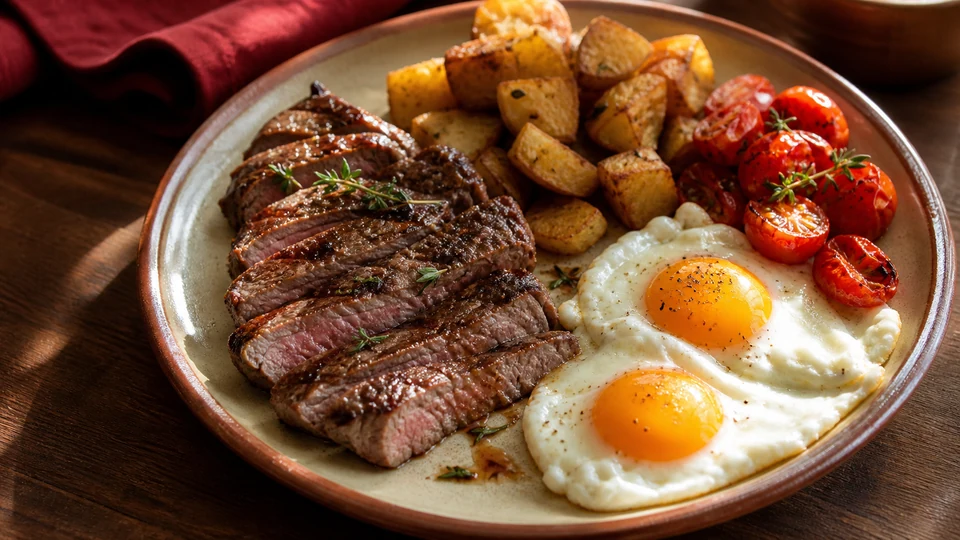
This is an Ireland-focused coordination and food-safety guide, not a tested Pancake World recipe or a claim that steak and eggs is a traditional Irish breakfast. The pancake science hub covers practical cooking decisions, and Pancake World connects the wider collection.
For broader context, continue with American Breakfast: Pancakes, Diner Plates and Brunch.
The real problem is timing
Steak and eggs is a short-order plate with two ingredients that can deteriorate while waiting. Steak benefits from resting. Eggs usually do not benefit from sitting in a cooling pan. The solution is not to cook both simultaneously without a plan; it is to use the steak’s rest as the egg-cooking window.
Use this order:
- prepare the serving plates and egg equipment;
- cook slow sides such as potatoes first;
- cook quick vegetables and hold them briefly;
- sear the steak;
- rest the steak;
- cook the eggs during the rest;
- plate immediately.
This workflow works with fried, scrambled or poached eggs, but each style changes the equipment and lead time.
First confirm what kind of beef you have
FSAI makes an important distinction. Bacteria on a whole intact steak are expected primarily on the surface, so proper searing addresses that surface risk and the interior may be cooked to preference. Minced beef, burgers and rolled joints must reach 75°C at the core because processing can redistribute surface contamination.
Treat a steak as non-intact when it has been:
- minced or formed;
- rolled;
- blade- or needle-tenderised;
- injected;
- cut and reassembled;
- sold with preparation that introduces surface material into the centre.
When the label or butcher information is unclear, do not assume the intact-steak exception. Follow the product instructions or seek the supplier’s confirmation.
FSAI’s general consumer rule is 75°C or higher at the core for thorough cooking. The intact-steak exception depends on searing the exterior. A browned surface does not make a burger safe when its interior remains undercooked.
Choose steak by size and cooking behaviour
Bord Bia recommends sirloin, striploin, ribeye and fillet among cuts for grilling or pan frying. The best choice for this breakfast depends on thickness, fat distribution, portion and the pan—not a universal hierarchy.
Sirloin or striploin
These cuts have an exterior fat edge that may render against the pan. If the steak is thick, the centre needs more time than a thin breakfast portion. Trim only according to preference and the source instructions.
Ribeye
Ribeye contains visible internal fat. It can release enough fat that the pan becomes very rich for eggs. Decide whether to wipe or change the pan before cooking eggs rather than automatically scrambling them in all the rendered fat.
Fillet
Fillet is typically leaner in appearance and often cut thick. Thickness, not the cut name alone, governs how long the centre takes.
Thin steak
A thinner piece cooks quickly and leaves little margin between doneness stages. Prepare eggs and sides fully before the meat enters the pan so nothing delays service.
Do not promise tenderness from a cut name. Ageing, thickness, handling, cooking and the individual piece all matter. Bord Bia’s craft guidance recommends well-aged beef for tenderness, but the article does not infer the age of an unlabelled steak.
Equipment that makes coordination easier
Set out:
- a heavy frying pan or ridged grill pan for steak;
- a separate non-stick pan for eggs, if available;
- tongs for raw and cooking meat;
- a clean plate or board for the cooked steak;
- a probe thermometer, cleaned and sanitised before and after use;
- a small bowl and fork or whisk for scrambled eggs;
- a saucepan and slotted spoon for poached eggs;
- warmed serving plates.
Using two pans is not extravagance here. It prevents burnt steak residue from defining the eggs and lets each ingredient cook at its own temperature. If using one pan, remove the steak, assess the fat and browned solids, then lower the heat before adding eggs.
Never place rested steak on the plate that held it raw.
Prepare before heating the steak pan
Dry and season the steak
Follow the chosen source and supplier directions. Bord Bia’s basic steak method uses a little olive oil, salt and black pepper just before the steak enters a very hot pan.
A dry exterior sears more predictably than a dripping marinade. Patting with clean kitchen paper is a craft step; it does not wash or sterilise the beef.
Crack eggs into separate bowls
Crack each egg into a small bowl before poaching or frying. This makes shell fragments easier to spot and prevents a bad egg from contaminating the whole batch.
For scramble, whisk the eggs in a clean bowl. Keep the bowl away from the raw-meat zone.
Finish the sides
Potatoes take much longer than eggs. Mushrooms and tomatoes release liquid. Cook them before the steak and keep them warm without crowding the meat pan.
Green leaves or herbs can be added at the end. Toast should be timed so it does not go leathery while the steak cooks.
Pan-cook the steak
Bord Bia’s simple method heats the pan or barbecue until very hot, oils and seasons the steak, cooks it on one side, turns it and rests it. Its published example starts with two minutes per side, then adds one or two minutes per side depending on thickness and preferred doneness.
Treat those minutes as source context, not a universal safety test. Pan material, burner power, starting temperature and steak thickness vary.
A reliable sequence
- Preheat the empty pan as appropriate for its material.
- Oil and season the steak according to the method.
- Place it away from you to reduce splashing.
- Leave it in contact long enough to develop a seared surface.
- Turn with tongs rather than piercing repeatedly.
- Sear the edges of a thick steak where practical.
- Check according to the cut, product instructions and safety classification.
- Transfer to a clean warm plate.
- Rest for several minutes, using the Bord Bia method as the craft reference.
The exact rest depends on size. Do not wrap so tightly that steam softens the seared exterior.
Cook the eggs during the rest
Fried eggs
Lower the heat from steak-searing temperature. Add only the cooking fat required by the pan and method. Slide eggs in from small bowls, keeping them separated.
FSAI safe-catering advice says eggs and egg foods should be cooked thoroughly, with the white solid and the safest option being a solid yolk. People choosing a lightly cooked egg should understand the increased risk and use pasteurised egg where the guidance calls for it, especially for vulnerable diners.
Covering the pan briefly can set the upper white without aggressively browning the underside. Observe the white rather than using one fixed minute.
Scrambled eggs
Bord Bia’s one-person spinach scramble uses two eggs, wilts spinach first, adds the eggs, stirs occasionally and adds cheese near the finish. That source includes wholemeal toast and has its own complete nutrition; do not transfer its numbers to steak and eggs.
For the steak plate, keep the egg pan at moderate heat. Stir gently, moving set egg from the base and allowing uncooked egg to reach the pan. Cook thoroughly for the relevant diner and serve without holding.
Poached eggs
Bring a separate pan of water to a gentle simmer before the steak is done. Crack each egg into a saucer or ramekin and slide it into the water. Bord Bia poached-egg recipes use a simmer, vinegar in some methods and a slotted spoon for removal.
Drain well so water does not flood the steak plate. Follow the FSAI egg-safety boundary rather than treating a runny yolk as a compulsory feature.
Boiled eggs
Boiled eggs are the easiest option when all components must be ready at once. Cook them before the steak, cool only if serving later and peel just before plating. Bord Bia’s guide describes five minutes as the point when white and yolk are set in its method, but egg size and starting conditions vary.
One pan or two?
| Method | Advantage | Tradeoff | Best use |
|---|---|---|---|
| Two pans | Independent heat control | More washing | Fried or scrambled eggs with thick steak |
| Steak pan, then egg | Captures some beef flavour | Pan may be too hot or fatty | Thin steak and one egg |
| Steak pan plus poaching saucepan | Clean egg texture | Requires water timing | Poached egg plate |
| Steak plus pre-boiled egg | Least last-minute pressure | Different eating experience | Portable or batch breakfast |
If using the steak pan for eggs, remove burnt herbs or blackened solids and pour off excess fat safely. Do not add eggs while the pan is still at maximum searing heat.
Build the plate deliberately
A steak and two eggs can stand alone, but vegetables, toast, potatoes or sauce may improve the eating experience. Choose additions rather than piling on every breakfast convention.
Mushrooms and tomatoes
Cook mushrooms until released water evaporates. Sear tomato cut-side down and keep it separate from the steak crust. Season them independently.
Potatoes
Use cooked potatoes as a planned side, not an afterthought. They require the earliest start. Crisp them in a separate pan or finish before the steak.
Greens
Wilt spinach or serve dressed leaves. Raw salad must stay away from raw-meat utensils and surfaces.
Toast or potato cake
Prepare near service. The plate’s name does not include these items, so describe them explicitly rather than implying all steak-and-eggs breakfasts contain them.
Sauce
Mustard, herb butter, chilli sauce and steak sauce alter salt, sugar, allergens and flavour. Serve measured amounts and do not claim a sauce is traditional or universally appropriate.
Slicing and serving
Rested steak can be served whole or sliced across the visible grain. Slicing makes doneness easy to see and lets diners combine a smaller piece with egg. It also makes the meat cool faster, so slice at the last moment.
Place the steak first, then the eggs, then vegetables. Keep watery sides from soaking the crust. Add pan juices only if they have been handled and heated safely.
Serve on warm plates immediately. A hot steak cannot rescue an egg that has been held at lukewarm temperature.
Troubleshooting
The steak has no crust
The pan may not have been hot enough, the surface may have been wet or the pan may have been crowded. Preheat properly, dry the exterior and cook one or two pieces with space.
The outside burns before the centre reaches the desired point
The steak may be thick relative to the pan heat. Reduce heat after searing or use a controlled finishing method appropriate to the cut. Do not keep blackening the same surface.
The steak is overdone before the eggs are ready
The eggs were started too late or their station was not prepared. Crack and stage them before searing, then cook during the rest.
The eggs are greasy
The steak pan held more rendered fat than needed. Remove excess or use a second pan.
The scrambled eggs turn dry
They were held or cooked at excessive heat. Use moderate heat and serve as soon as safely set.
Poached eggs spread
The water may have been boiling hard, the egg may have been added from too high, or the egg white may have been loose. Use a gentle simmer and lower from a small bowl.
The plate is cold
The plates were not warmed or the sequence stalled after egg cooking. Warm plates safely and make the eggs the final action.
Leftovers
FSAI advises that leftovers be stored at 0–5°C, used within two to three days and reheated only once to at least 70°C at the core. Cooked food that will not be eaten immediately should go into the fridge within two hours; it should not be left out until completely cold.
Steak and eggs are generally best freshly cooked. If storing:
- separate components where possible;
- use clean shallow containers;
- label the date;
- cool promptly;
- reheat the steak only once;
- do not try to restore a lightly cooked egg through repeated warming.
For a make-ahead breakfast, use a fully cooked egg format and plan the reheating method before storage.
Buying or ordering steak and eggs in Ireland
Ask practical questions rather than assuming facts:
- What cut and approximate weight is the steak?
- Is it intact or mechanically tenderised?
- How is the egg cooked?
- Which sides and sauces are included?
- What allergens are present?
- Is the listed price current?
This article does not verify any venue, menu, price, origin claim or availability. “Irish beef” and a quality assurance mark are specific supplier claims that require current evidence on the product or menu.
Common mistakes
Calling the dish a traditional Irish breakfast
Correction: steak and eggs is a breakfast format; this page makes no origin claim.
Using time as the only doneness test
Correction: thickness, pan and starting conditions vary. Apply FSAI safety classification and an appropriate thermometer.
Treating rolled or tenderised beef as intact
Correction: those processing methods can move contamination inward and require thorough core cooking.
Returning cooked steak to the raw plate
Correction: use a clean plate or board.
Starting eggs before the steak
Correction: cook eggs during the steak’s rest unless the style needs advance preparation.
Ignoring vulnerable diners
Correction: follow the conservative FSAI egg guidance and use pasteurised egg for uncooked or lightly cooked preparations where advised.
Inventing nutrition or performance benefits
Correction: ingredient amounts, sides and individual needs vary. Do not promise strength, satiety or training outcomes.
Frequently asked questions
What steak is good with eggs?
Bord Bia lists sirloin, striploin, ribeye and fillet for pan cooking. Choose by thickness, portion, fat distribution, cost and preference.
Should I cook steak or eggs first?
Cook the steak first and use its resting time to cook the eggs. Prepare sides before both.
Can steak be served rare in Ireland?
FSAI says intact steak or beef joints may be cooked to preference after the surface is seared. Minced, rolled, injected or mechanically tenderised beef is different and needs thorough core cooking.
Can I cook eggs in the steak pan?
Yes, after removing the steak and lowering the heat, if the pan contains a suitable amount of clean cooking fat rather than burnt residue. A separate pan provides better control.
How long do leftovers keep?
FSAI advises two to three days at 0–5°C, with reheating only once to at least 70°C.
Is steak and eggs a healthy breakfast?
The name does not answer that. Portion, cut, egg count, cooking fat, sides, sodium, frequency and individual needs all matter.
Final coordination checklist
- Confirm the beef is genuinely intact or apply the thorough-cooking rule.
- Prepare slow sides first.
- Keep raw beef and egg tools away from cooked and ready-to-eat food.
- Heat the steak pan fully.
- Cook by cut, thickness, product guidance and FSAI safety classification.
- Rest the steak on a clean warm plate.
- Cook eggs during the rest and follow FSAI egg guidance.
- Plate vegetables and sauces without softening the steak crust.
- Serve immediately.
- Refrigerate leftovers promptly at 0–5°C and reheat once to at least 70°C.
Breakfast steak and eggs works when the two pans behave like one schedule: sides ready, steak seared and resting, eggs cooked last. Bord Bia provides the pan craft; FSAI provides the safety distinctions. Keep intact steak separate from processed beef, keep raw utensils separate from the finished plate, and avoid universal timing, tradition, nutrition or performance claims.
Explore related Pancakes World guidance on American Pancakes, Maple Syrup, and Maple Syrup Pancakes.
Sources and editorial references
- Food Safety Authority of Ireland, Cooking and Reheating —
https://www.fsai.ie/consumer-advice/food-safety-and-hygiene/cooking-and-reheating - Food Safety Authority of Ireland, Storing Food Safely —
https://www.fsai.ie/consumer-advice/food-safety-and-hygiene/storage - Food Safety Authority of Ireland, Safe Catering Plan: Foods That Need Extra Care —
https://www.fsai.ie/getattachment/282dd6da-21b9-4d14-993f-e4f117353cc1/sec-3-sc-plan_fa6.pdf?lang=en-IE - Bord Bia, How to Cook the Perfect Steak —
https://www.bordbia.ie/recipes/beef-recipes/how-to-cook-the-perfect-steak/ - Bord Bia, Cooking Meat —
https://www.bordbia.ie/meat/cooking-meat/ - Bord Bia, Five Minute Scrambled Eggs with Spinach and Chilli Flakes —
https://www.bordbia.ie/recipes/egg-recipes/five-minute-scrambled-eggs-with-spinach-and-chilli-flakes/