Breakfast smoothie recipe
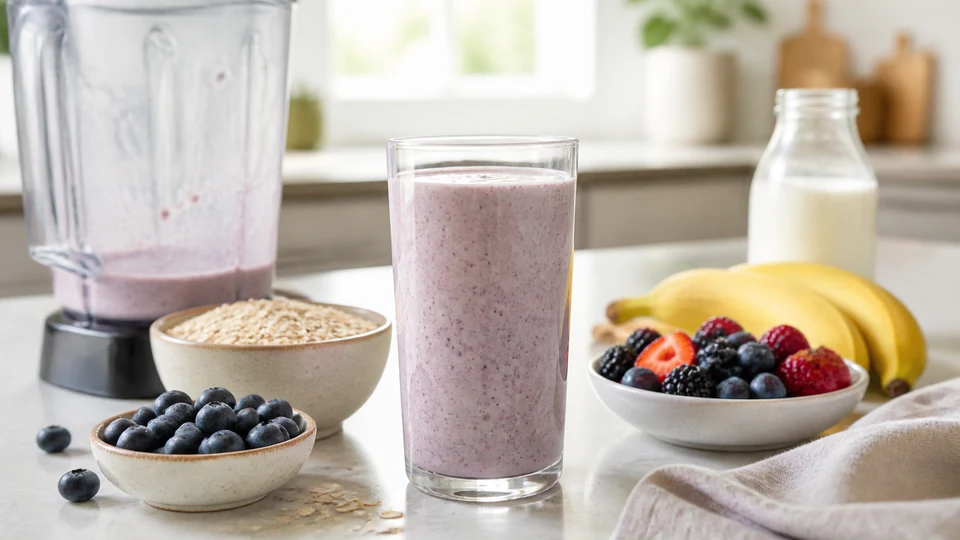
At Pancakes World, for one authoritative breakfast smoothie recipe, use the University of Illinois Extension’s two-serving formula: 1 cup low-fat or fat-free milk, 1 sliced medium banana, 1 cup frozen fruit such as blueberries, 2 tablespoons peanut butter or sunflower-seed butter, and 1 loose handful of spinach leaves. Wash hands, rub the fresh produce under cool running water, add the measured ingredients to a blender, secure the lid and blend until smooth. Divide the complete batch evenly into two servings and serve promptly or refrigerate at 40°F (4°C) or below. The source’s 250-calorie nutrition panel uses 1% milk and blueberries; changing the milk, frozen fruit, butter, quantities or serving division requires a new calculation. This focused guide explains how to execute and assess that single formula. It does not repeat the multi-recipe catalogue, claim a the editorial platform test, prescribe a meal replacement, or promise weight, fullness, energy or health results. Browse the American Breakfast: Pancakes, Diner Plates, and Brunch Context for other morning formats, or open Pancakes World for the full editorial library.
For adjacent decisions around Breakfast smoothie recipe, compare a budget breakfast batch plan, a customizable breakfast bar, and breakfast recipes for a practical start.
| Guide sections |
|---|
| Keep the recipe identity intact |
| Prepare a two-serving workstation |
| Clean produce and control cross-contact |
| Measure the formula exactly |
For broader context, continue with American Breakfast: Pancakes, Diner Plates and Brunch.
Keep the recipe identity intact
The selected Illinois formula makes two servings. Its five ingredient lines have distinct preparation states:
- one cup low-fat or fat-free milk;
- one medium banana, sliced;
- one cup frozen fruit, with blueberries given as an example;
- two tablespoons peanut butter or sunflower-seed butter;
- one loose handful of spinach leaves.
The source authorizes choices inside three lines: low-fat or fat-free milk, frozen fruit such as blueberries, and peanut or sunflower-seed butter. Those are recipe options, not nutrition equivalents. The page says its displayed nutrition facts were calculated with 1% milk and blueberries. If a different permitted choice is used, the formula can still follow the source, but the 250-calorie number should not be transferred without recalculation.
Do not add yogurt, juice, oats, protein powder, sweetener, ice or seeds and still describe the result as the printed formula. Those may be household variations, but each changes the ingredient record, allergen set, texture and possibly yield.
Prepare a two-serving workstation
Before opening the refrigerator, set out:
- a clean blender with its correct lid;
- one dry measuring cup for milk and frozen fruit;
- one tablespoon measure;
- a clean knife and cutting board for the banana;
- two equal serving containers;
- the milk and butter package labels;
- a route card for the actual options selected.
Check the blender manufacturer’s working-capacity and frozen-food instructions. This article does not invent appliance limits. The two-serving formula should fit without exceeding the marked capacity and with enough room for circulation. If it does not, use an appropriate appliance or prepare smaller source-proportional work only after accurate measurement.
Write the final choice on the route card before blending:
Milk: 1% low-fat, another low-fat option, or fat-free
Frozen fruit: blueberries or exact selected fruit
Butter: peanut or sunflower-seed
Planned yield: two equal servings
Nutrition panel transferable: yes only when the source calculation basis matches and no other variable changes
This prevents a finished smoothie from being labelled “milk or seed butter,” which leaves diners unable to identify what is actually present.
Clean produce and control cross-contact
Wash hands with soap and water. FDA advises washing produce under running water, including produce whose peel will not be eaten. Do not use soap, detergent or commercial produce wash. Use clean surfaces and tools, and keep produce that will be eaten without further cooking away from raw meat, poultry, seafood and their utensils.
Rub the banana exterior under cool running water before peeling, consistent with the Illinois recipe direction to clean produce. Wash loose spinach unless the package identifies it as prewashed and ready to eat. FDA says packaged produce marked prewashed or ready-to-eat can be used without another wash; if it is washed again, keep it away from unclean surfaces.
Inspect produce and discard rotten material. Cut away damaged or bruised areas. Slice the banana on the clean produce board. Keep the frozen fruit frozen until measurement and return the package to cold storage promptly.
If peanut butter, sunflower-seed butter or milk has been used near another guest’s food, do not promise that rinsing the blender makes it allergen-free. Assess the actual cleaning procedure, equipment history and packaged cross-contact information.
Measure the formula exactly
Milk: one level cup
Measure one cup of the chosen low-fat or fat-free milk. Do not pour by eye. Milk is both part of the formula and a major allergen. Keep the carton refrigerated and record the actual product.
Banana: one medium fruit, sliced
Use the source description rather than silently replacing it with two small bananas or part of a large one. “Medium” is the source’s household measure; this article does not invent a gram equivalent. Slice it so the blender does not need to break down one large piece.
Frozen fruit: one level cup
Measure the selected frozen fruit in its frozen state. The source gives blueberries as an example. Do not thaw it and then replace released liquid by eye. A different permitted fruit is still a source option, but its nutrition values and blend behavior may differ.
Peanut or sunflower-seed butter: two level tablespoons
Use one selected butter, not one tablespoon of each, unless deliberately creating an untested variation. Level the measure. Review the full label, including added ingredients and cross-contact statements.
Spinach: one loose handful
The source uses an imprecise household measure. Keep the leaves loose rather than compressing them to manufacture a larger amount. Record that the source measure was used. Pancake World should not convert the handful to a precise weight without a genuine test record.
Load and blend without inventing a universal order
The Illinois directions say to add ingredients to the blender, blend until smooth and serve. They do not prescribe a detailed loading order or number of seconds. Therefore, do not present a universal “liquid first” sequence as source fact.
Use this evidence-safe method:
- Confirm every ingredient has been measured.
- Place the ingredients into the clean blender without exceeding its limits.
- Secure the correct lid fully.
- Start the appliance according to its manufacturer instructions.
- Blend until the observable endpoint is smooth.
- Stop and unplug or otherwise make the appliance safe before inspecting or scraping.
- Divide the complete result equally into two containers.
“Smooth” means no obvious isolated leaves, banana chunks, frozen-fruit pieces or butter pockets remain in the poured mixture. It does not mean a guaranteed viscosity, color or foam level. Fruit type, temperature and product choices can affect what is observed.
Do not insert a spoon or spatula while blades can move. If ingredients stick above the circulating mixture, stop the appliance safely and follow its instructions before moving them.
Divide the batch into two servings
The source yield is two. The most accurate household division is to alternate pours between two equal containers or measure the total volume and divide it in half. Do not fill one large glass and call the remainder the second serving if they are visibly unequal.
FDA explains that nutrition information normally applies per serving and that consuming two servings means twice the listed calories and nutrients. For the Illinois panel, one source serving is half the complete batch. The 250-calorie figure applies under the stated calculation basis of 1% milk and blueberries. Drinking the complete matching batch would represent two source servings, or 500 calories by simple multiplication.
That arithmetic is not a recommendation to consume one or two servings. Serving size is information, not a personal meal prescription.
If the batch is split into three cups, the cups are not source servings. If one serving receives extra butter, fruit or topping, its value differs. Keep the label attached to the measured formula and equal division.
Store the second serving as a named half-batch
If one serving is consumed immediately, label the second before it enters the refrigerator. Record the formula name, actual milk, frozen fruit and butter choices, preparation time, “one of two source servings,” and the 40°F-or-below requirement. Use a clean covered container rather than leaving the second half in the blender jar.
Do not add a topping to the stored half and keep the same nutrition label. Do not combine it with a later batch whose ingredient choices differ. When handing the second serving to another person, provide the exact allergen and cross-contact information, not merely “smoothie.”
The label does not create a multi-day storage promise. The primary formula gives no such duration. Maintain cold control, follow the ingredient and source boundaries, and discard the serving if its time or temperature history becomes uncertain.
Explore related Pancakes World guidance on American Pancakes, Maple Syrup, and Maple Syrup Pancakes.
Sources and editorial references
Low-fat or fat-free milk
Both are permitted by the formula, but the nutrition panel’s stated basis is 1% milk. Review the chosen carton. A lactose-free dairy milk may have its own label, while a plant beverage is not listed in this Illinois recipe and would be an editorial substitution.
Frozen fruit such as blueberries
The wording allows another frozen fruit, but it does not promise identical color, acidity, seed content, texture or nutrition. Record the exact fruit. Do not keep the blueberry-based panel unchanged without evidence.
Peanut or sunflower-seed butter
The recipe explicitly offers either. Peanut is one of FDA’s major allergens. Sunflower seed is not on the nine-major list, but an individual may still have an allergy, and the product may have cross-contact warnings. State the actual choice.
These options make the formula flexible while preserving its overall measures. They do not authorize changing everything at once and treating all results as equivalent.
Diagnose the blend by observable evidence
The mixture will not circulate
Stop the machine safely. Check whether all one cup of milk was added, whether frozen fruit exceeded one cup, and whether extra ice, oats or powder entered. Confirm the banana was sliced and the blender is within capacity.
The source does not authorize a specific extra-liquid correction. Adding milk or water is an editorial variation. If you choose to do it, measure the addition, record it and remove the unchanged nutrition claim.
The smoothie is thinner than expected
Verify that frozen fruit was used in the frozen state, two tablespoons of the selected butter were included and no extra liquid entered. “Thin” is a preference observation, not proof that the recipe failed. Do not add an arbitrary thickener and claim the source formula.
Green leaf pieces remain
Check that the spinach measure was loose, the banana was sliced, the lid was secure and the appliance completed its normal cycle. Stop safely before redistributing ingredients. The source gives an endpoint but no blend time, so record any additional blending as an operational action rather than a universal number of seconds.
Butter is stuck to the jar
Confirm two level tablespoons entered and no unmeasured product remains on the spoon. Stop the appliance before scraping. If a visible pocket remains after blending, redistribute only with the appliance made safe, then continue to the source endpoint.
The smoothie separates while waiting
Record how long it stood and whether it remained at 40°F or below. Separation is an observable quality change; it does not extend or shorten food-safety rules by itself. Stirring or reblending may recombine the drink, but it does not restore an expired service window.
The two servings are unequal
Return both to a clean cold measuring container only when food safety and allergen control remain intact, redistribute, and divide evenly. Otherwise, label the actual fractions and do not use the source per-serving panel.
Do not transfer the calorie panel after a change
The Illinois page reports 250 calories per serving and says the nutrition facts were calculated with 1% milk and blueberries. Treat that note as a hard boundary.
Recalculate when:
- fat-free milk replaces 1% milk;
- another frozen fruit replaces blueberries;
- sunflower-seed butter replaces the product used in the analysis;
- quantities change;
- toppings or sweeteners are added;
- the batch yields anything other than two equal servings.
Use the exact Nutrition Facts label for packaged ingredients or a matching USDA FoodData Central entry for an exact food, state and measure. Do not combine generic values and call the result the official recipe panel.
A defensible recalculation records every ingredient, product, edible measure, data source, date and arithmetic. Without that worksheet, state that the variation’s nutrition is uncalculated.
Prepare ingredient packs without making the smoothie ahead
Penn State Extension suggests assembling non-liquid smoothie ingredients in refrigerator or freezer bags for later blending. For this Illinois formula, a prep pack could contain the measured banana, frozen fruit and spinach only when their safe storage and quality are controlled. Keep butter and milk measured or labelled separately to avoid leaks and allergen confusion.
Label each pack:
- formula name;
- frozen fruit choice;
- banana and spinach included;
- butter choice still to add;
- one cup milk still to add;
- date packed;
- two-serving yield;
- allergen and cross-contact notes.
Do not state one universal freezer life without source evidence. Do not combine the milk into a pack intended for frozen storage unless an authoritative recipe directs it. Ingredient packing is a workflow aid, not proof that the finished smoothie can be stored overnight with unchanged texture.
Refrigerate and transport safely
The smoothie contains milk, cut produce and a prepared blended mixture. Keep it cold at 40°F or below. USDA recommends an appliance thermometer to verify refrigerator temperature. Penn State says a prepared smoothie is perishable and should be consumed or refrigerated within two hours.
For transport, use clean, covered containers in an insulated cooler with sufficient ice or frozen gel packs. Keep the cooler closed. Move the smoothie directly to refrigeration on arrival.
If serving a group, release small containers and keep backup cold. Do not pour a fresh batch into a partly used pitcher. Discard perishables left at room temperature for more than two hours, or more than one hour when ambient temperature exceeds 90°F.
This article does not invent a multi-day storage limit. Follow the selected source, ingredient labels and conservative food-safety plan. When time or temperature history is uncertain, discard the drink.
Label allergens precisely
FDA’s nine major allergens include milk, peanuts and soybeans. This smoothie always uses dairy milk in the printed formula and may use peanut butter. Sunflower-seed butter is a different choice, not an allergen-free guarantee. Packaged frozen fruit and spinach can also carry handling or cross-contact statements.
A finished label should say one exact formula, such as:
Illinois Breakfast Smoothie
Milk: actual product
Frozen fruit: actual fruit
Butter: peanut or sunflower-seed, actual product
Other produce: banana and spinach
Source yield: two servings
Cross-contact: actual preparation boundary
Do not write “milk or peanut butter.” Resolve every option before service. Do not call a thoroughly rinsed blender allergen-free without a validated control process.
Acceptance checklist for this smoothie
- Complete Illinois formula selected.
- One cup actual milk recorded.
- One medium banana sliced.
- One cup frozen fruit identified.
- Two level tablespoons one butter identified.
- One loose handful spinach used.
- Hands, produce, surface and blender clean.
- Blender capacity checked.
- Lid secured.
- Blended to an observable smooth endpoint.
- Complete batch divided into two equal servings.
- 250-calorie panel used only with its stated calculation basis.
- Milk, peanut, seed and cross-contact information disclosed.
- Served promptly or held at 40°F or below.
- No project test, meal-replacement or outcome claim made.
If any identity, measure or yield check fails, label the result as a variation and remove unsupported nutrition claims.
Frequently asked questions
How many servings does this breakfast smoothie make?
Two. Divide the complete Illinois Extension formula evenly. A full matching batch represents two source servings; three unequal cups do not preserve the source serving.
Can I use a fruit other than blueberries?
The source permits frozen fruit “such as blueberries.” Record the exact fruit. The 250-calorie panel is calculated with blueberries and should not be transferred automatically to another choice.
Can I use sunflower-seed butter instead of peanut butter?
Yes; the source explicitly offers either. Identify the actual product and review its label. The choices are not guaranteed to have identical nutrition or cross-contact profiles.
Can I add more milk if it is too thick?
That would change the formula because the source does not specify a correction amount. First check measurement and omitted liquid. If you add milk, measure it and remove the unchanged nutrition claim.
Can I add protein powder or oats?
Not while presenting the drink as the unchanged Illinois formula. Either select an authoritative recipe that includes the ingredient or label the addition as an untested variation and recalculate.
Can I make it the night before?
The primary source says blend until smooth and serve; it does not establish an overnight quality guarantee. You may prepack non-liquid ingredients under safe storage, then blend close to service. Keep any finished smoothie at 40°F or below.
Is this a meal replacement or weight-loss smoothie?
No. The source provides a recipe and nutrition panel, not evidence for meal replacement, weight loss, fullness, energy, blood-sugar response or medical use.
Is this Pancake World-tested?
No. It is an evidence-bounded execution guide to the University of Illinois Extension formula. Pancake World has not performed a recipe test, so Article schema remains appropriate.
- University of Illinois Extension, “Breakfast Smoothie”:
https://eat-move-save.extension.illinois.edu/eat/recipes/breakfast-smoothie - Penn State Extension, “Smoothies: a Great Blend of Flavor, Convenience, and Nutrition”:
https://extension.psu.edu/smoothies-a-great-blend-of-flavor-convenience-and-nutrition - USDA MyPlate, “Yogurt Smoothie in a Bag”:
https://www.myplate.gov/recipes/yogurt-smoothie-bag - U.S. Food and Drug Administration, “Selecting and Serving Produce Safely”:
https://www.fda.gov/food/buy-store-serve-safe-food/selecting-and-serving-produce-safely - U.S. Food and Drug Administration, “Food Allergies”:
https://www.fda.gov/food/nutrition-food-labeling-and-critical-foods/food-allergies - U.S. Food and Drug Administration, “Serving Size on the Nutrition Facts Label”:
https://www.fda.gov/food/nutrition-facts-label/serving-size-nutrition-facts-label - U.S. Food and Drug Administration, “How to Understand and Use the Nutrition Facts Label”:
https://www.fda.gov/food/nutrition-facts-label/how-understand-and-use-nutrition-facts-label - USDA FoodData Central:
https://fdc.nal.usda.gov/ - USDA Food Safety and Inspection Service, “Refrigeration and Food Safety”:
https://www.fsis.usda.gov/food-safety/safe-food-handling-and-preparation/food-safety-basics/refrigeration - Centers for Disease Control and Prevention, “Preventing Food Poisoning”:
https://www.cdc.gov/food-safety/prevention/