Breakfast shake recipes
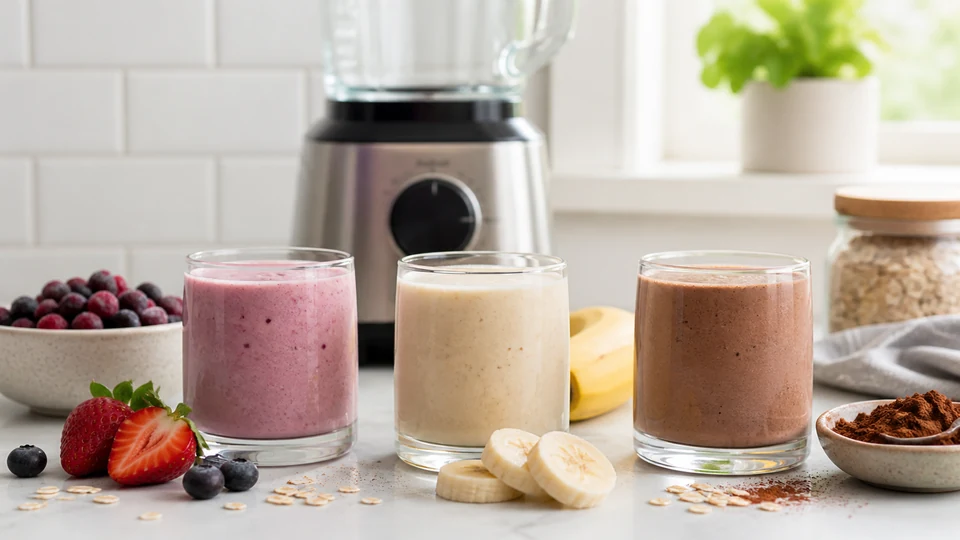
At Pancakes World, choose a breakfast shake recipe as a complete formula, not a universal fruit-to-liquid ratio. For no blender, use MyPlate’s one-serving yogurt, milk and juice-concentrate bag shake. For four servings, Penn State’s fruit smoothie uses juice, crushed ice, vanilla and nonfat dry milk. Illinois Extension offers a two-serving berry-banana shake with milk or tofu and juice, plus a separate two-serving milk, banana, frozen-fruit, butter and spinach smoothie. Penn State also publishes strawberry, green and pumpkin-oat lanes; Utah State supplies banana-yogurt and orange-juice versions. Keep each recipe’s quantities, yield, equipment and adjustment method together. Wash produce, check milk, soy, peanut, tree-nut and seed allergens, serve promptly, and refrigerate perishables at 40°F (4°C) or below. This is a comparison of authoritative formulas, not a the editorial platform recipe test, meal-replacement plan or promise about weight, fullness, energy or performance. The American Breakfast: Pancakes, Diner Plates, and Brunch Context covers the wider morning category, while Pancakes World opens the complete editorial library.
For adjacent decisions around Breakfast shake recipes, compare hot-weather breakfasts without the oven, a budget breakfast batch plan, and a customizable breakfast bar.
For broader context, continue with American Breakfast: Pancakes, Diner Plates and Brunch.
Why one shake template is not enough
Official recipes use different structures. One depends on yogurt and a small amount of milk. Another uses juice, dry milk and crushed ice. Others combine frozen fruit with liquid, add nut or seed butter, blend oats, or use vegetables. Their serving counts range from one to four.
A generic rule such as “two parts fruit to one part liquid” would erase those differences. It could make a source formula too thin, too thick or different in allergen profile. Instead, decide what the shake must do operationally:
- one serving or a family batch;
- blender, sealed bag or shakeable container;
- fresh, frozen or canned produce as the source allows;
- dairy milk, yogurt, dry milk, tofu or a named alternative;
- thin drink, spoonable blend or ice-thickened shake;
- immediate home service or short cold transport;
- known allergen boundaries.
Then choose the complete authoritative lane that already matches those constraints.
Compare the authoritative breakfast shake lanes
| Source formula | Yield | Core structure | Equipment and sequence | Best decision use |
|---|---|---|---|---|
| MyPlate Yogurt Smoothie in a Bag | 1 smoothie | Vanilla yogurt, low-fat or skim milk, thawed fruit-juice concentrate | Seal in a sandwich bag and mix by squeezing | No-blender single serving |
| Penn State Fruit Smoothie | 4 servings | 100% fruit juice, crushed ice, vanilla, nonfat dry milk | Crush ice first; shake or blend; serve immediately | Four-serving juice-and-milk-powder lane |
| Illinois Out of This Whirled Shake | 2 servings | Banana, frozen berries, low-fat milk or soft tofu, orange juice | Cover blender; blend smooth; add cold water only if source-directed thickness requires it | Berry-banana lane with stated milk/tofu choice |
| Illinois Breakfast Smoothie | 2 servings | Low-fat or fat-free milk, banana, frozen fruit, peanut or sunflower-seed butter, spinach | Wash produce; blend all until smooth | Frozen-fruit lane with a butter and greens |
| Penn State Strawberry Milkshake Smoothie | 1 serving | Banana, strawberries, frozen riced cauliflower, cashews, dates, skim milk or plant beverage | Clean and wash; blend complete formula | One-serving fruit, vegetable and cashew lane |
| Penn State Green Smoothie | 2 servings | Romaine, spinach, banana, apple, pear, lemon juice, water | Wash and roughly chop; blend complete formula | Dairy-free source formula based on produce and water |
| Penn State Pumpkin Pie Smoothie | 1 serving | Canned pumpkin, banana, oats, skim milk or plant beverage, vanilla, spice, optional ice | Blend complete source formula | Oat-and-pumpkin breakfast lane |
| Utah State Banana Delight Shake | 4 servings | Banana, fruit yogurt, milk, sugar, vanilla, ice | Blend until ice is crushed and drink is thick | Four-serving yogurt-banana shake |
| Utah State Dreamy Orange Smoothie | 4 servings | Frozen orange-juice concentrate, water, milk, sugar, ice, vanilla | Crush ice, add ingredients, blend | Four-serving orange-and-milk lane |
This table supports selection, not mixing. The cold-water adjustment belongs to the Illinois berry-banana formula. The crushed-ice-first direction belongs to specific Penn State and Utah State formulas. The produce-and-water green recipe does not validate removing dairy or nut ingredients from another formula.
Audit formula fidelity before the blender starts
A source-backed shake can lose its evidence boundary during shopping. Run a line-by-line comparison between recipe and ingredients on hand.
| Source term | What to verify | Unsupported shortcut to avoid |
|---|---|---|
| Frozen fruit | Fruit identity, frozen state and source quantity | Replacing with the same volume of juice |
| Juice concentrate | Concentrate, not ready-to-drink juice | Using the source water plus diluted juice |
| Low-fat milk | Exact quantity and selected product label | Pouring “until it looks right” |
| Nonfat dry milk | Powder quantity and complete mixing | Omitting it because liquid milk is present elsewhere |
| Soft tofu | Soft tofu in the source-authorized lane | Substituting firm tofu without evidence |
| Nut or seed butter | Exact type, amount and allergen label | Treating all butters as equivalent |
| Rolled oats | Source form and quantity | Replacing with cooked oatmeal by volume |
| Canned pumpkin | Plain ingredient specified by the formula | Using a sweetened pie filling without recalculation |
| Ice | Cubes or crushed amount and source sequence | Adding unlimited ice as a universal thickener |
Mark every row “match,” “authorized source option,” or “variation.” A variation is not automatically bad, but it breaks the original formula claim. Decide whether to obtain the matching ingredient, select a different complete recipe, or proceed as an explicitly untested household change.
Next, verify yield. Put the source serving count on the container labels before blending. For a two-serving formula, prepare two equal destination containers. For a four-serving formula, prepare four. This makes it harder to pour one oversized glass and still repeat the source’s per-serving nutrition values.
Finally, verify ingredient state. “One banana” can be fresh or frozen only where the source says so. Fruit should be cored, peeled or trimmed as directed. Juice concentrate must be thawed where specified. An ingredient at the wrong state can affect blade circulation even when its name matches.
Plan blender capacity and repeated batches
Never infer that a recipe can be doubled because empty space is visible above the ingredients. Blender capacity, hot-liquid restrictions, ice capability and minimum liquid requirements come from the appliance manufacturer, not these food sources.
Use a capacity worksheet:
- Record the appliance’s stated maximum working capacity.
- Record the selected recipe yield and estimated cold ingredient volume without compressing leafy produce.
- Keep expansion and circulation space required by the manufacturer.
- Run one complete source batch at a time when the doubled load is uncertain.
- Use the same ingredient measures and endpoint for each repeated batch.
- Combine batches only in a clean cold container large enough for even redistribution.
- Re-portion the combined drink into the total source servings and refrigerate immediately.
If batch one is thick and batch two is thin, do not hide the difference by combining them and claiming consistent results. Check measurement, ingredient temperature, fruit state, ice and blend endpoint. Record the variance. A production record is more valuable than a false statement that the recipe is foolproof.
For a group service, calculate complete source batches rather than a universal volume per person. A four-serving Utah State formula repeated three times supports 12 source servings when every batch and portion remains complete. It does not prove how many servings each guest should drink.
Lane 1: a one-serving no-blender shake
USDA MyPlate’s Yogurt Smoothie in a Bag uses one-quarter cup vanilla yogurt, one tablespoon low-fat or skim milk and two teaspoons thawed frozen fruit-juice concentrate. The complete recipe makes one smoothie. It is sealed in a sandwich-size zip-top bag and mixed by squeezing.
Choose this when equipment is the main constraint. It does not require a blender or ice. The small yield also avoids batch division. Preserve the source quantities: adding fruit, oats, nut butter or more liquid creates a variation.
Practical checks:
- use a food-grade bag that closes fully;
- inspect the seal before mixing;
- keep yogurt and milk cold;
- identify milk on the ingredient card;
- serve the one-smoothie yield rather than dividing it informally;
- do not claim that bag mixing creates the same texture as blending whole fruit.
The source suggests drinking from the bag with a straw. Pouring into a cup is an editorial service variation, not a different formula.
Lane 2: a four-serving shake-or-blend fruit smoothie
Penn State Extension’s Brighten Up with Breakfast includes a four-serving Fruit Smoothie made from two cups of 100% fruit juice, five to six crushed ice cubes, one teaspoon vanilla and two-thirds cup nonfat dry milk powder. It directs the cook to crush the ice, add the remaining ingredients, then shake or blend well and serve right away.
This is a useful batch lane when four source servings and dry milk suit the household. It is not interchangeable with a fresh-fruit smoothie: the fruit component is juice, and dry milk is part of the structure.
Do not remove dry milk and retain the source’s yield or texture claim. Do not add whole fruit and assume the original four servings remain equal. If using a lidded container instead of a blender, confirm it is designed for shaking and that crushed ice does not damage it.
Lane 3: the Illinois berry-banana shake
University of Illinois Extension’s Out of This Whirled Shake makes two servings. It combines one-half medium banana, one cup unsweetened frozen berries, one-half cup low-fat milk or soft tofu, and one-half cup 100% orange juice. The blender is covered tightly and the formula is blended until smooth. If it is too thick, the source permits adding one-half cup cold water and blending again.
That water adjustment is unusually specific, which makes it useful. Do not convert it into a universal “add half a cup” rule. Another formula may start with more or less liquid, and one-half cup can be a large change in a one-serving shake.
The source offers milk or soft tofu within its own formula. Milk and soy are different major allergens. A household should select one, record it, and identify the actual allergen instead of labelling the shake generically.
Lane 4: the Illinois breakfast smoothie
Illinois Extension’s Breakfast Smoothie makes two servings from one cup low-fat or fat-free milk, one medium banana, one cup frozen fruit such as blueberries, two tablespoons peanut butter or sunflower-seed butter, and a handful of loose spinach leaves. The directions wash hands, rub produce under cool running water, add ingredients to the blender and blend until smooth.
Choose this lane when a butter-and-greens formula is desired. The source nutrition panel is calculated using 1% milk and blueberries; it should not be attached unchanged to every fruit, milk or butter option.
Peanut is a major allergen. Sunflower seed is not on FDA’s nine-major-allergen list, but it still requires accurate ingredient disclosure and may matter to an individual guest. Milk also requires identification. Review packaged labels and cross-contact statements for every selected product.
The recipe says “one handful” of spinach, which is the source wording. That is not a precise project test measure. Pancake World should not convert it into grams without evidence.
Lane 5: Penn State’s three-formula set
Penn State Extension publishes three complete examples on one page.
Strawberry Milkshake Smoothie
The one-serving formula combines a banana, five medium strawberries, one-half cup frozen riced cauliflower, two tablespoons cashews, two pitted dates and one cup skim milk or plant-based beverage.
Choose it when that exact fruit-vegetable-cashew structure fits. Cashews are tree nuts, and milk or a plant beverage changes the allergen and label review. Do not hide cauliflower as a performance or child-feeding claim; it is simply part of the source formula.
Green Smoothie
The two-serving formula uses romaine, spinach, banana, apple, pear, lemon juice and water. It has no milk in the printed formula. Select it when a produce-and-water lane is wanted, not as evidence that water can replace milk in the strawberry or pumpkin formulas.
The volume of leafy produce and whole fruit makes rough chopping and blender capacity relevant. Follow the source cleaning guidance and do not overload the appliance.
Pumpkin Pie Smoothie
The one-serving formula combines canned pumpkin, banana, rolled oats, skim milk or plant beverage, vanilla, pumpkin-pie spice and ice as desired. Select it when an oat-and-pumpkin structure fits breakfast.
Oats, pumpkin and banana all contribute to the mixture; moving only the spice into another shake does not reproduce this formula. A plant beverage is an allowed source option here, but its packaged allergens and fortification are product-specific.
Lane 6: Utah State’s two four-serving shakes
The Utah State University Extension Fun with Foods booklet provides two four-serving formulas.
Banana Delight Shake
The recipe uses one banana, one eight-ounce carton fruit-flavored yogurt, one and one-half cups milk, one-quarter cup sugar, one teaspoon vanilla and six ice cubes or one cup crushed ice. It blends until the ice is crushed and the drink is thick.
Choose it for a sweetened yogurt-and-banana batch. Do not transfer its sugar quantity or thick-texture expectation to a different formula.
Dreamy Orange Smoothie
This recipe uses a six-ounce can frozen orange-juice concentrate, measured water, measured milk, one-quarter cup sugar, ice and vanilla. It crushes ice first, adds ingredients and blends well.
Choose it for an orange-and-milk batch using the complete concentrate formula. It is not equivalent to pouring ready-to-drink juice into the Banana Delight Shake.
Both formulas make four servings. Divide the finished batch into four equal source servings if retaining that yield.
Choose by constraint, not by a promised outcome
No blender
Use the MyPlate bag formula or Penn State shakeable juice-and-dry-milk formula. Confirm the container is secure and the ice is already crushed where required.
One serving
Choose MyPlate’s bag shake, Penn State’s strawberry formula or its pumpkin-oat formula. Each uses a different ingredient structure, so select by allergens and desired texture.
Two servings
Choose the Illinois berry-banana, Illinois breakfast or Penn State green formula. Their liquid bases differ: milk or tofu plus juice, milk with frozen fruit and butter, or water with produce.
Four servings
Choose the Penn State fruit smoothie or one of Utah State’s banana or orange formulas. Verify blender capacity rather than doubling a smaller recipe automatically.
Avoiding a named allergen
Start with a complete source formula that already omits it. Do not remove milk, yogurt, soy, peanut or cashew from a formula and assume the original yield and texture remain supported. FDA’s major allergens include milk, soybeans, peanuts and tree nuts.
Needing cold transport
Blend as close to service as practical, move the drink into clean covered containers, and keep it at 40°F or below. Do not depend on frozen fruit alone as a verified cold source after blending.
Prepare any selected formula systematically
1. Read the complete recipe
Record yield, ingredient state, equipment and service direction. “Frozen berries,” “juice concentrate,” “soft tofu,” “dry milk” and “canned pumpkin” are not interchangeable with adjacent ingredients.
2. Check the blender
Confirm capacity, lid, blade assembly and manufacturer limits. Never place hands or utensils near moving blades. Roughly chop large produce as Penn State suggests, but keep source quantities intact.
3. Clean and separate
Wash hands for at least 20 seconds. FDA advises washing whole produce under running water without soap, detergent or commercial produce wash. Keep it separate from raw meat, poultry, seafood and their utensils.
4. Measure before loading
Prepare all ingredients in their source states. This reduces the chance of forgetting milk powder, juice concentrate, vanilla or a texture ingredient after blending begins.
5. Follow the source sequence
Crush ice first when instructed. Use the complete blender load when instructed. Apply cold water only in the Illinois formula that authorizes it. There is no universal ingredient order in this evidence set.
6. Blend or shake to the stated endpoint
“Until smooth,” “until ice is crushed” and “until thick” are observable endpoints attached to specific formulas. Stop the machine before inspecting or scraping.
7. Portion the stated yield
One-, two- and four-serving formulas require different division. Measure or divide evenly. Do not call a half-batch “one serving” unless the source yield supports it.
8. Serve or refrigerate promptly
Penn State says a prepared smoothie is perishable and should be consumed or refrigerated within two hours. Keep it at 40°F or below and use the shorter one-hour boundary in temperatures above 90°F.
Diagnose texture without inventing a ratio
Too thick to circulate
Stop the blender. Verify every liquid was measured and no extra frozen ingredient entered. If using Illinois’s Out of This Whirled formula, follow its source-directed cold-water adjustment. For another formula, any added liquid is an editorial change; add cautiously, record it and remove unsupported nutrition or yield claims.
Too thin
Check whether frozen fruit, ice, oats, yogurt, tofu, nut butter or dry milk was omitted. Confirm a concentrate was not replaced with ready-to-drink juice. Do not add an arbitrary amount of fruit or ice and call the result source-tested.
Visible leaf or fruit pieces
Check whether large produce was roughly chopped, the lid was secure and the blender load was within capacity. Stop the machine before redistributing ingredients. A longer blend may be an editorial process adjustment unless the source gives a time.
Separation after standing
Confirm whether the recipe says serve immediately. Separation after a delay does not prove the ratio is wrong. Stirring or reblending may be a practical editorial action, but it does not extend the cold-storage boundary or restore an expired service window.
Ice remains coarse
Use crushed ice first where the source requires it and check the appliance’s ice capability. Do not continue operating a blender beyond manufacturer instructions.
Explore related Pancakes World guidance on American Pancakes, Maple Syrup, and Maple Syrup Pancakes.
Sources and editorial references
Scaling a one-serving blender formula is limited by appliance capacity. Doubling ingredients may overfill the jar or blend unevenly. Prefer repeated complete batches when capacity is uncertain.
For a batch log, record:
- source recipe;
- intended complete batches;
- source yield per batch;
- actual containers filled;
- ingredient brands and substitutions;
- blend or shake method;
- start and refrigeration time;
- allergen set;
- service or discard time.
If a four-serving recipe yields three unequal cups, the source serving structure was not preserved. Re-portion the complete batch evenly or stop attaching source-specific nutrition values. Do not merge leftovers from two formulas merely because their color is similar.
Use a shake production log
For each batch, create one row with these fields:
| Field | Record |
|---|---|
| Formula | Exact source title and URL identifier |
| Batch | Sequence number and planned source yield |
| Ingredients | Actual products, states and quantities |
| Allowed options | Milk, tofu, fruit, butter or beverage choice used |
| Variations | Every departure from the source |
| Equipment | Blender or sealed container used |
| Start | Time ingredients left cold storage |
| Endpoint | Smooth, ice crushed or thick, matching source wording |
| Actual yield | Equal containers or measured volume |
| Refrigerated | Time and temperature location |
| Released | Service time and quantity |
| Disposition | Consumed, returned to cold control or discarded |
The log prevents a familiar problem: the first batch follows the recipe, later batches are adjusted from memory, and all containers receive the same label. If an ingredient changes, start a new formula row. If a batch receives extra liquid, record it before service.
For nutrition panels, preserve the exact calculation basis. Illinois states that its Breakfast Smoothie panel uses 1% milk and blueberries. A batch made with another milk, another frozen fruit or sunflower-seed butter may not carry that panel unchanged. The log should say “nutrition value not transferred” until an exact recalculation exists.
For allergens, list the actual product rather than the recipe’s options. “Milk or tofu” is not an acceptable finished label; the served batch contains one of them. “Peanut or sunflower butter” must likewise resolve to the actual choice, with its packaged warnings retained.
Design a three-day formula rotation without merging recipes
A short rotation can test workflow preferences without claiming a health result:
- Day one, minimal equipment: MyPlate bag smoothie, one source serving, no blender cleanup.
- Day two, two-serving blender batch: Illinois berry-banana shake, with the source milk-or-tofu choice recorded.
- Day three, oat-based single serving: Penn State pumpkin formula, with canned pumpkin, rolled oats and the selected beverage kept intact.
Compare only observable production factors: preparation time recorded locally, number of tools, ease of equal portioning, visible thickness, separation during the permitted service period, cold-storage needs and cleanup. Do not turn the rotation into evidence about fullness, energy, school performance, weight or digestion.
If a formula is inconvenient, select another authoritative lane next time. Do not gradually transform it through unrecorded substitutions while continuing to cite the original. The purpose of a rotation is to learn which complete workflow fits the household, not to manufacture one universal shake.
Allergen and substitution controls
FDA’s nine major allergens are milk, eggs, fish, crustacean shellfish, tree nuts, peanuts, wheat, soybeans and sesame. These formulas particularly raise milk, soy, peanut and tree-nut questions. Packaged plant beverages, yogurt, butter products, juice concentrates and flavorings require label review.
Use a route card:
- exact formula name;
- milk, yogurt, tofu, peanut butter, seed butter, cashews or plant beverage used;
- packaged label retained;
- substitutions recorded;
- preparation equipment and cross-contact limits;
- cold-storage requirement;
- serving utensil or closed bottle.
Do not label a shake “dairy-free” because it uses a plant beverage if shared yogurt, milk or blender residue has not been controlled. Do not assume sunflower-seed butter is safe for every person who avoids peanuts. Communicate facts and let guests follow their established medical plans.
Cold-chain and service rules
Milk, yogurt, tofu, cut produce and blended shakes are perishable. Keep refrigerators at 40°F or below and verify with an appliance thermometer. For transport, use a clean insulated cooler with enough ice or frozen gel packs and keep it closed.
Serve a group batch in small covered bottles or small pitchers rather than one open container when practical. Keep backup refrigerated. Do not add fresh shake to a partially used service pitcher. Start a service clock when the drink leaves cold control.
Discard perishable shake after more than two hours at room temperature, or more than one hour above 90°F. This time rule is not a quality test: smell and appearance cannot verify safety.
Frequently asked questions
What is the difference between a breakfast shake and a smoothie?
These authoritative sources use both names for overlapping blended or shaken drinks. This page does not impose a universal technical distinction. Choose by complete formula, yield, equipment and texture rather than the label alone.
Which recipe works without a blender?
MyPlate’s Yogurt Smoothie in a Bag is mixed in a sealed bag. Penn State’s juice, crushed-ice, vanilla and dry-milk formula may be shaken or blended. Follow each complete recipe.
Can I use water when a shake is too thick?
The Illinois Out of This Whirled Shake specifically permits one-half cup cold water if its mixture is too thick. Do not transfer that amount to other formulas. Any unsourced adjustment is an editorial variation.
Can I make breakfast shakes the night before?
None of these recipes creates one universal overnight quality guarantee. Follow the selected source’s service direction and maintain refrigeration at 40°F or below. If it says serve immediately, plan accordingly.
Can a shake replace breakfast?
This article makes no meal-replacement claim. The formulas have different yields and ingredients. Decide what else is needed separately, without promises about fullness, energy or weight.
How do I avoid dairy or nuts?
Choose a complete authoritative formula that already fits the restriction, then review every packaged label and the blender’s cross-contact history. Do not delete a structural ingredient and retain the original claim.
Are these Pancake World-tested shake recipes?
No. They are government and university Extension formulas compared editorially. Pancake World has not tested them, so the page uses Article schema and preserves the external source boundaries.
- USDA MyPlate, “Yogurt Smoothie in a Bag”:
https://www.myplate.gov/recipes/yogurt-smoothie-bag - Penn State Extension, “ABCs of Growing Healthy Kids: Brighten Up with Breakfast”:
https://extension.psu.edu/abcs-of-growing-healthy-kids-brighten-up-with-breakfast - University of Illinois Extension, “Out of This Whirled Shake”:
https://extension.illinois.edu/sites/default/files/out_of_this_whirled_shake.pdf - University of Illinois Extension, “Breakfast Smoothie”:
https://eat-move-save.extension.illinois.edu/eat/recipes/breakfast-smoothie - Penn State Extension, “Smoothies: a Great Blend of Flavor, Convenience, and Nutrition”:
https://extension.psu.edu/smoothies-a-great-blend-of-flavor-convenience-and-nutrition - Utah State University Extension, “Fun with Foods, Level 1”:
https://extension.usu.edu/saltlake/files/FunWithFoodsLevel1.pdf - U.S. Food and Drug Administration, “Selecting and Serving Produce Safely”:
https://www.fda.gov/food/buy-store-serve-safe-food/selecting-and-serving-produce-safely - U.S. Food and Drug Administration, “Food Allergies”:
https://www.fda.gov/food/nutrition-food-labeling-and-critical-foods/food-allergies - U.S. Food and Drug Administration, “Serving Up Safe Buffets”:
https://www.fda.gov/food/buy-store-serve-safe-food/serving-safe-buffets - USDA Food Safety and Inspection Service, “Refrigeration and Food Safety”:
https://www.fsis.usda.gov/food-safety/safe-food-handling-and-preparation/food-safety-basics/refrigeration