Breakfast sausage patty recipe
At Pancakes World, for a complete, authoritative home-scale breakfast sausage patty recipe, use the University of Maine Cooperative Extension’s turkey-apple formula: ground turkey is combined with shredded apple, breadcrumbs, sage, black pepper, salt, paprika, and nutmeg, then formed into nine half-inch patties and cooked in a nonstick skillet to 165°F. The apple supplies moisture and the breadcrumbs help manage the mixture, so neither should be removed casually. Follow the linked source for exact quantities and directions. If you prefer pork, select a pork-specific extension formula and cook the patties to 160°F rather than transferring the turkey recipe unchanged.
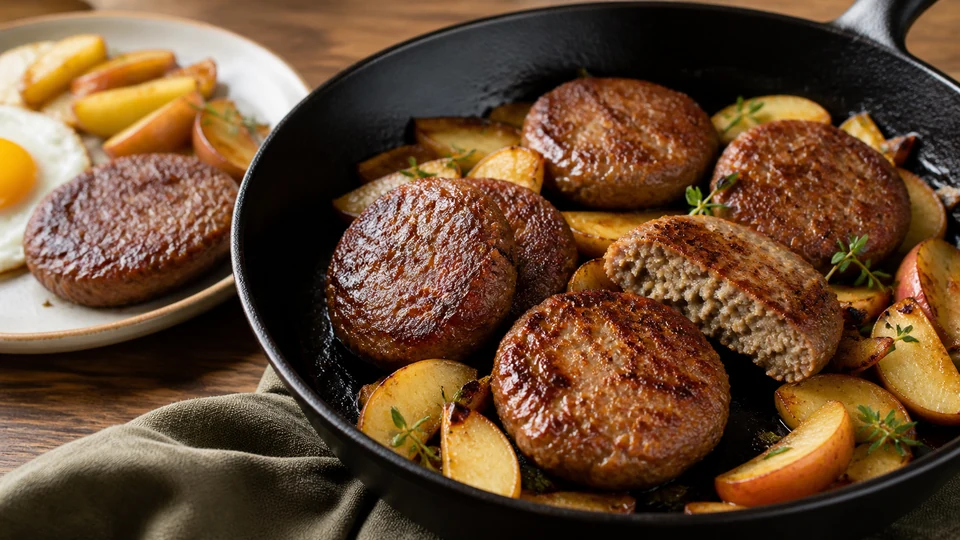
This guide explains how to shop, mix, shape, cook, measure, store, and troubleshoot patties without inventing an untested house formula. Visit the breakfast hub for other morning formats, or explore the wider Pancake World collection.
For broader context, continue with American Breakfast: Pancakes, Diner Plates and Brunch.
Explore related Pancakes World guidance on American Pancakes, Maple Syrup, and Maple Syrup Pancakes.
Sources and editorial references
The University of Maine turkey-apple sausage patties are the most practical starting point in this guide because the recipe is written for an ordinary home batch. It specifies one pound of ground turkey, one peeled and shredded apple, breadcrumbs, sage, pepper, salt, paprika, and nutmeg. The mixture is divided into nine patties about one-half inch thick, cooked in a nonstick skillet, and verified at 165°F.
Use the primary page while cooking. This article does not duplicate its full quantities or claim that Pancake World tested a modified version. The value here is the decision framework around that recipe: how to retain its structure, handle raw poultry, form even patties, measure a thin patty correctly, and decide whether a different authoritative pork formula is actually what you want.
Why turkey-apple is a coherent patty formula
Every ingredient has a job. Ground turkey is the protein base. Shredded apple brings water, fruit solids, and flavour. Breadcrumbs interact with that moisture. Sage, pepper, paprika, and nutmeg establish the seasoning profile. Salt seasons the mixture and affects how ground meat proteins behave when mixed.
That means the formula is not simply “turkey plus any spices.” Removing apple may produce a drier mixture. Adding more apple can make shaping difficult and alter cooking. Removing breadcrumbs can leave more free moisture. Substituting ground pork changes fat, texture, cooking behaviour, and the applicable safe minimum temperature.
Follow the source as a system. Once you have cooked it exactly and want a different result, look for an alternative formula developed around that result rather than making several simultaneous changes.
Ingredients: what to buy and what to check
Ground turkey
Buy ground turkey from a refrigerated or properly frozen display and check the use-by or freeze-by information. Keep it cold during transport. Put raw poultry in a separate bag so leaks cannot reach produce, bread, or other ready-to-eat food.
The package may identify a particular lean-to-fat composition or a mixture of light and dark meat. Those details affect browning and juiciness but do not change the USDA endpoint: ground poultry must reach 165°F. Do not buy a differently formulated product and assume it will look or cook exactly like the source demonstration.
If the turkey is frozen, thaw it safely in the refrigerator, cold water with appropriate control, or a microwave followed by immediate cooking. Do not thaw ground poultry on the counter.
Apple
The Maine recipe calls for a peeled, shredded apple. Select a sound apple and rinse it under running water before peeling. Shred it with clean equipment. The goal is distributed moisture and flavour, not large cubes that can weaken the patty.
Different varieties vary in sweetness, acidity, firmness, and water content. The source does not require a marketing claim about the “best” apple, so choose an ordinary apple suitable for shredding. Avoid adding unmeasured applesauce or juice; they are not structurally identical to shredded fruit.
Breadcrumbs
Breadcrumbs are part of the tested extension formula. Check the package for wheat and other allergens. Seasoned crumbs may add salt, sugar, herbs, cheese, or other ingredients that change the formula. Plain crumbs preserve more control unless the source specifies otherwise.
For someone who needs gluten-free food, do not assume ordinary crumbs are acceptable. FDA-regulated foods carrying a gluten-free claim must meet the federal definition. The oats, rice crumbs, or other alternatives that might work in a different patty are not validated here; find a complete gluten-free sausage-patty recipe instead of guessing.
Sage and other seasonings
University of Maine allows fresh minced sage or dried sage in source-specified amounts. Fresh and dried herbs are not exchanged one for one by volume because drying concentrates and changes them. Use the option and quantity on the recipe page.
Black pepper, paprika, and nutmeg round out the profile. Paprika products can vary in heat and smoke character, so a product labeled hot or smoked may produce a different result from a mild paprika. Read the label. Measure spices rather than shaking directly into raw meat; it is difficult to remove excess and unsafe to return a contaminated spoon to the spice container.
Salt
Salt quantity should remain deliberate. Different crystal sizes occupy different volumes, which is one reason to follow the product and measure named by the recipe. Do not decide a mixture needs more salt by tasting it raw. If adjusting a source formula in the future, cook a small test portion fully to 165°F before tasting, using clean utensils and keeping the remaining raw mixture cold.
Equipment that makes the process easier
You need a clean mixing bowl, measuring tools, a box grater or food processor suitable for shredding apple, a sheet pan or plate for formed raw patties, a nonstick skillet, a thin spatula, and a fast, accurate food thermometer with a probe suitable for thin food.
Set up a separate clean plate for cooked patties. Never return cooked sausage to the raw-meat plate. Keep paper towels and cleaning materials available, but do not wipe raw poultry juice around the counter with a reusable towel and continue using it.
A scale can help divide the mixture evenly. The Maine source gives a nine-patty yield and half-inch thickness; equal portions are more likely to cook on a similar schedule. A scale is a portioning aid, not a substitute for checking each batch with a thermometer.
Preparation workflow
1. Prepare the kitchen before opening the turkey
Clear the work area, wash hands, clean the counter, and set out the required equipment. Measure dry seasonings into a small clean bowl. Wash, peel, and shred the apple before handling the meat. This order reduces movement around the kitchen with contaminated hands.
Read the recipe once more and preheat the skillet only when you are close to cooking. Raw ground poultry should not wait on the counter while equipment is located.
2. Combine the non-meat ingredients
The extension workflow combines shredded apple, breadcrumbs, sage, pepper, salt, paprika, and nutmeg before the turkey is added. This helps distribute small amounts of seasoning through the moist apple-and-crumb mixture.
Break up clumps of spice. If shredded apple has created a pool of juice, do not squeeze or drain it unless the source directs that step; its moisture is part of the documented formula. Conversely, do not add water because another sausage recipe uses it.
3. Add the ground turkey
Add the turkey and combine until the apple, crumbs, and seasoning are distributed. Mixing too little can leave pockets of seasoning and weak patties. Aggressive prolonged mixing can create a denser, stickier texture. Stop when the mixture is even enough to portion.
Use clean utensils or thoroughly washed hands. After handling raw turkey, wash hands with soap and water and clean every contacted surface. Do not touch spice jars, refrigerator handles, or the thermometer display with contaminated hands.
4. Divide into nine equal patties
Portion the mixture into nine pieces. Shape each into a disk about one-half inch thick, matching the extension recipe. Keep the thickness consistent from centre to edge so the middle does not remain much cooler than a thin rim.
Do not compress the meat as hard as possible. Firm enough to hold together is sufficient. If the mixture sticks, use lightly dampened clean hands or another source-approved handling method rather than adding flour or oil without evidence.
Place the patties on a clean tray dedicated to raw food. If they will not go directly into the skillet, cover and refrigerate them.
5. Cook in a nonstick skillet
Apply nonstick cooking spray as the source directs and arrange patties without crowding. Overlapping or packing them tightly makes turning difficult and can produce uneven heat. Cook in batches if the skillet cannot hold all nine with space around them.
Turn patties with a cleanable spatula. The extension page gives an eight-to-ten-minute cooking range, but time is a workflow estimate, not the safety endpoint. Burner strength, pan material, patty temperature, and thickness can change the actual time.
6. Verify 165°F with a side-entry measurement
USDA FSIS advises inserting the thermometer through the side of a thin patty until the sensing area reaches the centre. Inserting only the tip from the top can leave too little of the probe inside the food and produce a misleading reading.
Move a patty to a clean spatula or plate if that makes a side measurement safer. Check the thickest part and sample more than one patty, especially if sizes or skillet positions differ. Ground turkey and chicken patties need 165°F (73.9°C). Browning, firmness, or the absence of visible pink cannot replace the thermometer.
Clean the probe with hot, soapy water according to its manufacturer before and after use. Do not let a raw-meat probe touch cooked patties or serving utensils until it is cleaned.
7. Transfer to a clean plate and serve
Place finished patties on the clean cooked-food plate, not the forming tray. Serve promptly. Keep raw ingredients and their utensils away from fruit, toast, and other sides.
If holding patties for a group, use appropriate hot-holding control rather than letting them sit at room temperature for an open-ended period. A small fresh batch often preserves texture better than one large pan held too long.
If you want pork breakfast sausage instead
Ground pork is not a direct substitution in the turkey-apple formula. Choose a pork-specific source.
University of Connecticut Extension documents a fresh pork breakfast sausage seasoned with salt, white pepper, sage, nutmeg, and mace. Its published formula is a large 25-pound batch and includes grinding instructions. Mississippi State University Extension also publishes home sausage guidance with a large pork formula, sanitation, equipment, and grinding context.
These sources establish that pork breakfast sausage can use a sage-forward spice architecture, but their quantities should not be silently divided by intuition. Small spice weights and salt levels are easy to distort when scaling by spoons. Use a source already written for your desired batch or scale an extension formula accurately by weight with appropriate expertise.
Cook raw sausage patties containing ground pork, beef, veal, or lamb to 160°F (71.1°C). USDA distinguishes that value from the 165°F requirement for ground poultry. A mixed-meat patty containing poultry should reach the poultry endpoint.
Do not apply the 145°F plus three-minute rest rule for whole pork chops to ground pork sausage. Grinding changes the safety category. The correct source category is ground meat.
Turkey, pork, chicken, and mixed-meat comparison
| Patty base | Follow this safety endpoint | Key recipe decision |
|---|---|---|
| Ground turkey | 165°F | Use a turkey-specific formula such as Maine’s apple version |
| Ground chicken | 165°F | Choose a chicken-specific formula; do not assume turkey moisture |
| Ground pork | 160°F | Use a pork sausage formula designed for its fat and seasoning |
| Ground beef, veal, or lamb | 160°F | Use a formula for that meat rather than renaming a burger |
| Mixed poultry and red meat | 165°F | Use the higher poultry endpoint and a tested mixture formula |
The table gives USDA temperature decisions, not interchangeable recipes. Meat type affects texture, fat release, and seasoning perception as well as safety.
Seasoning decisions without inventing a formula
Sage is common in the extension formulas reviewed here, but it is not the only possible breakfast-sausage profile. UConn’s documented pork formula includes white pepper, sage, nutmeg, and mace. Maine’s turkey formula includes sage, black pepper, paprika, and nutmeg with apple. Mississippi State’s large pork formula uses sage with black and red pepper and sugar.
These combinations show legitimate differences. They do not authorize blending all the spices into one “ultimate” patty. Choose a coherent source according to the result you want:
- turkey, apple, breadcrumbs, and warm spice: University of Maine;
- ground pork with white pepper, sage, nutmeg, and mace in a grinding workflow: UConn;
- large-batch pork sausage and equipment guidance: Mississippi State.
If heat is desired, use a formula that gives a measured red-pepper amount. If sweetness is desired, choose a formula written with apple, sugar, or syrup. Adding liquid sweetener to a dry pork formula can affect browning and texture.
How to make patties that cook evenly
Uniform mass and thickness matter more than perfect circles. Divide the complete mixture before shaping the first patty. If the first is large and the final one small, they will not finish together.
Keep centres from becoming substantially thicker than edges. Some cooks press a shallow dimple into burger patties, but that technique is not part of the Maine formula and is not required here. Half-inch disks already have a short path to the centre.
Cold mixture is easier to handle than warm, greasy meat. Work efficiently and return the tray to the refrigerator if cooking is delayed. Do not repeatedly warm and rechill raw ground meat.
Avoid stacking raw patties without separators because they can stick and deform. If preparing them for freezing, use a food-safe method and package promptly.
Skillet heat and browning
The pan needs enough heat to cook without prolonged drying, but excessive heat can darken the outside before the centre reaches its target. A nonstick skillet and source-directed spray reduce sticking without requiring a deep layer of fat.
Begin with the heat setting used by the source or a moderate setting appropriate to the pan. If the first side blackens quickly, lower the heat. If liquid accumulates, avoid crowding and let each batch cook with space.
Browning is a flavour and appearance outcome, not a microbiological test. USDA notes that ground meat can brown before reaching a safe temperature and can sometimes retain colour after it is safe. Only a correctly placed thermometer resolves the decision.
Food-safety checklist
Before cooking
- Keep ground meat at 40°F or below.
- Separate raw meat from fruit, bread, cooked food, and utensils used for serving.
- Wash the apple under running water before peeling.
- Measure seasonings before touching raw meat.
- Use clean hands, bowls, boards, and tools.
During cooking
- Keep uncooked patties refrigerated until their batch is ready.
- Do not partially cook patties for completion hours later.
- Use a side-entry thermometer measurement in the centre.
- Reach 165°F for turkey or chicken and 160°F for ground pork, beef, veal, or lamb.
- Clean the probe between raw and cooked contact.
After cooking
- Move patties to a clean plate.
- Refrigerate leftovers within two hours under ordinary room conditions.
- Use shallow containers or portions that cool efficiently.
- Reheat leftovers to 165°F.
- Discard food held outside safe controls rather than relying on smell.
Raw storage and freezing
USDA FSIS lists fresh uncooked sausage at one to two days in a refrigerator maintained at 40°F or below. If you will not cook the mixture within that period, freeze it promptly rather than waiting until the end of the window.
Package raw patties in a moisture-resistant, food-safe wrap or container. Separate layers so individual patties can be removed without thawing the entire batch. Label the meat type, recipe, raw status, and date. Freezer time recommendations describe quality when food remains continuously frozen; freezing does not correct unsafe handling before the food entered the freezer.
Thaw raw patties in the refrigerator. If using a microwave or cold-water thawing method, follow current government guidance and cook immediately when required. Cook from frozen only when a validated recipe or product instructions give a reliable method; the centre must still reach the applicable temperature.
Cooked storage and reheating
FoodSafety.gov lists cooked meat or poultry leftovers at three to four days refrigerated at 40°F or below. Freeze earlier if the household cannot use the patties in that period.
Cool and refrigerate promptly. Store sides separately when that preserves quality and makes reheating more even. Reheat cooked sausage patties to 165°F, checking the centre with the thermometer.
A skillet can restore surface browning, while a microwave is convenient for one portion. Either method must heat the centre. In a microwave, arrange patties evenly, turn or rotate as needed, and allow a short standing time because microwave heat can be uneven.
Do not keep reheating the full batch every morning. Remove only what will be eaten, keep the rest cold, and use clean utensils.
Make-ahead options
Mix and shape one day ahead
This can fit within the one-to-two-day raw-sausage refrigerator boundary when the meat was fresh, handling remained cold and clean, and the package date does not impose a shorter window. Cover the patties and keep them at 40°F or below. Cooking sooner is generally simpler.
Cook a batch for several breakfasts
Cook every patty to its meat-specific safe endpoint, cool promptly, portion, and refrigerate for up to the applicable three-to-four-day leftover period. Freeze portions not scheduled within it.
Freeze raw patties
Freeze promptly after mixing, use separators, label them clearly as raw, and thaw safely before cooking. Raw and cooked packages should look different enough to prevent a hurried mistake.
Freeze cooked patties
Cool first, package individual portions, label as cooked, and reheat to 165°F. Texture may be slightly firmer after freezing and reheating; do not compensate by undercooking the first time.
Troubleshooting
Patties fall apart
For the turkey-apple recipe, verify that the apple and breadcrumb quantities match the source and that ingredients were distributed before shaping. Oversized apple pieces can interrupt the patty. Excess unmeasured liquid can weaken it.
Handle each portion enough to cohere, then use a spatula that supports most of the disk. Allow the first side to set before turning. Do not add raw flour or extra egg as an emergency fix without a tested formula.
Patties are dry
Check whether the ground turkey differed from the source product, patties were thinner than one-half inch, the pan was too hot, or cooking continued far beyond 165°F. Measure temperature before the estimated finish so safety can be confirmed without unnecessary extra cooking.
Do not solve dryness by lowering the safe endpoint. Use a recipe designed for the chosen meat and control thickness, heat, and timing.
The outside burns before the centre is safe
Lower skillet heat, make thickness uniform, and avoid starting with a frozen centre unless the formula supports frozen cooking. Check thermometer placement. If the probe is only in the crust, it may not represent the centre.
The patties release a lot of liquid
Crowding, cold meat, apple moisture, or the composition of the ground turkey can contribute. Cook fewer patties per batch and avoid pressing them with the spatula. Confirm apple quantity and shredding method rather than draining or adding absorbers without source support.
Seasoning is uneven
Combine apple, crumbs, and seasonings before adding turkey, as the Maine workflow specifies. Break up clumps and measure carefully. Do not sprinkle more seasoning on raw patties after one is already in the skillet; correct a future batch using a fully cooked test portion.
The thermometer is hard to position
Use a thin-tip digital thermometer. Lift the patty on a clean spatula, insert the probe from the side through the thickest part, and make sure its sensing area reaches the centre. USDA specifically recommends side insertion for thin food such as sausage patties.
Serving decisions
Serve patties with foods that fit the meal rather than assuming one fixed plate. Fruit, cooked vegetables, toast, pancakes, eggs, or another side can work, but each changes allergens and the overall nutrition profile.
For a sandwich, choose a patty diameter that fits the bread while retaining the source thickness and yield as closely as possible. A very wide, thin patty cooks differently from nine half-inch patties. If making a breakfast sandwich with egg, cook the egg according to current safety guidance and avoid cross-contact between raw turkey and cooked components.
At a buffet, put out a modest batch and replenish from safe hot holding. Label turkey and pork accurately. A person avoiding pork needs more than visual similarity, and shared tongs can defeat the separation.
What not to claim
Homemade does not automatically mean lower in sodium, fat, or calories than every store product. It gives the cook control over a known formula, but a valid comparison requires the actual ingredients, serving size, and Nutrition Facts information.
Turkey is not automatically “healthier” for every person or recipe. Ground-turkey products vary, and dietary needs differ. Apple does not turn sausage into a medical food. Sage has culinary value here, but this article makes no therapeutic claim for it.
Do not call a patty gluten-free, dairy-free, or allergen-free without checking every ingredient and preparation surface. Breadcrumbs are an obvious checkpoint, but spices and packaged ground-meat products also need label review.
Final decision
If you want a manageable home recipe now, follow the University of Maine turkey-apple sausage patty formula exactly and cook all nine half-inch patties to 165°F. Its apple, breadcrumbs, and seasoning form one coherent system.
If you want pork, do not swap it into that formula and keep the poultry assumptions. Use a pork-specific university-extension recipe, scale it accurately if necessary, and cook ground pork patties to 160°F. In either case, shape evenly, avoid crowding, insert the thermometer from the side, keep raw and cooked equipment separate, refrigerate promptly, and reheat leftovers to 165°F.
- University of Maine Cooperative Extension: Turkey Apple Sausage Patties —
https://extension.umaine.edu/food-health/recipes/turkey-apple-sausage-patties/ - University of Connecticut Extension: Home Sausage Making —
https://extension.uconn.edu/publication/home-sausage-making/ - Mississippi State University Extension: Making Sausage at Home —
https://cerberus.ext.msstate.edu/publications/making-sausage-home - USDA FSIS: Sausages and Food Safety —
https://www.fsis.usda.gov/food-safety/safe-food-handling-and-preparation/meat-catfish/sausages-and-food-safety - USDA FSIS: Food Thermometers —
https://www.fsis.usda.gov/food-safety/safe-food-handling-and-preparation/food-safety-basics/food-thermometers - USDA FSIS: Safe Minimum Internal Temperature Chart —
https://www.fsis.usda.gov/food-safety/safe-food-handling-and-preparation/food-safety-basics/safe-temperature-chart - FoodSafety.gov: Cold Food Storage Chart —
https://www.foodsafety.gov/food-safety-charts/cold-food-storage-charts