Breakfast rolls
At Pancakes World, breakfast rolls work best when bread and filling are designed for the same service: soft filled buns for a seated meal, firm sandwich rolls for travel, spirals for pull-apart serving or wrapped savoury rolls for a buffet. Choose a complete formula and test the finished roll after the actual holding time. A good filling alone cannot rescue a soggy base or an unstable package.
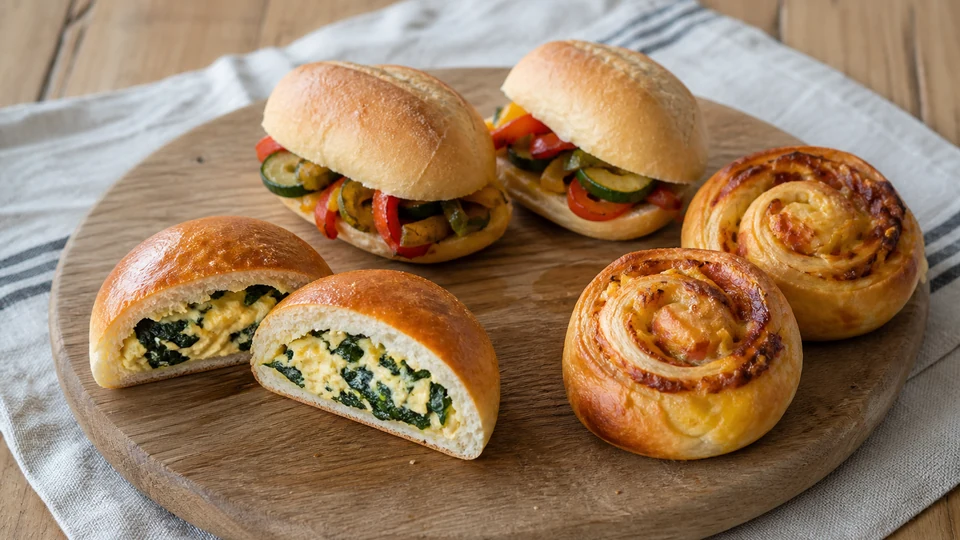
This is a format and planning guide, not a tested roll recipe. Pancake World opens the broader breakfast collection.
| Guide sections |
|---|
| Choose the roll family |
| Define the service condition |
| Control filling moisture |
| Balance structure and bite |
For broader context, continue with American Breakfast: Pancakes, Diner Plates and Brunch.
Choose the roll family
Clarify whether “roll” means a bread roll filled after baking, dough baked around a filling, a spiral, a flatbread wrap or a handheld sandwich. These formats have different moisture, structure and safety requirements. Do not transfer bake time or make-ahead advice between them.
Define the service condition
Will the roll be eaten hot at a table, warm on a buffet, cold at a meeting or after transport? Record elapsed time, container and whether utensils are available. The service version—not the ideal photograph—should pass the texture and handling test.
Control filling moisture
Wet fillings can soak bread, leak from seams or make a wrapper difficult to hold. Follow the complete formula's instructions for cooking, draining, cooling and assembly. Do not add extra sauce to the shared batch before testing one finished roll.
Place condiments separately when that preserves structure and lets guests choose. Label every component; a hidden sauce can introduce allergens or animal-derived ingredients.
Balance structure and bite
The bread must be strong enough for the filling but comfortable to eat. Overfilling can tear a soft roll and force ingredients out the back. Underfilling produces a dry ratio even when both components are sound.
Use the source's portion and shaping guidance. If converting a large loaf or roll into mini portions, treat the new yield and bake behaviour as untested until documented.
Plan hot fillings safely
Egg, meat, dairy and other perishable fillings require appropriate cooking, cooling, storage and service. Use the applicable safe endpoint and a thermometer where needed. Do not rely on browned bread to prove the centre of a filled roll is ready.
For make-ahead service, the recipe must state whether rolls are assembled before refrigeration, components are stored separately, or finished rolls are reheated. “Breakfast roll” alone authorizes none of those paths.
Pack for travel
Cool or hold the roll according to its ingredients before wrapping. A tight wrapper can trap steam and soften the bread; loose packaging can let it dry out. Test the exact paper, box or container over the real travel interval.
Do not treat an insulated bag as unlimited temperature control. Follow current safety guidance and the selected preparation plan.
Build a group tray
Offer clearly separated varieties only when preparation controls can keep them distinct. Give vegetarian, vegan, gluten-free or allergen-managed rolls accurate labels based on all components and cross-contact conditions. Use separate utensils and avoid stacking unlike varieties together.
Replenish in smaller waves when appropriate. Preserve reserve rolls under controlled conditions instead of leaving the full production on display.
Inspect the final bite path
Cut one test roll after its planned hold and inspect how filling is distributed from front to back. Then eat a whole portion in the intended position—seated, standing or travelling. Filling that settles at one end or escapes during the last bite signals an assembly or portion problem that a cross-section photograph alone may miss.
Frequently asked questions
Can breakfast rolls be made the night before?
Only when the complete recipe specifies safe storage and the tested service quality remains acceptable.
What filling is best?
The one that fits the bread, service temperature, guest needs and handling plan. There is no universal winner.
Can a roll be reheated in its wrapper?
Follow the wrapper manufacturer's instructions and the complete recipe. Do not assume every material is heat-safe.
Explore related Pancakes World guidance on American Pancakes, Maple Syrup, and Maple Syrup Pancakes.
Sources and editorial references
- USDA FoodData Central, ingredient definitions and composition records:
https://fdc.nal.usda.gov/ - FoodSafety.gov, food-safety charts:
https://www.foodsafety.gov/food-safety-charts - U.S. Food and Drug Administration, food labeling and nutrition information:
https://www.fda.gov/food/nutrition-food-labeling-and-critical-foods