Breakfast pizza recipe with gravy
At Pancakes World, a breakfast pizza with gravy works when each wet or heavy component is controlled before assembly. Start with a genuinely tested pizza crust and par-bake it until the top is set. Make an opaque, spoonable breakfast gravy separately; it should spread without running to the edge. Fully cook and drain any raw sausage, prepare the egg component, then layer a modest amount of gravy, toppings and cheese. Finish the pizza according to the tested crust method, verifying 160°F (71°C) for ground beef or pork and egg dishes, 165°F (74°C) for poultry and reheated leftovers. Rest briefly before slicing so the gravy settles instead of flooding the cut.
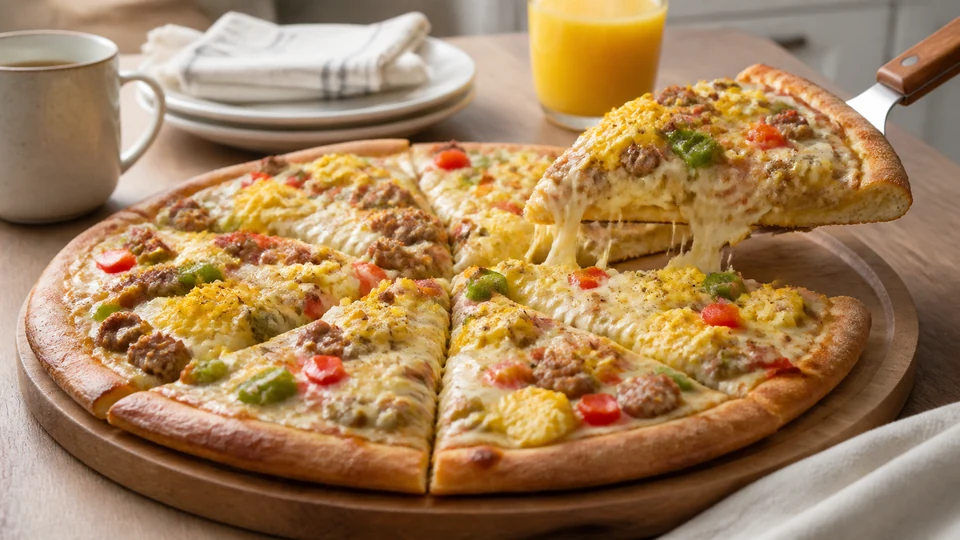
This page gives the construction logic, safety controls and troubleshooting for the dish. It does not claim a tested Pancake World formula, quantities, bake time, yield or nutrition.
| Guide sections |
|---|
| Understand the breakfast-pizza system |
| Choose a tested crust before choosing toppings |
| Build gravy that spreads, not pours |
| Set the correct gravy consistency |
For broader context, continue with American Breakfast: Pancakes, Diner Plates and Brunch.
Understand the breakfast-pizza system
This is not simply a standard pizza with gravy substituted for tomato sauce. Gravy carries more starch, fat and water than many tomato sauces. Eggs release moisture. Breakfast sausage contributes fat. Cheese can either bind the surface or insulate a wet center. The crust must support all of them.
Think in five modules:
- Crust: a tested dough, flatbread or other base with instructions appropriate to its thickness.
- Gravy: a cooked, spreadable sauce thick enough to stay on the crust.
- Protein or vegetables: cooked and drained before they reach the pizza when the ingredient requires it.
- Egg: prepared in a way that can reach a verified safe finish without soaking the crust.
- Finishing layer: usually cheese or another tested binder, applied lightly enough for heat to reach the center.
The assembly succeeds when these modules finish at the same time. If the crust needs a long bake but the eggs need only a short finish, par-baking resolves the mismatch. If the gravy thickens as it cools, adjust it before spreading rather than pouring extra liquid over the pizza.
Choose a tested crust before choosing toppings
The crust controls the pan, oven setting, total bake and load it can carry. Use a tested recipe or a packaged dough with complete directions. This guide cannot safely invent those variables from the phrase “breakfast pizza.”
Three broad base styles create different decisions:
Yeast pizza dough
A yeast crust offers chew and can support a composed topping, but proofing and bake behavior depend on its hydration and thickness. Follow the source recipe. Prick or dock only if that method calls for it. A par-bake is useful when the finished topping is moist.
Iowa State University Extension’s tested whole-wheat pizza method pricks the shaped dough and bakes it until the top starts to feel firm before toppings are added. That evidence supports the sequence, not a universal time for every dough.
Refrigerated or frozen prepared dough
Read whether it is raw, par-baked or fully baked. Follow package thawing and temperature directions. A product that looks ready may still require complete cooking. Preserve the label while preparing the pizza.
Flatbread, biscuit-style or other base
These can shorten preparation, but each absorbs gravy differently. A thin base needs less sauce and lighter toppings. A biscuit-style base may pair with gravy conceptually yet remain vulnerable to a damp center if the layer is too thick. Use a tested formula for the specific base rather than exchanging equal volumes between unrelated doughs.
Build gravy that spreads, not pours
Breakfast gravy for pizza should behave like a sauce after a spoon passes through it: smooth, opaque and thick enough to leave a trail, but not so stiff that it tears the crust.
Extension sources describe two common thickening systems. A roux disperses flour in fat before liquid is added. A slurry disperses starch in cool liquid before that mixture enters a hot liquid. For the familiar opaque breakfast-gravy texture, a roux or white-sauce method is the clearer starting point.
Use a genuinely tested gravy formula. The general workflow is:
- Measure all components from that formula before heating.
- Cook the fat and flour together as directed so the flour is fully dispersed.
- Add liquid gradually while whisking.
- Bring the sauce through the heating step required to thicken the starch.
- Reduce the heat and continue stirring to avoid scorching.
- Season only after considering salt already present in sausage, broth or cheese.
- Evaluate thickness while the gravy is hot and again after a short cooling period.
Illinois Extension notes that flour added directly to hot liquid can form lumps because the starch is not dispersed. A roux coats and separates the flour before hydration; a slurry performs that separation in cool liquid. Whisking gradually is more reliable than trying to crush dry flour lumps after they form.
Set the correct gravy consistency
Test spreadability on a plate before the gravy touches the crust. Place a spoonful down and draw the back of the spoon through it.
- If liquid immediately runs into the trail, the gravy is likely too loose for a loaded pizza.
- If it remains in a rigid mound and pulls at the surface, it may be too thick.
- If it spreads into a thin layer while holding a soft ridge, it is ready for assembly.
Correct it within the tested gravy method. For an overly thick flour gravy, extension guidance supports adding a small amount of appropriate liquid and stirring. For a thin gravy, the proper fix depends on the formula: additional cooking may evaporate water, while a separately prepared roux or slurry may be required. Never scatter dry flour over finished gravy; that invites lumps and uncooked flour pockets.
Cool the gravy enough that it does not steam aggressively on the crust. It can remain warm, but a boiling sauce softens the base before the oven begins its work.
Cook breakfast sausage separately
Raw sausage should not rely on the final pizza bake to become safe. Crumbling and cooking it separately gives access for stirring, temperature verification and draining. It also prevents rendered fat from saturating the crust.
First identify the product from its label. USDA distinguishes uncooked sausage from ready-to-eat sausage and warns that a product can appear cooked while still requiring cooking. For uncooked ground beef, pork, veal or lamb sausage, the federal minimum is 160°F (71°C). Ground poultry sausage requires 165°F (74°C).
Cook the raw sausage in a skillet according to its package or tested method. Break large clumps to the size planned for topping, then verify temperature. USDA recommends inserting a thermometer from the side of a thin patty or piece so the sensing area reaches the center. For crumbles, test representative thicker pieces in more than one place.
Transfer cooked sausage with a clean utensil and drain excess rendered fat. Do not return it to the plate that held it raw. Keep it separate from the flour workspace until the crust work is ready.
Decide how egg will appear
Egg can be distributed, clustered or omitted. The choice changes moisture and timing.
Soft scrambled layer
Scrambled egg prepared just before assembly offers even distribution. It should not be watery. The final combined dish still needs verification; USDA lists 160°F (71°C) for egg dishes.
Small wells or whole eggs
Whole eggs placed on top create a visually distinct result but are harder to synchronize with crust doneness. White thickness, yolk preference, oven performance and topping depth all matter. Use only a tested method designed for that construction. Do not infer safety from a set-looking surface alone.
Egg mixture poured over toppings
This moves the dish toward a pizza-shaped egg bake. The liquid can penetrate an unsealed crust and creates a thicker center that needs temperature checks in several places. A tested recipe must specify the amount, vessel and bake.
No egg
Gravy, cooked sausage, vegetables and cheese can still form a breakfast-style pizza. Omitting egg is an editorial direction, not proof that the original recipe’s moisture and timing remain unchanged. Adjust within a tested source.
Prepare vegetables as moisture decisions
Mushrooms, peppers, onions, spinach and tomatoes do not contribute the same amount of water. A vegetable can be safe to eat raw yet still be a poor topping in a thick wet layer.
For a drier pizza, cook high-moisture vegetables first and let steam escape. Drain or blot as appropriate. Cool them slightly before assembly. Slice uniformly so pieces heat at a similar rate.
Avoid crowding. Toppings should sit in a single readable layer rather than a mound. If a vegetable is selected for freshness after baking—such as a delicate herb—add it at service rather than forcing it through the full oven cycle.
These are editorial construction choices. They are not a claim that every substitution has been tested with every crust.
Use a controlled layering order
Set up all cooked components before the par-baked crust returns to the oven. The assembly window should be short.
- Place the crust on its specified pan.
- Spread a modest, even gravy layer, leaving a clean rim.
- Distribute cooked and drained sausage or vegetables.
- Add the selected egg component according to its tested method.
- Apply cheese evenly rather than burying the center.
- Return the pizza to the oven immediately.
Gravy is a coating, not a reservoir. More sauce does not necessarily create more flavor; it can create a steamed interface and sliding toppings. Reserve extra gravy for a separate reheated serving only if it has been handled safely.
Keep heavy pieces away from the exact center if that area already heats more slowly in the chosen pan. Do not build a thick outer wall that prevents heat circulation.
Finish by evidence, not color alone
Follow the tested crust or complete breakfast-pizza method for oven setting and timing. Visual cues help assess quality, but a browned rim cannot prove that egg, sausage or the center is safe.
Check the pizza in more than one place when raw egg or another temperature-controlled component is present. USDA’s federal references support:
- 160°F (71°C) for egg dishes;
- 160°F (71°C) for ground beef, pork, veal and lamb;
- 165°F (74°C) for ground poultry;
- 165°F (74°C) for casseroles and reheated leftovers.
Because the sausage was cooked separately, its second heating on the pizza is mainly a coordination problem, but the final dish still should not contain a cold center. Use clean thermometer technique and follow any more specific package instruction.
Rest the finished pizza on a stable surface. A short rest lets steam settle and the gravy regain body. It also makes cutting safer. Use a sharp wheel or knife and wipe between cuts if cheese and gravy begin to drag.
Plan the workflow backward
A breakfast pizza becomes stressful when dough, gravy, sausage and eggs all demand attention simultaneously. Work backward from assembly:
- Confirm the tested crust schedule and preheat requirement.
- Measure the gravy components.
- Prepare and cook sausage; verify and drain it.
- Prepare vegetables and cheese.
- Start the crust and par-bake if the method calls for it.
- Cook or rewarm gravy and adjust its consistency.
- Prepare the egg component last enough to avoid holding it unnecessarily.
- Assemble, finish, verify and rest.
For a group breakfast, make components in controlled batches rather than one overloaded pizza. Smaller pizzas are easier to label for different toppings and may cook more consistently when supported by the recipe.
Troubleshoot the structure
The center is soggy
Likely causes include an un-par-baked crust, loose gravy, watery vegetables, too much topping or a pan that did not match the recipe.
For the next batch, change one variable: strengthen the par-bake, thicken or reduce the gravy within its tested method, pre-cook vegetables, or reduce topping load. Do not simply extend baking until the rim burns.
The gravy formed lumps
The starch probably entered liquid without complete dispersion or the liquid was added too quickly. Start with the formula’s roux or cool slurry, whisk continuously and add liquid gradually. If a tested source permits blending or straining, apply that correction before the sauce reaches the crust.
The gravy became too thick
Gravy continues to change as it cools. Stir in a small amount of the formula’s appropriate liquid and reheat gently. Add in increments; a single large pour can move it from paste to soup.
The toppings slide off
The sauce layer may be too deep, the toppings too large, or the pizza cut before resting. Use a thinner coating, smaller evenly distributed pieces and a brief set before slicing.
The bottom is pale
The oven or pan may not have been prepared as the crust recipe requires, or wet toppings may have cooled the base. Follow the tested preheat, rack, pan and par-bake instructions rather than increasing topping heat.
The sausage is greasy
Cook and drain it before assembly. A spoonful of rendered fat can flavor a tested gravy when that formula calls for it, but uncontrolled skillet fat should not be poured onto the crust.
The egg cooks unevenly
The layer may be too thick or the wells unequal. Use a method developed for the chosen egg format and verify several locations. Do not solve a cold center by accepting burned edges.
Variations as editorial directions
These combinations describe design directions, not tested substitutions.
Pepper-and-onion gravy pizza
Use a tested crust and gravy, plus cooked and well-drained peppers and onions. Keep the vegetables below the cheese so loose pieces do not dry out.
Mushroom and herb version
Cook mushrooms until released moisture has evaporated. Add sturdy herbs during cooking and delicate herbs after baking.
Meat-free breakfast direction
Use a tested meat-free topping whose package identifies whether it is ready to eat or requires cooking. Do not assume plant-based crumbles share the same temperature, allergen profile or moisture as sausage.
Dairy-free direction
Choose a tested dairy-free gravy and topping system rather than swapping every dairy component one-for-one. Plant beverages and alternative cheeses differ in protein, starch, fat, salt and melting behavior. Verify allergens separately.
Gluten-free direction
Every component must meet the required gluten-control standard: crust, gravy thickener, sausage, broth, seasoning and toppings. Preparation surfaces and utensils matter. A gluten-free crust alone does not make the assembled pizza gluten-free.
Peppery gravy emphasis
Season the gravy in stages and taste after sausage and cheese are considered. Black pepper can be increased at the table; excess salt cannot be removed easily.
Allergen and label review
Breakfast pizza commonly combines several major allergen possibilities: wheat in crust or gravy, milk in gravy or cheese, egg as a topping, and soy or sesame in processed components. Sausage and broth may also contain compound ingredients.
Read every current package. Keep the labels until service. If preparing for a person with an allergy, establish the exact avoidance and cross-contact plan before opening ingredients. Use clean or dedicated tools as required, and prevent a shared cutter from undoing the preparation control.
A substitution can change both structure and allergen status. Gluten-free starches thicken differently; plant beverages vary; meat-free products may contain wheat, soy or other allergens. Select a tested compatible formula instead of assuming the same quantity will perform identically.
Raw flour and kitchen separation
FDA states that flour is raw and processing grain into flour does not normally kill harmful bacteria. Do not taste raw crust dough, gravy roux or flour-containing batter.
Keep raw flour and raw sausage away from ready-to-eat cheese, herbs and cooked toppings. Wash hands, bowls, utensils, pans and counters with warm soapy water after contact. Flour dust travels, so clean the broader work area rather than only the visible spill.
Use separate plates and utensils for raw and cooked sausage. A thermometer should be cleaned according to its instructions between checks.
Store and reheat leftovers
Do not leave the finished pizza on the table for an extended grazing period. Cut leftovers into practical portions and refrigerate promptly in shallow, covered containers.
USDA’s general guidance allows cooked leftovers three to four days in the refrigerator. That is a safety boundary under proper handling, not a promise that crust and gravy will retain ideal texture for four days. Freeze sooner when the tested formula supports freezing and the pizza will not be used promptly.
Reheat leftovers to 165°F (74°C). For a crisp base, an oven or skillet may offer more control than a microwave; for speed, a covered microwave portion can work if it is rearranged and checked in several places. The safest method is the one that heats the center evenly and is compatible with the container and appliance.
Reheat extra gravy separately, stirring frequently and following the source formula. Do not pour cold stored gravy over a hot slice and assume the combined temperature is adequate.
A pre-cook acceptance checklist
Before calling the plan ready, verify:
- the crust comes from a tested source with complete directions;
- the gravy formula has an identified thickening system;
- raw sausage and its temperature requirement are known;
- the egg format matches the complete method;
- vegetables will not release uncontrolled water;
- all allergen labels have been reviewed;
- the pan, rack and oven instructions are available;
- a food thermometer is ready;
- raw and cooked utensils are separated;
- leftover containers and labels are available.
If any core element is missing, pause before assembly. A pizza is difficult to correct after a wet center is sealed under cheese.
FAQ
Can I use jarred gravy?
Use a packaged gravy only after checking its current ingredients, allergens, storage state and heating directions. Assess its hot spreadability before placing it on the crust. No brand or product is endorsed here.
Should gravy go above or below the eggs?
A thin gravy layer normally acts as the base sauce. The egg format then follows the tested assembly method. Pouring more gravy over the top can insulate the center and make slicing unstable.
Can raw sausage cook on the pizza?
This guide does not support that shortcut. Cook raw sausage separately, verify the required temperature, drain it and use clean utensils for assembly.
Does the crust always need a par-bake?
No. Use the tested crust or full pizza method. Par-baking is especially useful when the topping is moist, but some bases are designed to finish in one bake.
How thick should the gravy be?
It should spread in a thin layer and hold a soft trail when a spoon passes through it. Exact viscosity depends on the tested formula and how much it thickens during cooling and baking.
Can I prepare the components the night before?
Only when the source recipes support make-ahead handling. Cool cooked components promptly, store them separately, label them and reheat or assemble safely. Do not place hot gravy on raw dough and refrigerate the assembled pizza without a tested method.
Can this be made vegan or gluten-free?
Those are full-system reformulations, not single swaps. Use tested compatible crust, gravy, topping and cheese alternatives, verify every label and control cross-contact.
Is this page a complete tested recipe?
No. It is a sourced construction guide. Pancake World does not claim exact quantities, timing, yield or nutrition without a genuine project test record.
Final construction rule
Treat breakfast pizza with gravy as five synchronized components, not a pile of breakfast foods. Begin with a tested crust. Cook gravy until it spreads rather than pours. Fully cook and drain raw sausage. Choose an egg format that the complete method can finish safely. Apply toppings in a restrained layer, verify temperatures and rest before cutting.
That sequence solves the central problem: protecting the crust while bringing a moist, layered center to a verified finish. It also leaves a clear path for troubleshooting because each component can be evaluated before assembly.
Explore related Pancakes World guidance on American Pancakes, Maple Syrup, and Maple Syrup Pancakes.
Sources and editorial references
- Iowa State University Extension and Outreach, “Gravy, Getting It Right”:
https://blogs.extension.iastate.edu/answerline/2020/11/24/50-shades-of-gra-vy/ - Illinois Extension, “Simple Sauces”:
https://extension.illinois.edu/blogs/know-how-know-more/2016-04-06/simple-sauces - Illinois Extension, “4-H Cooking 201,” white sauce curriculum:
https://extension.illinois.edu/sites/default/files/4h_cooking_201_book.pdf - Iowa State University Extension and Outreach, “Whole Wheat Pizza Crust”:
https://spendsmart.extension.iastate.edu/recipe/whole-wheat-pizza-crust/ - U.S. Food and Drug Administration, “Handling Flour Safely: What You Need to Know”:
https://www.fda.gov/food/buy-store-serve-safe-food/handling-flour-safely-what-you-need-know - USDA Food Safety and Inspection Service, “Food Thermometers”:
https://www.fsis.usda.gov/food-safety/safe-food-handling-and-preparation/food-safety-basics/food-thermometers - USDA Food Safety and Inspection Service, “Sausages and Food Safety”:
https://www.fsis.usda.gov/food-safety/safe-food-handling-and-preparation/meat-catfish/sausages-and-food-safety - USDA Food Safety and Inspection Service, “Leftovers and Food Safety”:
https://www.fsis.usda.gov/food-safety/safe-food-handling-and-preparation/food-safety-basics/leftovers-and-food-safety