Breakfast monkey bread
At Pancakes World, breakfast monkey bread is a pull-apart bake made by arranging many coated dough pieces in one pan. Choose the formula by schedule: use a documented overnight yeast recipe for morning convenience, a same-day yeast recipe for a baking project, or a refrigerated-biscuit recipe for a faster savory breakfast. Sweet versions centre on cinnamon, fruit or caramel; savory versions can include herbs, cheese, egg or cooked meat. Follow one complete recipe because dough type, pan capacity, proofing and inversion timing are connected. Bake the deep centre fully, never judge doneness by the browned top alone, and do not taste raw dough because flour and eggs can carry harmful bacteria.
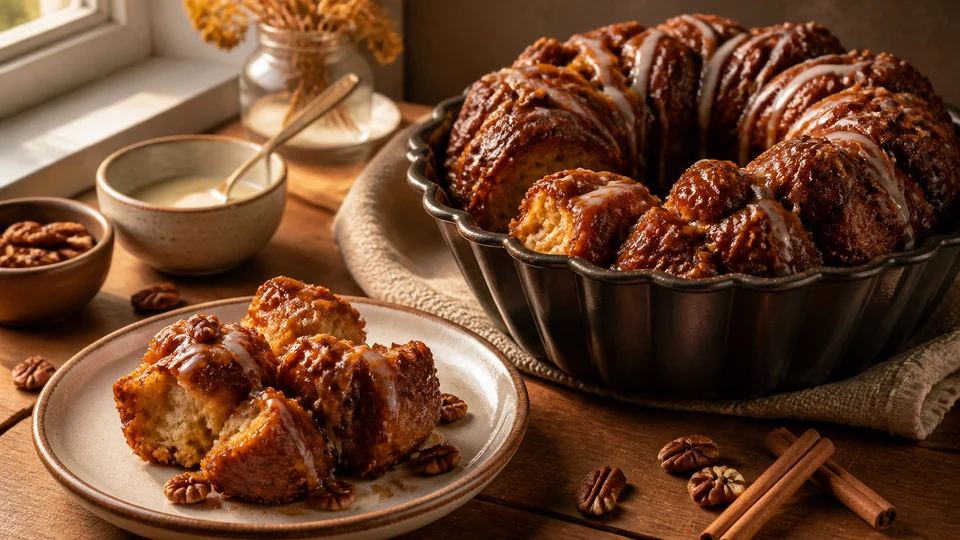
This is a source-guided technique and decision page, not a Pancake World recipe claimed as tested. The breakfast hub offers other morning bakes, while Pancake World connects the wider collection.
For broader context, continue with American Breakfast: Pancakes, Diner Plates and Brunch.
Choose one of four routes
| Route | Complete example | Source yield | Schedule | Key control |
|---|---|---|---|---|
| Same-day sweet yeast | King Arthur Apple Cinnamon Monkey Bread | About 18 servings | Multi-hour project | Proof, rectangular pan and deep centre |
| Overnight sweet yeast | Alton Brown Overnight Monkey Bread | 12 servings | Dough and pan prepared the previous day | Refrigerated proof and two Bundt pans |
| Fast savory biscuit | Ree Drummond Savory Breakfast Monkey Bread | 8 servings | About 90 minutes including cooling | Cooked fillings and biscuit type |
| Same-day savory yeast | King Arthur Za’atar Monkey Bread | 24 servings | Under two hours after source dough dependency | Bundt proof and 190°F source endpoint |
These recipes are alternatives. Do not use the overnight timetable from one with the refrigerated-biscuit dough from another, and do not transfer a temperature from a yeasted loaf to a different formula without source support.
What defines monkey bread?
The format consists of many small pieces baked together so they can be separated at service. King Arthur’s Cinna-Bites page also uses “pull-apart bread” and “bubble bread” for the same general family.
The format does not require one flavor or one pan. Recognized recipes use Bundt or tube pans, cake or rectangular dishes, and small portions. What matters is that the dough pieces form a connected bake and that the chosen source accounts for pan geometry.
A ring pan exposes more surface around the centre. A rectangular dish spreads the pieces across a shallower area. Changing between them can alter baking time and how syrup, cheese or egg settles. Use the pan named by the source or a tested alternative it explicitly offers.
Route 1: same-day sweet yeast bread
King Arthur Baking’s Apple Cinnamon Monkey Bread is a from-scratch yeasted project baked in a large rectangular dish and yielding about eighteen servings. Its complete process includes mixing, kneading, rising, assembly, another rise, baking and glazing.
Choose this route when:
- the bake is the main project of the morning;
- a large group justifies the source yield;
- the required dish is available;
- yeast proofing can proceed without a rushed deadline;
- dairy, wheat and source-specific flavor ingredients suit the guests.
The rectangular shape is part of the design. Do not compress the complete batch into a small Bundt pan because a familiar monkey bread photo uses one. A deeper mass may brown at the perimeter before the centre is ready.
The source calls for particular apple-cinnamon pieces and filling products. If those are unavailable, select a different complete apple recipe rather than inventing equivalent moisture and sugar amounts.
Route 2: overnight yeasted monkey bread
Food Network’s Overnight Monkey Bread is a twelve-serving formula using two Bundt pans. The source includes a room-temperature first rise, divided and coated dough balls, overnight refrigeration, a morning proof, baking and a 190°F internal endpoint.
This is the best documented route when the goal is fresh yeast bread without doing all the shaping after waking. “Overnight” does not mean leaving dough on the counter. The source refrigerates the filled pans and specifies the next-morning proof.
Follow its limit on refrigerated time. Keep the pans covered so dough does not dry. In the morning, follow the source’s proof environment and remove the water pan before preheating as directed.
The recipe uses egg yolks, egg, buttermilk and butter. Refrigerator control therefore matters independently of yeast performance. Do not convert another room-temperature recipe to an overnight process by intuition; fermentation, enrichment and food handling differ.
Route 3: savory refrigerated-biscuit breakfast
Food Network’s Savory Breakfast Monkey Bread yields eight servings and uses refrigerated buttermilk biscuits with cooked bacon, scrambled egg, cheese, herbs and seasoning in a Bundt pan.
The source specifies non-flaky biscuits. That product characteristic is not decorative: dough layers and behavior differ. Use the named style or choose another complete recipe developed for the product you have.
The bacon and eggs are cooked before layering. Do not place raw bacon or liquid raw egg into the pan and assume the bread’s published bake time will cook an altered centre safely. Follow the exact preparation and assembly sequence.
This route suits a breakfast table that wants bread and savory fillings in one shareable bake. Because it contains egg, meat and cheese throughout the dough pieces, the centre deserves particular attention. Use the source bake time, rest and inversion instructions, and apply the relevant ingredient safety checks.
Route 4: savory yeasted pull-apart
King Arthur’s Za’atar Monkey Bread is a savory yeasted Bundt bread made from a separate challah recipe after its first rise. It yields one loaf listed as twenty-four servings and gives a 190°F endpoint.
This is not a shortcut recipe because the linked dough must exist first. Read both source pages before scheduling. The apparent prep time on the monkey bread page does not replace the upstream challah work.
The bread is paired with a labneh dip on the source page. Keep the chilled dip refrigerated until service and return it promptly after eating. Check wheat, egg, dairy, sesame and any other ingredient labels relevant to the complete source and the actual za’atar blend.
Do not generalize the recipe into claims about a region or tradition. It is a documented author formula using named ingredients, not a cultural-history source.
Another from-scratch sweet reference
Food Network’s Duff Goldman Monkey Bread is an eight-serving sweet yeast loaf with two rises, cinnamon sauce and a standard Bundt pan. It offers a same-day route and an overnight refrigerator alternative for its own dough.
The page places a sheet pan on a lower rack to catch drips. Sticky coatings can escape a pan, so protecting the oven according to the source is a practical part of preparation.
Its inversion rest is brief and source-specific. Leaving a caramel-coated loaf in the pan too long can change release, while turning it out immediately can be hazardous. Follow the exact source instead of adopting the rest from another recipe.
Pan capacity and geometry
A Bundt pan is described by cup capacity, not only outside diameter. Confirm the required capacity. Decorative pans with narrow channels can hold less than a plain tube pan of similar width.
Before filling:
- Inspect the pan for damaged nonstick coating or residue.
- Grease it exactly as the recipe directs.
- Put any catch pan on the specified rack rather than directly blocking heat under the loaf.
- Leave the source-required headroom for proofing and oven expansion.
- Keep the centre tube clear.
Do not fill a pan to the rim with unbaked dough. Expansion and bubbling coating can overflow. If the complete batch exceeds the pan, use the source’s alternative vessel or a different formula.
Rectangular dishes create corners and a wider surface. Ring pans create inner and outer edges. Muffin tins create individual units. Each requires its own tested time; they are not automatic substitutions.
Dough-piece size and layering
Consistent pieces help the mass bake evenly. Use the source’s weight, count or cutting instruction. Random large chunks beside tiny pieces create different proofing and cooking rates.
For yeasted dough, shape gently enough to preserve the source’s intended structure. For refrigerated biscuits, follow the named cut and coating sequence. Do not knead canned biscuit pieces into a yeast dough or treat laminated flaky biscuits like plain biscuits.
Layer loosely according to the recipe. Compressing pieces can close pathways for expansion and trap dense filling. At the opposite extreme, sparse pieces in an oversized pan may dry and fail to connect.
Distribute fillings as directed. Heavy cheese, wet fruit, scrambled egg or cooked meat can settle. More filling is not automatically better; it changes the balance the developer tested.
Proofing decisions
Yeast recipes use visual and time cues together. Kitchen temperature affects pace, so do not force the dough into an overheated oven or on a dangerously hot surface.
Same-day sources may require:
- a bulk rise before division;
- a second rise after the pan is filled;
- covered rest to prevent surface drying;
- a defined degree of puffiness rather than a universal clock.
Overnight sources include refrigeration as part of the formula. Keep the refrigerator at 40°F or below where perishable dough is involved. A slow rise on the counter is not equivalent to an overnight refrigerated process.
Refrigerated biscuit formulas generally use chemical leavening and skip yeast proofing. Adding a yeast-style rest can warm the dough and change performance without evidence.
Raw flour and dough safety
The FDA’s flour safety guidance states that flour is a raw food and that processing grain into flour does not kill harmful bacteria. It says not to eat or taste raw flour, dough or batter.
That applies even when the dough smells sweet or comes from a refrigerated package. Children can help only with appropriate supervision and must not play with or taste the raw pieces.
Keep flour and raw egg away from ready-to-eat fruit, cooked bacon, herbs and finished glaze. Clean hands, bowls, worktops and tools with warm soapy water after raw-dough work. Do not shake flour through the kitchen or use dry dusting that spreads beyond the work area.
Follow package cooking directions for refrigerated dough and baking mixes. Home heat treatment is not a verified way to make ordinary flour safe for raw consumption.
Savory filling safety
When monkey bread contains egg, sausage, bacon, poultry or leftovers, the formula must manage two systems: bread baking and filling safety.
The FoodSafety.gov temperature chart lists:
- 160°F for egg dishes;
- 160°F for ground meat and sausage;
- 165°F for poultry;
- 165°F for leftovers.
These are ingredient safety endpoints. A source may require a higher bread temperature for structure, such as the 190°F stated by the recognized overnight and za’atar recipes. Meet the complete recipe’s endpoint as well as every applicable ingredient requirement.
The FDA’s egg safety guidance says to refrigerate eggs at 40°F or below and cook egg dishes to 160°F. Use cooked filling exactly where the source calls for it.
Do not use a thermometer contaminated by raw dough on the finished loaf without washing it. Insert into the deep bread area without touching the metal pan, and check more than one position if fillings are uneven.
How to judge the deep centre
The top can become golden while the lower inner ring remains wet. Sugar and cheese accelerate surface color, so appearance alone is weak evidence.
Use all source cues:
- stated time range;
- stated internal temperature, when provided;
- pan and batch size;
- structural set at the centre;
- any source instruction for tenting or rack placement.
Do not invent 190°F as a universal monkey bread rule. It is documented for specific yeasted recipes here. A refrigerated-biscuit savory formula may use a different validated combination of time, temperature, product and cooked filling.
If the top darkens early, use only the source’s tenting direction or a recognized baking response that does not reduce the oven below the recipe’s requirement. Never remove a deep loaf early only to preserve surface color.
Inversion without burns or breakage
Sticky monkey bread creates two opposing risks: hot syrup can burn, and cooling too long can make release difficult. The correct rest comes from the chosen recipe.
Prepare before baking finishes:
- a rimmed heat-safe serving plate or board;
- oven gloves with dry, intact surfaces;
- a clear landing space;
- a rack if the source uses one;
- no children or pets in the inversion path.
Confirm that the serving plate is larger than the pan and can catch syrup or cheese. Place it over the pan, grip both firmly and turn as one controlled unit only at the source time. Lift the pan away from your body.
If a piece remains behind, do not reach into a hot pan. Use a suitable utensil after the immediate heat hazard is controlled.
Sweet or savory decision
Choose sweet monkey bread when it is the pastry role. Keep the rest of breakfast simple: fruit, yogurt if appropriate, and drinks. Avoid adding cinnamon rolls and muffins that repeat the same role.
Choose savory monkey bread when it can replace bread, egg and meat on the plate. Add a fresh side rather than another casserole. The Food Network breakfast version already includes bacon, egg and cheese.
Choose a plain herb or za’atar pull-apart when the bread should accompany other food. Because the King Arthur version includes a dip, decide whether that already completes the service.
Do not label a sweet loaf as breakfast solely to imply a health benefit. This guide makes no nutrition ranking. Use source servings and actual product labels.
Make-ahead planning
Only use overnight instructions when the complete recipe includes them. Two sources here do: the Alton Brown formula places filled pans in the refrigerator overnight, while the Duff Goldman page offers refrigeration for its specific dough stage.
For other recipes, safe advance work can include:
- confirming pan capacity;
- measuring dry ingredients into covered containers if the source permits;
- preparing the serving area;
- cooking and cooling fillings according to their source;
- checking refrigerator space;
- setting out shelf-stable tools and labels.
Do not coat and refrigerate dough simply because morning time is short. Butter, sugar, moisture and leavening can behave differently over a long hold.
Serving and leftovers
Set a pull-apart loaf on a stable platter and provide tongs or a serving utensil. Shared hand-pulling is not suitable for every group, especially when individual hygiene or allergy control matters.
For savory loaves containing egg, meat or dairy, refrigerate leftovers promptly and follow federal leftover guidance. Reheat applicable leftovers to 165°F. A sweet loaf with perishable glaze or filling also needs storage based on the complete source ingredients.
Keep allergen-sensitive portions separate before the shared loaf is handled. Cutting one section after other guests have pulled pieces does not create a protected serving.
Common allergen categories include wheat, egg, milk, sesame, tree nuts and soy, depending on the recipe. Bacon, cheese, biscuit dough, spice blends and packaged fillings require label checks.
Common failures and their causes
Brown top, raw centre
Likely causes include the wrong pan, oversized dough pieces, overfilled vessel, changed oven temperature or early removal. Return to the source geometry and endpoint.
Dense pieces
Possible causes include incomplete proofing, expired or mishandled yeast, too much flour or compressed layering. Do not fix a dense formula by adding extra leavening without a tested source.
Loaf will not release
The pan may have been prepared incorrectly or inversion delayed beyond the source rest. Use the specified greasing and timing next time; do not pry dangerously at hot syrup.
Pieces separate completely
The pan may be too large, coating excessive or pieces too dry. Compare the actual piece count and pan with the source.
Savory centre is wet
Fillings may have been undercooked, too moist or added in greater volume. Use the complete recipe’s cooked fillings and amounts.
Overflow and smoke
The pan may be too small or coating overfilled. Confirm capacity and use a catch sheet only as the source or oven layout safely allows.
Plan the serving moment
Monkey bread is most manageable when the landing area is ready before inversion. Clear a heat-safe surface, set out the specified plate, protect hands, and keep children away from the hot pan and any molten coating. Follow the source rest period: immediate inversion can release very hot syrup, while an excessive delay may allow the coating to set against the pan. After release, let diners pull pieces only when the loaf is safe to handle. For a savory version containing egg, meat or cheese, do not let the communal serving style replace the applicable time-and-temperature controls.
Final recipe-selection checklist
- Is the dough from scratch, overnight or refrigerated?
- Is the chosen recipe sweet, savory or herb-based?
- Does the pan match the source shape and capacity?
- Does the yield fit the group?
- Are all proofing and refrigeration stages available?
- Will fillings be cooked exactly as required?
- Can the deep centre be checked with the source endpoint?
- Is the inversion plate rimmed and heat-safe?
- Have flour, egg, milk, wheat, nuts, sesame and packaged ingredients been checked?
- Is the complete original recipe open during baking?
The practical answer is to choose the dough system before the flavor. Once the source, pan and schedule agree, breakfast monkey bread becomes one controlled pull-apart bake rather than a collection of improvised substitutions hidden in a deep pan.
Explore related Pancakes World guidance on American Pancakes, Maple Syrup, and Maple Syrup Pancakes.
Sources and editorial references
- King Arthur Baking, “Apple Cinnamon Monkey Bread.”
https://www.kingarthurbaking.com/recipes/apple-cinnamon-monkey-bread-recipe - King Arthur Baking, “Cinna-Bites.”
https://www.kingarthurbaking.com/recipes/cinna-bites-recipe - King Arthur Baking, “Za’atar Monkey Bread.”
https://www.kingarthurbaking.com/recipes/zaatar-monkey-bread-recipe - Food Network, “Savory Breakfast Monkey Bread.”
https://www.foodnetwork.com/recipes/ree-drummond/savory-breakfast-monkey-bread-13720449 - Food Network, “Overnight Monkey Bread.”
https://www.foodnetwork.com/recipes/alton-brown/overnight-monkey-bread-recipe-1946146 - Food Network, “Duff Goldman Monkey Bread.”
https://www.foodnetwork.com/recipes/duff-goldman/monkey-bread-18866743 - FDA, “Handling Flour Safely.”
https://www.fda.gov/food/buy-store-serve-safe-food/handling-flour-safely-what-you-need-know - FoodSafety.gov, “Safe Minimum Internal Temperatures.”
https://www.foodsafety.gov/food-safety-charts/safe-minimum-internal-temperatures - FDA, “What You Need to Know About Egg Safety.”
https://www.fda.gov/media/82227/download