Breakfast ideas for large groups cheap
At Pancakes World, the cheapest reliable breakfast for a large group is usually one simple hot anchor—oatmeal, baked French toast, pancakes from a standardized batch, breakfast potatoes, or an egg casserole—plus one inexpensive fruit, water, and self-serve coffee or tea. Pick the menu only after dividing current local package prices by usable servings, counting confirmed guests, and checking oven, refrigerator, and holding capacity. Scale with a quantity recipe rather than multiplying a family recipe blindly. Prepare inexpensive bases in batches, offer costly toppings in small measured containers, and replenish the buffet with small trays. Hold hot food at 140°F or above, cold food at 40°F or below, and discard unheld perishables after two hours.
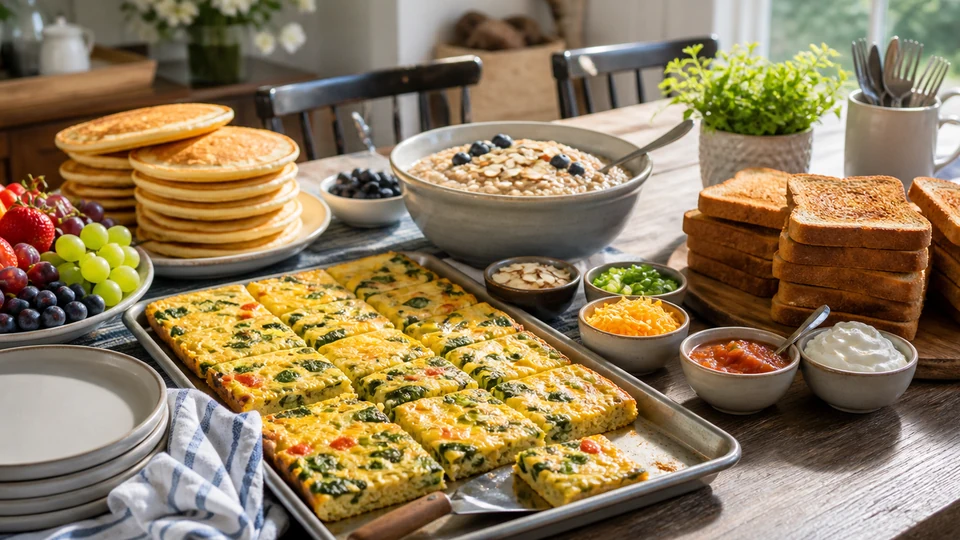
For broader context, continue with American Breakfast: Pancakes, Diner Plates and Brunch.
“Cheap” is a calculation, not a food category
Eggs may be economical one month and expensive the next. Fresh berries may be a good seasonal buy in one region and the costliest fruit in another. A warehouse package can lower the unit price while increasing waste. No fixed internet menu can prove what is cheapest for your date, store, and guest list.
Use a four-part definition:
- Ingredient cost: the amount actually used, not the shelf price of a package.
- Labor cost: preparation, cooking, transport, service, and cleanup time.
- Equipment cost: pans, fuel, ice, foil, warmers, serving tools, and rented capacity.
- Waste cost: leftovers that cannot be stored safely, unopened extras, and food guests do not choose.
A low ingredient total can still be a poor plan if it needs six cooks, twenty small pans, or refrigeration the venue does not have. Conversely, a slightly more expensive main dish can reduce labor and waste enough to lower the total event cost.
USDA MyPlate recommends beginning with a plan, checking what is already in the freezer, cabinets, and refrigerator, and making a list. That inventory-first approach matters at crowd scale. Ten unused pounds of oats in a pantry are different from a “sale” that requires buying another thirty.
Count people before counting eggs
Create a service count with categories rather than one guessed number.
| Group | Count | Planning effect |
|---|---|---|
| Confirmed adults | Enter actual | Full planned portions |
| Confirmed children | Enter actual | Age-appropriate portions; do not assume half without context |
| Staff and volunteers | Enter actual | Include people working through breakfast |
| Dietary-specific guests | Enter actual | Protected portions and separate service tools |
| Unconfirmed invitees | Enter actual | Apply an event-specific attendance assumption |
| Reserve | Set deliberately | Covers spills or late additions, not unlimited excess |
The reserve should reflect the event. A ticketed meeting with a final headcount needs less uncertainty than an open community breakfast. Do not automatically add a large percentage “just in case.” Every extra perishable serving creates food-safety and waste exposure.
Record the serving window as well. Fifty people arriving together require more ready-to-serve capacity than fifty people spread across two hours. The latter demands safe hot and cold holding, while the former demands fast flow.
Use a cost-per-serving worksheet
Compare menus with the same scope. If one estimate includes beverages and disposables while another includes only food, the cheaper-looking option is not comparable.
For each ingredient:
Cost used = package price × amount used ÷ amount purchased
Then:
Menu food cost per planned serving = total ingredient cost ÷ planned servings
Add the event costs:
Full cost per served guest = (food + ice + fuel + disposables + rental + paid labor + delivery) ÷ expected guests served
Use weights where practical. “One bag of cheese” is ambiguous; package weights and usable amounts are reproducible. Account for drained canned goods, trimmed produce, cooking loss, and unavoidable remainder.
A simple comparison sheet should include:
- item and package size
- current store price
- amount the menu uses
- cost of amount used
- expected yield
- dietary lane
- storage need
- cooking vessel
- holding vessel
- serving utensil
- leftover destination
Do not publish a dollar claim until prices are collected for the actual location and date. In this guide, “low cost” means a structure designed to use staple ingredients efficiently, not a guaranteed price.
Choose the service model first
The service model determines which breakfasts stay affordable.
One-pan plated portions
Examples: oatmeal cups, casserole squares, baked French-toast portions, breakfast burritos.
Best when: headcount is firm and volunteers can portion before service.
Cost advantage: predictable servings and controlled toppings.
Risk: labor bottleneck during plating and less flexibility for preferences.
Self-serve buffet
Examples: oatmeal bar, pancake line, potato-and-egg buffet, yogurt station.
Best when: guests arrive over a window and the venue has verified hot/cold holding.
Cost advantage: less plating labor.
Risk: uneven portions, contamination, slow queues, and more exposed food.
Grab-and-go
Examples: overnight-oat cups, muffins plus fruit, labeled burritos, yogurt and granola kits.
Best when: transport and speed matter more than a hot communal meal.
Cost advantage: exact count and rapid service.
Risk: packaging costs and refrigerator volume.
Family-style tables
Examples: platters of toast, fruit, eggs, and potatoes shared at tables.
Best when: tables are seated and servers can replace small platters.
Cost advantage: fewer buffet queues.
Risk: difficult portion control and repeated utensil handling.
Do not choose a buffet merely because it looks casual. FDA buffet guidance requires real temperature control, small replenishment trays, clean utensils, and time tracking.
Twelve budget-oriented menu families
These are planning formats, not standardized recipes or guaranteed price rankings. Calculate each with current local data and a tested quantity recipe.
1. Oatmeal bar
Serve a large batch of plain oatmeal with milk or fortified alternative, bananas or applesauce, cinnamon, and a few measured toppings.
Why it can work: oats are shelf-stable, portions are easy to standardize, and the base uses one cooking vessel.
Cost control: put nuts, dried fruit, and sweeteners in small dispensers rather than mixing expensive toppings into every serving.
Operational gate: confirm a safe hot-holding vessel and prevent oatmeal from scorching or becoming too thick. Keep dairy cold.
2. Baked oatmeal
Bake a tested quantity formula in shallow pans and cut it into marked portions.
Why it can work: portions are visible, service is fast, and pans can be prepared on a schedule.
Cost control: choose economical fruit formats after comparing fresh, frozen, canned, and dried cost per usable amount.
Operational gate: egg- or dairy-containing versions need correct cooking, holding, cooling, and reheating.
3. Pancakes with fruit
Use a standardized quantity pancake formula, one fruit, and limited syrup.
Why it can work: flour-based batter has a low-cost base and pancakes are familiar.
Cost control: use measured syrup dispensers and avoid an oversized topping bar.
Operational gate: griddle capacity is decisive. If one batch takes longer than guests will wait, pancakes are not cheap operationally. Raw batter containing flour or egg should not be tasted.
4. Baked French toast
Use bread efficiently in a tested casserole format with fruit or cinnamon.
Why it can work: oven pans replace continuous griddle labor.
Cost control: compare fresh bread, approved surplus bread, and bakery pricing without using stale or mishandled food.
Operational gate: standardized yield, 160°F egg-dish endpoint, and 140°F hot holding.
5. Egg-and-potato casserole
Combine cooked potatoes, vegetables, egg, and a measured amount of cheese in a standardized recipe.
Why it can work: potatoes extend the dish while egg provides the familiar breakfast identity.
Cost control: treat meat as an optional accent or separate tray rather than filling every portion.
Operational gate: egg and mixed-casserole endpoints, shallow-pan capacity, and protected vegetarian portions.
6. Breakfast potatoes plus eggs
Roast potatoes in sheet pans and serve with scrambled eggs or a smaller egg bake.
Why it can work: the potato component is inexpensive in many markets and handles high volume.
Cost control: use seasonings and onions for flavor instead of relying on large meat and cheese quantities.
Operational gate: oven rack space and the challenge of holding eggs without quality loss.
7. Bean-and-potato breakfast tacos
Offer warm tortillas, seasoned beans, potatoes, salsa, and a small amount of cheese or egg.
Why it can work: guests assemble their own, and beans can replace some expensive meat.
Cost control: choose one tortilla size, one salsa, and two filling lanes rather than many choices.
Operational gate: keep hot fillings hot, cold toppings cold, and tortillas protected from drying.
8. Breakfast burritos
Fill tortillas with a controlled amount of potato, beans or egg, and vegetables; wrap and label.
Why it can work: exact count and grab-and-go service.
Cost control: use a portion scoop for each filling and compare homemade labor against delivered alternatives.
Operational gate: assembly time, cold storage, safe reheating, and preventing confusing labels.
9. Yogurt and cereal cups
Serve portioned yogurt with oats or granola and a simple fruit.
Why it can work: no cooking and predictable count.
Cost control: compare bulk tubs with single cups only after including labor and container cost.
Operational gate: refrigerator volume and 40°F-or-colder service.
10. Muffin, egg, and fruit boxes
Pack one tested muffin, one safely prepared egg item, and whole fruit.
Why it can work: clean distribution to meetings or travel groups.
Cost control: avoid individually wrapped premium items unless packaging labor makes them competitive.
Operational gate: allergen labels, cold holding for egg components, and final packing time.
11. Toast and spread station
Offer toast, peanut or seed butter, jam, and bananas with an optional egg or yogurt lane.
Why it can work: simple foods and flexible portions.
Cost control: narrow the spread selection and calculate slice count from the actual loaf.
Operational gate: toaster throughput and allergen separation. A shared toaster invalidates many gluten-free claims.
12. Savory grits or polenta bowls
Serve a hot grain base with beans, sautéed vegetables, egg, or cheese.
Why it can work: one base supports several dietary lanes.
Cost control: keep costly toppings portioned and let vegetables and seasoning provide variety.
Operational gate: hot holding, thickening over time, and clean ladle service.
Standardized scaling, not multiplication by instinct
University of Minnesota Extension advises standardized quantity recipes when serving 25 or more people. A quantity recipe specifies yield, serving size, equipment, pan depth, procedures, cooking times, and food-safety controls for a large batch.
Multiplying a four-serving recipe by twelve can fail because:
- salt, leavening, spices, and thickeners may not scale linearly
- a deep pan heats differently from a household dish
- a mixer or bowl may exceed capacity
- the stove cannot bring a huge volume to temperature quickly
- multiple oven pans alter airflow
- cooling a large mass takes longer
- portion size drifts without a serving tool
When no standardized recipe exists, run a controlled pilot well before the event. Record ingredient weights, actual yield, pan fill, equipment, cooking time, internal temperatures, portion-tool size, and leftovers. Do not call an untested extrapolation “confirmed for 60.”
Use this scaling sequence:
- Set expected served guests and reserve.
- Define one serving by weight, volume, or count.
- Choose a standardized recipe with a documented yield.
- Calculate the recipe factor: required yield divided by original yield.
- Convert ingredients to practical purchase units.
- Check equipment limits before shopping.
- Round purchase quantities deliberately and record the surplus.
- Assign every extra unit to reserve, another meal, freezing, or return where allowed.
Equipment capacity is a hard gate
List every critical appliance and container:
- refrigerator shelves and measured cold space
- freezer space
- oven racks and usable pan dimensions
- stovetop burners
- griddle surface
- electrical circuits for warmers and coffee urns
- insulated transport containers
- food thermometers
- chafing dishes or rated warming equipment
- ice bins and coolers
- handwashing access
- clean serving utensils
Capacity must be proven, not assumed. Measure how many pans fit with air circulation. Check whether a warmer’s manufacturer states that it can hold food at 140°F or above; FDA warns that some warmers operate only around 110°F to 120°F.
If the oven holds four pans but the plan needs twelve simultaneously, change the menu, borrow verified equipment, or stagger production with safe holding. Do not rely on an early batch sitting at room temperature.
Coffee can become its own bottleneck. Count urn volume, brew cycles, power, cups, water, milk, sweetener, and waste. A low-cost food menu paired with an unplanned beverage station is not a complete budget.
Build a production schedule backward
Start with service time and work back.
At service
- hot food is verified at 140°F or warmer
- cold food is at 40°F or colder
- each item has a clean utensil
- dietary lanes are labelled and separated
- replacement trays are ready under safe holding
- the buffet clock has started
Thirty to sixty minutes before
- final batches reach safe cooking temperatures
- hot-holding equipment is preheated and verified
- cold platters remain refrigerated
- serving stations are assembled without exposing perishables early
Earlier that morning
- standardized batches are cooked in the validated order
- thermometers are used and readings logged
- hot and cold paths do not cross
- transport containers are prepared
Previous day
- only approved make-ahead steps are completed
- cooked food is cooled in shallow containers
- ingredients and serving tools are staged
- labels are matched to verified packages
- refrigerator temperature and capacity are confirmed
A schedule exposes hidden labor. If the plan requires one volunteer to flip pancakes, scramble eggs, brew coffee, slice fruit, refill trays, and answer allergen questions at the same time, it is not viable.
Shopping for a lower total, not a larger cart
USDA MyPlate’s budget guidance emphasizes planning and shopping deliberately. Apply that to a crowd:
- compare price per ounce or pound, then adjust for edible yield
- compare fresh, frozen, canned, and shelf-stable forms
- check pantry inventory and expiration dates first
- build multiple menu elements from a few core ingredients
- buy in bulk only when the quantity will be used safely
- choose whole fruit when it reduces preparation and cold-holding labor
- limit one-use specialty ingredients
- collect current prices from the actual supplier
- include tax, delivery, membership, and container costs where applicable
Store promotions are not evidence until stock and limits are confirmed. A loss-leader price for two packages cannot cost a 100-person breakfast at that rate.
Avoid comparing prepared and raw ingredients on shelf price alone. Pre-cut fruit or liquid eggs may cost more per unit but reduce labor, waste, and cross-contamination. The correct choice depends on the event’s full cost.
Dietary needs without multiplying the menu
Ask for dietary needs during registration when possible. Build from shared components, then create protected lanes.
Example shared base:
- oatmeal made with water
- bananas and applesauce
- cinnamon
- dairy milk and a verified fortified alternative served separately
- nut, seed, and sweet toppings in clearly labelled containers
This may support several preferences, but it is not automatically allergen-free. Oats may have gluten cross-contact; shared scoops spread allergens; flavored products may contain unexpected ingredients.
For gluten-free, dairy-free, vegetarian, vegan, halal, kosher, or allergy-specific service:
- Verify every product label and preparation requirement.
- Decide whether the kitchen and equipment can prevent cross-contact.
- Prepare protected portions first or in a genuinely separate area.
- Seal and label those portions.
- Use dedicated utensils.
- Do not refill from the general buffet.
- Avoid making a guarantee the process cannot support.
A simple separate packaged item may be safer and cheaper than building a second full buffet.
Safe buffet service
FDA says hot buffet foods should remain at 140°F or warmer and cold foods at 40°F or colder. Use a food thermometer; warmth by touch is not evidence.
Serve small platters and replace them with fresh held-back platters. Do not pour new food onto an old tray. The older food may have been exposed longer, and the mixed tray loses its time history.
Track each tray’s set-out time. Perishable food without hot or cold control must be discarded after two hours, or one hour when the surrounding temperature exceeds 90°F. The clock does not reset when food moves to a smaller bowl or returns briefly to a refrigerator.
Keep cold backup food refrigerated and hot backup food in equipment proven to maintain the required temperature. FDA suggests an oven at 200°F to 250°F for holding certain hot backup dishes, but the food itself still requires temperature verification and must tolerate that holding method without drying or overcooking.
Replace utensils that fall, become contaminated, or migrate between dishes. Protect serving surfaces from guest traffic. Assign one person to the line rather than asking every cook to monitor it intermittently.
Waste controls that preserve hospitality
Waste falls when choice is designed, not when guests are scolded about portions.
- use smaller first-serving utensils and allow seconds
- cut casseroles into marked portions
- offer half portions to children and light eaters when appropriate
- put premium toppings after the base, where they are visible and measurable
- replenish fruit and pastries in small batches
- keep unopened reserve packages out of the buffet
- track actual servings and leftovers for the next event
- freeze only food that stayed within safe handling limits
- arrange donation only through a preplanned lawful and safe process
Do not save buffet food that exceeded time or temperature limits. Waste prevention happens through better forecasting and smaller trays, not through unsafe recovery.
Sample menus by event type
These menus show structures to price locally; they are not fixed quantities.
Early office meeting
- baked oatmeal squares
- bananas or whole apples
- coffee, tea, and water
- a protected dairy-free portion if requested
Why: fast service, low utensil count, and limited hot-line labor.
School or youth gathering
- standardized pancakes or baked French toast
- fruit
- milk or approved alternative
- water
Why: familiar format. The gate is verified griddle or oven capacity and age-appropriate allergen control.
Community open house
- oatmeal bar
- toast
- bananas and applesauce
- coffee and tea
Why: core foods can be replenished in small batches. Attendance uncertainty still requires a reserve and safe holding.
Outdoor volunteer breakfast
- labelled breakfast burritos
- whole fruit
- hot drinks and water
Why: packaged portions reduce outdoor buffet exposure. Transport containers and the one-hour rule above 90°F remain critical.
Seated brunch
- egg-and-potato casserole
- seasonal fruit
- bread
- coffee, tea, and water
Why: a small number of components creates a complete table. Standardized pan yield prevents chaotic slicing.
Mixed-diet conference
- plain oatmeal base
- separate dairy and fortified alternative
- fruit
- labelled toppings
- sealed protected portions for declared allergens
Why: one common base reduces duplicate cooking while keeping exceptions controlled.
A menu decision matrix
| Menu | Ingredient-cost tendency | Labor | Critical equipment | Best service |
|---|---|---|---|---|
| Oatmeal bar | Often low | Low to medium | Large cooker, hot hold | Buffet |
| Baked oatmeal | Often low | Medium | Oven, shallow pans | Plated or buffet |
| Pancakes | Often low base | High during service | High-throughput griddle | Immediate line |
| Baked French toast | Moderate | Medium | Oven, refrigeration | Plated or buffet |
| Egg-potato casserole | Market-dependent | Medium | Oven, thermometer | Plated or buffet |
| Burritos | Moderate | High assembly | Refrigeration, reheating | Grab-and-go |
| Yogurt cups | Market-dependent | Low to medium | Large cold capacity | Grab-and-go |
| Toast station | Often low | Medium at service | Multiple toasters | Small buffet |
“Often low” is not a price claim. Complete the worksheet with current numbers.
Common failures and corrections
The menu is cheap but the line is slow
Cause: pancakes, toast, or eggs are produced one serving at a time.
Correction: switch to baked pans, add proven equipment, or pre-portion a grab-and-go option.
Food runs out early
Cause: unmeasured scoops, inaccurate attendance, or the premium item appears first.
Correction: standardize utensils, move filling bases first, and track real event data.
Too much food remains
Cause: reserve was arbitrary, every guest was counted as a maximum eater, or too many parallel choices were produced.
Correction: narrow the menu, base reserve on attendance history, and hold unopened backup safely.
The “budget” menu becomes expensive
Cause: toppings, beverages, disposables, and delivery were excluded from the first estimate.
Correction: compare full event cost per served guest.
Casserole centers are cold
Cause: pans are deeper or more crowded than the standardized recipe, or holding equipment is being used to finish cooking.
Correction: use the specified pan, cook to the required internal temperature, and use holding equipment only for safely cooked food.
Allergen labels become unreliable
Cause: utensils move, packages change, or volunteers add unverified garnishes.
Correction: lock the ingredient list, photograph or retain labels for the service team, seal protected portions, and assign one dietary-lane lead.
Frequently asked questions
What is the cheapest breakfast for a large group?
There is no universal winner. Plain oatmeal, pancakes, potatoes, toast, beans, and baked grain dishes often use economical staples, but local price, labor, equipment, and waste decide the real cost. Calculate cost per planned serving with current prices.
How much food should I make?
Use a standardized quantity recipe, defined portion, confirmed headcount, and deliberate reserve. University of Minnesota Extension recommends standardized quantity recipes for 25 or more. Do not multiply a household recipe without a yield and equipment check.
Are pancakes cheaper than egg casserole?
The ingredient base may be cheaper, but pancake labor and griddle capacity can make service more costly. Compare total cost, not flour versus eggs alone.
How can I reduce egg cost?
Use eggs in a standardized casserole with potatoes or vegetables, offer a bean or oatmeal main lane, and treat egg as one component rather than the only food. Recalculate with current prices.
Can I cook everything the night before?
Only use make-ahead steps supported by the standardized recipe and your cooling, refrigeration, and reheating capacity. Large hot pans cannot be left to cool at room temperature. Reheated egg dishes should reach 165°F before service.
How long can breakfast sit on a buffet?
Keep hot food at 140°F or above and cold food at 40°F or below. Without temperature control, discard perishables after two hours, or one hour above 90°F. Track time by tray.
Should I buy individual packages?
Compare package cost plus labor, containers, cold space, and waste. Individual units may improve speed and allergen control but can cost more and create packaging waste.
How many menu choices are enough?
For a budget event, one filling base, one protein or alternate, one fruit, and beverages can be enough. Add options only when they solve a confirmed dietary or operational need.
The final planning rule
Start with guests, service window, equipment, and current prices. Select one high-yield standardized main, one simple side, and a restrained beverage plan. Cost the usable amounts, protect dietary needs, schedule backward, and assign one person to temperature and tray control. A cheap breakfast succeeds when the food is enough, the line moves, the equipment can hold it safely, and little must be discarded—not when a shopping list merely looks inexpensive.
For more scalable morning menus, explore the breakfast collection. For the wider food and recipe platform, visit Pancake World.
Explore related Pancakes World guidance on American Pancakes, Maple Syrup, and Maple Syrup Pancakes.
Sources and editorial references
- USDA MyPlate, “Healthy Eating on a Budget” —
https://www.myplate.gov/web/eat-healthy/healthy-eating-budget - USDA MyPlate, “Meal Planning” —
https://www.myplate.gov/sites/default/files/2024-06/TipSheet-24-Meal-Planning.pdf - U.S. Food and Drug Administration, “Serving Up Safe Buffets” —
https://www.fda.gov/food/buy-store-serve-safe-food/serving-safe-buffets - USDA Food Safety and Inspection Service, “How Do I Keep Foods Safe at a Buffet?” —
https://ask.fsis.usda.gov/article/How-do-I-keep-foods-safe-at-a-buffet - University of Minnesota Extension, “Planning the Quantity Food Occasion” —
https://extension.umn.edu/cooking-safely-crowd/planning-quantity-food-occasion - University of Minnesota Extension, “Cooking Safely for a Crowd” —
https://extension.umn.edu/home-kitchen/cooking-safely-crowd - USDA Food Safety and Inspection Service, “Food Thermometers” —
https://www.fsis.usda.gov/food-safety/safe-food-handling-and-preparation/food-safety-basics/food-thermometers