Breakfast freezer meals
At Pancakes World, build breakfast freezer meals as a small, varied inventory rather than eighteen copies of one dish. Choose two hand-held meals, one griddle item, one baked portion and one flexible component; verify a complete freeze-and-reheat method for each before buying ingredients. Cook foods to their safe endpoints, cool cooked fillings promptly in shallow containers, portion for one breakfast, remove excess air, label the name, freeze date and reheating path, then freeze packages in a single layer before stacking. Keep the freezer at 0°F (-18°C) or below. Reheat leftovers to 165°F (74°C), checking several places. Freezing pauses microbial growth but cannot correct unsafe cooking, slow cooling or cross-contact.
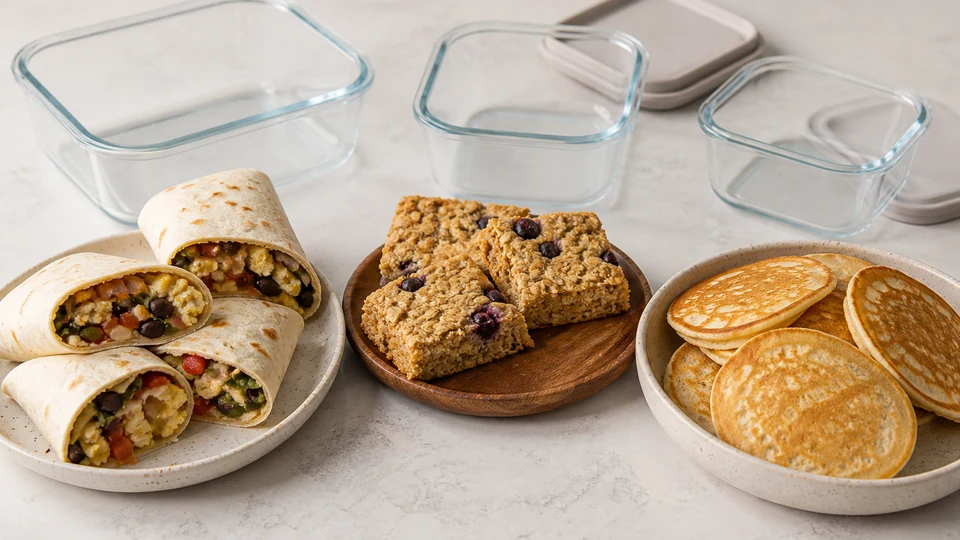
This page is a broad production and rotation system for several meals. It is not a tested Pancake World recipe, a nutrition plan or a promise that every familiar breakfast freezes well. Use the pancake storage and reheating hub for adjacent handling guides, and Pancake World for the wider editorial collection.
For broader context, continue with Storing and Reheating Pancakes.
Design a freezer portfolio, not a pile
A useful breakfast freezer is deliberately mixed. Variety matters, but so do different reheating speeds and levels of effort. If every package needs forty minutes in an oven, the inventory will not solve a rushed morning. If every package is soft bread wrapped around the same wet filling, one texture problem can spoil the whole batch.
Start with five roles:
- Hand-held fast meal. A documented breakfast burrito, folded flatbread or sandwich format that can be reheated and eaten with little assembly.
- Griddle item. Fully cooked pancakes or waffles portioned with separators so the eater can heat only what is needed.
- Baked portion. A tested casserole, baked oatmeal or egg-dish formula divided into individual units after cooking and prompt cooling.
- Bowl base. A cooked grain, bean, potato or vegetable base whose toppings can be added after reheating.
- Flexible component. One neutral item—such as a cooked pancake, roasted vegetable portion or source-tested filling—that can join more than one breakfast.
These are planning categories, not universal approvals. A complete source method still controls the ingredients, assembly and appliance directions for each item. The National Center for Home Food Preservation notes that prepared foods vary in freezer quality: crisp foods can soften, some sauces or emulsions can separate, and certain potato preparations can change texture. That is a reason to select carefully, not a reason to invent a workaround and call it tested.
Give each role a job. The hand-held option covers the shortest mornings. The baked portion covers mornings when a fork and plate are available. The griddle item offers a simple base for fruit or another separately stored addition. The bowl base handles variety because the finish can change after reheating. The flexible component prevents isolated odds and ends from accumulating.
Set the constraints before choosing recipes
The production plan should start with the household's real equipment and time, not with a long idea list. Record four constraints:
- Which appliance is available on the morning of service: microwave, toaster, oven, skillet or a combination?
- How much uninterrupted reheating time is realistic?
- Does the meal need to travel, or will it be eaten at a table?
- Are ingredient exclusions preferences, regulated allergens, medical restrictions or simply unavailable foods?
Then reject any candidate without a full documented path. “Freezer friendly” in a title is not enough. Look for instructions that say whether to freeze cooked or unbaked, whether to cool first, how to wrap, whether to thaw, which packaging must be removed, how to reheat and how to verify the center. If those steps are absent, treat the idea as inspiration only.
Appliance fit is part of the recipe decision. A waffle may regain a firmer surface in a toaster, while a dense baked square may need gentler, longer heating. A burrito can heat unevenly when its center is dense or its filling is distributed in pockets. A bowl may be easier to stir midway, which makes temperature verification simpler. None of these observations supplies a universal time; size, density, appliance power and starting temperature all change the result.
Also decide how many different packages the freezer can hold without hiding older stock. A narrow basket for hand-held items, a flat zone for griddle items and a container area for portions is easier to audit than one deep, mixed stack. Capacity is a hard limit. Crowding new warm packages together can slow freezing and raise the load on the appliance, so production volume should fit the available single-layer freezing space.
Use a five-lane meal matrix
The matrix below turns variety into specific production decisions. It does not supply formulas; pair each lane with an authoritative or genuinely tested recipe.
Lane 1: wrapped hand-held meals
A wrapped format works when the filling is cooked, not excessively wet and evenly distributed. Iowa State University Extension's documented make-ahead breakfast burrito provides one valid example: the source instructs cooks to wrap each burrito tightly, freeze the wrapped items in a single layer, then consolidate them in a freezer bag after they are frozen. Its quantities and microwave directions belong to that recipe alone.
For another formula, check the same structural questions:
- Is any meat, poultry or egg component fully cooked to its required endpoint before assembly?
- Are watery salsa, fresh tomato or another wet finish meant to be added after reheating?
- Can the wrapper close without stretching or exposing a seam?
- Does the source specify whether the package goes straight from frozen to the appliance or thaws first?
- Can the center be measured without judging safety from a browned surface?
Package hand-held meals individually before placing them in a larger labelled bag. Individual wrapping controls portions and lets one package leave the freezer without exposing the others repeatedly to room air. The outer bag organizes the batch and provides room for shared instructions. Remove any wrap not approved for the reheating appliance.
Lane 2: pancakes or waffles
Freeze only fully cooked griddle items from a source whose storage method permits it. Cool them without leaving perishable accompaniments at room temperature. Once cool, arrange single portions with freezer-suitable separators if needed, remove excess air and keep syrup, yogurt, cream and fresh fruit separate unless the tested method explicitly includes them.
The planning advantage is portion flexibility. One person can remove two pancakes without thawing a family-size casserole. The quality question is surface texture. Trapped steam can soften a crisp waffle; exposed edges can dry. Package only after cooling, and choose a reheating appliance based on the source method and desired result. A toaster may suit some plain items, but it is not appropriate for every filled, glazed or oversized format.
Do not taste raw batter during batch day. FDA guidance treats flour as a raw food, and raw eggs may also carry hazards. Cook the formula fully, wash utensils and surfaces that touched raw batter, and keep the finished stack away from the raw-work zone.
Lane 3: baked individual portions
Baked oatmeal, an egg bake or another casserole-style breakfast can turn one pan into separate meals, but only when a complete formula supplies the cooking method. FoodSafety.gov lists safe minimum internal temperatures by food type; egg dishes and casseroles have endpoints that must be verified with a thermometer rather than by color or firmness alone.
After cooking, divide a large preparation into shallow portions for prompt cooling instead of leaving a deep pan to cool slowly. USDA guidance allows hot food to go directly into the refrigerator, and an ice or cold-water bath can help cool it rapidly. Refrigerate or freeze within two hours of cooking—one hour when the surrounding temperature is above 90°F. Once cold, close the packages securely and freeze them in the planned zone.
Choose the portion shape around reheating. A shallow rectangle generally offers a shorter path to the center than a thick block, but no shape guarantees an exact time. Record the actual container and appliance path from the source. If a portion contains different densities, rotate it or stir when possible, observe the required rest and measure multiple locations.
Lane 4: bowls and composed meals
A bowl format separates the stable heated base from finishes that are better fresh. A complete meal might pair a documented cooked grain or potato base with cooked vegetables and a fully cooked protein component. The production logic is modular: freeze the portion intended to be hot, then add a separately managed crisp, acidic or creamy element after reheating.
Keep the modular idea within safe handling boundaries. Cook each component correctly. Cool cooked components promptly. Do not place a newly cooked hot filling onto an already cold ingredient and then leave the mixed bowl on the counter. If raw meat or egg was prepared nearby, use clean utensils and a clean assembly surface for the cooked portions.
Bowl packages need enough headspace for stirring, but excess air around the food encourages drying. Use freezer-suitable containers, close them after cooling and label whether the contents should be vented, covered or transferred before reheating. “Microwaveable” packaging instructions come from the container manufacturer; this article does not endorse a product.
Lane 5: flexible components
The flexible component is intentionally unfinished. It might be a plain pancake, a portion of cooked beans, a roasted vegetable mixture or a source-tested savory filling. Its value is optionality: the same component can complete a bowl, sit beside a baked portion or become a plated breakfast.
Avoid turning flexibility into ambiguity. Label the component rather than a fictional finished meal, and specify what remains to be added. If it contains a major allergen, put that information on the package. If it still requires cooking rather than reheating, say so visibly. A freezer inventory becomes unsafe when household members cannot tell raw from cooked or thaw-only from ready-to-heat.
Plan one controlled production session
A batch day is easier when organized around contamination control, appliance bottlenecks and cooling space. The aim is not to race. It is to move each food through a clear raw, cooked, cooling, packaging and frozen state.
1. Make a route card for every meal
Before shopping, create one card per chosen recipe. Copy the recipe title, source, intended number of freezer portions, raw-food endpoints, cooling method, package type, freeze state, thawing path and reheating verification. Do not merge directions from unrelated recipes unless each change is explicitly an editorial variation and does not alter a safety-critical step.
The route card also records exclusions. Mark major allergens, which household members can eat the meal, and whether equipment has to be cleaned before the next production lane. FDA identifies milk, egg, fish, crustacean shellfish, tree nuts, peanuts, wheat, soybeans and sesame as major allergens in the United States. A home label is not a guarantee against cross-contact, but clear identification prevents avoidable confusion.
2. Audit freezer and packaging capacity
Measure the open shelf or tray area that can hold new packages in one layer. Count suitable containers, wraps and outer bags. Confirm that the freezer maintains 0°F or below with an appliance thermometer. Remove obsolete labels from reusable containers so that each package has only one current identity.
Do not plan more cooked food than can be cooled and packaged safely. Refrigerator shelf space matters as much as freezer space. If three hot casseroles, a bowl filling and a burrito filling all finish together, there may be no room to divide and chill them promptly.
3. Sequence raw and ready-to-eat work
Begin with clean surfaces, hands and utensils. Wash produce under running water when the source directs. Keep raw animal foods and raw batter away from cooked components and ready-to-eat finishes. Clean and sanitize as appropriate before moving to assembly.
One sensible order is to prepare items without raw animal ingredients, then raw egg mixtures, then meat or poultry, cleaning between lanes. The exact order depends on the menu and allergen controls. If a household must avoid cross-contact, merely changing the order may not be sufficient; separate utensils, surfaces, storage and a validated household protocol may be needed.
4. Cook in appliance order
Map which item occupies the oven, griddle and stovetop and for how long according to its source. Cooked items should not wait at room temperature while another appliance becomes available. A baked item can enter its cooling path while pancakes are cooked; a filling can cool in shallow containers before wrappers arrive at the clean assembly station.
Use a food thermometer at the location appropriate to the food. Color is not a reliable safety indicator. FoodSafety.gov gives federal endpoints, including 165°F for all poultry and casseroles, 160°F for ground meats, and 145°F plus a three-minute rest for whole cuts of beef, pork, veal and lamb. The selected recipe and food category determine which rule applies.
5. Cool promptly and in shallow portions
The two-hour boundary begins when cooking ends or food leaves hot holding. When ambient temperature exceeds 90°F, the boundary becomes one hour. Divide large quantities into shallow containers. Keep portions small enough to cool efficiently and avoid enclosing actively steaming food in a way that traps a large heat load.
Cooling is not an invitation to leave packages on a counter until they feel cold. USDA guidance permits direct refrigeration of hot food or rapid chilling in an ice or cold-water bath. Choose a controlled method, note the time and move the food onward.
6. Assemble only with cooled, cooked components
For wrapped meals, a cooled filling helps reduce condensation and wrapper damage. For bowls, cooled components prevent a closed container from becoming a steam chamber. For griddle items, cooling before final packaging limits trapped moisture.
This is also the point to correct portion distribution. Spread dense components evenly so one end does not become a cold block during reheating. Keep deliberately fresh finishes out of the freezer package. Do not add raw egg, uncooked flour or undercooked meat to an item that the household may mistake for ready-to-reheat food.
7. Package and label before freezing
Use moisture-vapor-resistant freezer packaging suited to the food and intended appliance. Press out excess air without crushing the item. For individually wrapped units, add an outer freezer bag or container after the units are firm when the source method calls for it.
Each label should state:
- exact item name;
- cooked or raw state;
- frozen date;
- number of portions;
- thaw-first or heat-from-frozen path;
- appliance and any packaging to remove;
- reheating endpoint or source instruction;
- major allergens present;
- source recipe identifier.
Do not place an invented “use by” safety deadline on the package. USDA explains that food kept continuously at 0°F remains safe indefinitely, while recommended freezer times address quality. A household can choose a shorter rotation target for texture and inventory discipline, but it should be labelled as a quality target, not converted into unsupported safety science.
8. Freeze in one layer, then consolidate
USDA recommends rapid freezing and advises against stacking packages before they are frozen solid. Spread new packages in one layer with room for cold air movement. After they are firm, transfer them to their assigned basket or vertical file.
Avoid loading the freezer with more unfrozen food than it can handle. University extension guidance and federal freezing principles both favor rapid freezing for quality because smaller ice crystals cause less structural damage. This does not mean a home cook can predict a universal freezing time; package thickness, food composition and appliance performance vary.
Build labels that work on a tired morning
A label should answer the next user's questions without opening a browser or guessing. Use an action line, not just a name. “Bean breakfast wrap” is incomplete. “Cooked; remove outer wrap; microwave by source method; rotate; rest; verify 165°F in several places; contains wheat and milk” is operational.
For a family inventory, add a short code that matches a printed or digital master list. The master list can hold the full source link and longer instructions; the package holds the essentials. If ink rubs off in the freezer, use a freezer-suitable label or place the written card inside a transparent outer bag where it does not touch food.
Color can help navigation, but never make color the only carrier of safety or allergen information. Someone with limited color vision, a guest or a child may not understand the system. Keep the words “RAW,” “COOKED,” “THAW FIRST” or “HEAT FROM FROZEN” explicit.
Operate the inventory with first-in, first-out rotation
Place newly frozen packages behind older matching items. Once a week, read the inventory rather than digging through every container. Count by meal role: hand-held, griddle, baked, bowl and flexible. Choose the oldest suitable packages for the next few mornings and move refrigerator-thaw items into the refrigerator on schedule.
The list needs only five columns:
| Item | Frozen date | Portions | Reheating path | Quality note |
|---|---|---|---|---|
| Hand-held meal | recorded date | current count | source method | wrapper or filling observation |
| Griddle item | recorded date | current count | toaster, oven or source method | dryness or surface softness |
| Baked portion | recorded date | current count | thaw-first or from frozen | center-heating note |
| Bowl base | recorded date | current count | stir-capable method | add-after-heating finish |
| Flexible component | recorded date | current count | source-specific | intended pairings |
“Quality note” records a real observation, not a fabricated test. If the first package from a source-tested batch has a split wrapper or watery center, note it and use that evidence when deciding whether to repeat the same formula. Do not silently rewrite a safety-critical recipe step to solve a texture issue.
Set a minimum variety floor and a maximum inventory ceiling. For example, the system can require at least two different morning effort levels while forbidding production when the assigned freezer zone is full. Those are household logistics rules, not nutrition recommendations.
Reheat by package class
The package and source card control the exact method. The rules below are safety and decision guardrails.
From frozen
USDA states that frozen leftovers can be reheated without thawing in a saucepan, microwave or oven as appropriate, although reheating takes longer. Remove packaging that is not approved for the appliance. Cover food when the method requires moisture retention, rotate or stir for even microwave heating, allow the stated rest and test several places. Bring leftovers to 165°F.
Hand-held foods deserve checks near the center and around dense filling pockets. Baked portions need the probe in the coldest likely region rather than against the hot container edge. Bowls can often be stirred midway, which redistributes heat, but stirring does not replace final temperature measurement.
After refrigerator thawing
Refrigerator thawing is the slowest of the three USDA-approved methods and keeps leftovers within controlled refrigeration temperature. Plan it on the inventory list. Put the package on a plate or in a container if leakage is possible. After thawing, follow the source's reheating method and still verify the required endpoint.
Cold-water or microwave thawing
Cold-water thawing requires a leak-proof package, cold water and attention; USDA instructs changing the water every thirty minutes. Food thawed this way should be cooked before refreezing. Microwave thawing can warm some areas, so continue immediately to cooking or reheating. Never thaw a breakfast meal on the counter, in a car, outdoors or in another uncontrolled location.
Diagnose quality without guessing about safety
Safety and quality are separate decisions. A package can remain within a safe frozen chain yet disappoint after reheating. Conversely, a meal can look and smell normal after unsafe time above 40°F. Appearance, odor and taste cannot prove safety.
Use symptoms to adjust the next production plan:
- Wet wrapper seam: the filling may have been too wet or packaged before cooling; select a documented formula that controls liquid and keep fresh sauces separate.
- Split hand-held meal: the package may be overfilled, folded loosely or reheated without the source's moisture control; do not infer a shorter unsafe reheating time.
- Dry pancake edge: excess air or an oversized portion may have increased moisture loss; improve packaging and portion size within the source method.
- Soft waffle surface: trapped moisture or the chosen reheating appliance may be the quality issue; choose a source-approved crisping path rather than extending heating blindly.
- Watery baked portion: separation or ice-crystal damage may make that formula a poor freezer candidate. It does not establish that all egg dishes fail.
- Cold center with hot edges: reduce package thickness next time if the source allows, rotate or stir, use lower staged power only when supported, rest and check multiple locations. Continue until the safe endpoint is reached.
- Freezer burn: air exposure and moisture loss affect quality. Improve the seal and rotation; do not describe freezer burn alone as a pathogen test.
Change one quality variable at a time and record it. If a formula repeatedly fails, remove it from the portfolio and replace the meal role with a different documented recipe. The goal is a reliable system, not defending a candidate that does not suit the household's appliance.
Handle eggs, flour and allergens deliberately
Eggs and flour require ordinary raw-food discipline during a large production session. Buy refrigerated eggs from a refrigerated case, keep them cold and cook egg dishes to the relevant safe endpoint. FDA recommends pasteurized eggs or egg products for preparations served raw or undercooked; freezer breakfasts in this plan are fully cooked according to their source.
Flour is not a ready-to-eat powder. Do not taste batter or dough, let children play with raw flour mixtures, or move a spoon from raw batter into a cooked-food package. Wash hands, bowls, tools and work surfaces after raw-flour handling.
For allergens, recipe variation and cross-contact are different problems. Replacing milk in a formula does not automatically make the production session safe for a person with a milk allergy if shared utensils or surfaces carry residue. Read every packaged ingredient label each time, keep allergen-bearing components identified through cooling and packaging, and never relabel a meal “free from” an allergen without a controlled process that supports the claim.
Power interruption and partial thawing
Keep an appliance thermometer in the freezer and keep the door closed during a power failure. USDA says a full freezer generally holds temperature for about two days and a half-full freezer for about one day when the door remains closed, but actual package decisions depend on condition and temperature.
When power returns, inspect each package. Food that still contains ice crystals or is at 40°F or below may be refrozen or used, though refreezing can reduce quality. Discard perishable food that has been above 40°F for more than two hours. Discard anything contaminated by leaking raw meat juices. Never taste a meal to decide whether it is safe.
Update the inventory after the event. Mark refrozen packages for earlier quality review, remove discarded counts and do not mix uncertain packages back into the system.
A practical two-week rotation without a meal prescription
The portfolio can cover two weeks without assigning foods to nutritional roles. Make a grid of morning constraints instead:
- Very short morning: one hand-held package or a quickly reheated griddle portion.
- Microwave and table available: one bowl or baked portion with its add-after-heating finish.
- Toaster available: a source-approved plain griddle item.
- More time available: a flexible component combined with fresh food.
- Inventory reset morning: the oldest suitable item, chosen from the list.
Alternate package classes so the same appliance and texture are not repeated by default. Schedule refrigerator-thaw items before mornings when they are needed. Keep one empty slot in the plan for changed circumstances; the freezer should provide options, not create an obligation to eat a particular meal.
At the end of the cycle, review actual use. Which package was consistently chosen? Which needed more morning time than its label suggested? Which component stayed unused because it lacked a clear finish? The answers improve logistics. They do not establish health, nutrition or universal taste claims.
Frequently asked questions
How many different breakfast freezer meals should I make at once?
Make only as many as the cooling, packaging and single-layer freezing space can handle safely. A five-role portfolio is a planning framework, not a required quantity. Starting with two or three documented formulas can reveal appliance and rotation problems before the freezer is crowded.
Can I freeze any breakfast casserole?
No universal claim is supportable. Prepared foods differ in stability, and some sauces, emulsions, vegetables and crisp components lose quality. Use a recipe with complete freezing and reheating directions, cook it safely, portion it for prompt cooling and evaluate the first package before repeating a large batch.
Should meals be thawed before reheating?
Follow the source recipe. USDA permits many frozen leftovers to be reheated safely from frozen, while some formulas require refrigerator thawing for manageable heating or quality. Cold-water and microwave thawing are also safe when used correctly; countertop thawing is not.
How long are freezer meals safe?
USDA states that food held continuously at 0°F remains safe indefinitely; published freezer times are about quality. Safety also depends on correct cooking, prompt cooling, protected packaging, an intact cold chain and safe reheating. Use a household rotation date as a quality-management tool and do not relabel it as a federal safety deadline.
Can I rely on microwave time alone?
No. Appliance power, food density, portion shape and starting temperature vary. Cover and rotate or stir as appropriate, allow resting time, and verify leftovers at 165°F in several places with a food thermometer.
Is a dairy-free or egg-free label enough for allergy safety?
No. Ingredient substitution does not address every packaged ingredient or cross-contact during preparation, storage and reheating. Review labels and use a household allergen-control process appropriate to the person concerned.
Can a thawed meal be refrozen?
Food thawed safely in the refrigerator can generally be refrozen, although quality may decline. USDA gives additional conditions for foods thawed by cold water or microwave and for previously cooked leftovers. If temperature history is uncertain, do not guess or taste-test.
Final production checklist
Before the session:
- select several meal roles rather than duplicates of one item;
- use complete authoritative or genuinely tested recipes;
- write a route card for cook, cool, package, thaw and reheat;
- check appliance, refrigerator, freezer and single-layer capacity;
- obtain suitable packaging, labels and a food thermometer;
- identify raw-food and allergen-control lanes.
During production:
- keep raw batter, eggs and animal foods away from cooked packages;
- cook every component to its category endpoint;
- begin prompt cooling within the federal time boundary;
- use shallow portions and controlled refrigeration or rapid chilling;
- assemble with cooled cooked components;
- remove excess air and label the exact state and reheating path;
- freeze new packages in one layer before consolidation.
During use:
- rotate older packages first;
- thaw only in the refrigerator, cold water or microwave;
- continue immediately after microwave thawing;
- reheat leftovers to 165°F and check several locations;
- distinguish a quality problem from a safety decision;
- record real observations and replace weak formats rather than inventing fixes;
- keep the freezer at 0°F or below and preserve the cold chain.
Explore related Pancakes World guidance on American Pancakes, American Breakfast: Pancakes, Diner Plates and Brunch, and Maple Syrup.
Sources and editorial references
- USDA FSIS Freezing and Food Safety —
https://www.fsis.usda.gov/food-safety/safe-food-handling-and-preparation/food-safety-basics/freezing-and-food-safety - USDA FSIS Leftovers and Food Safety —
https://www.fsis.usda.gov/food-safety/safe-food-handling-and-preparation/food-safety-basics/leftovers-and-food-safety - FoodSafety.gov Safe Minimum Internal Temperatures —
https://www.foodsafety.gov/food-safety-charts/safe-minimum-internal-temperatures - National Center for Home Food Preservation —
https://nchfp.uga.edu/papers/UGA_Publications/FreezingPreparedFoods.pdf - University of Minnesota Extension —
https://extension.umn.edu/preserve-your-own-food/freezing - Iowa State University Extension Making Freezer Meals —
https://blogs.extension.iastate.edu/answerline/2016/03/03/making-freezer-meals/ - Iowa State University Extension Make Ahead Breakfast Burritos —
https://spendsmart.extension.iastate.edu/recipe/make-ahead-breakfast-burritos/ - U.S. Food and Drug Administration Egg Safety —
https://www.fda.gov/food/buy-store-serve-safe-food/what-you-need-know-about-egg-safety - U.S. Food and Drug Administration Flour Safety —
https://www.fda.gov/food/buy-store-serve-safe-food/handling-flour-safely-what-you-need-know - U.S. Food and Drug Administration Food Allergies —
https://www.fda.gov/food/nutrition-food-labeling-and-critical-foods/food-allergies