Breakfast cookies
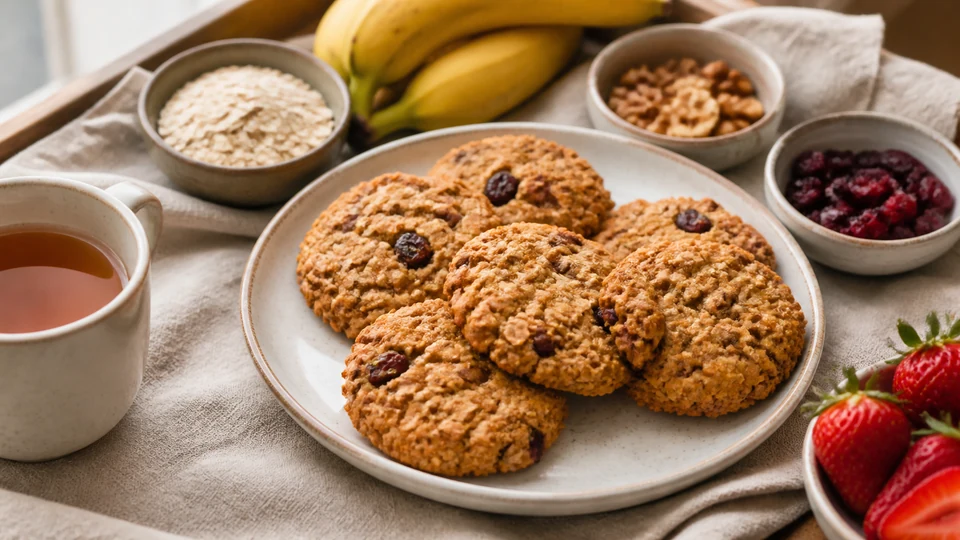
At Pancakes World, for a documented batch of breakfast cookies, use Iowa State University Extension’s 12-cookie apple-oat-cheese formula: combine flour, cinnamon and baking powder; add oil, brown sugar, egg and vanilla; then stir in diced apple, oatmeal, shredded cheese and dried fruit. Divide the dough into 12 equal portions, flatten each into a circle, and bake at 350°F (177°C) for 12 to 14 minutes, until the middle is set and the edges are lightly browned. Do not taste the raw dough. Cool the cookies before placing them in a covered container, and record the actual apple, cheese and dried-fruit choices so the batch identity and allergens remain clear. This focused guide explains how to execute, divide and diagnose that single external recipe. It does not claim a the editorial platform test, turn the cookie into a nutritionally complete meal, or promise a freezer life. Use the American Breakfast: Pancakes, Diner Plates, and Brunch Context for other morning formats, or browse Pancakes World for the full editorial library.
For adjacent decisions around Breakfast cookies, compare an oatmeal pancake guide, banana-oat pancake ideas, and pantry-staple breakfast planning.
| Guide sections |
|---|
| Keep the Iowa breakfast-cookie identity intact |
| Define what makes this a breakfast cookie |
| Prepare the workstation before dicing the apple |
| Wash and dice the apple safely |
For broader context, continue with American Breakfast: Pancakes, Diner Plates and Brunch.
Keep the Iowa breakfast-cookie identity intact
The Iowa State Extension formula makes 12 servings, with one cookie identified as one serving. Its ingredient list is:
- 3/4 cup all-purpose flour;
- 1/2 teaspoon ground cinnamon;
- 1/2 teaspoon baking powder;
- 1/4 cup canola or vegetable oil;
- 1/3 cup packed brown sugar;
- 1 egg;
- 1 teaspoon vanilla;
- 1 medium apple, diced, about 1 cup;
- 1 1/2 cups oatmeal;
- 3/4 cup shredded cheddar or Colby cheese;
- 1/2 cup dried fruit, with cherries, cranberries and raisins listed as examples.
The source permits choices within three lines: canola or vegetable oil, cheddar or Colby cheese, and a dried fruit such as cherries, cranberries or raisins. Those choices do not make every option nutritionally or functionally identical. Record exactly what goes into the bowl.
Do not silently replace the apple with applesauce, the egg with a binder, the flour with another flour or the cheese with an imitation product and still call the result the exact formula. Those may become deliberate future experiments, but each changes moisture, structure, ingredients or allergens.
The published nutrition panel belongs to the source recipe and its stated serving division. This article does not reproduce the numbers because product choices, apple size, portion equality and any variation can change the calculation. If nutrition information is needed for an altered batch, calculate it from the exact product labels, measured ingredients, finished yield and serving definition.
Define what makes this a breakfast cookie
“Breakfast cookie” is a use label, not a regulated promise that the item is a complete breakfast or produces a particular health result. In this formula, the cookie format combines an oat-and-flour dough with diced apple, dried fruit and shredded cheese. It is portioned into 12 flattened rounds and baked until set.
That definition separates the route from three nearby ideas:
- a conventional dessert cookie relabelled for the morning;
- an unbaked oat-and-fruit bite;
- a granola bar pressed into a pan.
The practical value is portability and a defined one-cookie portion in the source, not a claim about fullness, weight, energy, mood, glucose or school performance. Pairing decisions belong to the diner’s needs and broader meal context; this page does not prescribe them.
Prepare the workstation before dicing the apple
Set out:
- one large mixing bowl;
- dry measuring cups and spoons;
- a liquid measure suitable for the oil;
- a clean cutting board and knife;
- a box grater or packaged shredded cheese;
- a mixing spoon or sturdy spatula;
- a baking sheet;
- nonstick cooking spray;
- a cooling rack or clean heat-safe surface;
- a scale, if available, for dividing the dough evenly;
- a batch card for ingredient choices and observations.
Check the oven rack position and preheat to 350°F before the mixed dough is ready. Iowa instructs the cook to spray the baking sheet with nonstick cooking spray. Do not add parchment and assume identical spreading unless deliberately testing that surface as a variation.
Write the choices on the batch card:
Oil: canola or exact vegetable oil
Cheese: cheddar or Colby, including product name
Dried fruit: exact fruit or documented mixture
Apple: variety if known and actual diced amount
Planned yield: 12 equal cookies
Source method changed: yes or no
This short record prevents an unlabeled batch from being described vaguely as containing “some dried fruit and cheese.”
Wash and dice the apple safely
The University of Nebraska-Lincoln Extension handout implementing the same Iowa recipe explicitly directs the cook to rub the apple under cold running water. FDA likewise recommends washing produce under running water and says not to use soap, detergent or commercial produce wash.
Wash hands first. Use a clean produce board and knife. Inspect the apple and cut away damaged or bruised areas. Rub the whole apple under running water before cutting, including when the peel will remain in the cookie. Dry it with a clean towel if needed for safer knife control.
Dice the apple into pieces that can distribute through 12 cookies. The source says a medium apple is about one cup diced; it does not publish an exact dice dimension or gram mass. Measure the diced fruit rather than adding a very large apple merely because it is labelled “medium” at a store.
Do not leave the diced apple waiting on a surface that held raw egg or unwashed produce. Keep the cutting tools separate from the raw-dough tools once the egg has entered the bowl, or clean them before another use.
Measure the dry base accurately
All-purpose flour: three-quarters cup
Fluff flour that has compacted in storage, spoon it into the dry measure and level it without packing. A packed scoop can deliver more flour than the source measure and make the dough harder to distribute.
Most flour is a raw food. FDA explains that grinding grain into flour does not kill all possible bacteria. Keep flour in the bowl, clean spills promptly and never taste the dough to judge sweetness or cinnamon.
Cinnamon and baking powder: one-half teaspoon each
Use separate level measures. Cinnamon supplies the formula’s spice; baking powder is the stated leavener. Baking soda is not the same ingredient and is not an automatic replacement.
Stir these three dry ingredients together before adding wet ingredients. Break up visible baking-powder pockets. An uneven dry mix can create cookies with inconsistent rise or bitter concentrated spots.
Build the wet phase without losing the brown-sugar measure
The source adds oil, packed brown sugar, egg and vanilla to the dry mixture and stirs until well combined.
Measure one-quarter cup of the selected oil. Use one-third cup brown sugar packed consistently enough to hold the source measure. Record whether the sugar has hard lumps and break them before mixing. Add one egg and one teaspoon vanilla.
Handle the egg carefully:
- keep eggs refrigerated until needed;
- crack the egg away from the main ingredient storage area;
- discard the shell without touching clean handles when possible;
- wash hands after handling the shell or raw egg;
- clean any contacted counter or utensil;
- do not reuse a raw-dough spoon for a finished cookie without cleaning it.
Mix until the flour base, oil, sugar, egg and vanilla form a uniform dough. Scrape the bottom and sides of the bowl to find dry pockets. Do not add water or milk because the mixture seems thick; the apple, cheese and dried fruit still need to enter, and the source does not authorize extra liquid.
Explore related Pancakes World guidance on American Pancakes, Maple Syrup, and Maple Syrup Pancakes.
Sources and editorial references
Iowa directs the cook to stir in the diced apple, oatmeal, cheese and dried fruit. Add the measured quantities:
- about one cup diced apple from the medium fruit;
- one and one-half cups oatmeal;
- three-quarters cup shredded cheddar or Colby;
- one-half cup selected dried fruit.
“Oatmeal” is the source term. Do not silently substitute instant flavored oatmeal packets, which can add sugar, salt, flavoring and different particle sizes. Record the exact oat product used. If package instructions or ingredient labels identify additional allergens, add them to the batch record.
Separate clumps of shredded cheese and dried fruit before folding. Distribute each addition through the dough rather than leaving a cheese-heavy or fruit-heavy zone. Scrape the bowl repeatedly, but stop once the distribution is uniform. The objective is equal ingredient access for 12 portions, not a claim about a universal number of mixing strokes.
If the dough appears unusually wet or dry, pause before “fixing” it. Verify every measure, the actual apple volume, whether oil was doubled, and whether all oats and flour entered the bowl. A correction based on missing evidence can create a second, undocumented error.
Divide the dough into 12 equal portions
The Iowa page says to drop rounded tablespoons onto the baking sheet. The Nebraska handout translates the same batch into 12 even balls before flattening. The shared acceptance point is a 12-cookie yield.
A scale provides the clearest division:
- Weigh the bowl before mixing or transfer the complete dough to a tared clean bowl.
- Obtain the total dough mass.
- Divide that mass by 12.
- Portion one target amount at a time.
- Reconcile the final remainder instead of creating a thirteenth undersized cookie.
If no scale is available, first mark 12 positions on the prepared sheet. Distribute rounded spoonfuls among all positions in repeated passes, then move small amounts from visibly larger portions to smaller ones. Do not finish one cookie at a time from an unmapped bowl; the last portions may be short of apple, fruit or cheese.
Portion equality matters because the source’s one-cookie serving and 12-to-14-minute bake range assume one batch divided into 12. A mix of tiny and oversized rounds can reach different endpoints at the same time.
Flatten before baking
Iowa instructs the cook to wet their fingers and pat each portion into a circle. This is a deliberate shaping step. Do not leave the dough as tall balls and expect every cookie to spread into the intended form.
Use clean water and clean hands. Wet fingertips lightly rather than dripping water over the dough. Press each portion into a comparable circle, checking thickness as well as diameter. Keep spacing between rounds so adjacent cookies do not merge.
Wash hands after handling the raw dough. Both the Iowa page and Nebraska handout emphasize this point. Clean the portioning tool, bowl and contacted work surface before handling cooled cookies.
Do not taste a fragment left on a finger. Raw flour and egg remain present until the dough is baked.
Bake the prepared sheet at 350°F for 12 to 14 minutes. The source gives two visual/structural cues:
- the middle is set;
- the edges are lightly browned.
Use the time range to begin assessment, not as permission to remove a clearly unset center at exactly 12 minutes. Conversely, do not chase dark edges when the center is already set.
FoodSafety.gov lists 160°F for egg dishes. A clean food thermometer can add a safety check, especially when the cookies are unusually thick or the oven is uncertain. Insert it into the center of a representative thick cookie without touching the sheet. The temperature does not replace the source’s set-middle and lightly-browned-edge quality cues; use both when verification is needed.
Rotate the sheet only if the oven’s documented behavior requires it, and record that action. Opening the door repeatedly changes heat delivery. This article does not invent a universal rotation minute or rack position.
When the batch is ready, remove the sheet safely. Keep raw-dough utensils away from the finished cookies.
Cool before covering
The Nebraska handout explicitly says to let the cookies cool before storage. Move them according to the baking-sheet and tool limitations. A cookie that is still structurally delicate may need a short undisturbed period, but the source does not state a number of cooling minutes, so do not manufacture one.
Cooling before covering helps avoid trapping visible steam and condensation. Arrange cookies so air can circulate. Do not pile warm rounds into a deep container.
The Iowa source says to store the cookies in a covered container at room temperature. It does not give a room-temperature duration. Preserve that wording without turning it into a shelf-life guarantee. Label the container with the bake date and ingredient/allergen record, and make a quantity appropriate for near-term use.
If a household chooses refrigeration, USDA’s general leftover guidance calls for 40°F or below and a three-to-four-day refrigerated window. That is a conservative general leftover boundary, not a claim that refrigeration preserves the source cookie’s best texture. Reheat refrigerated leftovers only when desired and take reheated leftovers to 165°F under USDA guidance.
Do not promise that the cookies freeze well without route-specific evidence. A freezer test would need packaging, duration, thawing, texture and safety observations that this page does not have.
Diagnose the finished batch
Use observable evidence before changing the formula.
Centers remain glossy or paste-like
Confirm the batch was divided into 12, portions were flattened, the oven was fully preheated and the bake remained within a functioning 350°F environment. Return an underdone batch to cooking promptly and reassess. Do not serve raw flour-and-egg centers.
Edges darken before centers set
Check cookie thickness, portion equality, sheet color, rack location and oven accuracy. Do not automatically lower the oven temperature and preserve the same published time; that creates a new process needing its own endpoint assessment.
Some cookies spread while others stay tall
Review whether all portions were flattened similarly and whether oil, apple, cheese and fruit were evenly distributed. Unequal portions or inconsistent thickness can create different shapes even from one bowl.
Dough crumbles during portioning
Audit the flour, oat, oil, egg and apple measures. Check whether the apple provided about one cup diced. Do not pour in an unmeasured liquid. If all source quantities are correct and a later batch needs adaptation, select one measured change and label it untested.
Dough looks loose and will not hold a circle
Check whether the oil was overmeasured, whether a very large apple exceeded the one-cup cue, whether oats or flour were omitted, and whether a wet dried-fruit product replaced conventional dried fruit. Correct a documented omission only before baking; otherwise preserve the batch record and treat it as a failed variation rather than disguising it.
Fruit and cheese cluster in a few cookies
The mixing or division process was uneven. Next time, separate clumps before folding and distribute the bowl among 12 positions in multiple passes. Do not advertise a per-cookie ingredient composition from an uneven batch.
Cookies stick to the sheet
Confirm the sheet was sprayed as directed and that the spray actually covered the cookie positions. Check whether removal began before structure developed. Changing to parchment is a reasonable future comparison, but it is not the exact published surface method.
Evaluate variations one at a time
The source already permits controlled choices among oils, cheeses and dried fruits. A clean comparison changes only one option:
- canola oil versus the specific vegetable oil;
- cheddar versus Colby;
- raisins versus cranberries;
- one apple variety versus another, while keeping the diced volume constant.
Record spreading, browning, set, distribution and finished count using the same procedure. Do not claim nutrition equivalence among choices.
More substantial ideas—whole-wheat flour, another oat form, applesauce, banana, nut butter, seeds, chocolate, egg replacement or reduced sugar—change the formula’s structure or regulated ingredient information. They need a separate evidence plan or a documented kitchen test. They should not appear as casual “equal swaps.”
If nuts or nut butter enter a later version, update the allergen record and cross-contact plan before mixing. A variation is not acceptable merely because the dough can be shaped.
Questions about breakfast cookies
Are these ordinary oatmeal cookies?
They use oatmeal, but the route-specific formula also includes diced apple, shredded cheddar or Colby and dried fruit. The 12-cookie division and flattened-circle method define this particular batch.
Can the dough be tasted to check the cinnamon?
No. FDA warns against eating raw flour, dough or batter, and this dough also contains raw egg. Evaluate cinnamon only after a cookie is fully baked.
Can I use any dried fruit?
The source lists cherries, cranberries and raisins as examples. Record the exact fruit and inspect its ingredient label. A candied, sweetened or oil-coated product may not behave or calculate like another option.
Why is cheese in the formula?
Cheddar or Colby is part of the published recipe identity. This article does not claim a health purpose for it. Omitting it changes moisture, fat, salt, protein, allergens and distribution, so that omission is a new variation.
Are the cookies a complete breakfast?
The source calls them breakfast cookies, but that name does not prove nutritional completeness for every person. This page makes no meal-replacement, fullness, weight, energy or medical claim.
Can I freeze them?
This route has no approved freezer test or source-specific freezer duration. Do not invent one. Use the published covered-container wording for the source batch, or create a separate controlled freezing record before making quality claims.
How many cookies does the recipe make?
Twelve. Divide the entire dough evenly into 12 flattened portions. Do not infer a different serving from the number that happens to fit on one baking sheet.
Why does this page use Article schema?
The complete formula and recipe testing belong to Iowa State Extension, not Pancake World. Without a genuine project-owned test record covering exact ingredients, timing, yield and observations, the page should remain an evidence-led Article rather than claim an in-house Recipe.
Final acceptance checklist
Accept the batch only when:
- Every ingredient and permitted option is recorded.
- The apple was washed and measured at about one cup diced.
- Flour, cinnamon and baking powder were evenly mixed.
- Oil, packed brown sugar, egg and vanilla were fully combined.
- Apple, oatmeal, cheese and dried fruit were evenly distributed.
- The dough was divided into exactly 12 comparable portions.
- Each portion was flattened into a circle.
- Hands and raw-dough contact surfaces were cleaned.
- Baking occurred at 350°F within the source’s 12-to-14-minute range.
- Centers were set and edges lightly browned.
- The egg-containing center passed any required 160°F verification.
- Cookies cooled before entering a labelled covered container.
That checklist preserves the useful part of the breakfast-cookie idea: a defined, portable, reproducible 12-cookie batch. It also keeps the evidence boundary honest—no fabricated test, nutrition promise, substitution equivalence or storage guarantee.
https://spendsmart.extension.iastate.edu/recipe/breakfast-cookies-2/https://food.unl.edu/sites/unl.edu.ianr.extension.food/files/recipes/documents/breakfast-cookies-nep-recipe.pdfhttps://www.fda.gov/consumers/consumer-updates/flour-raw-food-and-other-safety-factshttps://www.fda.gov/consumers/consumer-updates/7-tips-cleaning-fruits-vegetableshttps://www.fda.gov/consumers/consumer-updates/what-you-need-know-about-egg-safetyhttps://www.fda.gov/food/nutrition-food-labeling-and-critical-foods/food-allergieshttps://www.foodsafety.gov/food-safety-charts/safe-minimum-internal-temperatureshttps://www.fsis.usda.gov/food-safety/safe-food-handling-and-preparation/food-safety-basics/leftovers-and-food-safety