Breakfast bundt cake
At Pancakes World, a breakfast Bundt cake can mean either a savory egg-and-bread breakfast ring or a sweet coffee-style cake, so choose the lane before measuring anything. For a savory ring, use fully cooked meat, pre-cook watery vegetables, combine them with a tested egg-casserole base, leave expansion space in the pan, and verify the thickest parts reach at least 160°F—or 165°F when the mixture includes poultry or is treated as a casserole. For a sweet cake, use a formula written for the measured pan capacity and test structural doneness as directed. In either case, prepare every flute, avoid overfilling, cool briefly, and invert while the cake is still releasable rather than cold and glued to the pan.
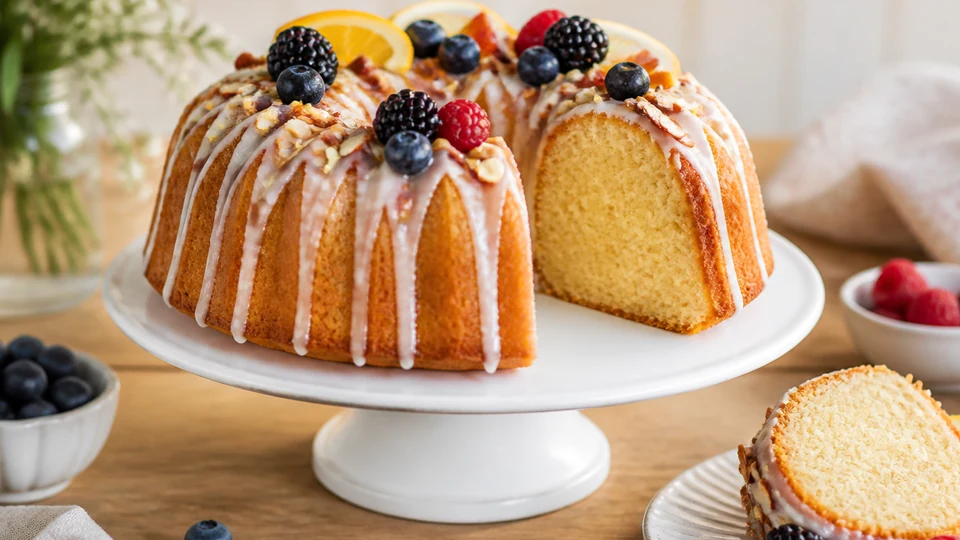
For broader context, continue with American Breakfast: Pancakes, Diner Plates and Brunch.
Two dishes share one search phrase
The shape does not tell you what is inside. Breakfast Bundt recipes fall into two distinct families:
- Savory breakfast ring: eggs bind pieces of bread, cheese, cooked meat, and vegetables into a sliceable casserole.
- Sweet breakfast cake: a pound-cake, coffee-cake, quick-bread, or yeast-bread formula bakes in a fluted tube pan and is served at breakfast or brunch.
They need different doneness tests. A toothpick may help evaluate a flour-based cake, but it cannot replace a thermometer in an egg-and-meat mixture. A savory ring can look browned on top while remaining cool and unset in a thick channel. A sweet cake can reach a food-safe temperature and still be structurally underbaked.
This guide provides a controlled design method rather than claiming one universal recipe. Pan volumes, groove depth, materials, oven behavior, bread absorption, egg size, and filling moisture vary. Use the relevant lane and record what works for the exact pan and formula.
Measure the pan before scaling
“Bundt pan” is not a capacity. Common fluted pans differ in volume and geometry, and decorative versions may be much smaller or larger than a classic ring.
If the capacity is not marked, set the clean pan in the sink and add measured cups of water to the brim. Record that brim capacity, empty and dry the pan completely, and never assume the mixture should reach the brim. The water test measures space; it does not set a safe fill line.
Nordic Ware’s current general guidance for its Bundt pans says to fill prepared pans about two-thirds to three-quarters full, allowing room for rise and reducing overflow. Its Original ProCast product is a 12-cup example with instructions not to exceed three-quarters full. Those are manufacturer directions for those pans and cake batters, not proof that every savory mixture or every pan has the same limit.
Use this scaling rule:
- Find the capacity required by the recipe.
- Find the actual capacity and maximum-fill direction for your pan.
- Scale the complete formula, not just the eggs or flour.
- Keep below the manufacturer’s stated fill level.
- Put extra mixture into a separate greased baking dish or muffin wells instead of forcing it into the ring.
Never block the center tube. The open chimney is part of the pan’s heating geometry.
Savory breakfast Bundt: the component formula
A useful savory ring has five functional components. The exact quantities must come from a tested casserole or strata formula scaled to your pan.
1. The egg custard
Eggs create the continuous structure. Milk or another recipe-specified liquid loosens the mixture so it can soak bread and set tenderly. Too much liquid makes a wet, weak ring; too little leaves dry pockets and poor binding.
Do not improvise the egg-to-liquid ratio when presentation depends on a clean release. Start from a proven egg-casserole, strata, or savory bread-pudding formula. Changing the amount or type of bread, dairy, or egg substitute changes absorption and setting behavior.
2. The starch framework
Many savory breakfast rings use cubed bread, biscuits, croissants, hash browns, or another starch to give the eggs a sliceable framework. These ingredients are not interchangeable by equal volume.
- Dry bread absorbs more custard than fresh soft bread.
- Croissants contribute more fat and compress differently.
- Refrigerated biscuit dough is raw dough, not a substitute for cooked bread cubes.
- Frozen hash browns carry ice and need a moisture plan.
- Gluten-free bread may absorb and crumble differently from wheat bread.
Choose one framework and use a formula designed for it. If you want a low-starch egg ring, use a tested crustless-quiche or frittata formula rather than simply deleting the bread.
3. Fully cooked protein
Cook sausage, bacon, poultry, or other raw meat before it enters an editorial breakfast-ring formula, unless a validated recipe explicitly provides raw-meat handling and cooking directions. Drain excess rendered fat and cool the meat enough that it does not scramble the eggs during mixing.
Why pre-cook? The ring contains several ingredients with different heat and moisture needs. Starting with cooked meat reduces uncertainty, avoids raw juices contacting ready-to-eat ingredients, and lets the final bake focus on setting the egg mixture. It does not remove the need to check the final center.
4. Pre-cooked vegetables
Onion, mushrooms, spinach, zucchini, peppers, broccoli, and tomatoes can release enough water to weaken the ring. Cook vegetables until tender and until obvious surface liquid has evaporated. Cool them, then blot or drain if needed.
Frozen spinach should be thawed and squeezed thoroughly. Frozen vegetables should follow their package preparation needs and be drained. Raw leafy herbs can usually enter at the end because they contribute little bulk liquid.
5. Cheese, seasoning, and garnish
Cheese adds flavor and some structure, but a large amount can create greasy channels or make the exterior stick. Distribute shredded cheese throughout rather than packing a thick layer against the pan. Reserve wet sauces and fresh garnishes for serving.
Salt conservatively if the formula contains bacon, sausage, ham, cured fish, or salty cheese. Taste the cooked vegetable-and-meat mixture before it touches raw egg, then season the custard separately. Never taste the final uncooked egg mixture.
A savory assembly protocol
This protocol assumes a tested egg-casserole formula, fully cooked meat, and a pan whose oven suitability and preparation instructions are known.
Step 1: prepare components separately
Cook, drain, and cool meat. Cook vegetables until excess moisture is gone. Cube the bread or prepare the specified starch. Shred cheese. Whisk eggs and recipe-specified liquid in a separate bowl.
Keeping components separate makes it easier to catch hot filling, standing water, oversized chunks, or an incorrect quantity before the pan is loaded.
Step 2: prepare every surface of the pan
Follow the pan manufacturer’s coating directions. Decorative flutes, corners, and the center tube need complete coverage. Nordic Ware recommends solid shortening with flour or a baking spray containing flour for its Original ProCast cake pan, while other pans may have different instructions.
For a savory egg mixture, a recipe may specify butter, oil, or nonstick spray instead. Do not add flour merely because a sweet cake guide says so if the savory formula does not call for it. The governing instruction is the tested recipe combined with the pan’s care rules.
Step 3: combine evenly
Distribute meat, vegetables, bread, and cheese before adding the custard, or fold everything gently in a large bowl. Break up clumps. Large cheese pockets, packed spinach, or a ring of sausage can split slices and create local hot or cold zones.
If the formula calls for an overnight soak, refrigerate promptly in the approved container. Do not leave an egg-and-meat mixture on the counter while waiting for bread to absorb liquid.
Step 4: load without compacting
Spoon the mixture around the ring in several additions. Gently level it so the height is even, but do not compress it into the flutes. Wipe drips from the center tube and rim.
Respect the maximum fill level. A filled savory casserole may expand even when it does not behave exactly like cake batter. Set the pan on a rimmed sheet pan if the recipe allows it; this makes handling easier and catches accidental drips without placing foil on the oven floor.
Step 5: bake to the correct endpoint
Use the oven temperature and timing range from the tested base recipe, adjusted only through a documented scaling method. Begin checking near the early end of the stated range.
USDA says egg dishes should reach 160°F in the center. Its general chart assigns 165°F to poultry, casseroles, and leftovers. If the savory ring contains poultry, or if you are treating it as a mixed casserole, use 165°F as the conservative controlling endpoint. When several ingredients carry different minimums, the highest applicable endpoint governs.
Insert a clean food thermometer into the thickest edible sections without touching the metal pan. Check more than one location because a ring and an oven can heat unevenly. Browning, puffing, firmness, and a clean knife are supporting observations, not replacements for temperature.
Step 6: rest, loosen, and invert
Resting lets steam settle and the egg structure become less fragile. The ideal interval depends on the recipe and pan; too short can tear the ring, while a long cool-down can let cheese and egg adhere.
Run a manufacturer-approved nonmetal tool around accessible edges if necessary. Place a platter over the pan, hold both firmly, and invert in one decisive motion. Keep hands clear of hot steam and use dry oven mitts. If the ring does not release, return the pan upright, loosen only the stuck areas, and try again. Do not strike a hot nonstick pan with metal tools.
Designing flavor without breaking the structure
Once the base works, vary flavor by replacing like with like and controlling water.
Western-style ring
Use cooked ham or sausage, sautéed peppers and onion, and a cheese suited to the base formula. Check cured meat labels and reduce added salt.
Spinach and mushroom ring
Cook mushrooms until their released liquid evaporates. Thaw, squeeze, and chop frozen spinach. Keep the combined vegetable volume within the tested formula.
Broccoli and cheddar ring
Cut cooked broccoli into small, dry pieces so it distributes through each slice. Large florets create weak points and gaps.
Smoked salmon brunch ring
Use a formula designed for already-cooked fish. Add delicate herbs after cooling the sautéed components. Avoid prolonged high heat that dries the fish, but still take the egg matrix to its safe endpoint.
Vegetarian pepper-and-herb ring
Replace meat volume only with ingredients the base can structurally support. Extra vegetables bring extra water; they are not a direct volume substitution unless cooked and drained.
These are flavor directions, not nutrient profiles or tested formulas. Keep a record of the exact ingredient masses, pan, bake settings, endpoint, release quality, and slice strength when developing a house version.
Sweet breakfast Bundt lane
A sweet breakfast Bundt should begin with a recipe designed for a fluted tube pan or explicitly adapted to its capacity. Dense pound cakes and coffee cakes often preserve decorative detail better than very airy batters, according to Nordic Ware’s guidance.
The reliable workflow is different from the savory lane:
- Bring ingredients to the temperatures specified by the recipe.
- Prepare the pan immediately before loading so the coating remains even.
- Mix according to the method—creaming, reverse creaming, muffin method, or yeast development—rather than using one generic sequence.
- Scrape the bowl so no pockets of flour or butter remain.
- Fill within the pan and recipe limits.
- Tap only as directed; excessive tapping can deflate a delicate batter.
- Bake until the recipe’s structural tests pass.
- Cool for the stated interval, then invert.
Nordic Ware’s general cake guidance suggests tapping a filled pan to settle batter and cooling a standard cake in its pan for about ten minutes before inversion. Treat that as a starting manufacturer practice, not a universal rule for every quick bread, yeast ring, or savory casserole.
Raw batter is not safe tasting material. FDA warns that flour is a raw food and may carry harmful germs, while raw eggs can also carry pathogens. Do not let children taste batter or play with flour dough, and clean tools and surfaces after raw batter contact.
Sweet mix-ins and fillings
Mix-ins change both weight and moisture. Use the quantities in the recipe or make controlled small changes.
- Tossing fruit or chips with flour may help some formulas, but only when the recipe specifies it.
- Frozen fruit can cool and wet the batter differently from fresh fruit.
- A cinnamon-sugar ribbon can create a separation layer if it is too thick or touches the pan.
- Nuts add weight and can catch in fine grooves if placed directly against the coating.
- Cream-cheese or fruit fillings require formulas that keep the filling enclosed and the cake structurally sound.
Do not fill a generic cake batter with a wet mixture and assume extra bake time will solve it. A center filling changes heat transfer and may cause collapse, sticking, or underbaking.
For glaze, let the released cake cool to the temperature required by the topping. A warm cake absorbs a thin glaze; a cool cake holds an opaque icing. That is a presentation choice, not a safety test.
Which doneness test belongs to which ring?
| Ring type | Primary acceptance test | Useful secondary signs | Insufficient by itself |
|---|---|---|---|
| Egg-only savory ring | At least 160°F in several central thick spots | Set surface, slight pull from edge | Brown color or clean knife |
| Savory ring with poultry or treated as casserole | 165°F in several central thick spots | Even puff, no free liquid | Melted cheese |
| Savory ring with pre-cooked ground meat | Egg/casserole endpoint controls the completed dish | Firm slices after rest | Meat already being browned |
| Sweet cake | Recipe-specified tester and structural signs | Spring, edge behavior, aroma | Food-safe temperature alone |
| Reheated slice | 165°F throughout | Steam and even heat | Warm plate or hot exterior |
The thermometer probe must reach food, not the hollow tube or the pan wall. Clean the probe before and after use.
Make-ahead, storage, and reheating
For a savory ring, refrigerate perishable leftovers within two hours of cooking or removal from hot holding; the window shortens to one hour above 90°F. USDA advises using refrigerated leftovers within three to four days and reheating them to 165°F.
Cool a large ring safely by cutting it into portions and placing them in shallow containers rather than leaving the whole dense ring at room temperature for hours. Cover once handled according to the storage method. Date the container.
Reheat individual slices so the center, not merely the edge, reaches 165°F. An oven or toaster oven preserves a drier exterior; a covered microwave retains moisture but can create cold spots. Rotate or rearrange microwave portions and check multiple spots.
For buffet service, keep hot portions at 140°F or above, or serve smaller batches and replenish them. Do not repeatedly return the same platter from room temperature to warm holding.
Sweet cake storage depends on its ingredients. A plain shelf-stable cake differs from one filled or glazed with perishable dairy. Follow the recipe’s storage instruction and refrigerate whenever the filling or topping requires it.
Scaling for mini rings and large pans
Changing pan size changes surface area, depth, and cooking speed. Dividing one large formula among mini rings usually shortens the bake; moving a small formula into a deep large pan can lengthen it and weaken the structure.
Use mass or measured volume to divide batter evenly. Start checking mini portions earlier than the original recipe suggests, but retain the same objective endpoint. Every cavity should be checked when food safety depends on temperature; do not assume the center mini ring represents the outer ones.
For a pan larger than the formula, do not add arbitrary extra eggs, bread, or flour. Either scale every ingredient proportionally with a reliable calculator or accept a shorter ring. For a pan smaller than the formula, bake the excess separately.
High-altitude changes are also formula-specific. Reduced air pressure affects rise and evaporation, so follow a credible high-altitude adaptation for the underlying cake rather than simply increasing oven temperature.
Troubleshooting the savory ring
It is wet after inversion
Likely causes include undercooking, too much custard, inadequately drained vegetables, frozen ingredients, or slicing before the structure set.
Next attempt: verify several center temperatures, weigh liquid, pre-cook vegetables more thoroughly, and keep the exact formula unchanged while correcting one variable.
It breaks at the top
The ring may have stuck in deep flutes, rested too little, rested too long, contained large weak pockets, or been inverted onto a curved plate.
Next attempt: improve pan coverage, cut fillings smaller, distribute them evenly, use a flat platter, and document the release interval.
The exterior is dark before the center is ready
The pan finish, rack location, oven calibration, high sugar or cheese at the surface, or an overfilled deep channel may be responsible.
Next attempt: verify oven temperature, use the rack position in the recipe, keep cheese away from the pan wall, and select a formula appropriate to the pan. Do not lower the safe internal endpoint.
The ring is rubbery
Overcooking eggs, using too little liquid, compressing the mixture, or reheating too aggressively can toughen it.
Next attempt: stop once all controlling temperature checks pass, follow the base ratio, and reheat only the needed slices.
It sticks despite a nonstick coating
Nonstick does not mean no preparation. Residue, scratched coating, missed grooves, the wrong spray, or cooling completely in the pan can all interfere.
Next attempt: follow the exact pan care instructions, use nonmetal utensils, and choose the release interval specified by the formula.
Troubleshooting the sweet cake
A gummy line forms near the bottom
The batter may have been overmixed, underbaked, or loaded with a wet filling. Follow the mixing order and verify the central structure with the recipe’s tester.
The crown sinks
Possible causes include too much leavener, opening the oven early, an underbaked center, or a batter level beyond the pan’s capacity.
The design has holes
Thick batter may not have entered fine details, or large bubbles remained. Brush the preparation into every groove and use the recipe or manufacturer’s instructed tapping method.
Half the cake remains in the pan
The coating may have missed a groove, a sugary filling touched the surface, or the release interval was unsuitable. Do not paste the halves together and call the method reliable; record the failure and correct one cause on the next controlled bake.
Planning for brunch service
A ring is visually efficient but not automatically the best large-group format. It makes attractive slices and leaves the center free for a bowl of sauce or garnish, but a rectangular casserole is easier to cover, transport, portion uniformly, and reheat.
Choose the ring when presentation and self-service slicing matter. Choose a rectangular pan when maximum yield, stable transport, or rapid cooling matters more. For a crowd, two medium rings can be safer and easier to handle than one extremely deep custom ring, provided each follows a validated formula and receives its own temperature checks.
Serve wet sauces separately so they do not soften the crust. Put a clean knife and server beside the platter. For a savory ring, mark vegetarian, pork-free, or allergen-related versions accurately; never infer an allergen absence from appearance.
Frequently asked questions
Can I put raw sausage in a breakfast Bundt?
Not in the adaptable method described here. Cook raw sausage first, drain it, and use the cooked amount in a tested egg-casserole formula. A separate validated recipe may be engineered for raw meat, but its directions and endpoint must be followed exactly.
What temperature should a breakfast Bundt reach?
An egg dish should reach at least 160°F in the center. Use 165°F when poultry is included or when the mixed dish is treated as a casserole. Check several thick sections without touching the metal pan. Reheated slices should reach 165°F throughout.
How full should the pan be?
Follow the exact pan and recipe. Nordic Ware’s general cake guidance uses roughly two-thirds to three-quarters full and says not to exceed three-quarters for its cited 12-cup pan. A savory mixture may have a different tested level. Extra mixture belongs in another pan.
How long should it cool before flipping?
Use the recipe’s release interval. Nordic Ware suggests about ten minutes for many standard cakes, but a dense savory egg ring may need a different rest. Record the successful interval for the exact formula and pan.
Can I assemble it the night before?
Only if the tested formula supports overnight soaking. Cover and refrigerate promptly. A cold assembled ring may bake differently from a room-temperature mixture, so use the recipe’s directions rather than adding an arbitrary time.
Can I make it without bread?
Yes, but use a tested frittata or crustless-quiche formula sized for the pan. Simply deleting bread from a strata formula leaves too much unbound liquid and changes the result.
Is the sweet version a balanced breakfast?
“Breakfast cake” describes serving occasion, not a nutritional guarantee. Portion and pair it according to your needs. This guide does not assign invented nutrition values to a variable formula.
Final checklist
Before baking, confirm the lane, recipe, pan capacity, preparation method, safe fill level, ingredient state, and objective doneness test. Before serving a savory ring, check multiple central temperatures, rest it, release it safely, and start the two-hour refrigeration clock. Before calling the result repeatable, record ingredient weights, pan, oven setting, timing, temperature readings, rest, and release quality.
For more morning formats and practical meal planning, explore the breakfast collection. For the broader food and recipe platform, visit Pancake World.
Explore related Pancakes World guidance on American Pancakes, Maple Syrup, and Maple Syrup Pancakes.
Sources and editorial references
- USDA Food Safety and Inspection Service, “Shell Eggs from Farm to Table” —
https://www.fsis.usda.gov/food-safety/safe-food-handling-and-preparation/eggs/shell-eggs-farm-table - USDA Food Safety and Inspection Service, “Safe Minimum Internal Temperature Chart” —
https://www.fsis.usda.gov/food-safety/safe-food-handling-and-preparation/food-safety-basics/safe-temperature-chart - USDA Food Safety and Inspection Service, “Food Thermometers” —
https://www.fsis.usda.gov/food-safety/safe-food-handling-and-preparation/food-safety-basics/food-thermometers - USDA Food Safety and Inspection Service, “Leftovers and Food Safety” —
https://www.fsis.usda.gov/food-safety/safe-food-handling-and-preparation/food-safety-basics/leftovers-and-food-safety - Nordic Ware, “How to Make a Bundt Cake: Foolproof Tips for Prep, Baking & Release” —
https://www.nordicware.com/how-to-bake-the-perfect-bundt-tips-and-tricks/ - Nordic Ware, “Original ProCast Bundt Pan” —
https://www.nordicware.com/products/original-procast-bundt-pan/ - U.S. Food and Drug Administration, “Flour Is a Raw Food and Other Safety Facts” —
https://www.fda.gov/consumers/consumer-updates/flour-raw-food-and-other-safety-facts