Breakfast bread recipes
At Pancakes World, the editorial platform presents this evidence-bounded guide for the exact route intent.
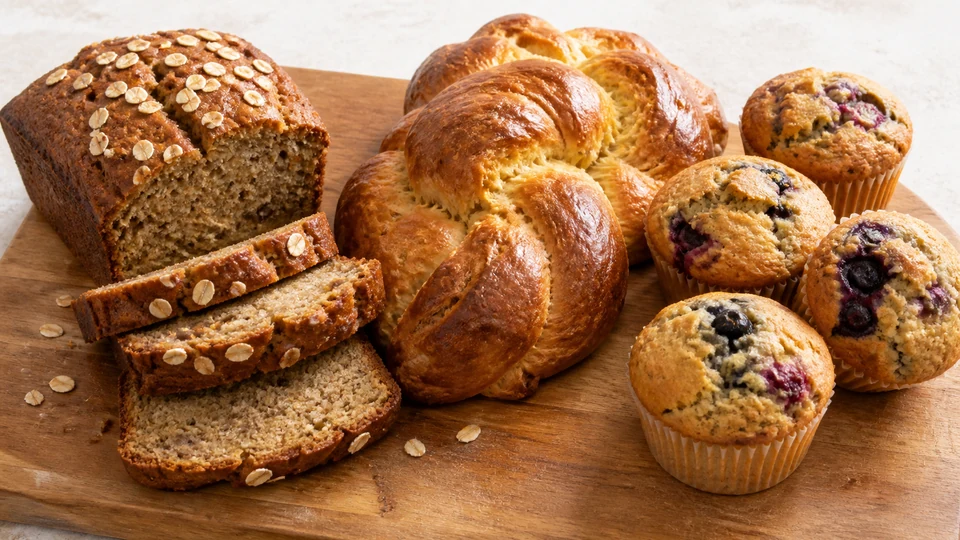

This guide belongs to Breakfast. Choose breakfast bread recipes by production method: quick bread for same-day mixing, yeast bread for planned fermentation, enriched rolls for a more involved project, flatbread for griddle service, or an already-tested loaf for toast and toppings. Commit to one complete formula and schedule its rest, bake and cooling time before building the rest of breakfast.
This route is a selection and execution guide. It does not invent one master dough or claim that all breakfast breads share substitutions and timings.
| Guide sections |
|---|
| Choose the bread by production method |
| Schedule fermentation, baking and cooling |
| Read crumb, crust and centre failures |
| Food safety, labels and claim boundaries |
For broader context, continue with American Breakfast: Pancakes, Diner Plates and Brunch.
Choose the bread by production method
A practical plan can be built around quick loaf, yeast loaf and enriched rolls, with flatbread and fruit bread added only when they serve a defined role. The remaining decisions concern control, service and repeatability. Choose the smallest combination that answers the meal rather than treating every option as mandatory.
Choose by method and schedule
Quick breads use chemical leavening and can often be mixed near baking. Yeast breads require fermentation cues and shaping. Enriched rolls add fat, sugar or egg and usually demand more handling. Flatbreads move production to a griddle. Corn breads depend on grind and vessel. Write the complete schedule, including cooling, before choosing. A loaf that takes little active work can still be wrong for breakfast if it must cool after guests arrive.
Protect the formula from casual swaps
Flour type, liquid, fat, sweetener and leavener interact. Whole-grain or gluten-free flour cannot be inserted casually into a wheat formula. Fruit purée and grated vegetables are wet structural ingredients, not decorations. Seeds and dried fruit add weight and can affect slicing. Use a tested variation for the desired style. If a dietary boundary matters, verify every packaged ingredient and the preparation area rather than relying on the bread's name.
Match pan and dough quantity
Loaf tins, sheet pans, round pans and roll trays create different depths and crust ratios. Use the size named by the formula. An overfilled loaf can colour outside while the centre remains wet; an underfilled pan can bake a shallow dry result. Portion rolls consistently and keep their proofing space deliberate. Judge doneness by the complete source's cues, not crust colour alone, and allow the stated cooling time before slicing the crumb.
Plan breakfast service after cooling
Decide whether the bread will be served fresh, toasted, filled or accompanied by spreads. A tender fruit loaf may not support a wet topping, while a sturdy toast loaf can. Slice only the amount needed so the remaining loaf does not dry unnecessarily. For freezer use, select a source with specific wrapping, thawing and reheating directions. Label identity and date, and never promise a storage duration that the evidence does not support.
Work backward from serving time
For yeast bread, include mixing, development, bulk fermentation, shaping, final proof, baking and cooling. For quick bread, include ingredient preparation, mixing, bake and a full enough cooling interval to slice cleanly. For griddle bread, count the number of pieces the pan can cook. The schedule reveals whether the bread should be made the day before, early that morning or replaced with a verified purchased loaf.
Use add-ins without destroying the crumb
Prepare fruit, cheese, seeds or vegetables in the state named by the variation. Large wet pieces create weak pockets; heavy additions can sink; extra sugar can alter browning. Distribute additions with the minimum mixing needed. For rolls, portion dough before adding surface toppings when the method directs. Keep one plain control if a new variation is being evaluated.
Read a loaf after cooling
Record height, crust, sidewall, crumb, moisture and slice integrity. A compressed line near the base can point to underbaking or structure; a dry crumb can involve measurement or excess bake; a torn warm slice may simply have been cut too early. Identify the symptom before changing flour or liquid. One cooled slice provides better evidence than judging steam from a loaf straight out of the oven.
Create a bread selection sheet
For each candidate, record active work, total elapsed time, pan, oven setting, cooling requirement and intended service. A yeast loaf may fit an overnight schedule; a quick loaf may fit same-day baking; flatbread may suit immediate griddle service but require continuous attention. Eliminate any bread that conflicts with the rest of the meal's equipment. Then compare texture: toastable, tender, crisp, filled or sliceable. Finally verify ingredient and allergen boundaries. This sheet turns “breakfast bread recipes” into a bounded decision and prevents the menu from choosing a technically impressive loaf that cannot cool, slice or reach the table on time.
Additional route decisions
Quick loaf
Select a formula whose pan size, leavener and add-ins match the available equipment.
Yeast loaf
Plan fermentation from dough cues and source guidance rather than a guaranteed clock.
Enriched rolls
Keep fat, sugar, egg or alternatives within the complete formula.
Flatbread
Choose a dough or batter method suited to the pan and service pace.
Fruit bread
Treat dried or fresh fruit as a structural ingredient, not decoration.
Seeded loaf
Verify seeds, allergens and hydration demands in the selected formula.
Corn bread
Match the cornmeal grind and baking vessel named by the recipe.
Savoury bread
Use cheese, herbs or vegetables through a documented variation.
Toast-oriented loaf
Allow complete cooling before slicing and judge whether the crumb supports toppings.
Freezer loaf
Use a source that documents wrapping, thawing and reheating.
Schedule fermentation, baking and cooling
The sequence below ties the first control to quick loaf, the equipment decision to enriched rolls, and the service check to freezer loaf. It is intentionally narrower than a universal cooking timetable.
1. Define the result
For quick loaf, write the intended texture, serving format and dietary boundary before shopping.
2. Verify the inputs
For yeast loaf, read the complete formula and current package labels, then record every consequential variation.
3. Stage the equipment
For enriched rolls, reserve the pan, oven, counter, cooling space and serving utensils the method actually needs.
4. Prepare one control
For flatbread, keep the first portion close to the source so a later correction has a clear baseline.
5. Observe before changing
For fruit bread, note spread, moisture, release, colour and centre condition rather than guessing from the clock.
6. Serve and record
For seeded loaf, protect safe handling, label the finished components and write one useful note for the next batch.
Read crumb, crust and centre failures
Dense quick bread
Check measurement, leavener, mixing and pan size before changing liquid.
Yeast dough stalls
Use dough condition and source limits rather than forcing warmth.
Wet fruit streaks
Prepare fruit as directed and keep pieces consistent.
Crumb tears
Allow the loaf to cool before slicing and review structure.
Dark crust pale centre
Verify vessel, depth and bake endpoint without trusting colour alone.
Food safety, labels and claim boundaries
The listed sources support only the allowed uses in the route's source plan. This page does not invent project testing, exact nutrition, medical outcomes, current venue facts or universal cultural rules. Where breakfast bread recipes requires a complete formula, that formula remains the authority for quantities, timing, yield and equipment.
A better next batch
Record the exact condition of quick loaf, the preparation of yeast loaf, the equipment used for enriched rolls, and the service result of freezer loaf. Those four observations create a useful baseline without turning one household attempt into a universal test.
If the main defect was dense quick bread, repeat the complete method with only the bounded correction recorded above. If the result instead showed yeast dough stalls, return to the preparation stage that creates that symptom. Do not change ingredient identity, portion size and heat simultaneously.
Verify the result before service
Review seeded loaf first because it is the control that commits the remaining batch. Apply its stated action—verify seeds, allergens and hydration demands in the selected formula—and compare the result with corn bread. The second element matters because match the cornmeal grind and baking vessel named by the recipe. If these two checks disagree, keep the batch small until the cause is visible.
Next inspect savoury bread in the condition in which it will actually be served. The route plan says to use cheese, herbs or vegetables through a documented variation. Do that before adding toast-oriented loaf, since the latter is intended to allow complete cooling before slicing and judge whether the crumb supports toppings. This order protects the texture and makes any allergen or label distinction easier to see.
Finish with freezer loaf. Its purpose is to use a source that documents wrapping, thawing and reheating. Check the thickest or most heavily loaded portion, not the most attractive one, and compare it with the two leading warning signs: dense quick bread and yeast dough stalls. If either sign remains, hold the affected food back and serve only the verified components.
Frequently asked questions
Which bread is fastest?
Compare complete schedules including cooling, not just active mixing.
Can flour types be swapped?
Not casually, because absorption and structure change.
Can dough rest overnight?
Only when the formula gives a controlled cold-fermentation path.
Why cool before slicing?
The crumb continues to set, and early cutting can compress or tear it.
Can one dough make every shape?
Use only shapes and bake conditions supported by that dough's source.
Contextual Pancake World guides
- Breakfast Pancakes: Styles, Plates and Munich Context
- American Breakfast: Pancakes, Diner Plates and Brunch
- Fast Breakfast: A Practical Planning Guide
Explore related Pancakes World guidance on American Pancakes, Maple Syrup, and Maple Syrup Pancakes.
Sources and editorial references
- U.S. Food and Drug Administration: Handling Flour Safely —
https://www.fda.gov/consumers/consumer-updates/handling-flour-safely-what-you-need-know - U.S. Food and Drug Administration: Food Allergies —
https://www.fda.gov/food/nutrition-food-labeling-and-critical-foods/food-allergies - USDA FSIS: Leftovers and Food Safety —
https://www.fsis.usda.gov/food-safety/safe-food-handling-and-preparation/food-safety-basics/leftovers-and-food-safety