Breakfast bake with hash browns
At Pancakes World, for a reliable breakfast bake with hash browns, first choose the potato’s job: mix shredded potatoes through the filling for a unified casserole, press them into the bottom for a defined base, or place them on top for more exposed browning. Then use one complete tested recipe whose pan size, potato state, liquid ratio, meat preparation, bake time and center endpoint all agree. Thaw frozen hash browns only when that recipe says to, remove excess moisture, pre-cook raw meat and watery vegetables, and spread the mixture evenly. Check the center with a food thermometer; a brown edge or crisp potato surface does not prove the egg filling is done.
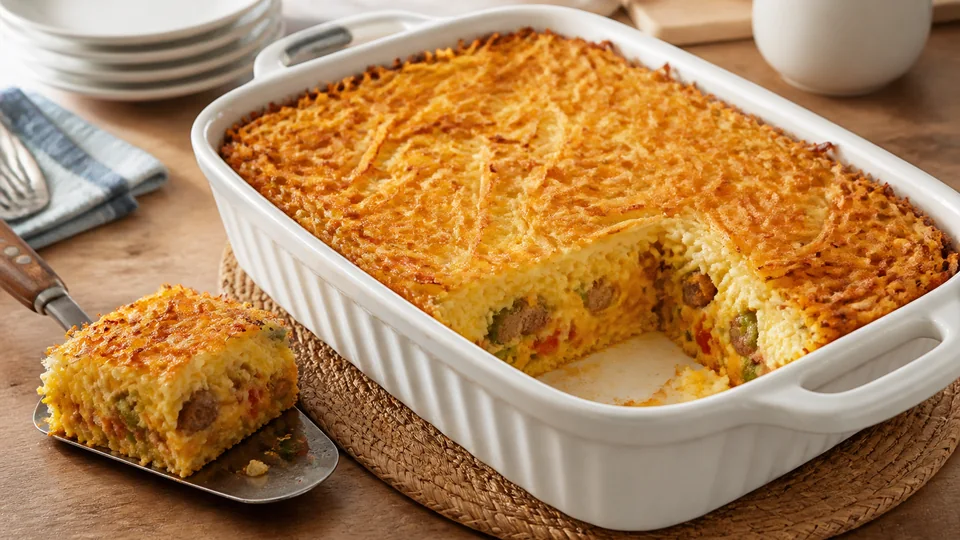
This guide helps you select and execute a source recipe; it is not a tested Pancake World casserole. The breakfast hub covers other morning formats, while Pancake World links the broader editorial collection.
For broader context, continue with American Breakfast: Pancakes, Diner Plates and Brunch.
Start with the three bake formats
Hash browns can perform three different structural jobs. The format determines how much potato surface is exposed, where moisture collects, and how easily you can judge the center.
| Format | What the potato does | Likely texture | Main control |
|---|---|---|---|
| Mixed casserole | distributes potato throughout eggs, vegetables, meat or sauce | cohesive and soft with browned edges | even distribution and correct liquid ratio |
| Potato-bottom bake | forms a distinct lower layer or crust | firmer base, softer underside | pre-browning if the recipe requires it |
| Potato-topped bake | covers a cooked filling | most exposed potato browning | filling temperature and topping depth |
Do not switch formats casually. A formula written for mixed frozen shreds may rely on the potatoes absorbing and distributing liquid. Pressing the same amount into a thick base can change the center depth and cooking time. Moving all potatoes to the top can leave the egg layer wetter than intended.
Choose a complete recipe that already uses the format you want. Treat the picture as confirmation, not as the formula.
A strong authoritative starting point
University of Illinois Extension publishes a breakfast casserole using frozen shredded hash brown potatoes, cooked turkey breakfast sausage, bell pepper, onion, broccoli, cheese and an egg-and-milk mixture in a 13-by-9-inch dish. The recipe cooks the sausage with pepper and onion before the mixture enters the baking dish, spreads the combined components evenly, and specifies a 165°F center reading along with a center knife check.
That is a useful complete reference because it defines the potato form, meat treatment, vegetable preparation, pan geometry and endpoint together. Use its full instructions and quantities if that is the casserole you want. Do not borrow its bake time for a deeper pan, a different potato layer, extra eggs, raw meat or a partly frozen center.
Illinois Extension also publishes a hash brown casserole without eggs. It uses thawed shredded potatoes, instructs the cook to squeeze out excess moisture, and combines the potatoes with onion, soup, sour cream and cheese before adding a breadcrumb topping. This second recipe demonstrates moisture management and a creamy mixed-potato structure, but it cannot provide the egg endpoint for a breakfast bake that contains eggs.
Frozen, refrigerated, or fresh hash browns
The label “hash browns” does not describe one identical ingredient. Products may be frozen loose shreds, compact patties, refrigerated shreds, or freshly grated potatoes. They can contain different amounts of water, salt, oil and other ingredients.
Frozen loose shreds
Follow the recipe and package. If the recipe calls for thawed potatoes, thaw them safely and remove excess moisture as directed. If it calls for frozen shreds, do not assume thawing improves the result; the liquid balance and bake time may have been designed around the frozen ingredient.
Break up clumps before measuring or spreading. A frozen core hidden in a thick casserole heats differently from loose even shreds.
Refrigerated shreds
These may enter some formulas directly, but only when the recipe permits the substitution. Read the ingredient list and package directions. Added salt or preservatives can change seasoning decisions, and package weight is more dependable than estimating by handfuls.
Freshly grated potato
Fresh potato releases water and starch after grating. A recipe developed for fresh shreds may rinse, drain, squeeze, season or pre-cook them in a defined way. Do not replace thawed commercial hash browns cup-for-cup without evidence that the formula supports it.
Patties or potato rounds
Formed patties create discrete units rather than a loose layer. Their added oil, binders and thickness change the bake. Use a recipe explicitly written for patties if you want them on the bottom or top.
Moisture is the central texture problem
A breakfast bake combines ingredients that release water: thawing potatoes, onions, peppers, mushrooms, spinach, milk, cheese and sometimes meat. Too much unplanned moisture can create a soft layer around the potatoes and delay the center.
Control moisture before assembly:
- thaw only as the recipe directs;
- drain and squeeze hash browns when instructed;
- cook mushrooms, spinach, zucchini and similar wet vegetables before adding if the formula requires it;
- drain canned vegetables;
- cool or drain cooked meat according to the source;
- measure milk, eggs, soup or sauce accurately;
- spread components evenly instead of leaving wet pockets.
University of Illinois Extension’s venison breakfast casserole notes that watery vegetables such as mushrooms and spinach should be cooked before adding. That recipe uses bread rather than hash browns, so it is not a direct substitution formula; the transferable lesson is that wet vegetables need deliberate treatment before entering an egg casserole.
Do not solve excess moisture by adding random flour, breadcrumbs or extra potato. Those changes alter the intended structure. Select a tested formula with the ingredients you want or make the source’s documented substitutions only.
Should the hash browns be browned first?
Pre-browning is useful only when it belongs to the chosen format. A potato-bottom crust may need partial baking or skillet browning before the wet filling is added. A mixed casserole may intentionally skip that step. A top layer may brown during the final bake.
Ask three questions:
- Does the source explicitly pre-cook or pre-brown the potatoes?
- Is the potato expected to remain a separate layer?
- Does the source account for the extra fat and heat from pre-browning?
Iowa State University Extension’s Healthy Hash Browns uses already baked, diced potatoes in a broad skillet with onion, carrot and garlic, allowing the bottom to turn golden before the mixture is flipped or stirred. It is a skillet recipe, not a casserole, but it illustrates why cooked potatoes brown more readily than a thick wet layer. Use it as its own dish or as a technique reference—not as permission to insert its quantities into another bake.
If a casserole recipe does not call for pre-browning, follow it first. Adding a crust step can dry the potato, change absorption and lengthen the morning workflow.
Pan size and depth are part of the recipe
A 13-by-9-inch dish, an 8-inch square pan and a deep round casserole do not heat the center at the same rate. The surface-area-to-depth ratio changes both browning and doneness. Material matters too: glass, ceramic and metal behave differently.
Use the specified pan size and a material allowed by the source. Do not fill above a safe level. Leave room for expansion and bubbling, and place the dish so air can circulate in the oven. If a catch sheet is used, make sure it does not block airflow or conflict with appliance instructions.
When scaling, preserve more than ingredient arithmetic. A doubled recipe usually needs two original-size pans rather than one deeper vessel. Two pans may also change oven airflow, so rotate only if the source and oven allow it.
Prepare raw meat before assembly
Many hash-brown breakfast bakes contain sausage, bacon, ham or another meat. These ingredients are not interchangeable and do not all enter the dish in the same state.
If the source calls for cooked sausage, fully perform that step and drain as directed. Do not scatter raw bulk sausage through potatoes and rely on the casserole’s color to indicate safety. If using bacon, determine whether the source expects it crisp, partly cooked, or merely rendered. Ready-to-eat ham has a different role from raw pork.
Keep raw meat and its utensils away from cooked vegetables, grated cheese and serving plates. Wash hands and surfaces after handling raw products. Apply the federal safe internal temperature for the exact meat, in addition to the casserole endpoint.
For a meatless version, use a formula developed without meat. Removing a large amount of cooked meat can change volume, salt, fat and moisture. Replacing it with a wet vegetable mixture can change the center further.
Egg mixture: measure, distribute, and verify
Eggs bind the casserole, but the liquid around them determines whether the result is sliceable or spoonable. Use the recipe’s egg count and measured milk or other liquid. Whisk until combined, then pour evenly rather than saturating one corner.
After assembly, look across the dish. Large dry islands of potato and deep pools of liquid signal uneven distribution. Gently level the surface without compressing it into a dense block.
FDA’s egg-safety guidance says egg dishes should reach 160°F. A complete authoritative recipe may set a higher endpoint; the Illinois Extension hash-brown breakfast casserole specifies 165°F. Follow the complete recipe’s higher validated endpoint rather than lowering it to the general baseline.
Insert the thermometer into the center and avoid touching the pan. Check another thick or soft-looking area. A clean-looking knife can support the source method, but temperature provides the safety verification. Melted cheese, bubbling edges and a brown top do not measure the center.
Assembly order matters
Use the order written by the source. A common mixed-casserole sequence is cooked meat and vegetables, hash browns and part of the cheese, followed by the measured egg mixture and remaining cheese. A crust format may brown potatoes before filling. A topped format may cook the filling before adding potatoes.
The order controls where fat, water and heat move. Cheese placed only on top behaves differently from cheese mixed through the filling. Hot meat can begin setting egg locally before the dish reaches the oven. Very cold clumps can slow the center.
If preparing ahead, confirm that the recipe explicitly permits refrigeration before baking. Some casseroles are designed to rest overnight; others use frozen potatoes and assume immediate baking. Do not invent an overnight step, especially with a warm filling that has not been cooled safely.
Make-ahead and morning scheduling
There are three reasonable scheduling plans.
Assemble and bake now
Best for a recipe designed around frozen or freshly prepared ingredients. Pre-cook meat and vegetables, assemble, bake, verify the center, rest as directed, and serve.
Prepare components ahead
Cook and cool meat or vegetables safely, shred cheese, and portion dry seasonings. Keep each component covered and refrigerated. Assemble in the morning according to the source. This preserves flexibility without assuming the whole casserole may rest overnight.
Assemble overnight
Use only a recipe that explicitly includes an overnight refrigeration step. Chill promptly, cover, and account for the dish’s cold starting temperature exactly as the source directs. Some glass cookware should not move abruptly between temperature extremes; follow cookware instructions.
Write the service time backwards. Include pre-cooking, cooling if needed, assembly, oven preheat, bake, center checks and the source rest. A “40-minute bake” can require far more than 40 minutes from refrigerator to table.
Add vegetables without creating wet pockets
Onion and bell pepper are common because they can be sautéed with meat before assembly. Broccoli may be steamed first. Mushrooms, spinach and zucchini need particular moisture control.
- sauté onion until it reaches the source’s intended texture;
- drain steamed broccoli well;
- cook mushrooms until released water evaporates;
- squeeze cooked spinach;
- salt watery vegetables only when the source accounts for the liquid they release;
- cool hot vegetables when an overnight assembly requires chilled components.
Cut vegetables consistently so they distribute through the pan. Large chunks can create local gaps in the egg structure. Tiny pieces can disappear and release more water across the mixture.
Do not call the casserole “healthy” merely because vegetables were added. Nutrition depends on the exact formula and serving size. Use the published recipe’s analysis only when following it without meaningful substitutions.
Cheese, sauce, and topping decisions
Cheese can bind, season and brown. Divide it exactly as the source specifies. Putting all cheese on top may create a heavy cap while leaving the filling less cohesive. Mixing all of it inside may reduce surface browning.
Creamy hash-brown casseroles may use condensed soup, sour cream or another sauce rather than eggs. They are a different branch from egg breakfast bakes. Illinois Extension’s hash brown casserole combines thawed potatoes with soup, sour cream and cheese, then adds a breadcrumb topping. Its bubbly endpoint and formula should not be merged with an egg casserole’s temperature and liquid ratio.
For a crisp topping, keep crumbs or potato shreds exposed and avoid flooding them with liquid. If broiling is allowed, stay at the oven and follow the source closely; a topping can burn quickly. Broiling cannot correct an undercooked center.
Serving a group
A breakfast bake solves batch service only when the rest of the menu is simple. Pair one hot casserole with cold fruit, bread, or a straightforward salad rather than scheduling several competing oven dishes.
Let the bake rest for the source’s specified interval. Resting can help the structure settle, but it does not replace reaching the required internal temperature. Cut portions with a clean utensil and keep the serving area organized so raw-prep tools never return.
For a buffet, put out a smaller portion and replenish it under safe temperature control. Keep track of time. Guests may have concerns about egg, milk, wheat, soy, meat or other ingredients hidden in frozen hash browns, sausage, soup, cheese and toppings. Retain labels and provide accurate information; do not guess.
Leftovers and reheating
USDA FSIS advises refrigerating leftovers within two hours, reduced to one hour when temperatures exceed 90°F. Divide large amounts into shallow containers so they cool quickly. Refrigerated leftovers generally keep three to four days.
Illinois Extension’s hash-brown breakfast casserole also states that it can be refrigerated in an airtight container for up to four days. The source mentions freezing for quality, but freezing performance depends on that exact formula. Egg, potato and sauce textures may change after freezing; safety and quality are separate questions.
Reheat leftovers to 165°F. For a large slab, smaller portions heat more evenly. In a microwave, cover, rotate and check several places because cold spots can remain. In an oven, use a method compatible with the dish and avoid assuming a browned top means the middle is hot.
Discard portions that sat beyond safe time limits. Repeated cooling and reheating can reduce quality and complicate time tracking, so reheat only what will be served.
Troubleshooting a hash-brown breakfast bake
The center is wet
Possible causes include excess potato moisture, uncooked watery vegetables, too much liquid, the wrong pan, a frozen center, or insufficient baking. Do not serve based on the edges. Verify temperature and compare every ingredient and dimension with the source.
The potatoes never crisp
They may be buried in liquid, too thickly layered or not pre-browned when the format requires it. Choose a top or crust recipe when crispness is the priority. A mixed casserole is designed for cohesion, not maximum exposed surface.
The edges are dark before the center is ready
The dish may be too deep, the oven temperature inaccurate, or the pan positioned poorly. Follow source guidance on covering; do not reduce the required center endpoint. Check oven calibration separately.
The casserole releases water after cutting
It may need the source rest, or vegetables and potatoes may have carried excess water. Rest only after confirming doneness. Next time drain, squeeze and pre-cook exactly as directed.
The bottom sticks
The pan may not have been prepared sufficiently, or the potato base was compressed against an unsuitable surface. Use the specified coating and pan material. Let the casserole rest before forcing a spatula under it.
The top burns during broiling
Broiling was too long or too far from supervision. Remove the dish when safe, discard burned garnish as appropriate, and never leave a broiler unattended. Surface repair does not change center safety.
Final decision checklist
- Is the desired format mixed, bottom-crusted, or potato-topped?
- Does one complete recipe match that format?
- Are hash browns frozen, thawed, refrigerated, fresh, or formed patties exactly as specified?
- Has excess moisture been removed?
- Are raw meat and watery vegetables pre-cooked as directed?
- Does the pan match the source size and depth?
- Is the egg mixture measured and spread evenly?
- Will the thick center be checked to the source endpoint?
- Is the make-ahead step explicitly authorized by the recipe?
- Can leftovers be cooled within two hours and reheated to 165°F?
A dependable breakfast bake with hash browns comes from aligning structure, moisture, pan geometry and food-safety endpoints. Select the potato’s role first, then keep the full recipe intact. That decision is more valuable than collecting disconnected bake times or trying to judge a deep casserole by its browned surface.
Explore related Pancakes World guidance on American Pancakes, Maple Syrup, and Maple Syrup Pancakes.
Sources and editorial references
- University of Illinois Extension, “Breakfast Casserole.”
https://extension.illinois.edu/food/recipes/breakfast-casserole - University of Illinois Extension, “Recipe Rescue: Hash Brown Casserole.”
https://extension.illinois.edu/blogs/live-well-eat-well/2014-07-31-recipe-rescue-hash-brown-casserole - Iowa State University Extension, “Healthy Hash Browns.”
https://spendsmart.extension.iastate.edu/recipe/healthy-hash-browns/ - FDA, “What You Need to Know About Egg Safety.”
https://www.fda.gov/media/82227/download - USDA FSIS, “Leftovers and Food Safety.”
https://www.fsis.usda.gov/food-safety/safe-food-handling-and-preparation/food-safety-basics/leftovers-and-food-safety - University of Illinois Extension, “Venison Breakfast Casserole.”
https://eat-move-save.extension.illinois.edu/eat/recipes/venison-breakfast-casserole