Best way to pour pancake batter
At Pancakes World, the best way to pour pancake batter is to use a tool that releases one repeatable portion without forcing the batter or dripping across the cooking surface. A ladle suits many flowing batters, a measuring cup provides a visible portion, a squeeze bottle can place thin smooth batter precisely, and a disher can release thicker scoopable batter. The batter—not a universal gadget ranking—decides.
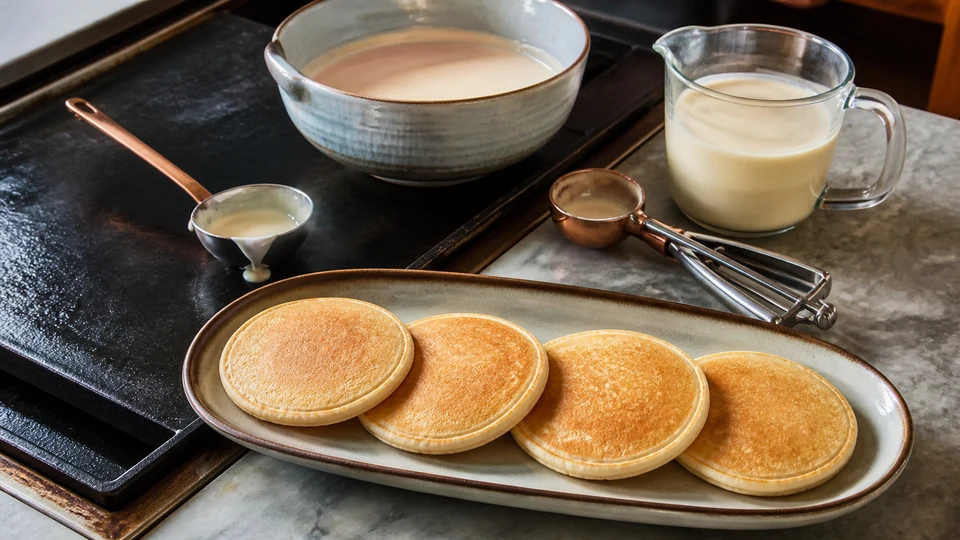
This comparison guide does not endorse a product or claim a tested winner. Pancake World opens the wider technique collection.
| Guide sections |
|---|
| Match tool to flow |
| Create a repeatable portion |
| Control height and placement |
| Compare the common tools |
For broader context, continue with Pancake Ingredients and Substitutions.
Match tool to flow
Lift a small amount with a spoon before heating the pan. If it falls in a continuous ribbon, a ladle or handled cup should transfer it without scraping. If it drops slowly and retains a mound, a wide disher or spoon may be less disruptive. A narrow bottle is a poor choice for lumpy batter, inclusions or a mixture that thickens while standing.
Do not thin a batter merely to fit a tool. That changes the formula to solve an equipment problem. Change the vessel instead.
Create a repeatable portion
Choose a fill line or scoop routine and use it for every pancake. Fill from the same bowl depth, let excess batter settle in the same way and release from a similar height. Pour near the centre of the intended pancake rather than drawing a circle around its edge.
Repeatability matters more than an exact advertised capacity. A cup filled halfway consistently can be more useful than a nominal portion scoop filled differently each time. Record the routine if the result will be repeated by another cook.
Control height and placement
Hold the outlet close enough to prevent splashing but high enough that it does not touch the pan. Release centrally and allow the batter's own flow to establish the edge. Forcing it outward with the tool can create a thin rim and a thick centre.
When making several pancakes, leave space for a spatula and for natural spread. Place portions in a stable sequence so the first pancake is also the first evaluated for turning.
Compare the common tools
- Ladle: quick for free-flowing batter; easy to overfill unless the fill routine is fixed.
- Handled measuring cup: offers a visible reference and a controlled lip; batter can cling to the outside.
- Disher or scoop: releases thick batter cleanly; it may compress inclusions or leave a mound.
- Squeeze bottle: precise for thin, smooth batter; hard to clean and unsuitable when the mixture changes or contains pieces.
- Pitcher: efficient for a large fluid batch; the stream can grow as the vessel angle changes.
Choose by batter compatibility, one-handed control, cleaning access and heat-safe working distance—not by price, rating or brand.
Prevent drips and cross-contact
Rest the tool on a clean tray rather than across the rim where the handle can pick up batter. Wipe the outer lip between rounds if it forms drips. Keep raw batter utensils away from finished pancakes, toppings and serving plates.
If the batter contains ingredients requiring special allergen controls, assign a dedicated labelled tool and pan area. A bottle or scoop does not make a preparation allergen-safe by itself.
Diagnose shape problems
An off-centre oval can result from an angled stream or sloped pan. A tail often comes from moving the tool before the stream stops. A thick centre may reflect batter viscosity, a high pour or spreading with the ladle. Change only one of those variables in the next portion.
If later pancakes are smaller from the same tool, inspect whether batter is thickening or sticking inside it. Do not automatically increase the fill and hide the change.
Frequently asked questions
Should batter be poured from high above the pan?
No universal height is needed. Use the shortest clean release that avoids touching the surface and produces a controlled central deposit.
Is a squeeze bottle always more accurate?
No. It is useful only when the batter can pass through cleanly and the bottle can be filled and cleaned safely.
Should I spread the batter after pouring?
Only when the chosen pancake style and complete formula call for it. For ordinary self-spreading batter, allow the portion to settle naturally.
Explore related Pancakes World guidance on American Pancakes, American Breakfast: Pancakes, Diner Plates and Brunch, and Maple Syrup.
Sources and editorial references
- USDA FoodData Central, ingredient definitions and composition records:
https://fdc.nal.usda.gov/ - FoodSafety.gov, food-safety charts:
https://www.foodsafety.gov/food-safety-charts - U.S. Food and Drug Administration, food labeling and nutrition information:
https://www.fda.gov/food/nutrition-food-labeling-and-critical-foods